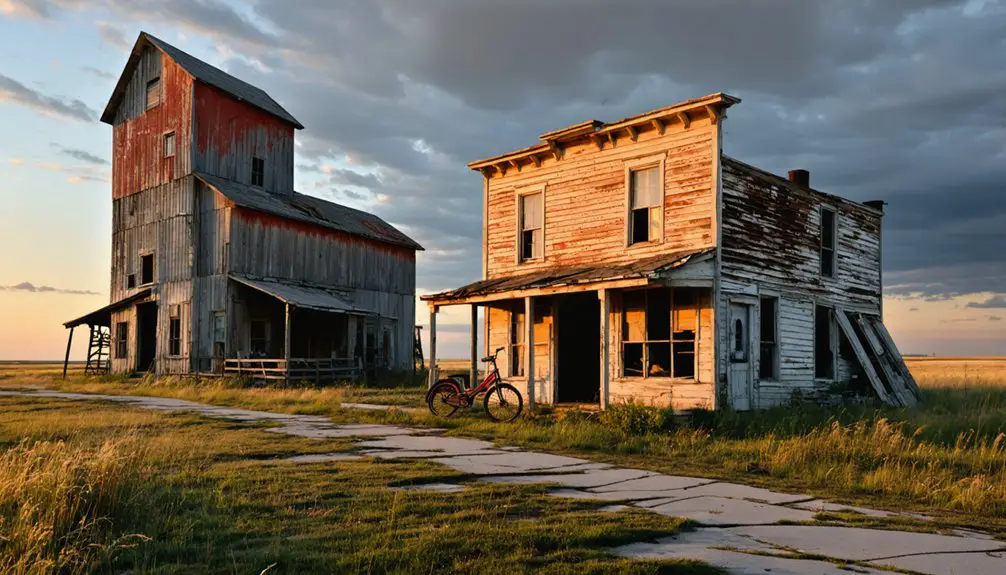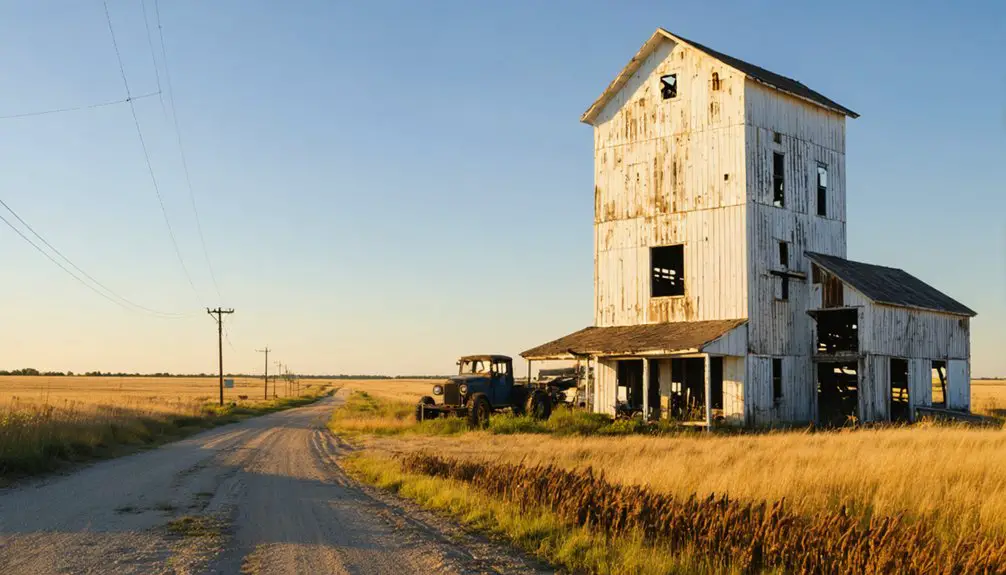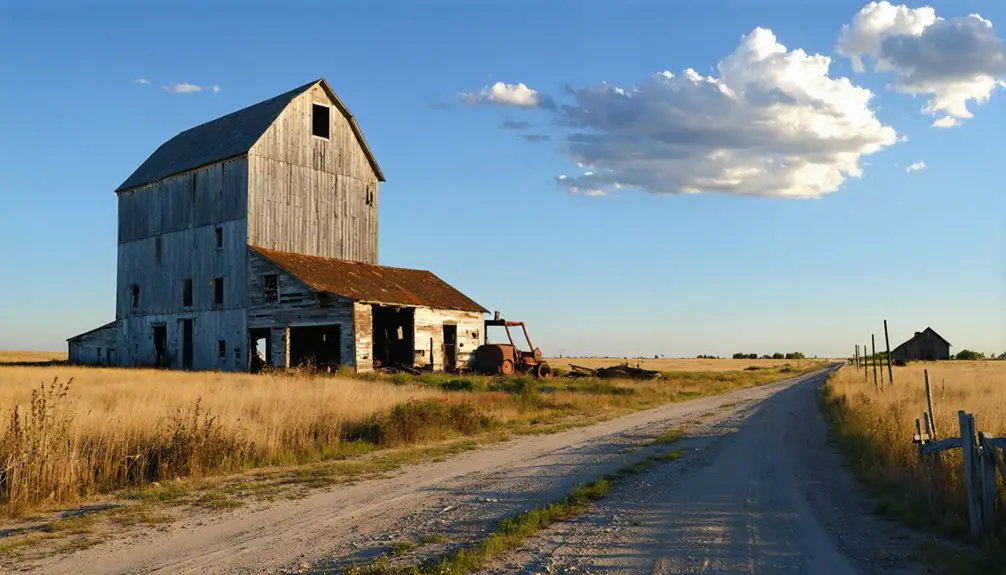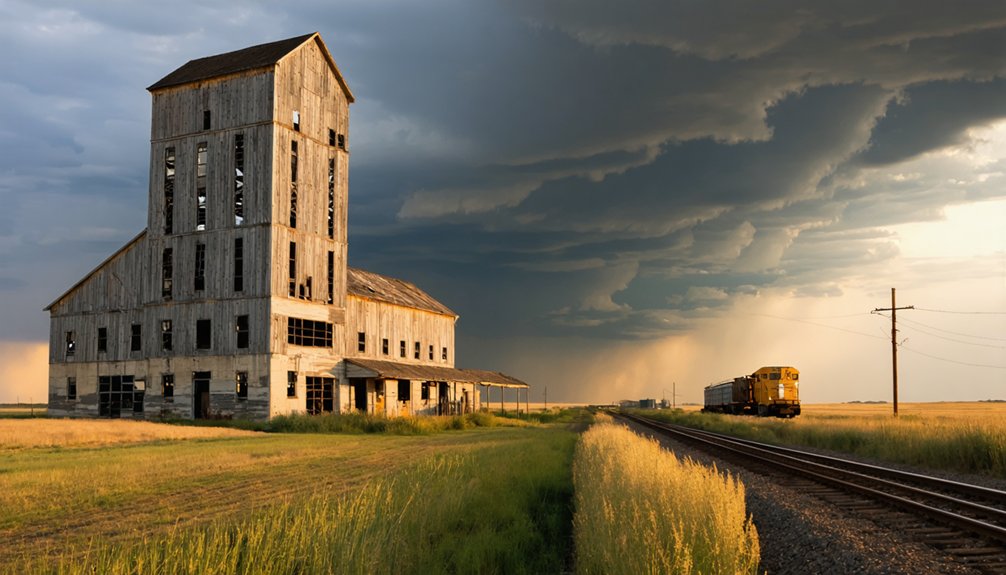
You’ll find North Dakota’s most famous ghost towns scattered across the prairies, including Arena in Burleigh County with its 1906 post office origins, Tagus in Mountrail County marked only by an old rail car, and Sherbrooke in Steele County that’s completely abandoned since 1985. Sims stands out for its 1900 Scandinavian Lutheran Church and Gray Lady ghost legend, while Charbonneau and Wheelock offer extensive abandoned structures from their railroad town heyday. These settlements reveal fascinating stories of frontier ambition and inevitable decline.
Key Takeaways
- Sims features the oldest Lutheran church west of the Missouri River and the famous Gray Lady ghost legend.
- Arena was a thriving railroad town with 150 residents by 1920 before declining during the Great Depression.
- Tagus peaked at 140 residents in 1940 but completely declined by 1976, now marked by phantom train folklore.
- Wheelock contains over 100 abandoned structures and has a dark history including multiple murders at the bank.
- Sherbrooke served as a county seat until 1919 but was completely abandoned by 1985 after devastating fires.
Arena: A Century-Old Settlement in Burleigh County
Arena’s story began on January 23, 1906, when the rural settlement established its post office in the rolling prairie of Burleigh County, 35 miles northeast of Bismarck.
A small prairie settlement took root in Burleigh County’s rolling hills, establishing its postal identity on a winter day in 1906.
You’ll find that Postmaster Harry A. Mutchler named it for the natural basin resembling an arena amid rolling hills. The Patterson Land Company developed this agricultural community after purchasing over one million acres of railroad land.
Arena’s historical significance emerged when the Northern Pacific Railroad arrived in 1910, bringing prosperity to 150 residents by 1920. By 1924, the community featured a train depot, general stores, and a schoolhouse serving the growing population. The town attracted a significant German immigrant population alongside Jewish merchants who contributed to the local economy.
You’d have witnessed agricultural innovation as farmers experimented with advanced techniques, cultivating corn, wheat, oats, and flax.
However, the Great Depression and Dust Bowl devastated this thriving community.
Tagus: Mountrail County’s Abandoned Risk
While Arena faded quietly into obscurity, Tagus in Mountrail County earned notoriety as North Dakota’s most sinister ghost town. Founded in 1900 as a railroad settlement forty miles west of Minot, this prairie community peaked at 140 residents in 1940 before declining to just 14 by 1970. Urban decay accelerated after the last business closed in 1976.
Tagus’s dark reputation began when vandals burned down the town’s sole church in 2001, painting an upside-down cross on its front. Ghost folklore flourished around tales of hellhounds, phantom trains, and screams from beneath the burned foundation. Local legend claims the site contains a stairway to hell beneath the old church ruins.
Persistent vandalism and wild Halloween parties prompted armed residents to chase away visitors. Interestingly, this North Dakota ghost town shares its name with the Tagus River, which flows through Spain and Portugal as the second largest river basin on the Iberian Peninsula. You’ll find this abandoned settlement marked only by an old rail car along Highway 2.
Sherbrooke: Steele County’s Zero Population Town
You’ll find Sherbrooke in Steele County, where this true ghost town maintains zero population after complete abandonment by 1985.
This Francophone settlement, established in 1881 and named after Sherbrooke, Quebec, once served as the county seat until 1919 and hosted President William McKinley at the Sherbrooke House Hotel in 1896.
Today, you can explore field stone foundations and scattered artifacts that mark where this thriving railroad and farming community once stood before devastating fires in 1916 and 1920 triggered its irreversible decline. The Sherbrooke House Hotel served as a prominent site that welcomed notable visitors during the town’s heyday. Visitors should exercise caution while exploring, as the area contains deep wells and open holes that pose safety risks to those investigating the ruins.
Steele County Location
Since its establishment in 1881, Sherbrooke has occupied a remote corner of Steele County in northern North Dakota, where Francophone settlers chose this isolated location north of present-day Finley to build their community.
You’ll find this ghost town within Sherbrooke Township, accessible only through a gravel road branching off Highway 6. The route leads you deep into farmlands that define the region’s agricultural character.
Sherbrooke history reveals how these settlers strategically positioned their town amid fertile farming territory. The surrounding landscape consists entirely of working farmland, creating the desolate atmosphere you’ll encounter today.
Sherbrooke agriculture once thrived here, supporting the community’s growth through the late 1800s and early 1900s. This geographic isolation that initially protected the settlement eventually contributed to its abandonment when economic conditions shifted. The town reached its peak during the railway connections era of the 1850s before gradually declining as transportation routes changed. The community once served as the county seat before losing this important designation to Finley when business interests relocated.
Complete Population Abandonment
After surviving decades of gradual decline, Sherbrooke reached complete population abandonment through a series of devastating setbacks that sealed the town’s fate.
The 1920 fire proved catastrophic, preventing any recovery from earlier setbacks. Sherbrooke history shows how isolation and lack of transportation infrastructure accelerated population decline after losing county seat status in 1919.
You’ll find the abandonment timeline reveals the town’s final chapter:
- The school closed in 1961, eliminating educational services for remaining families
- Arlene Carpenter’s home, the last occupied residence, was vacated in the 1980s
- The post office shuttered in 1993, ending the town’s final official function
Today, visitors navigate via GPS to reach the site on a nameless gravel road, where silhouetted ruins and overgrown structures stand as haunting reminders of the community that once thrived here.
Historical Significance Remains
Despite reaching zero population, Sherbrooke’s historical significance endures through its remarkable legacy as Steele County’s former seat of government and its connection to presidential history.
You’ll discover that President William McKinley stayed at the Sherbrooke House Hotel in 1896, cementing the town’s place in American political history. The community served as county seat from 1885 to 1919, wielding considerable governmental influence until residents lost a vital relocation vote.
Today, you can observe historical artifacts scattered across the landscape, from a Studebaker car abandoned in fields to various remnants of daily life. The town represents the broader pattern of rural decline affecting small communities throughout North Dakota during the twentieth century.
Architectural remnants tell Sherbrooke’s story through field stone foundations, charred timber from devastating fires, and partially collapsed two-story structures that once housed banks, elevators, and essential businesses serving the thriving farming community.
Sims: Morton County’s Haunted Church Community

You’ll find Sims stands apart from other North Dakota ghost towns through its remarkably preserved 1900 Scandinavian Evangelical Lutheran Church, the oldest Lutheran church west of the Missouri River in the state.
The town’s haunted reputation centers on the legendary Gray Lady of Sims, making this Morton County settlement a destination for both history enthusiasts and paranormal investigators.
First Lady Laura Bush’s 2008 visit as part of Save America’s Treasures highlighted Sims’ national significance, cementing its status as one of North Dakota’s most recognized ghost town communities.
Historic Lutheran Church Legacy
When 35 Scandinavian men and 8 women established the Scandinavian Evangelical Lutheran Church in 1884, they created what would become North Dakota’s oldest Lutheran church west of the Missouri River in the coal town of Sims, Dakota Territory.
You’ll discover these pioneers built their parsonage first, ingeniously using its second story for worship services until completing the actual church in 1900.
The church restoration in 2006 preserved this remarkable pioneer heritage through:
- Grant funding from Preservation North Dakota’s Preserving Prairie Places program
- 2,000 volunteer hours from dedicated congregation members
- Save America’s Treasures grant support matching community contributions
You can visit this 140-year-old structure today, where services continue alternating Sundays with Almont’s United Lutheran Church.
Former First Lady Laura Bush recognized its significance in 2008, declaring they “saved the best for last.”
Gray Lady Ghost Legend
Between 1916 and 1918, a young pastor’s wife died from illness in the Scandinavian Lutheran Church parsonage, creating what became one of North Dakota’s most enduring ghost legends.
You’ll find the Gray Lady still haunts Sims, refusing to leave her earthly home even after her husband relocated following her death.
Residents documented haunting experiences to the bishop during the 1930s, reporting mysterious organ music without players and second-floor windows opening independently.
You can witness her figure walking the grounds at dusk or glimpse curtains moving in upstairs windows during morning hours.
Church records, translated from Norwegian by an Almont couple, verify the tragic death that sparked this legend.
The Gray Lady’s presence drove out subsequent ministers, leaving her to wander the abandoned town between bi-weekly services.
Presidential Visit Recognition
The visit spotlighted Sims’s transformation from a bustling 1,000-person railroad town to a preserved ghost town with active worship services:
- Recognition elevated the church’s national preservation profile beyond regional significance
- Presidential attention validated community restoration efforts funded through Preserving Prairie Places grants
- Visit cemented Sims’s status as North Dakota’s most historically significant haunted location
Charbonneau: Western North Dakota’s True Ghost Town
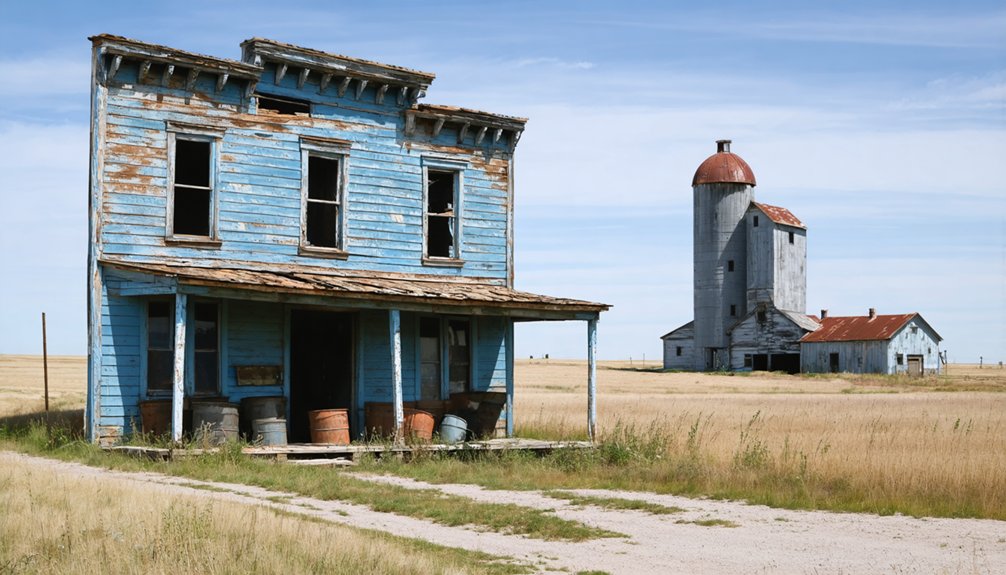
Although many North Dakota settlements experienced decline during the twentieth century, Charbonneau stands apart as the state’s most authentic ghost town. Founded in 1913 as a Great Northern Railroad town in northwestern McKenzie County, you’ll find it named after French-Canadian fur trapper Toussaint Charbonneau, who served Lewis and Clark as an interpreter alongside his Shoshone wife Sacagawea.
You’d discover this town peaked at 125 residents in 1920 before steadily declining to just 15 by 1960. The post office’s closure in the 1960s marked its final abandonment, and utility companies designated it a ghost town by 1965.
Today’s Charbonneau heritage includes unsafe structures like the school, post office, and grain elevators. Ghost town exploration requires caution since the townsite sits on private property amid McKenzie County’s isolated landscapes.
Wheelock: Among the State’s Creepiest Abandoned Places
You’ll find Wheelock three miles south of Route 2 in Williams County, where over 100 abandoned homes and structures create one of North Dakota’s most unsettling ghost towns.
The town reached its peak population of 115 in 1930 before steadily declining until disincorporation in 1994, leaving behind a deteriorating schoolhouse and empty buildings along active BNSF Railway tracks.
If you’re brave enough to visit this eerie remnant of railroad history, you’ll discover why travelers described the few remaining residents as unnervingly watchful in 2008.
Wheelock’s Eerie Abandoned History
Among North Dakota’s most unsettling ghost towns, Wheelock stands as a reminder of how quickly prosperity can dissolve into decay.
You’ll discover a settlement that thrived from 1901 to the 1930s, reaching 115 residents before economic forces triggered its abandonment. The town’s haunting legends include multiple murders that occurred at the original brick bank building, where two madmen killed entire families during Wheelock’s declining years.
Today’s abandoned architecture tells this tragic story:
- Over 100 deteriorating homes and structures scattered across the prairie
- A crumbling schoolhouse that once educated local children
- The infamous brick bank where Wheelock’s first murder occurred
Walking through these ruins, you’ll understand why visitors report feeling unsettled.
Death seemed to follow Wheelock’s fading population until complete abandonment claimed this once-prosperous community.
Visiting at Your Risk
Modern explorers who venture to Wheelock face considerable dangers beyond the town’s dark reputation.
You’ll encounter unstable structures deteriorating since the 1990s, with 100+ abandoned buildings posing collapse risks. The remaining residents often stare at visitors, creating an unsettling atmosphere that deters urban exploration enthusiasts. Active BNSF Railway tracks running through town present serious safety hazards.
Property values have plummeted as neglect consumes the landscape. You’re fundamentally alone in this isolated location, three miles from Route 2, where help isn’t readily available. The few remaining farm shacks and deteriorating schoolhouse offer little shelter during emergencies.
While historical preservation advocates document Wheelock’s decline, the physical risks outweigh research benefits. Smart explorers photograph from safe distances rather than entering unstable structures in this genuinely dangerous ghost town.
The Rise and Fall of North Dakota’s Railroad Towns

When the Milwaukee Road began its ambitious western expansion in 1905, it sparked a railroad construction boom that would reshape North Dakota’s landscape forever.
This railroad impact created dozens of settlements across the prairie, with town formation following a predictable pattern as communities sprang up like “beads on a string” along the tracks.
Towns established during this era include:
- Griffin (1905) – Named after Henry T. Griffin, peaked at 67 residents in 1930
- Gascoyne (1907) – Originally called Fischbein, featured commercial buildings and post office
- Wheelock (1902) – Incorporated in 1916, reached 115 residents by 1930
However, the Great Depression, drought, and automobile travel sealed their fate.
Exploring the Remaining Structures and Landmarks
While many of North Dakota’s ghost towns have vanished entirely, several sites still showcase tangible remnants of their former communities.
When exploring ruins across Burleigh County, you’ll discover Arena’s St. John’s Lutheran Church standing as the primary landmark alongside two intact homes.
Sims features an active church with an abandoned home and hilltop cemetery nearby.
Deisem’s former Seventh Day Adventist Church dominates the landscape, while store and post office ruins hide in tall grass.
Nanson offers four abandoned homes with scattered outbuildings in complete isolation.
Bowesmont’s stone church holds annual services, with grave markers commemorating the vanished city hall and post office.
These remaining landmarks provide tangible connections to North Dakota’s pioneering past.
Ghost Stories and Paranormal Activity Reports
Beyond the crumbling foundations and weathered landmarks, North Dakota’s abandoned settlements harbor darker legends that have persisted for generations.
You’ll discover these haunted legends aren’t confined to ghost towns—active locations throughout the state report ongoing spectral encounters that defy explanation.
San Haven Sanatorium stands as the state’s most notorious paranormal hotspot. Between 1912 and 1989, over 1,000 patients died there, many buried in unmarked graves.
The sanatorium’s tragic history of mass deaths and unmarked burials has cemented its reputation as North Dakota’s most haunted location.
You’ll hear reports of crying babies echoing through decaying halls and apparitions appearing in intact windows.
- Medora’s Chateau de Mores features body impressions on beds and rearranged silver brushes
- Sims’ abandoned church hosts a Gray Lady who plays organ music
- Rough Riders Hotel experiences disembodied laughter and autonomous plumbing
These spectral encounters continue attracting paranormal investigators and freedom-seeking adventurers.
Visiting North Dakota’s Ghost Towns Safely
Whether you’re drawn by paranormal curiosity or historical fascination, exploring North Dakota’s ghost towns requires careful planning and safety awareness.
As you embark on your adventure exploring abandoned sites in North Dakota, it’s essential to research the locations beforehand to uncover their stories and hidden treasures. Keep in mind that some sites may be on private property, so respect local laws and ask for permission if needed. With the right preparations, your exploration can lead to unforgettable discoveries and insights into the region’s past.
As you venture through events in Medora’s ghost town, you’ll encounter remnants of the past that tell tales of the people who once inhabited the area. Guided tours often illuminate the rich history and folklore associated with these sites, adding depth to your experience. Don’t forget to bring your camera; the hauntingly beautiful landscape provides the perfect backdrop for capturing memories of this unique journey.
Essential safety precautions include preparing your vehicle for remote travel and carrying communication devices, as many sites lack cell coverage. Respect private land boundaries, particularly at population-zero locations like Griffin, and approach active cemeteries quietly.
Travel tips for successful exploration start with using resources like Ghosts of North Dakota’s searchable database and Google maps for accurate directions.
From Minot, you’ll find scenic drives to nearby ghost towns like Tagus, Ruso, and Bergen within 30-60 minutes.
Exercise extreme caution around abandoned structures in disrepair, as sites like Sims and Arena contain hazardous ruins. Consider group visits for enhanced safety in isolated locations.
Frequently Asked Questions
What Caused Most North Dakota Towns to Become Abandoned Ghost Towns?
Railroad failures sparked North Dakota’s ghost town epidemic. You’d witness economic decline as automobiles replaced trains, triggering massive population migration. Towns lost two-thirds of residents between 1920-1940s, abandoning dreams for modern conveniences elsewhere.
Are There Any Legal Restrictions on Visiting These Ghost Towns?
You’ll face standard trespassing laws on private property, but most North Dakota ghost towns lack specific ghost town regulations. Historical preservation doesn’t restrict casual visits to public areas or abandoned sites.
What’s the Best Time of Year to Explore North Dakota’s Ghost Towns?
Like photographers capturing autumn’s last light, you’ll find late summer through early fall ideal for exploring. Fall foliage frames decaying structures beautifully while preserving their historical relevance, offering comfortable temperatures and accessible roads before winter’s harsh arrival.
How Many Total Ghost Towns Exist Throughout North Dakota?
You’ll find conflicting total counts ranging from 23 to 81 ghost towns across North Dakota’s archives. Historical significance varies, but twenty meet strict population-zero definitions, representing the state’s boom-and-bust settlement patterns throughout different eras.
Can You Camp Overnight Near Any of These Abandoned Settlements?
You can camp near some ghost towns on USFS and BLM lands without overnight permits, following standard camping regulations. However, you’ll face 14-16 day limits and must avoid state trust lands entirely.
References
- http://www.onlyinyourstate.com/experiences/north-dakota/ghost-towns-nd
- https://us1033.com/a-haunting-look-at-some-real-life-north-dakota-ghost-towns/
- https://northernsentry.com/2025/06/26/north-dakota-ghost-towns/
- https://ghostsofnorthdakota892857007.wordpress.com/2015/10/30/true-ghost-towns-population-zero/
- https://www.youtube.com/watch?v=8GO57Im_dss
- https://www.youtube.com/watch?v=59hzueQkmok
- https://nodakangler.com/forums/threads/ghost-towns-of-north-dakota.15365/latest
- https://www.quincyvagell.com/arena/
- https://www.legendsofamerica.com/arena-north-dakota/
- https://www.youtube.com/watch?v=JrbLsH8cdps