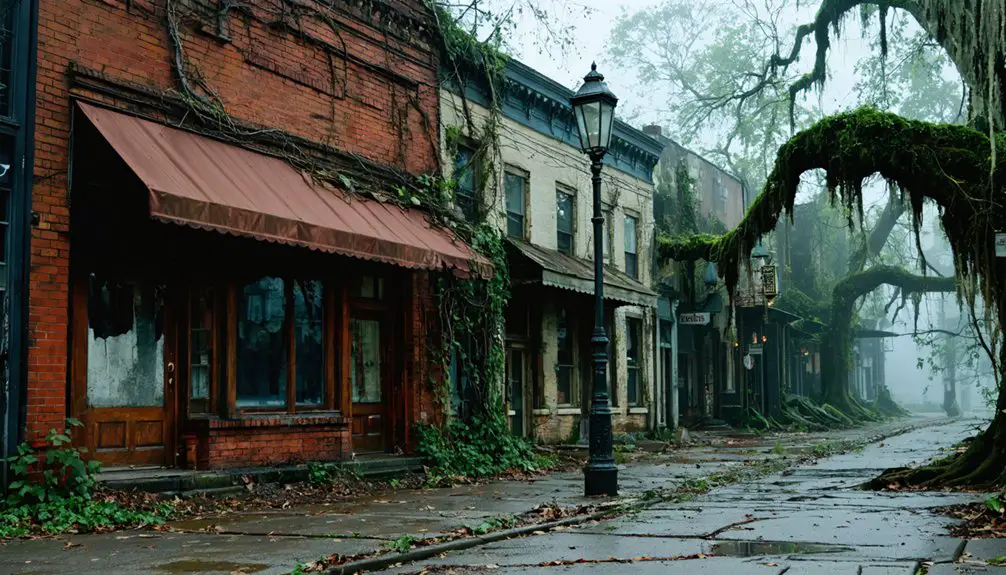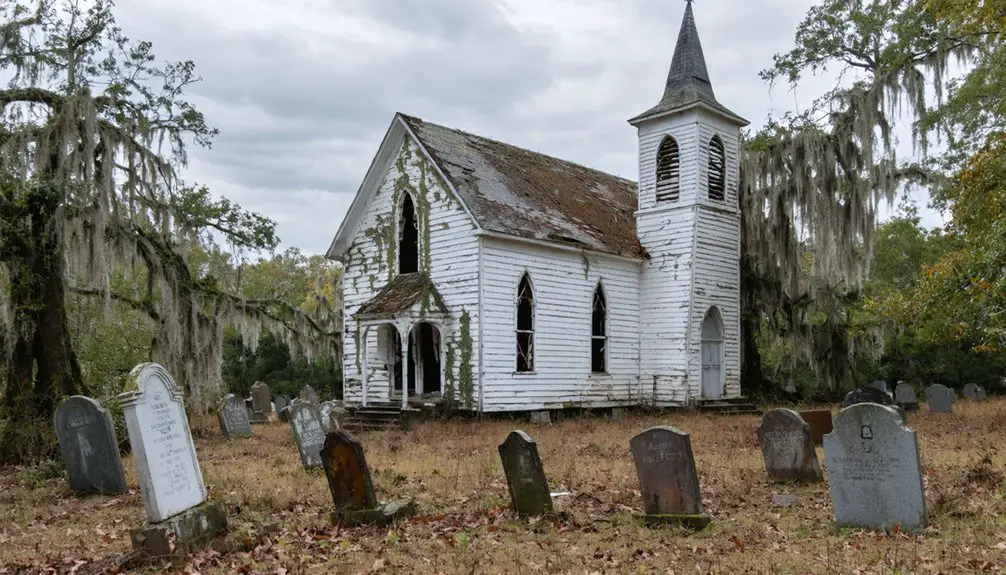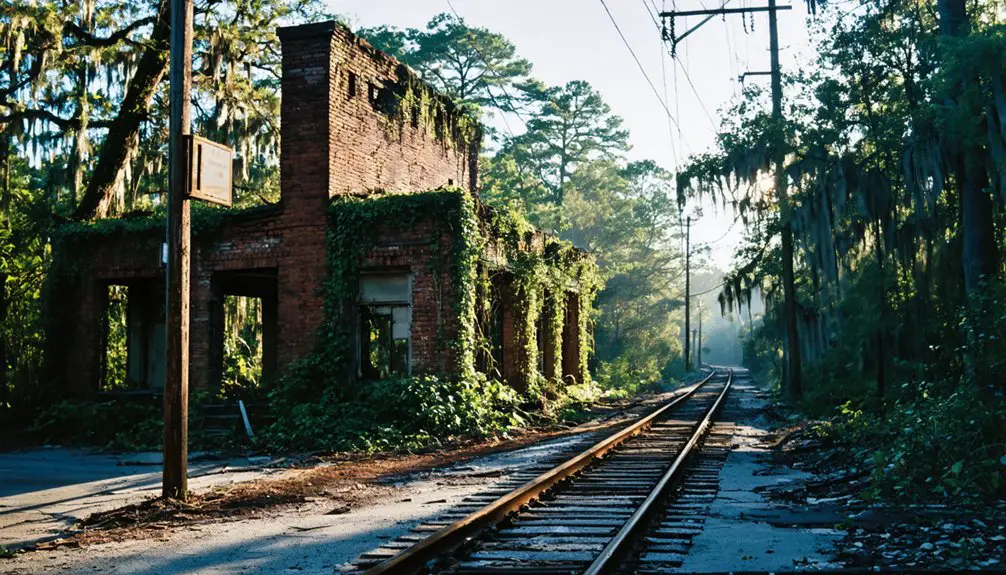
You’ll find South Carolina’s most fascinating ghost towns include Colonial Dorchester, abandoned in 1775 after Puritan settlers established this Ashley River trading center in 1696. Ellenton disappeared when the government seized it in 1950 for nuclear facilities, displacing 6,000 residents. Andersonville succumbed to devastating floods before Lake Hartwell submerged it entirely. Glenn Springs transformed from a Cherokee medicinal site to a luxury resort before economic decline claimed it. Each location reveals compelling stories of prosperity, tragedy, and abandonment that shaped the state’s forgotten communities.
Key Takeaways
- Colonial Dorchester was a Puritan trading center from 1696-1775, featuring a distinctive oyster-shell concrete fort and 6,500 archaeological artifacts.
- Ellenton was seized by the U.S. Atomic Energy Commission in 1950, displacing 700 residents for nuclear weapons production facilities.
- Andersonville thrived as a textile town until devastating floods in the 1840s-1850s caused abandonment and eventual submersion under Lake Hartwell.
- Glenn Springs was a celebrated Cherokee-discovered resort destination that declined during the Great Depression due to changing travel patterns.
- Hamburg served as a major cotton port and railroad terminus in the 1820s-1830s before flooding and competition led to its decline.
Colonial Dorchester: South Carolina’s Creepiest Abandoned Settlement
When New England Puritans from Dorchester, Massachusetts acquired 4,050 acres along the Ashley River in 1696, they couldn’t have predicted their settlement would become one of South Carolina’s most haunting archaeological sites.
You’ll discover a town that flourished as a prosperous trading center until 1775, when residents voluntarily abandoned it during the Revolutionary War.
The settlement’s historic significance extends beyond its commercial success—Francis Marion briefly commanded this fortified American post before British forces claimed it in 1780.
You can explore the Colonial Dorchester State Historic Site today, where archaeological findings include 6,500 artifacts from a single lot: pipe stems, pottery fragments, and British military insignia. The site features a distinctive fort constructed from oyster-shell concrete known as tabby, showcasing the unique building materials used by colonial settlers.
These remnants tell the story of America’s colonial past through tangible evidence. The 325-acre park now encompasses the entire ghost town, allowing visitors to wander through ruins and explore an old cemetery that marks this once-thriving colonial community.
Ellenton: The Radioactive Town Lost to Nuclear Production
Unlike Colonial Dorchester’s voluntary abandonment, Ellenton faced forced extinction when the U.S. government seized an entire community for nuclear weapons production.
You’ll find that Ellenton history began in 1880 as a thriving farming community along the Savannah River, benefiting from railroad access and waterfront location.
In 1950, the U.S. Atomic Energy Commission abruptly announced plans for the Savannah River Plant, displacing approximately 700 residents from Ellenton and 6,000 people across 300 square miles.
The government demolished the original site for hydrogen bomb production facilities. Access to the former town is now highly restricted, making entry without proper authorization illegal.
Today, Ellenton’s radioactive legacy marks it as one of Earth’s most contaminated locations, with toxic waste affecting ground, streams, and wildlife.
Former residents continue to hold annual reunions to preserve the memory of their lost community.
Only a highway sign remains where this community once flourished.
Andersonville: When Nature Reclaimed a Textile Community
While Ellenton met its end through government intervention, Andersonville’s demise came from nature’s relentless forces that ultimately claimed an entire community beneath reservoir waters.
You’ll find this forgotten settlement was established in 1801 at the fork of Seneca and Tugaloo Rivers, named for Revolutionary War hero Robert Anderson.
The town thrived on textile mills and river transportation along the Savannah River lowlands.
However, devastating floods in 1840 and 1852 destroyed the cotton and wool mills twice, forcing residents to abandon rebuilding efforts as railroads bypassed their community. Economic decline accelerated when the post office closed in 1893, marking the town’s final chapter before complete abandonment. The construction of the Hartwell Dam by the Army Corps of Engineers permanently submerged what remained of the town beneath Lake Hartwell.
Glenn Springs: From Luxury Resort to Forgotten Ruins
Deep in the South Carolina Piedmont, a natural spring discovered by Cherokee medicine men would eventually become one of the state’s most celebrated resort destinations.
You’ll find that Glenn Springs’ transformation began when John B. Glenn purchased 500 acres in 1825, opening an inn that expanded into a grand hotel by 1835. The Glenn Springs Company developed a bottling facility, shipping mineral springs water across the Southeast.
Railroad access in 1894 brought countless visitors seeking relief from malaria and rheumatism. However, automobiles and the Great Depression ended its golden era. Fire destroyed the hotel in 1941, leaving only ruins. The Glenn Springs Academy home for boys continued operations at the site until May 2015.
Today, historic preservation efforts by the Glenn Springs Preservation Society maintain the Old Stone Church and spring house. Water analysis reveals calcium, sulfur, and magnesium compounds that support the historical claims of the spring’s healing properties.
Hamburg: Rise and Fall of a Cotton Trade Empire
When Henry Shultz crossed the Savannah River from Augusta, Georgia, in the early 1820s, he envisioned creating a commercial powerhouse that would rival his former home.
Named after his German birthplace, Hamburg’s strategic location in Aiken County positioned it perfectly for cotton merchants seeking inland port access.
Hamburg’s prime Aiken County location made it an ideal inland port for cotton merchants needing river access.
Hamburg history reveals remarkable success when the South Carolina Canal and Rail Road Company selected it as their western terminus in 1833. The 136-mile rail line, then the world’s longest, transformed Hamburg into South Carolina’s largest inland port.
Key factors in Hamburg’s rise included:
- Strategic positioning between 5th and 13th Street bridges
- Direct shipping routes to Savannah and Charleston
- Thriving cotton and tobacco trade
- Railroad connectivity spanning 136 miles
However, frequent Savannah River flooding and railroad development in Augusta ultimately doomed this once-prosperous trading empire. The town’s fate was sealed when the rail line extended to Augusta in 1853, causing white merchants to abandon Hamburg and leading to its eventual desertion by the Civil War. After the war, Hamburg briefly experienced revival as a freedmen community with a population reaching 1,100 residents.
Frequently Asked Questions
Are Any of These Ghost Towns Safe to Visit Without a Guide?
You can safely visit Dorchester independently, as it’s an established historical site without radioactive contamination or structural hazards. However, safety tips recommend avoiding Ellenton entirely, while guided tours help navigate boat-accessible Ferguson and Andersonville.
What Time of Year Is Best for Exploring South Carolina’s Abandoned Towns?
Fall’s your best season for exploring abandoned towns. Weather conditions offer mild temperatures, reduced humidity, and clearer visibility without summer overgrowth. You’ll avoid flood-prone periods while enjoying comfortable hiking conditions and extended daylight hours for safe exploration.
Do You Need Special Permits to Visit These Ghost Town Sites?
You’ll generally roam freely through most sites without bureaucratic chains binding you. However, Ellenton’s permit requirements demand government approval due to radioactivity, while boat-accessible towns like Andersonville face natural site accessibility barriers.
Which Ghost Town Has the Most Remaining Structures to Explore Today?
Chappells offers you the most remaining structures with active preservation efforts maintaining Feasterville Academy, Liberty Universalist Church, and multiple Main Street buildings showcasing significant historical significance from its railroad town era.
Are There Any Other Notable Ghost Towns in South Carolina Worth Visiting?
Yes, you’ll find several others with rich historical significance and local legends. Consider exploring Bambberg’s abandoned districts, Old Ninety Six’s Revolutionary War ruins, and Millwood’s antebellum plantation remains for authentic paranormal experiences.
If you’re seeking more adventures, ghost towns to explore in South Carolina offer captivating stories and a glimpse into the past. Each site has its own unique mysteries, from eerie structures to the whispers of bygone residents. Don’t miss the chance to delve into these hidden gems and uncover the tales they hold.
References
- https://www.hotels.com/go/usa/haunted-places-south-carolina
- https://www.randomconnections.com/ghost-towns-of-south-carolina/
- https://www.onlyinyourstate.com/trip-ideas/south-carolina/haunted-road-trip-sc-ghost-towns
- https://www.blueridgeoutdoors.com/go-outside/southern-ghost-towns/
- https://sctravelguide.com/2018/06/11/south-carolina-ghost-towns/
- https://wnok.iheart.com/content/2023-10-11-abandoned-south-carolina-town-named-the-creepiest-ghost-town-in-the-state/
- https://www.youtube.com/watch?v=FY9L9EeJjCs
- https://archaeology.org/issues/march-april-2014/off-the-grid/south-carolina-colonial-dorchester/
- https://www.onlyinyourstate.com/experiences/south-carolina/dorchester-ghost-town-in-sc
- https://www.islands.com/2015722/colonial-dorchester-site-between-charleston-columbia-south-carolina-abandoned-historic-gem-unique/