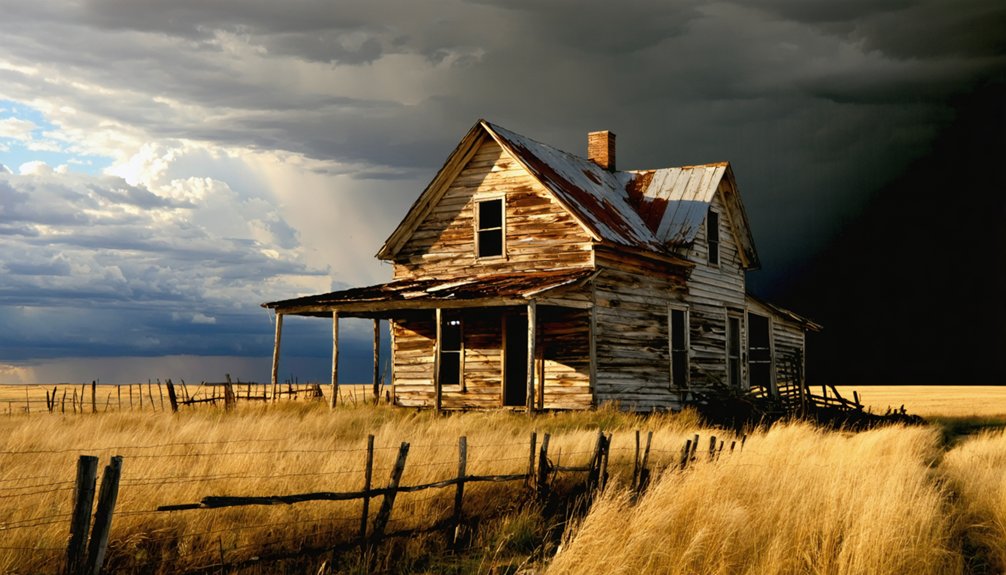
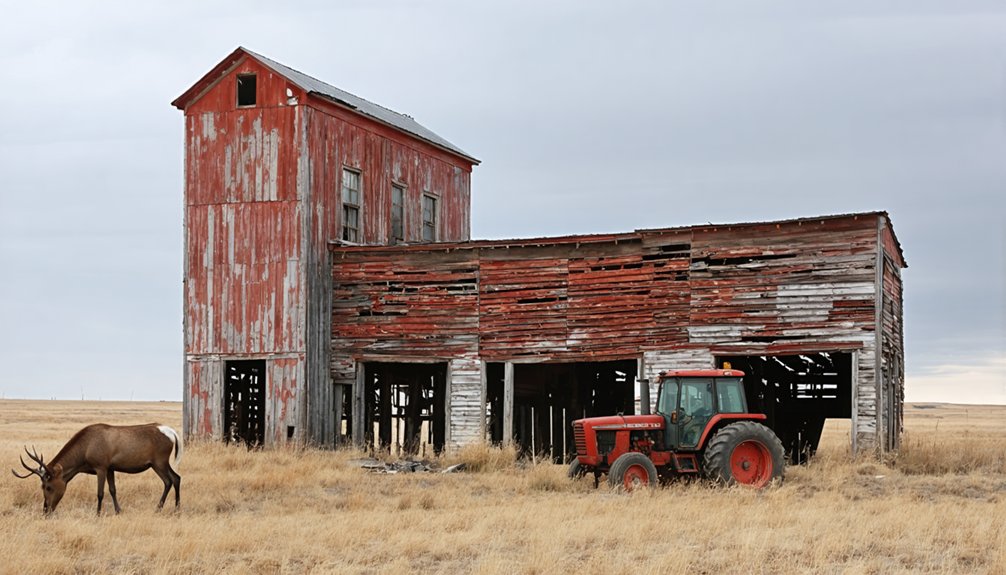
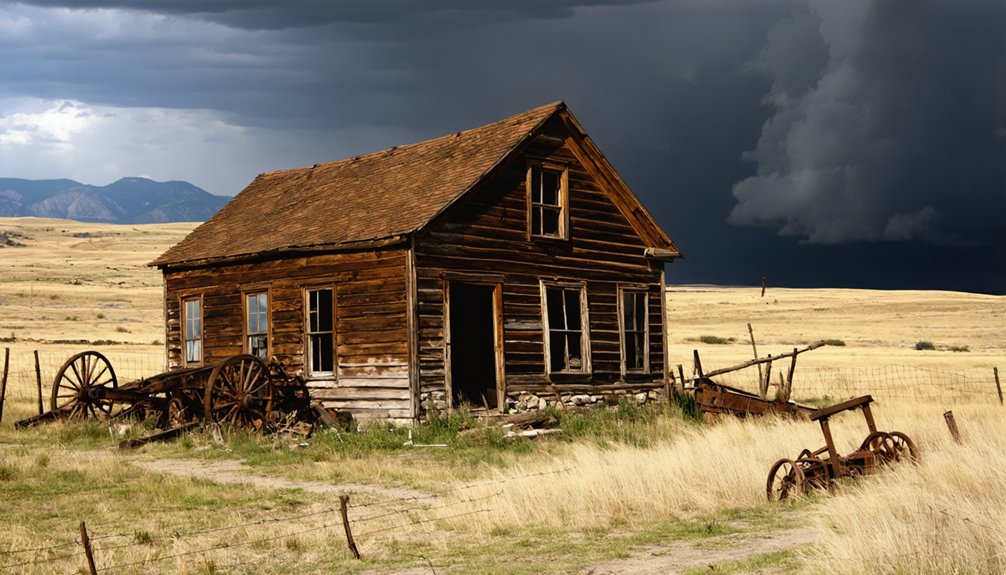
You’ll find South Dakota’s most famous ghost towns scattered across its diverse landscape, each telling stories of boom and bust. Badlands Prairie Abandonment once housed 1,645 residents before water scarcity drove nearly everyone away. Argonne peaked at 100 people in the 1920s before agricultural mechanization caused its decline. Spokane thrived with 300 miners until silver ore ran out in 1940. Capa lost its last residents when Interstate 90 bypassed the community. These weathered ruins offer glimpses into the state’s fascinating past.
Key Takeaways
- Argonne Ghost Town peaked at 100 residents in the 1920s before school closure and agricultural mechanization led to complete abandonment.
- Spokane Ghost Town thrived as a silver mining community with 300 miners until ore deposits dried up by 1940.
- Badlands Prairie Abandonment once housed 1,645 residents and was visited by President Calvin Coolidge in 1927 before economic decline.
- Capa Ghost Town features fourteen remaining buildings including abandoned houses, with one sole resident living in his ancestral home.
- Okaton Ghost Town was established in 1906 as a railroad settlement and declined when tracks ceased operation in the 1980s.
Scenic Ghost Town: Badlands Prairie Abandonment
While nomadic tribes roamed the Badlands for over 10,000 years, European settlement didn’t begin until the Homestead Act of 1862 made 160 acres available for just $18.
You’ll find that Scenic’s history exemplifies the boom-and-bust cycle that defined prairie settlement. Founded in 1889 as a stopping point between the Badlands and Rapid City, this town peaked at 1,645 residents before economic decline and water scarcity forced abandonment.
Today, you can witness prairie nostalgia in Scenic’s dramatic population reduction to a single resident. President Calvin Coolidge’s 1927 picnic visit marked the town’s brief moment of fame.
A ghost town’s fleeting brush with presidential glory before fading into the haunting solitude of the prairie.
Now you’ll discover bullet casings and military ordnance scattered across the ground, remnants of the area’s later military use within Badlands National Park boundaries. The area protects mixed grass prairie that represents the largest undisturbed ecosystem of its kind in the United States. The region’s cultural significance extends beyond abandoned settlements, as the nearby Stronghold Unit contains sites where the Ghost Dance movement took place in the 1890s.
Argonne Ghost Town: Mid-Century Rural Decline
You’ll find Argonne’s story differs from earlier prairie settlements through its mid-20th century collapse rather than boom-bust cycles of the 1800s.
The town reached its peak of 100 residents in the early 1920s but couldn’t survive the rural consolidation trends that swept across South Dakota’s farming communities. The consolidated school closed permanently in spring 1955, marking the beginning of Argonne’s final decline.
Today, only a derelict grain silo, a former bank vault, and a small sign remain as physical remnants of what was once a functioning agricultural community.
Prairie Population Exodus
Although Argonne began as St. Mary’s in 1886, you’ll witness how rural migration devastated this prairie community by the 1970s. Economic factors transformed a thriving town of 100 residents into a ghost town within decades.
You can trace Argonne’s decline through these key population milestones:
- 1920s peak: 100 residents with school, bank, and businesses
- 1930 census: Population dropped to 65 after school fire
- 1970 count: Only 8 residents remained
- Late 1970s: Last resident departed, town officially abandoned
You’ll find the exodus accelerated when railroad service ceased and schools closed permanently. Economic opportunities vanished as agriculture mechanized, forcing families to seek livelihoods elsewhere.
Today, you’ll discover only a grain silo, bank vault remnants, and historical marker marking where this community once flourished on South Dakota’s unforgiving prairie. These abandoned structures continue to attract photographers and ghost town enthusiasts seeking dramatic images of prairie decline. Like many forgotten towns across America, Argonne’s deteriorating buildings reflect the broader pattern of declining tax bases that leave communities unable to maintain their infrastructure.
1970s Town Abandonment
When the last resident departed Argonne in the late 1970s, this prairie community completed a transformation from hopeful railroad town to abandoned ghost site that exemplifies mid-century rural decline across South Dakota.
You’ll find this urban decay pattern repeated throughout the state’s forgotten settlements. The town’s death spiral began with the devastating school fire in 1933, which destroyed the $100,000 consolidated building that once symbolized community pride.
Railroad service ended in the 1970s, severing Argonne’s economic lifeline. Originally established as St. Marys by Dr. Louis Gotthelf in 1886, the settlement was renamed in 1920 to honor the fallen soldiers of the Meuse-Argonne offensive. Today, you can visit the site where only a derelict grain silo, bank vault remnants, and small historical marker survive among the semi-forested grove.
The location holds historical significance as a reflection of rural America’s struggle against modernization and centralization.
Capa Ghost Town: Interstate Bypass Casualty
When you visit Capa today, you’ll witness firsthand how interstate highway construction devastated small railroad communities across South Dakota.
The town’s isolation became complete after passenger train service ended in 1960, forcing residents to abandon their homes and businesses as economic opportunities vanished. The community’s post office closure in 1976 marked the final chapter of Capa’s decline as a functioning town.
You can still explore fourteen remaining buildings scattered across the prairie, including abandoned houses with deteriorating furnishings that tell the story of a once-thriving community of 300 residents. Philip O’Connor remains as the sole resident, living in his ancestral home that his family has owned since 1916.
Interstate’s Economic Impact
While Capa’s railroad-era decline had already weakened the community, Interstate 90’s construction in the 1970s delivered the final economic blow that transformed this once-viable siding into a complete ghost town.
The bypass eliminated vital traveler traffic that sustained local businesses, accelerating Capa’s economic decline through devastating rural isolation. These abandoned structures now serve as silent witnesses to what was once a vibrant community with dreams and aspirations.
You’ll find Interstate 90’s impact followed a predictable pattern:
- Traffic diversion – Highway 44 lost through-traffic to the new interstate corridor
- Business closures – Local stores and services couldn’t survive without customers
- Population exodus – Residents fled when no jobs remained after agricultural work proved insufficient
- Complete abandonment – By the 1980s, Capa achieved full ghost town status
This economic devastation mirrors over 50 documented vanished South Dakota towns, where interstate development prioritized efficiency over small community survival.
Remaining Prairie Structures
Today, fourteen weathered buildings scattered across the windswept prairie mark all that remains of Capa’s once-thriving community of 300 residents.
You’ll find mostly abandoned houses with tattered furnishings still inside, creating an eerie snapshot of interrupted lives.
Three outhouses stand defiantly against the elements, while the old Catholic church has collapsed into rubble since 2009.
These prairie relics tell stories of sudden departure and gradual decay.
You can explore crumbling foundations, caved staircases, and tipped gravestones that reveal the town’s former liveliness.
The abandoned architecture includes cement foundations and stone plots from the original cemetery, marking where families once built their dreams.
Only Philip O’Connor remains, the last guardian of this ghostly settlement that’s accessible solely by dirt road.
Ardmore Ghost Town: Black Hills Stopover Ruins
Ardmore’s weathered structures and abandoned streets tell the story of a railroad town that once thrived along South Dakota’s southern border. Founded in 1889 as a frontier railroad stopover, this community served steam trains along the New Burlington Railroad route.
Ardmore history reveals a town shaped by both opportunity and hardship. You’ll discover how drought and acidic creek water challenged residents, while steam trains paradoxically provided their drinking water during refueling stops.
Ardmore architecture reflects its agricultural heritage through surviving structures that witnessed both prosperity and decline.
Today’s ruins include:
- 15-25 abandoned wooden and brick houses
- Boarded-up Main Street stores and post office
- White experimental farming barn on the hillside
- Original water tower standing sentinel
The shift from steam power ultimately eliminated Ardmore’s purpose, transforming it into the atmospheric ghost town you’ll encounter along Highway 71.
Spokane Ghost Town: Mining Boom to Forest Reclamation

Deep in the Black Hills near Custer, Spokane’s abandoned buildings stand as silent witnesses to South Dakota’s most dramatic mining boom and bust cycle.
You’ll discover this ghost town’s origins trace to 1890, when the Judd family found silver ore so rich it dripped silver puddles on their stove. Named after a similar mine in Washington, Spokane thrived through the 1920s, housing over 300 miners who extracted gold, silver, lead, and copper worth nearly $150,000 annually by 1927.
The mining legacy ended abruptly when ore deposits dried up by 1940.
You can explore the remarkably preserved ruins today, including standing homes, root cellars, and mining equipment. This ghost town exemplifies the Black Hills’ volatile mining heritage.
Okaton Ghost Town: Railroad Era Remnants
While the Black Hills drew fortune seekers to mining camps, eastern South Dakota’s prairie witnessed a different kind of boom along the expanding railroad lines.
You’ll find Okaton’s railroad heritage traces back to 1906 when the Chicago, Milwaukee & St. Paul Railroad established this settlement for workers and homesteaders.
Today’s Okaton remnants tell a story of boom and bust:
- Railroad decline – Tracks ceased operation in the 1980s
- Tourist attraction – Westlake’s Ghost Town drew I-90 travelers with rock shops and petting zoos
- Current structures – Abandoned school, grain elevator, and tumbling shacks remain
- Tiny population – Just 23 residents recorded in 2023
You can’t access traditional services here since the post office closed in 2013, but the crumbling facades preserve this railroad era’s legacy.
Frequently Asked Questions
Are These Ghost Towns Safe to Visit Alone at Night?
Are you prepared for danger? You shouldn’t explore these ghost towns alone at night. Follow essential safety tips: bring companions, avoid trespassing, carry lights, and inform others. Nighttime exploration amplifies structural hazards, wildlife risks, and isolation dangers considerably.
Which Ghost Town Has the Best Preserved Buildings for Photography?
Deadwood offers you the best preserved abandoned architecture with authentic 1876 gold rush buildings. You’ll find the most historical significance here, as it’s a National Historic Landmark maintaining original structures perfectly.
Do Any of These Towns Have Paranormal Activity or Ghost Sightings?
You won’t find documented ghost stories or verified paranormal reports for these specific towns. While they’re atmospheric haunted locations that feel eerie, there aren’t established supernatural sightings recorded in primary sources.
The absence of official accounts does not detract from the interest these towns hold for urban explorers and history buffs alike. Many are drawn to the abandoned structures in South Dakota, which tell stories of a bygone era with their crumbling facades and decaying interiors. Each site evokes a sense of mystery, inviting those who dare to uncover the secrets that lie within.
What’s the Best Time of Year to Visit South Dakota Ghost Towns?
You’ll find late September through early October ideal for ghost town exploration, offering comfortable 70s°F temperatures, stunning fall foliage, fewer crowds, and most seasonal attractions remain open before winter closures begin.
Are There Guided Tours Available for Exploring These Abandoned Sites?
You’ll find several guided tour options available, including Deadwood Ghost Tours starting at $20 per person and Black Hills Adventure Tours. Local tour guides offer evening walks and private group experiences through historic abandoned sites.
References
- https://en.wikipedia.org/wiki/List_of_ghost_towns_in_South_Dakota
- https://www.atlasobscura.com/things-to-do/south-dakota/ghost-towns
- https://coratravels.com/blog/ghost-towns-in-south-dakota
- https://www.youtube.com/watch?v=_0WNYsFLSLA
- https://kxrb.com/the-creepiest-ghost-towns-in-all-of-south-dakota/
- https://www.blackhillshikingbikingandmore.com/old-mining-ghost-towns
- https://www.sdpb.org/rural-life-and-history/2023-08-21/some-black-hills-ghost-towns-and-their-origins
- https://www.tripadvisor.com/Attractions-g28962-Activities-c47-t14-South_Dakota.html
- https://www.legendsofamerica.com/sd-badlands/
- https://en.wikipedia.org/wiki/Badlands_National_Park