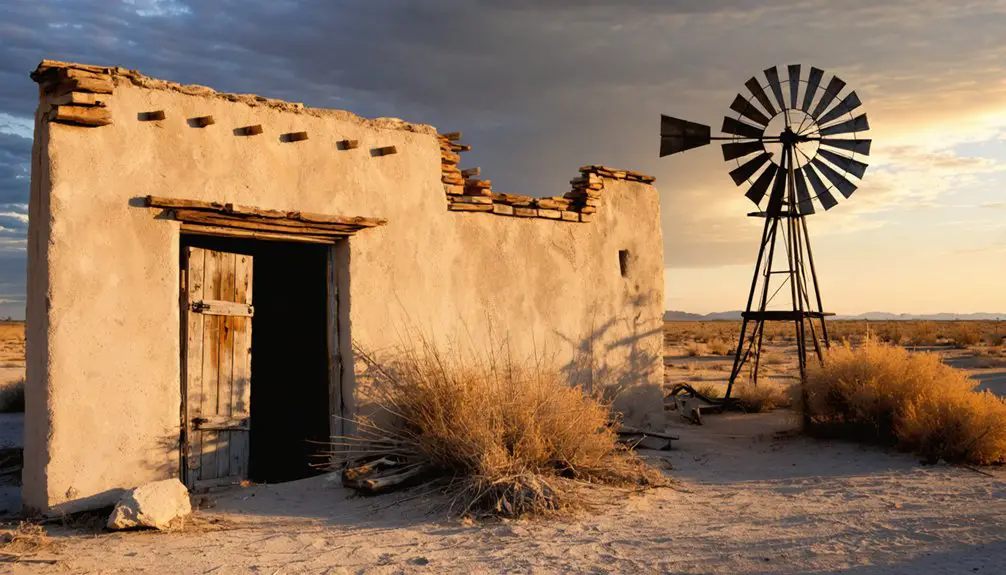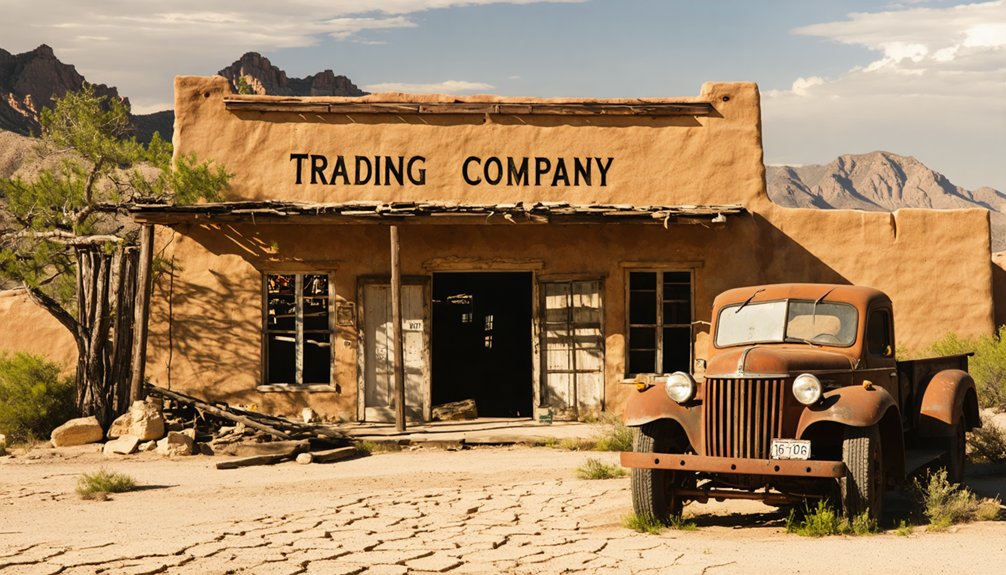
You’ll find Texas’s most famous ghost towns scattered across diverse landscapes, each telling unique stories of rise and fall. Terlingua’s mercury mining ruins dot West Texas, while Thurber stands as the state’s first company town with its iconic red smokestack visible from Interstate 20. Indianola’s port city lies submerged beneath Gulf waters after devastating hurricanes, and Fort Griffin preserves Wild West lawlessness along the Brazos River. These abandoned settlements offer authentic glimpses into frontier life that reveal fascinating details about Texas’s complex past.
Key Takeaways
- Terlingua was Texas’s largest mercury mining town, peaking at 2,000 residents during WWI before closing in 1946.
- Thurber became Texas’s first company town with 10,000 residents and full electrification before oil discoveries caused abandonment.
- Indianola rivaled Galveston as a major port until two devastating hurricanes in 1875 and 1886 destroyed the city.
- Fort Griffin served as a lawless frontier settlement known as “Babylon on the Brazos,” frequenting famous outlaws and gunfighters.
- Glenrio thrived as a Route 66 border town until Interstate 40 bypassed it in 1973, leaving derelict buildings.
Terlingua: Mercury Mining Legacy in West Texas
Deep in the rugged terrain of West Texas, where the Chihuahuan Desert meets the Rio Grande, Terlingua stands as one of America’s most fascinating ghost towns—a reflection of the boom-and-bust cycle of mercury mining that defined the early 20th century.
You’ll discover Terlingua history began in 1888 when Jack Dawson first produced mercury from cinnabar ore. Howard E. Perry’s Chisos Mining Company dominated operations from 1903, becoming the nation’s largest mercury producer during the 1910s and 1920s.
World War I drove demand for mercury in explosives, transforming Terlingua into a thriving community of 2,000 residents. The town featured amenities including a well-stocked commissary, ice plant, and the Chisos Store which served as the largest trade hub between Del Rio and El Paso. The Terlingua District became the third-largest mercury-producing area in the United States, cementing its importance in American mining history. However, post-war decline and health hazards from mercury poisoning led to the mine’s closure in 1946, leaving behind skeletal structures that attract modern explorers.
Thurber: Texas’s First Company Town
You’ll discover Thurber’s transformation from a struggling 1886 mining operation into Texas’s most sophisticated company town under the Texas & Pacific Coal Company’s control after 1888.
The company created an entirely self-contained community with over 10,000 residents, complete infrastructure, and strict corporate governance that eliminated traditional municipal structures. Thurber became one of the first fully electrified towns in Texas with its 24-hour electric plant powering the entire community.
Thurber’s decline began when the 1917 Ranger oil discovery shifted energy markets, ultimately leading to the town’s abandonment by the 1930s after decades as the state’s largest bituminous coal producer. Today, only a red smokestack and scattered brick buildings remain visible from Interstate 20, serving as silent reminders of this once-thriving metropolis.
Coal Mining Operations Era
When William Whipple Johnson and Harvey Johnson initiated mining operations in December 1886, they launched what would become Texas’s most significant coal mining enterprise and the state’s largest company town.
You’ll find Thurber’s coal mining history represents a fascinating chapter of industrial ambition and labor struggles that shaped the American West.
The operation’s growth showcased remarkable scale:
- Peak population reached 8,000-10,000 residents around 1920
- Diverse workforce included Italians, Poles, Mexicans, British, and Irish miners
- United Mine Workers achieved America’s first 100% closed-shop status by 1903
After payroll failures triggered strikes in 1888, new investors formed the Texas and Pacific Coal Company.
They imported experienced miners, negotiated railway contracts, and built essential infrastructure. The company controlled all aspects of daily life through company stores, schools, churches, and even entertainment facilities like an opera house.
Miners endured grueling twelve-hour workdays before 1903, emerging covered in coal dust with common physical ailments including stooped backs and knee calluses.
Despite labor struggles, the mines supplied locomotives for thirty years until oil conversion ultimately ended Thurber’s coal dominance.
Company Town Structure
After Colonel R.D. Hunter founded Thurber in 1888 with Horace K. Thurber’s backing, you’d witness America’s most thorough example of company control over daily life.
The Texas and Pacific Coal Company owned everything—every house, store, church, and street. You couldn’t live there unless you worked for the company or received their explicit approval.
This community structure eliminated traditional governance entirely. No taxes existed since no private property did. No city council made decisions—company executives did.
The railway funded law enforcement while the company provided schools, utilities, and infrastructure. You’d find over 200 houses, shops, churches, and even a 650-seat opera house, all company-owned.
This self-contained system housed several thousand diverse miners and families under complete corporate authority. The company excluded union activists from their hiring practices to maintain control over the workforce.
By 1903, this control paradoxically led to complete unionization when every worker in Thurber joined one of seven unions after Edgar L. Marston signed a labor agreement.
Industrial Decline Aftermath
Despite Thurber’s seemingly unshakeable foundation as Texas’s premier company town, the discovery of oil would ultimately seal its fate.
When the J.H. McCleskey No. 1 well struck black gold in October 1917, you’d witness the beginning of an economic transformation that would devastate Thurber’s coal-dependent community.
The shift hit workers hardest through:
- Massive wage cuts in the 1920s as coal demand plummeted
- Labor struggles culminating in the major 1926-1927 strike
- Population exodus from over 10,000 residents to complete abandonment by the 1930s
Railroads converted to oil-burning locomotives, and even the local brick plant switched to natural gas by 1917.
The company’s focus pivoted entirely to oil profits, leaving thousands of ethnic miners without purpose in a town whose fate was sealed.
Indianola: Hurricane-Devastated Port City
You’d find it hard to believe that Indianola once rivaled Galveston as Texas’s second major port, serving as the gateway for thousands of European immigrants heading west.
Originally known as Indian Point, the settlement served as a disembarkation site for German colonists organized by the Aldesverein, a society of German nobility that helped families escape economic and political turmoil in their homeland. The thriving city of over 5,000 residents couldn’t withstand nature’s double blow—a devastating Category 3 hurricane in 1875 that killed 300 people and destroyed 75% of buildings, followed by an even more catastrophic Category 4 storm in 1886.
After that second hurricane left only two buildings standing and washed away the railroad, survivors abandoned the coast forever, moving inland to escape the Gulf’s deadly power. The original town site has since been swallowed by the Gulf of Mexico, leaving no trace of the once-prosperous port.
Twin Hurricane Disasters
When nature strikes twice with devastating force, even the most resilient communities can’t survive the blow. You’ll find no better example than Indianola’s tragic fate through twin hurricane disasters that sealed its doom.
The first catastrophe struck September 16, 1875, when a Category 3 hurricane brought 115 mph winds and devastating storm surge. Three-quarters of buildings vanished, boats washed 9 miles inland, and 270-800 lives were lost.
Eleven years later, just as recovery seemed possible, nature delivered the final blow:
- August 20, 1886: 150 mph winds and 15-foot storm surge
- Fire destruction: Wind-driven flames consumed remaining structures
- Total abandonment: Only two buildings survived
This complete coastal abandonment proved that even determined hurricane resilience has limits when facing repeated devastation.
Survivors Fled Inland
After the second hurricane’s flames died down in August 1886, Indianola’s remaining residents made the painful decision to abandon their devastated port city forever.
You’ll find survivor stories documenting how families gathered what little remained and began their inland migration to safer ground. These resilient people had already endured the 1875 hurricane that killed nearly 300 residents, but this second disaster proved insurmountable.
The complete destruction left no infrastructure, no commerce, and no hope for rebuilding what had once been Texas’s second-largest port.
You can still visit the site today, where a small modern community exists among the ruins, serving as a stark reminder of nature’s power to reshape human destiny.
Fort Griffin: Wild West Frontier Settlement
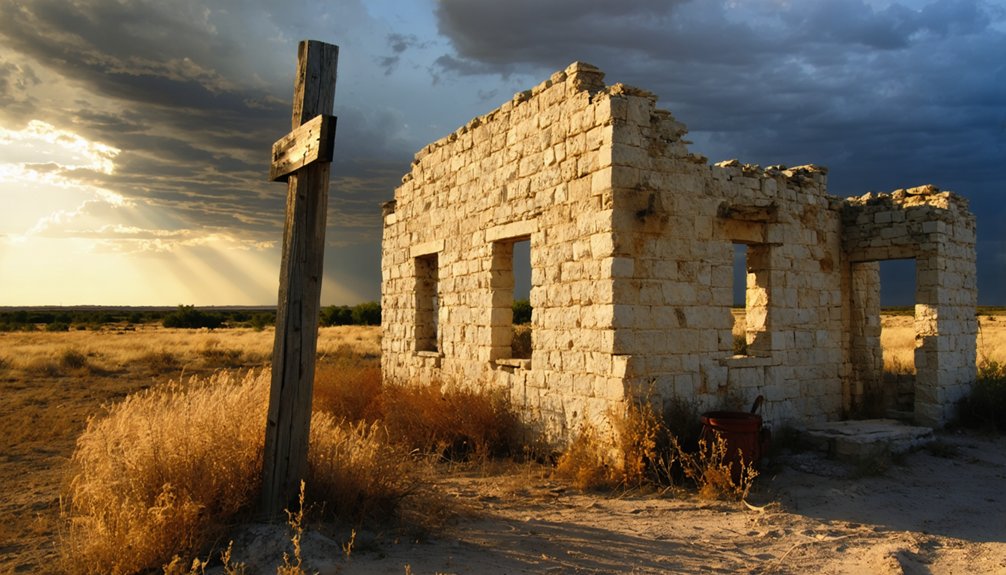
Established on July 31, 1867, by four companies of the Sixth Cavalry under Lieutenant Colonel S.D. Sturgis, Fort Griffin emerged as a frontier military post protecting settlers from Comanche and Kiowa raids in northwestern Texas.
Four companies of cavalry established this Texas frontier outpost to shield settlers from fierce Comanche and Kiowa attacks in 1867.
The settlement below the fort became known as “Babylon on the Brazos” due to its extreme lawlessness and violence.
You’d find three distinct elements that defined this wild settlement:
- Notorious inhabitants – Buffalo hunters, outlaws, gunfighters, and gamblers congregated here.
- Famous visitors – Wyatt Earp, Doc Holliday, and John Wesley Hardin frequented the town.
- Military intervention – Fort commanders imposed martial law in 1874 to control rampant crime.
Fort Griffin’s reputation as one of the West’s five wildest towns persisted until the railroad bypassed it in 1881, leading to its eventual abandonment.
Glenrio: Route 66 Border Town
Straddling the Texas-New Mexico border along the historic Route 66, Glenrio emerged in 1901 when the Chicago, Rock Island, and Pacific Railroad arrived in this remote corner of the Great Plains.
You’ll discover fascinating Glenrio history in this town that never exceeded thirty residents yet thrived as an essential waystation between Amarillo and Tucumcari.
Route 66 culture flourished here through motels, diners, and gas stations serving cross-country travelers seeking freedom on America’s Mother Road.
The town’s unique border location created quirky regulations—no bars on the Texas side due to dry laws, no gas stations on New Mexico’s side due to higher taxes.
When Interstate 40 bypassed Glenrio in 1973, businesses fled and residents abandoned their dreams, leaving behind seventeen derelict buildings as monuments to America’s vanished highway culture.
Old Bluffton: The Town Beneath Lake Buchanan

Beneath the tranquil waters of Lake Buchanan lies Old Bluffton, a Central Texas community that flourished along the Colorado River for over fifty years before vanishing forever. Established in the 1880s on a stagecoach route, this thriving town housed fifty families with essential businesses including a schoolhouse, cotton gin, and general store.
When Buchanan Dam’s completion in 1937 created Lake Buchanan for flood control, the Lower Colorado River Authority seized residents’ land through eminent domain.
You can witness Old Bluffton’s dramatic Bluffton history during severe droughts when lake levels drop:
- 1984 drought – Partial structures emerged before storms refilled the lake
- 2009 excavation – Texas Historical Commission conducted archaeological studies
- 2010-2013 emergence – Foundations, roads, and relocated tombstones became visible
Most residents relocated reluctantly, leaving behind a submerged legacy beneath Lake Buchanan.
Exploring Texas Ghost Town Heritage
What draws countless visitors to explore Texas’s abandoned settlements scattered across 269,000 square miles of diverse landscape?
You’ll discover authentic remnants of American frontier life through ghost town preservation efforts that protect these historical treasures. From Terlingua’s mining ruins near Big Bend to Belle Plain’s college remains, each site tells unique stories of boom and bust cycles that shaped Texas.
You can walk through Hagerman’s preserved 19th-century structures or examine Indianola’s coastal markers where hurricanes erased entire communities.
The historical significance of these settlements extends beyond tourism—they’re living museums documenting railroad expansion, mining booms, natural disasters, and economic shifts.
These authentic locations offer you unfiltered glimpses into Texas’s complex past without modern interference.
Frequently Asked Questions
Are Any of These Texas Ghost Towns Safe to Visit Alone?
Most Texas ghost towns aren’t safe for solo exploration due to structural hazards, crime rates exceeding major cities, and zero emergency services. Follow essential safety tips: visit tourist-connected sites like Kellyville near state parks instead. Exploring ghost towns in Texas can be a thrilling adventure, but it’s crucial to prioritize safety above all. Consider joining guided tours that offer insights into the history and allure of these abandoned places while ensuring your well-being. Many photographers and historians frequent these locales, sharing stories that breathe life into the silent streets once more.
What’s the Best Time of Year to Explore Texas Ghost Towns?
Coincidentally, fall’s perfect seasonal weather aligns with ghost towns’ historical significance during Halloween. You’ll find cooler temperatures ideal for exploring Texas’s 511 abandoned sites, while spring offers mild conditions and fewer crowds for comfortable adventures.
Do You Need Special Permits to Visit These Abandoned Towns?
You’ll need permits for state historic sites but not most privately-owned ghost towns. Always research ownership first and respect visiting regulations supporting historical preservation—trespassing laws still apply even in abandoned areas.
Which Texas Ghost Towns Have the Most Paranormal Activity Reported?
Helena leads with over 250 documented EVP sessions capturing supernatural sightings. You’ll find the most haunted history there, followed by Pontotoc’s cemetery spirits and Toyah’s black-eyed children roaming empty streets nightly.
Can You Camp Overnight at Any of These Ghost Town Locations?
Yes, you can camp overnight at several locations. Terlingua offers RV parks and rental accommodations near the ghost town. Other sites allow primitive roadside camping, though you’ll need to check local camping regulations and overnight permits.
References
- https://www.youtube.com/watch?v=bbVM_-giQIE
- https://www.chron.com/life/travel/article/ghost-towns-texas-21221278.php
- https://www.hipcamp.com/journal/camping/texas-ghost-towns/
- https://tpwmagazine.com/archive/2018/jan/wanderlist_ghosttowns/
- https://www.tripadvisor.com/Attractions-g28964-Activities-c47-t14-Texas.html
- https://www.texasescapes.com/TOWNS/Texas_ghost_towns.htm
- https://authentictexas.com/texas-ghost-towns/
- https://content.govdelivery.com/accounts/TXPWD/bulletins/1dcdee4
- https://www.tshaonline.org/handbook/entries/mercury-mining
- https://www.hmdb.org/m.asp?m=220385