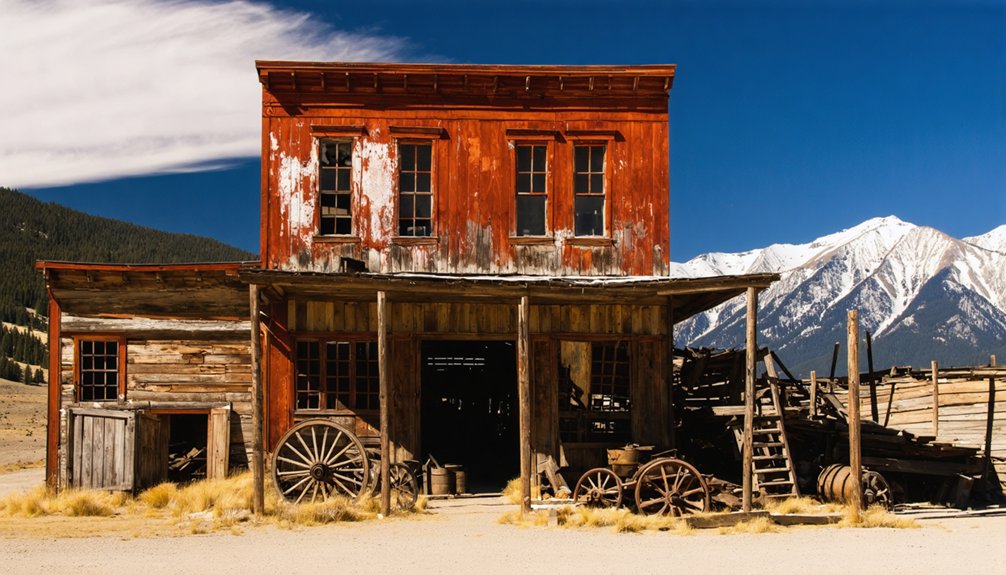
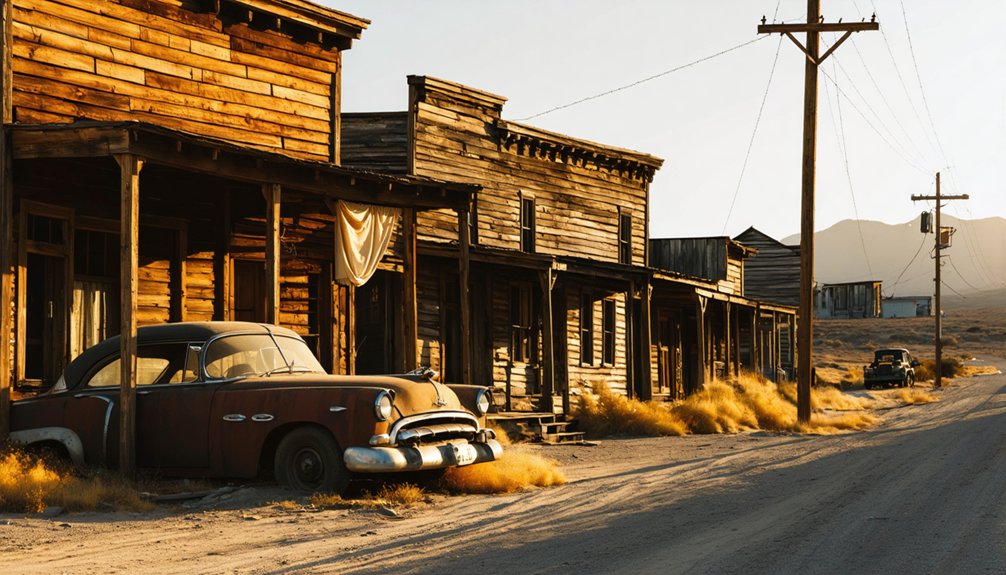
California’s forgotten Gold Rush towns offer windows into America’s most dramatic mineral boom. You’ll discover Bodie’s well-preserved saloons, Calico’s silver legacy, and Coloma’s historic significance as gold’s birthplace. These once-thriving settlements housed thousands of fortune seekers before economic downturns transformed them into atmospheric ghost towns. Each abandoned main street, mine shaft, and weathered building holds stories of extraordinary wealth, lawlessness, and the diverse communities that shaped the Wild West.
Key Takeaways
- Bodie, California’s best-preserved ghost town, housed 8,000-10,000 residents with 65 saloons during its 1876 gold rush peak.
- Calico thrived with 3,000 residents producing $20 million in silver before the 1890 Silver Purchase Act caused its decline.
- Coloma transformed after James Marshall’s 1848 gold discovery, growing to 10,000 miners by 1849.
- Eagle Mountain, founded in 1948, represents a modern mining ghost town that supported California’s largest iron mine until 1981.
- Silver City preserves authentic Gold Rush structures rescued from abandoned mining settlements dating back to 1855.
Bodie: The Best-Preserved Ghost Town of the Sierra Nevada
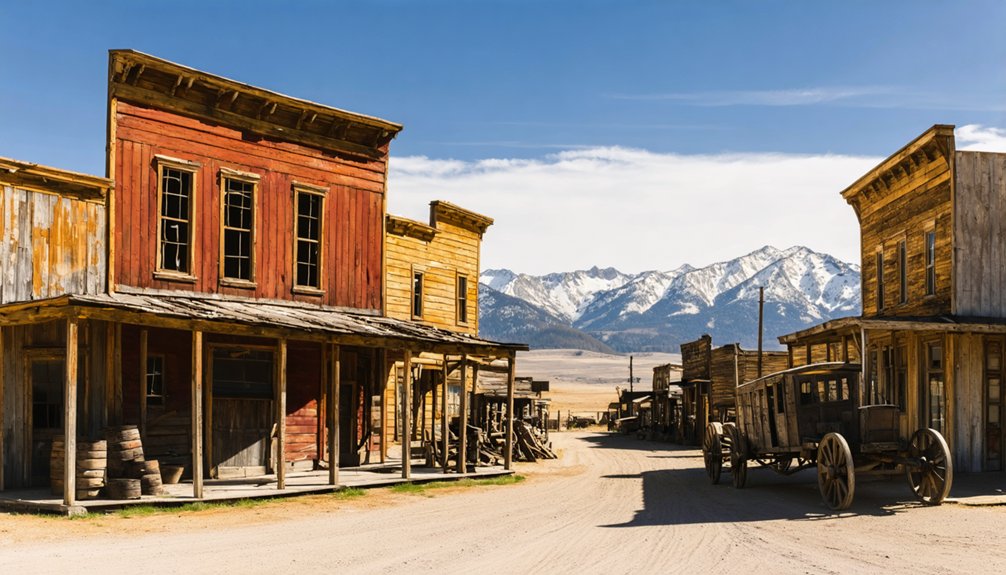
Nestled in the eastern Sierra Nevada foothills lies Bodie, a time capsule of California’s gold rush era. This remarkable ghost town began in 1859 when W.S. Bodey discovered gold but tragically died in a blizzard shortly after. A painter’s misspelling gave the town its current name.
Bodie history truly exploded in 1876 when miners struck a rich gold vein, transforming a small camp into a boomtown of 8,000-10,000 people.
At its peak, Bodie boasted 65 saloons, hotels, and even an early hydro-electrical plant. The town was also home to a vibrant Chinese community that contributed significantly through various trades such as laundry services and logging. Bodie’s notorious reputation earned it the phrase Badman from Bodie by 1880, placing it among the wildest mining towns in the American West.
Calico’s Silver Legacy: From Boom to Bust
While Bodie represents the gold rush era in the Sierra Nevada, Calico tells a different story—one of silver and borax in the Mojave Desert. Founded in 1881 after prospectors discovered rich silver deposits, this boomtown quickly grew to 3,000 residents and produced up to $20 million in silver before market forces destroyed its economy.
When exploring Calico’s dramatic rise and fall, you’ll discover:
- The Silver Purchase Act of 1890 crashed silver prices to $0.57 per ounce, making mining unprofitable by 1896.
- A brief revival occurred around 1915 when a cyanide plant extracted silver from leftover mining dumps.
- Silver mining challenges ultimately defeated all attempts at Calico’s revival, leaving it abandoned by 1935.
The town that once boasted 500 mines now stands frozen in time, a monument to boom-and-bust economics. Similar to how cotton industry combines formed in the late 19th century to address overcapacity, silver mining companies attempted consolidation to survive market pressures. Today, this California historic monument offers visitors a glimpse into the past through mine tours, gunfight shows, and old-time attractions.
Exploring ghost towns in the american west reveals the remnants of an era defined by dreams of wealth that ultimately faded away. Each deserted street and crumbling building tells stories of pioneers who sought fortune and stability in a harsh landscape. As these artifacts of history continue to erode, they serve as poignant reminders of the relentless pull between ambition and reality.
Eagle Mountain: The Modern Mining Ghost Town
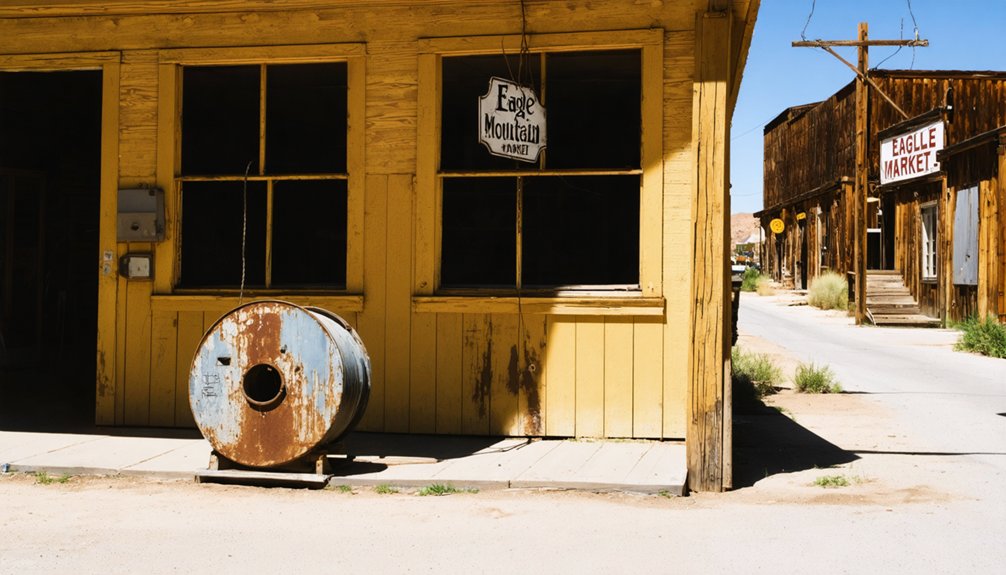
If you’d visited Eagle Mountain in its heyday, you would’ve seen Henry J. Kaiser‘s 1948 vision of a complete company town with 400 single-story homes, schools, churches, and commercial amenities serving 4,000 residents.
Unlike older mining settlements, Kaiser Steel Corporation deliberately engineered this modern desert community with landscaped, tree-lined streets and parks near Joshua Tree National Park.
The town’s meticulously planned infrastructure directly supported Southern California’s largest iron mine, connecting to Kaiser’s Fontana steel mill via a dedicated 51-mile railroad that transported over 100 million tons of ore during the operation’s lifetime. The mine set an impressive production record in 1975 with 350,000 tons of material produced.
Despite its initial prosperity, the town faced environmental concerns and foreign competition in the late 1970s that ultimately led to the mine’s closure in 1981.
Engineered Urban Blueprint
Unlike typical haphazard mining camps of the Gold Rush era, Eagle Mountain emerged as a meticulously engineered urban blueprint designed to support Kaiser Steel’s massive iron mining operation.
The urban planning created a complete community with over 400 homes, wide tree-lined streets, and extensive amenities that transformed an isolated desert location into a thriving hub of community dynamics. The town reached its peak production levels in the 1970s before economic forces led to its eventual abandonment. Founded in 1948 by Kaiser, this planned community represented a significant departure from California’s historical mining settlements.
Three standout features of Eagle Mountain’s design:
- A full spectrum of facilities including three schools, a mall, swimming pool, and churches
- Single-story multi-bedroom houses arranged along organized streets for all 4,000 residents
- A dedicated 51-mile railroad connecting the mine directly to the Fontana steel plant
This company town’s infrastructure supported its peak population until the late 1970s when mining operations began to decline.
Kaiser’s Desert Experiment
Henry J. Kaiser’s 1948 founding of Eagle Mountain represents an ambitious industrial experiment in California’s desert.
After acquiring the Iron Chief Mine in 1944, Kaiser transformed this gold mining site into a substantial iron ore operation, connecting it via a 52-mile railroad to his Fontana steel plant.
The mine flourished through the 1970s, shipping its 100 millionth ton in 1977 and employing 1,500 workers at its peak.
Kaiser’s legacy extended globally when securing Japanese contracts in 1963.
Foreign competition triggered decline by the late 1970s, with final closure in 1983 forcing town evacuation.
Mining impacts continued as the site briefly operated as a prison until 2003.
Kaiser’s proposed landfill transformation faced opposition, leaving Eagle Mountain as a symbol of industrial boom-and-bust cycles in California’s forgotten landscapes.
The thriving town established by Kaiser featured integrated medical care through his Kaiser Permanente system, which had been founded in 1942.
Daily ore blasting occurred at 3:00 PM, followed by heavy equipment transportation to processing facilities.
Silver City: Relics of California’s Golden Age
Nestled among the hills of Kern Valley, Silver City Ghost Town stands as a remarkable preservation of California’s Gold Rush heritage.
Amid Kern Valley’s rolling landscape, Silver City preserves the authentic spirit of California’s golden frontier.
Unlike typical historic sites, it’s a composite town created by rescuing structures from abandoned mining settlements across the region after gold’s discovery in 1855. The Mills family began this preservation effort in the 1960s, with the Corlews later investing 20,000 hours in restoration work.
When you visit, you’ll experience:
- Over 20 authentic buildings preserved in “arrested decay,” showcasing diverse Mining Techniques
- Thousands of artifacts reflecting the Cultural Influences of immigrant miners
- Self-guided tours through an outdoor museum that captures daily life in a boom-and-bust mining community
The town remains open year-round, offering a window into the grit of California’s golden age.
Old Shasta City: Where Gold Rush Dreams Faded

You’ll find Old Shasta City’s main street lined with the brick ruins of what was once northern California’s busiest Gold Rush hub, processing over $100,000 in gold dust weekly during its 1852-1857 peak.
After surviving two devastating fires, the town rebuilt with distinctive brick walls and iron shutters, architectural features still visible in the preserved structures at today’s Shasta State Historic Park.
The courthouse museum houses remarkable judicial artifacts from when Shasta served as the county seat, before the railroad’s arrival in nearby Redding triggered the town’s decline and eventual abandonment in the late 19th century.
Gold Boom’s Urban Hub
While prospectors panned the streams of northern California in 1849, a tent city known as Reading’s Springs emerged as the foundation of what would become Old Shasta City.
This urban development quickly transformed into the commercial heart of northern California’s mining economy. By 1851, the renamed Shasta became county seat, with gold dust worth $100,000 flowing through weekly during its 1852-1857 peak.
Despite devastating fires that twice destroyed the town, residents rebuilt with resilient brick and iron structures, demonstrating their commitment to Shasta’s future.
Three facts about Shasta’s boom years:
- Over $2.5 million in gold passed through within two years after 1850
- Up to 100 freight teams traveled through daily during peak operations
- The town supported diverse industries beyond mining, including lumber, copper, and agriculture
Preserved Justice Relics
Standing as silent witnesses to the Gold Rush era’s legal system, the preserved justice relics of Old Shasta City offer a compelling glimpse into frontier law and order.
As Shasta County’s seat from 1851, the town’s brick courthouse and jail facilities handled the chaotic realities of mining life – claim disputes, property conflicts, and violence that filled nine cemeteries by 1855.
You’ll notice thick walls, iron shutters, and heavy hinges on remaining structures, evidence of security concerns in a boomtown environment.
These architectural features protected both legal documents and prisoners during the town’s heyday.
The justice system’s historical significance is preserved within Shasta State Historic Park, where these durable buildings outlasted the wooden structures nearby.
Even after losing the county seat to Redding in 1888, these relics continue telling stories of how law operated on California’s dangerous frontier.
Hidden Treasures of Grass Valley’s Empire Mine
Beyond the surface landmarks of Grass Valley lies one of California’s most significant gold mining operations, the Empire Mine, whose remarkable history began in 1850 when lumberman George Roberts stumbled upon gold-bearing quartz veins.
When you visit, you’ll discover how the Bourn family transformed this operation after gaining control in 1869, implementing advanced Gold Extraction techniques that allowed miners to reach depths of over 1,250 feet by 1874.
The Empire Mine became California’s richest hard-rock gold mine, producing approximately 165 tons of gold through its 367-mile network of tunnels.
Three highlights you shouldn’t miss:
- The Cornish pump technology that revolutionized deep-shaft mining
- The extensive underground workings that reached extraordinary depths
- The economic impact that sustained Grass Valley through the Great Depression
Coloma: Birthplace of the California Gold Rush
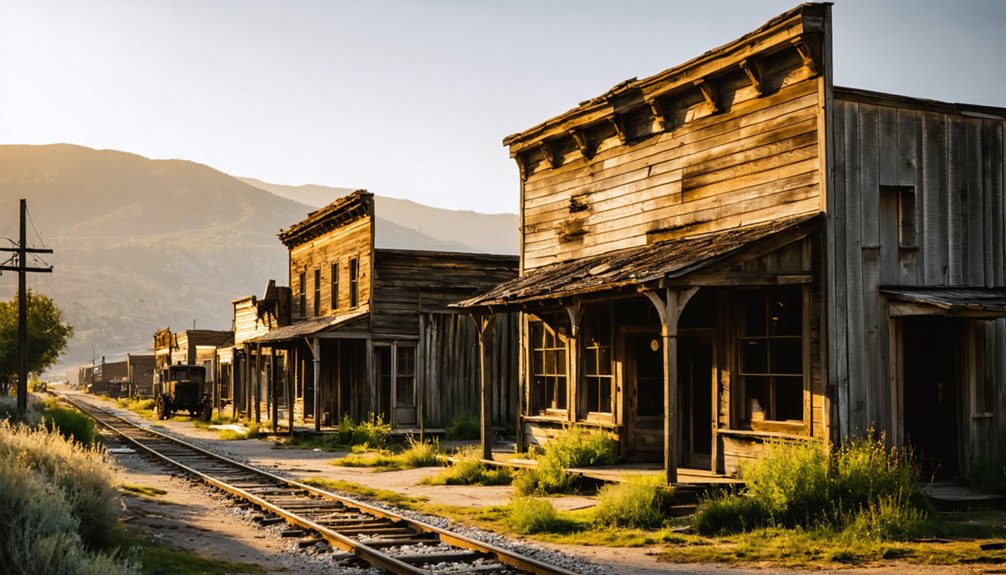
When James Marshall spotted gold flakes glimmering in the tailrace of Sutter’s Mill on January 24, 1848, he couldn’t have imagined how his discovery would transform California forever.
This historic gold discovery occurred near Cullumah Valley, a beautiful area named by the local Nisenan people.
By 1849, Coloma exploded from a simple sawmill site to a bustling town of 10,000 miners with hotels, banks, and saloons.
Neither Sutter nor Marshall profited greatly from the find that sparked this frenzy.
The rush had devastating indigenous impact, displacing Nisenan communities and contaminating their lands with mercury from mining operations.
Today, you can visit Marshall Gold Discovery State Historic Park, where a full-sized replica of the mill stands alongside preserved Gold Rush-era buildings, telling the story of California’s dramatic transformation.
Placerville’s Gold Bug Mine: Journey Underground
While the initial gold rush focused on easily accessible placer deposits in streambeds, the discovery of gold-bearing quartz veins beneath Placerville’s hills led to the establishment of hard rock mining operations like the Gold Bug Mine.
Originally named Hattie Mine in 1888, this preserved 352-foot horizontal shaft offers you a rare glimpse into authentic gold mining history.
When you visit Gold Bug Park‘s 61-acre historic site, you’ll experience:
- Self-guided audio tours showcasing pickaxe marks on quartz walls and authentic mining techniques
- The connected Priest Mine where miners once worshipped, demonstrating the cultural aspects of mining life
- Hattie’s Gold Rush Museum with historic mining tools and the Joshua Hendy Stamp Mill that crushed gold-bearing ore
Historic tours provide hands-on education about California’s evolution from placer to hard rock mining methods.
Main Street Memories: Architectural Heritage of Sutter Creek

Strolling through Sutter Creek today, you’ll discover a living architectural museum where native stone buildings with iron doors stand shoulder to shoulder with ornate Victorian structures adorned with Carpenter Gothic columns.
After the discovery of rich quartz deposits in 1851, this once-simple mining camp transformed into a proper industrial town. The devastating fires that plagued the settlement, with the last major blaze in 1888, sparked architectural innovation through fire-resistant materials.
The town’s commitment to architectural preservation shines through carefully restored 1800s buildings.
You’ll find America’s last water-powered foundry, established by Samuel Knight in 1873, alongside the brick schoolhouse rebuilt in 1870 for $10,000—both examples of community resilience and Sutter Creek’s enduring Gold Rush legacy.
Frequently Asked Questions
Can Visitors Stay Overnight in Any California Ghost Towns?
Home is where you hang your hat. Yes, you can enjoy ghost town accommodations at Calico with cabins and camping, while Temecula offers themed overnight stays in an Old West rental property.
What Survival Items Should You Bring When Exploring Remote Ghost Towns?
For remote exploration, you’ll need water, food, navigation tools, first aid supplies, recovery gear, proper clothing, emergency shelter, fire-starting kit, and communication devices as essential survival gear for ghost town adventures.
Are There Any Active Paranormal Investigations in These Abandoned Towns?
Where spirits linger, ghost hunters follow. You’ll find active paranormal investigations in Bodie State Historic Park and Calico Ghost Town, where teams conduct EVP sessions and use EMF detectors to document paranormal activity.
How Did Women and Children Experience Life in Gold Rush Towns?
You’d find women earning more than miners as business owners, while managing family roles. You’d see children helping with chores, receiving limited education, and learning survival skills in harsh frontier conditions.
What Environmental Impacts Did Gold Mining Leave on California’s Landscape?
Like a ravenous beast, gold mining devoured California’s landscape. You’ll find its scars in massive soil erosion, habitat destruction, mercury-poisoned waterways, clogged rivers, and deforested hillsides—all sacrificed for golden dreams.
References
- https://patch.com/california/banning-beaumont/13-ghost-towns-explore-california
- https://www.loveexploring.com/gallerylist/67994/americas-eeriest-gold-rush-ghost-towns
- https://en.wikipedia.org/wiki/List_of_ghost_towns_in_California
- https://www.worldatlas.com/cities/9-undisturbed-towns-to-visit-in-california-s-sierra-nevada.html
- https://www.latimes.com/travel/list/california-gold-rush-towns-travel
- https://wanderwisdom.com/road-trips/top-old-west-and-mining-towns-to-visit-in-california
- https://myfamilytravels.com/exploring-forgotten-gold-rush-landmarks-on-a-california-road-trip/
- https://asyaolson.com/the-best-gold-rush-ghost-towns-in-california/
- https://thelittlehouseofhorrors.com/bodie-the-cursed-ghost-town/
- https://www.bodiehistory.com