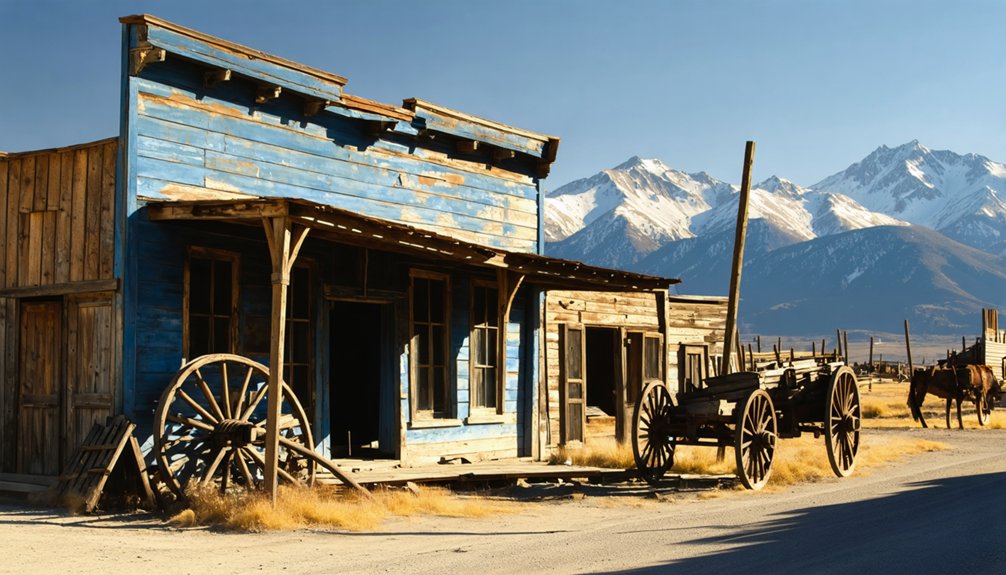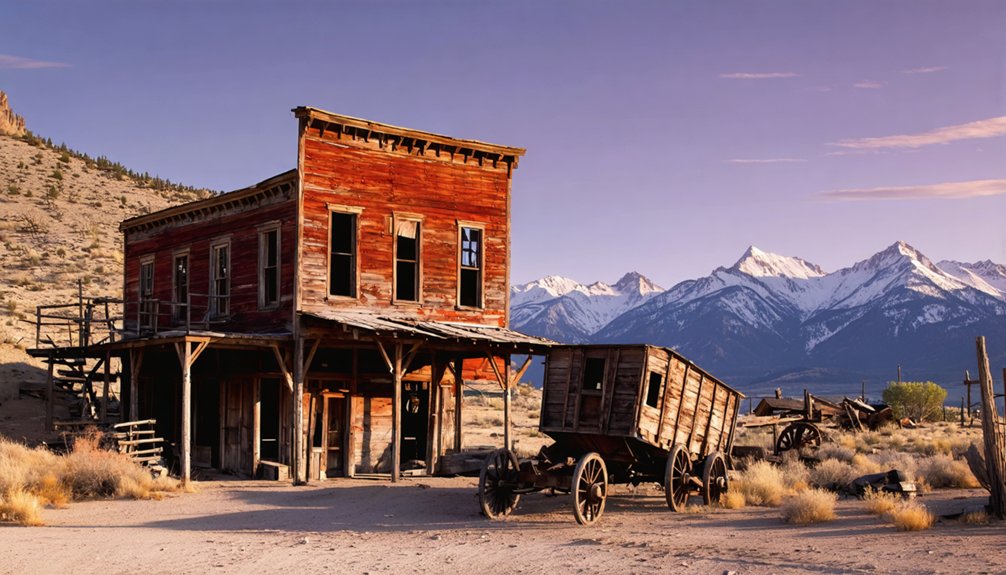
The Western US landscape is dotted with forgotten mining towns like Bodie, California and Castle Dome, Arizona, where thousands once sought fortune. You’ll find remnants of saloons, processing operations, and community infrastructure now standing silent. Women played vital roles, transforming volatile boomtowns into stable communities through schools and civic organizations. Environmental impacts persist through contaminated waterways and hazardous abandoned structures. These ghost towns reveal America’s complex relationship with resource extraction and boom-bust economics.
Key Takeaways
- Bodie, California transformed from a small mining outpost to a 10,000-resident boomtown before becoming a ghost town and State Historic Park.
- Castle Dome Mining District in Arizona operated for 115 years until 1979, supporting 3,000 residents with lead production peaking during World Wars.
- Steins, New Mexico developed around the Southern Pacific Railroad as a water-scarce settlement notorious for Apache raids.
- Lake Pactola submerged Camp Crook, a former gold mining community and county seat in South Dakota, leaving only underwater foundations.
- Mining towns typically followed boom-bust cycles, with some communities diversifying beyond extraction while others became ghost towns after resource depletion.
The Rise and Fall of Bodie, California’s Legendary Ghost Town
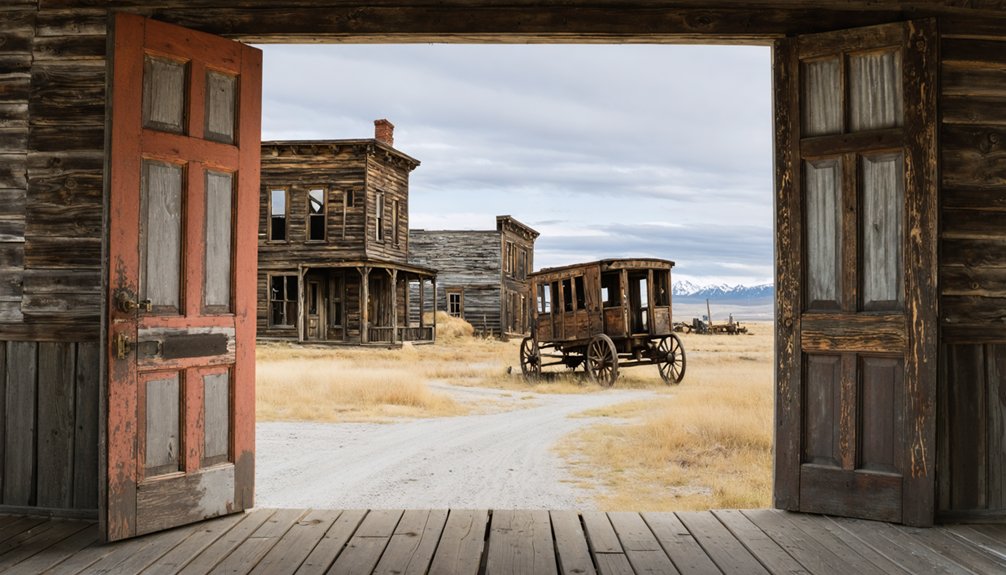
When you explore the story of Bodie, California, you’ll discover that its origins date back to September 1860, when prospectors first uncovered valuable gold and silver quartz deposits in the region.
Named after W.S. Bodey (though misspelled), this settlement transformed from a 20-miner outpost into a bustling town of 7,000-10,000 residents after the Standard Mining Company struck rich gold veins in 1877.
At its peak, Bodie boasted 65 saloons, churches, and extensive infrastructure—a symbol of its mining legacy. The town’s economic prosperity was staggering, with monthly ore production reaching $400,000 at its height. The town earned a reputation for its lawless character, with frequent killings and robberies becoming part of its notorious history.
However, declining ore quality, despite technological advances like steam pumps and cyanide processing, led to its inevitable downfall. By 1942, mining operations ceased completely, accelerating the ghost town phenomena.
Despite all human ingenuity, Bodie’s fading mineral wealth ultimately sealed its fate as a silent monument to bygone ambitions.
California recognized Bodie’s historical significance, establishing it as a State Historic Park in 1962, preserving this authentic slice of Wild West boomtown history.
Hidden Treasures of Castle Dome: Arizona’s Lead Mining Legacy
While Bodie represents California’s gold rush narrative, Castle Dome Mining District reveals an equally compelling chapter in Arizona’s mining heritage.
You’ll discover a remarkably enduring operation that spanned over a century, from 1864 until 1979, making it Arizona’s longest-operating mining district.
Castle Dome’s significance peaked during both World Wars when its lead production became strategically crucial for ammunition manufacturing. The Arizona Lead Company produced millions of pounds of bullets, placing these mines firmly in America’s defense supply chain.
The district’s robust mining infrastructure once supported a 3,000-person community with extensive facilities including saloons, hotels, and processing operations. Today, visitors can explore over 60 renovated buildings showcasing the town’s rich history.
The economic advantage of proximity to the Colorado River enabled cost-effective shipping, while massive wagons pulled by up to 40 horses transported ore across the rugged landscape. The area’s mining history actually extends back to the 1400s with Spanish miners who utilized Indian slaves to extract valuable ore for European markets.
Steins, New Mexico: Where Railroads and Mining Converged
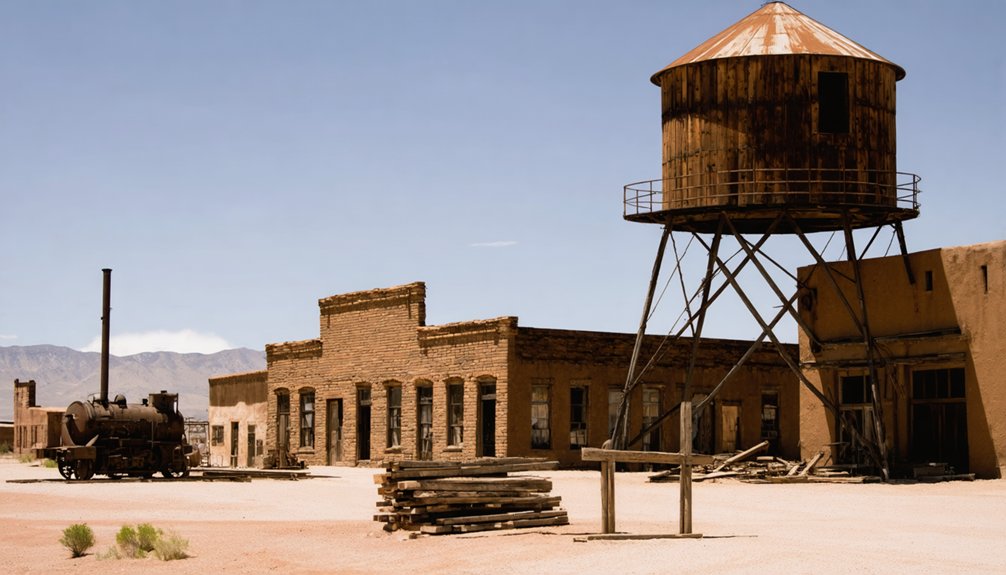
Unlike the primarily mining-focused communities of Bodie and Castle Dome, Steins developed as an essential railroad hub where transportation infrastructure and mineral extraction intersected in New Mexico’s rugged terrain.
Named after Army Major Enoch Steen, this settlement grew around the Southern Pacific Railroad in the 1880s as a fueling station along the second transcontinental line. You’ll find the town’s railroad significance evident in its rock-crushing plant, which produced track ballast starting in 1905.
Water scarcity defined life here—with no natural sources, water arrived by train at prices exceeding oil. Despite nearby gold, silver, and copper discoveries in the Peloncillo Mountains, Steins maintained its identity as a railroad town rather than a mining center. The area became notorious for Apache raids during the settlement period, creating additional challenges for residents.
At its peak around 1920, approximately 1,000 residents called this isolated outpost home until the post office closed in 1944. The remnants of the town were later purchased by the Garrison family in the 1970s, who transformed it into a tourist attraction with refurbished historic buildings.
Submerged History: The Underwater Remnants of Lake Pactola
If you’re exploring Lake Pactola today, you’d never suspect an entire mining settlement lies beneath its waters.
Camp Crook, later renamed Pactola after the Lydian river Pactolus, thrived as a gold mining community from the 1870s until the dam’s construction between 1952 and 1956 transformed the valley into a reservoir.
The submerged town’s foundations, building remnants, and a preserved dynamite bunker from the Civilian Conservation Corps now attract historical interest and recreational divers seeking to connect with this flooded chapter of Black Hills history. Before the flooding, most buildings were auctioned and removed, leaving only traces of the once-bustling mining village.
Before the Flood
Before the waters of Lake Pactola claimed its foundations, Pactola thrived as a bustling mining settlement born from the 1870s Black Hills gold rush.
The town’s Pactola history began as Camp Crook, a cavalry base named after General George Crook, established to remove prospectors from Lakota treaty lands.
As mining operations expanded, the population swelled to nearly 300 residents. You would’ve found a long flume, store, and hotel supporting this community. The town’s name originated from a tipsy lawyer’s speech referencing King Midas’ treasure.
Pactola briefly served as Pennington County’s seat of government, showcasing its regional importance.
The mining legacy faded as profits declined, leading to abandonment. Illegal operations characterized the early mining years, contributing to the town’s eventual economic struggles. By the 1950s, the government condemned the land for dam construction, forcing remaining structures to be auctioned and relocated.
The valley’s flooding from 1952-1956 submerged all but foundations and a dynamite bunker underwater.
Secrets Below Surface
Beneath Lake Pactola‘s serene waters lies a complete town, preserved like an underwater time capsule since its inundation between 1952 and 1956.
You’ll find a wealth of submerged artifacts if you’re willing to explore the depths—building foundations, mining infrastructure, and even a CCC dynamite bunker rest on the lake floor.
Scuba divers regularly document these underwater archaeological treasures, tracing the old railroad bed and discovering construction equipment abandoned during the dam project.
The condemned buildings that weren’t relocated or auctioned off remain as concrete evidence of the once-thriving settlement.
This subaquatic ghost town represents the government’s practical approach to water management—sacrificing one community to provide flood control and water supply for another.
The freedom to explore these remnants offers a tangible connection to the Black Hills’ pioneering past.
Women’s Influence on Mining Town Development and Stability

While gold and silver lured men to mining frontiers, you’ll find it was women who transformed raw settlements into viable communities through what historians call the “Frontier Domesticity Revolution.”
You can trace this evolution in countless Western towns where women established permanent homes, organized schools, and created social institutions that replaced the temporary chaos of male-dominated saloons and gambling halls.
Your understanding of mining town stability remains incomplete without recognizing how women served as social anchors by maintaining community cohesion through education, healthcare networks, and cultural traditions that outlasted the boom-and-bust cycles of mineral extraction.
Frontier Domesticity Revolution
As the dust of frontier development settled across mining landscapes, women emerged as the architects of permanence, transforming volatile boomtowns into stable communities through what historians now recognize as the “Frontier Domesticity Revolution.”
Their arrival marked a decisive turning point in mining town trajectories—where men had created extractive economies focused solely on mineral wealth, women established the social infrastructure necessary for sustainable development.
You’ll find frontier women revolutionized these settlements through:
- Initiating beautification campaigns that transformed crude camps into livable towns
- Establishing educational institutions that anchored permanent populations
- Creating domestic economies that diversified beyond mineral extraction
- Forming civic organizations that instituted governance and social order
- Facilitating cultural preservation that integrated diverse immigrant populations
Their domestic stability converted transient extractive outposts into functioning societies—transforming places where men merely worked into communities where families lived, learned, and built lasting foundations for western development.
From Saloons to Schoolhouses
The transformation from chaotic mining camps to enduring communities hinged upon women’s multifaceted contributions that reached far beyond domestic spheres into economic, educational, and civic domains.
You’ll find that women’s entrepreneurship reshaped these frontier settlements, operating saloons, boarding houses, and laundries that functioned as both businesses and community centers.
When women established schools, they cemented town permanence while sometimes discovering mining claims themselves. Their presence dramatically improved community cohesion, transforming transient camps into stable settlements with higher marriage rates and organized social institutions.
As grubstakers, women financially backed mining ventures, securing ownership stakes and economic power.
They maintained cultural continuity through historical documentation while advocating for social reforms.
Though gender norms eventually reasserted themselves, women’s adaptation to frontier necessities created the foundation upon which mining towns evolved from crude camps into functioning societies.
Mining Town Social Anchors
Beyond their economic entrepreneurship, women served as foundational social anchors that transformed volatile mining camps into enduring communities. You’ll discover that women’s contributions extended far beyond domestic duties, creating the social infrastructure necessary for mining settlements to survive beyond boom-bust cycles.
- Women established stable family units, with mining counties showing higher marriage rates than non-mining regions.
- They maintained vital community institutions like schools and churches.
- Their presence moderated male behaviors and fostered community cohesion.
- By providing essential services—cooking, lodging, healthcare—they supported miners’ well-being.
- Women’s childrearing and family development anchored transient populations, enabling demographic stability.
This social foundation work proved just as valuable as ore extraction, transforming temporary encampments into legitimate towns with lasting civic identities and sustainable futures.
From Boom to Bust: Economic Cycles That Shaped Western Mining Settlements
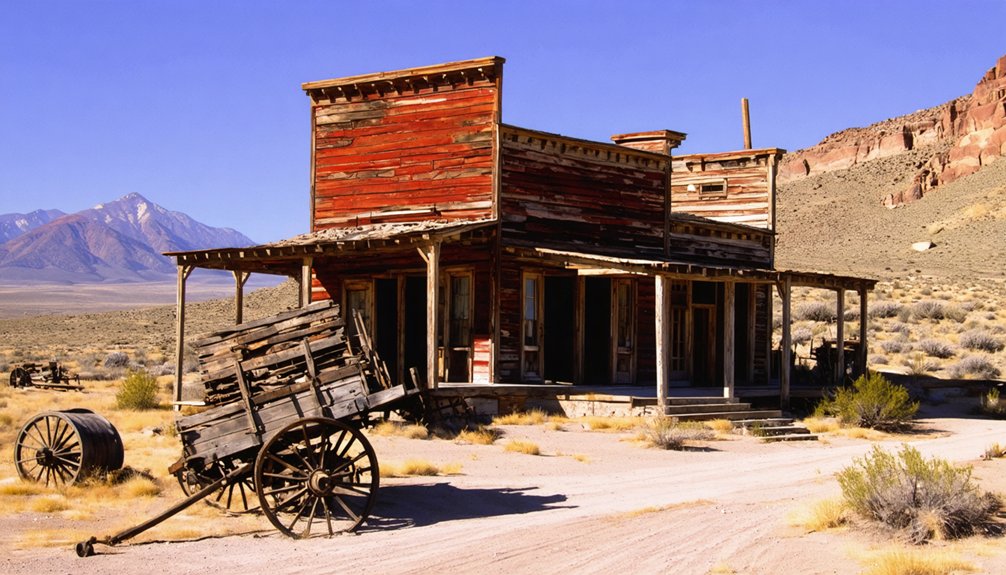
Mining towns across the Western United States experienced dramatic economic oscillations that defined their rise and eventual decline throughout the 19th and 20th centuries.
You’d witness communities like Tombstone and Coeur d’Alene explode from nothing to 10,000 residents almost overnight following precious metal discoveries, only to face devastating busts when resources depleted.
Economic resilience varied widely, with some towns diversifying beyond their extractive foundations.
While some mining towns evolved beyond ore extraction, others remained fatally tethered to depleting resources.
The 1982 “Black Sunday” oil shale collapse in Colorado demonstrates how swiftly fortunes reversed—Exxon’s withdrawal eliminated $85 million in annual payroll.
Community adaptation became essential as corporate interests replaced individual prospectors, transforming the economic landscape.
While railroads initially boosted mining towns‘ connectivity, many settlements couldn’t survive the inevitable downturn when mines failed or commodity prices plummeted, leaving behind the ghost towns you can still explore today.
Preserving the Past: Conservation Efforts in Historic Mining Districts
As federal and state agencies recognized the historical significance of abandoned mining sites, extensive preservation efforts emerged to balance safety concerns with cultural heritage protection.
You’ll find these conservation initiatives operating across multiple levels, with community stewardship playing an essential role alongside governmental programs. Historical archaeology informs preservation decisions, helping prioritize structures and landscapes for protection.
Conservation approaches include:
- National Register listings providing frameworks for evaluating mining properties
- State programs like Utah’s AMRP combining safety remediation with heritage documentation
- Conservation easements protecting sites from development while categorizing preservation priorities
- Environmental assessments addressing toxic contamination while preserving industrial heritage
- Community-led fundraising partnerships with preservation organizations ensuring long-term site maintenance
These efforts represent a growing integration between environmental protection and cultural heritage conservation, allowing these forgotten places to tell their stories while addressing practical safety concerns.
Cultural Diversity in Western Mining Communities

While abandoned mining structures tell stories of industrial achievement, the true cultural legacy of these towns emerges through their remarkably diverse populations.
You’ll find evidence of ethnic enclaves where immigrant miners from Italy, Poland, Hungary, and beyond clustered together, preserving their languages and traditions despite discrimination.
These communities weren’t simply divided; they were vibrant. Immigrant groups brought specialized mining skills from their homelands, established churches reflecting distinct faiths, and organized cultural festivals celebrating their heritage.
Walking through towns like Butte, Montana, you’d encounter Cornish pasties alongside Slavic povitica. Women played significant roles in formalizing civic life through schools and churches.
Over generations, intermarriage created ethnically diverse families, though distinct community identities persisted through fraternal lodges and ethnic associations that provided essential mutual aid.
Environmental Challenges and the End of the Mining Era
Behind the picturesque ruins of ghost towns and weathered headframes lies a devastating environmental legacy that continues to plague these forgotten mining communities. When you visit these sites today, you’re witnessing the aftermath of unregulated extraction that decimated Western landscapes:
- Mercury and arsenic contamination poisoned waterways and wildlife, causing nervous system damage that persisted for generations.
- Strip mining created massive erosion and altered drainage patterns, increasing flood risks.
- Abandoned infrastructure and collapsed shafts remain dangerous physical hazards.
- Mine tailings destroyed natural vegetation, creating barren zones resistant to environmental restoration.
- Economic collapse followed resource depletion, transforming boomtowns into ghost towns virtually overnight.
These environmental challenges ultimately led to modern mining regulations, though cleanup efforts remain incomplete decades later as communities struggle to balance historical preservation with necessary remediation.
Frequently Asked Questions
Were Ghost Towns Ever Reoccupied After Their Initial Abandonment?
Yes, you’ll find numerous ghost towns were reoccupied after abandonment, following several reoccupation trends: mining revivals, tourism development, heritage preservation, and small-scale residential resettlement, as historical examples demonstrate.
Exploring haunted ghost towns in California can offer a unique glimpse into the past, where visitors might experience echoes of history amidst the ruins. The eerie atmosphere and well-preserved remnants of these towns draw throngs of adventurers and history buffs alike, eager to uncover the stories behind their abandonment. As night falls, the allure of these towns intensifies, sparking curiosity and perhaps even a few ghostly encounters.
What Happened to Mining Equipment When Towns Were Abandoned?
Ever seen a rusted giant frozen in time? Mining equipment was often abandoned due to removal costs, eventually corroding onsite. Some pieces underwent historical preservation, while others were scrapped for metal or left deteriorating in isolation.
How Did Mining Towns Handle Law Enforcement and Crime?
You’d see lawlessness controlled through miners’ courts, vigilante justice, and eventually sheriffs. Mining regulations were loosely enforced, while crime prevention relied on posses, private enforcement, and financial rewards for capturing outlaws.
Did Indigenous Communities Interact With Western Mining Settlements?
Amid storms of change, you’ll find Indigenous communities did interact with mining settlements through limited cultural exchanges, but primarily through violent land disputes that resulted in their displacement and economic marginalization.
How Did Extreme Weather Affect Daily Life in Mining Towns?
You’d face brutal seasonal challenges as snowdrifts isolated towns for months. Your weather adaptations included winterizing cabins, stockpiling supplies, and enduring respiratory illnesses from mine dust in cramped, poorly ventilated quarters.
References
- https://www.geotab.com/ghost-towns/
- https://hobblecreek.us/blog/entry/mining-towns-of-the-old-west
- https://www.blackhillsbadlands.com/blog/post/old-west-legends-mines-ghost-towns-route-reimagined/
- https://westernmininghistory.com/map/
- https://backroadplanet.com/9-ghost-towns-still-standing-in-the-west/
- https://explorethearchive.com/western-ghost-towns
- https://wildwestcity.com/old-west-ghost-towns/
- https://www.atlasobscura.com/lists/americas-best-preserved-ghost-towns
- https://www.usawelcome.net/news/explore-ghost-towns-west-usa.htm
- https://www.legendsofamerica.com/gt-hiddentales/