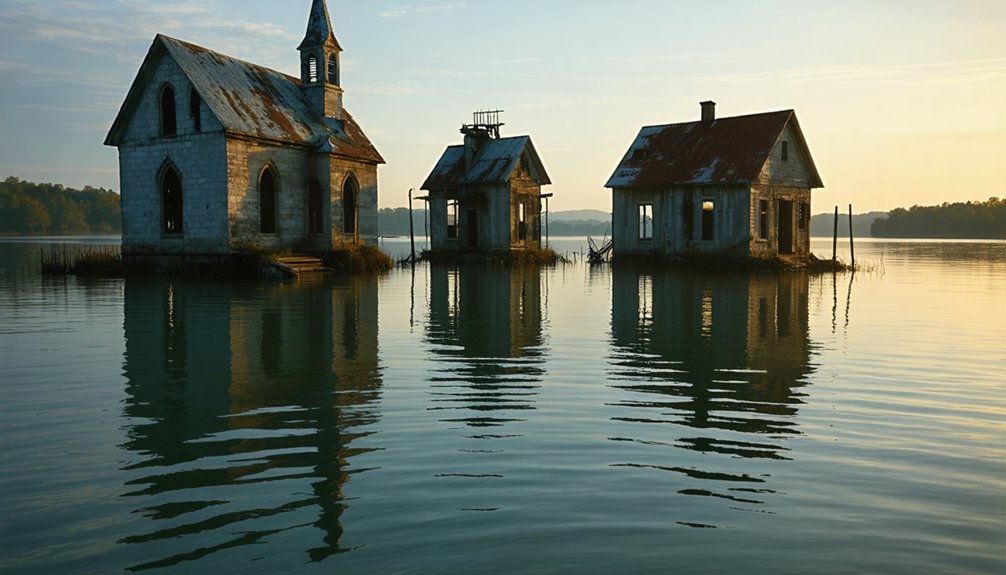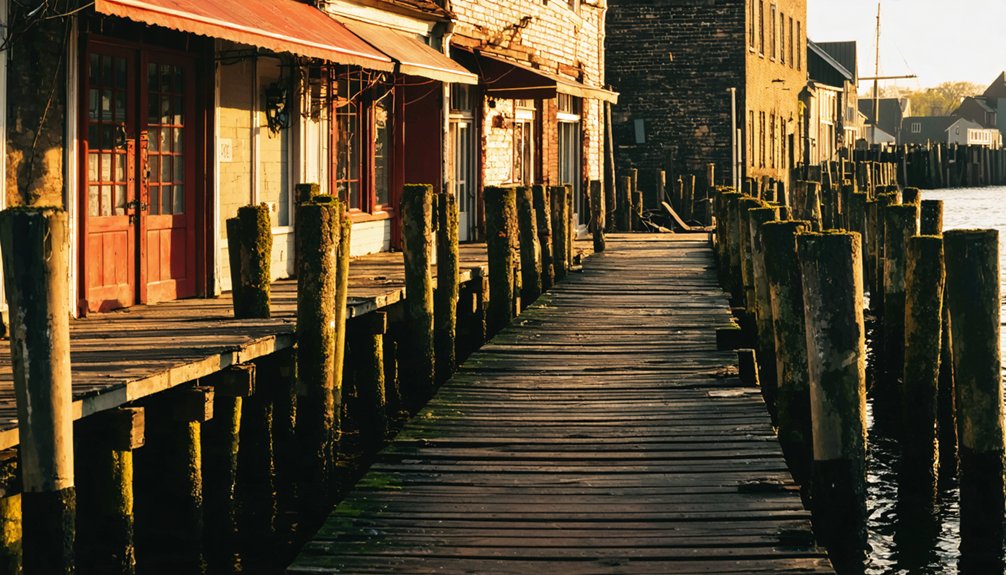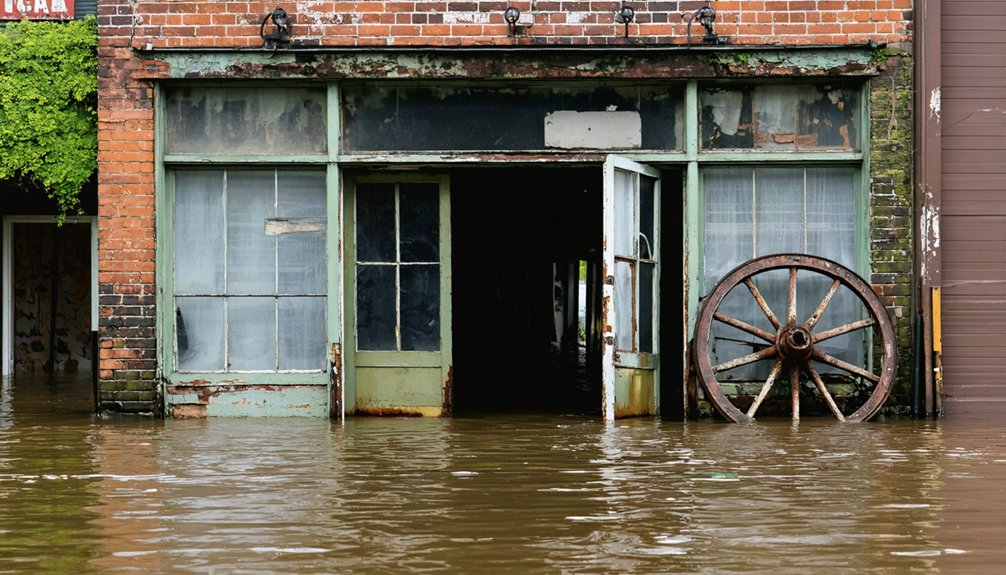
Across North America, hundreds of submerged towns rest beneath reservoir waters. You’ll find communities like Proctor, NC and Loyston, TN—sacrificed for mid-20th century dam projects that displaced thousands of families. Other settlements succumbed to natural flooding, like Old Shawnee Town which lost 95% of its homes in 1937. From Quabbin Valley’s four disincorporated Massachusetts towns to St. Thomas, Nevada’s occasionally visible ruins, these underwater ghost towns tell compelling stories of progress, sacrifice, and forgotten promises.
Key Takeaways
- Proctor, North Carolina was submerged by Fontana Lake during WWII, displacing 1,200 families for aluminum production.
- Lake Murray in South Carolina covered European settlements, leaving over 2,300 graves underwater.
- The Tennessee Valley Authority projects erased Loyston, Tennessee, a 19th-century trading center.
- St. Thomas, Nevada periodically resurfaces during Lake Mead’s drought periods, revealing its historical structures.
- Shicheng, China was submerged in 1959 for hydroelectric power, displacing nearly 300,000 residents.
Underwater Appalachian Communities: Proctor and Andersonville
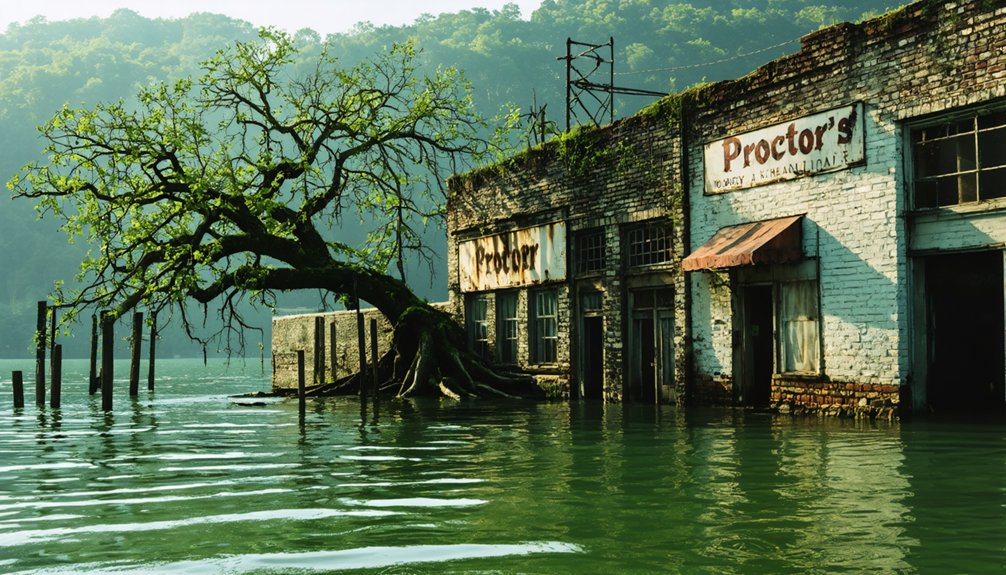
Shrouded beneath the placid waters of Fontana Lake lie the submerged remnants of Proctor, once a vibrant Appalachian community with deep historical roots in western North Carolina. The town’s history began in 1886 as a lumber settlement named after Moses and Patience Proctor, flourishing until World War II necessitated the construction of Fontana Dam.
You’ll find Proctor’s legacy inextricably linked to wartime sacrifice—approximately 1,200 families were displaced when their homes were flooded to power aluminum production for military needs. The government’s unfulfilled promise of a proper access road left the “Road to Nowhere,” a haunting symbol of displacement. Former residents still gather at the preserved cemetery during annual Decoration Day events, maintaining connections to their submerged hometown.
Today, visiting requires a challenging 12-mile hike or boat journey. The Calhoun House stands as the only remaining original structure from the once-thriving community. Like neighboring Andersonville, Proctor represents the often-overlooked cost of progress—communities erased for national priorities, leaving only scattered foundations and memories.
Southern Ghost Towns Claimed by Rising Waters and Natural Forces
Across the American South, dozens of once-thriving communities now rest beneath murky waters, sacrificed to infrastructure demands and natural disasters that reshaped entire landscapes.
The flooded history of Lake Murray covers former European settlements like Dutch Fork and Saxe Gotha, where more than 2,300 graves lie submerged.
Beneath Lake Murray’s waters rest forgotten European pioneers, their 2,300 graves silently marking what civilization sacrificed for progress.
You’ll find similar submerged heritage in Southern Illinois, where the 1937 Ohio River flood destroyed 95% of Old Shawnee Town’s homes, forcing relocation.
The historic First State Bank of Illinois, an impressive three-story brick structure with ornate limestone facade, survived as one of the few remaining landmarks from Old Shawnee Town’s commercial heyday.
The TVA’s dam projects swallowed Loyston, Tennessee, a 19th-century trading center, leaving only documentation and memories.
The Fontana Dam, completed in 1944, created Fontana Lake which completely submerged the town of Proctor, leaving family cemeteries inaccessible to former residents.
In Texas, Toledo Bend Reservoir claimed Fairdale and Robinson Bend in the 1960s, where displaced families still gather to commemorate their lost communities.
Other towns like Wheeler on the Virgin River simply washed away entirely, victims of nature’s unforgiving power.
abandoned towns along American rivers serve as haunting reminders of how communities can be swallowed by the elements. The remnants of homes and businesses tell silent stories of resilience and loss. As the waters rise and fall, these ghost towns stand as testaments to the relentless march of nature and the impact it has on our lives.
Lost American Settlements From the Great Dam-Building Era
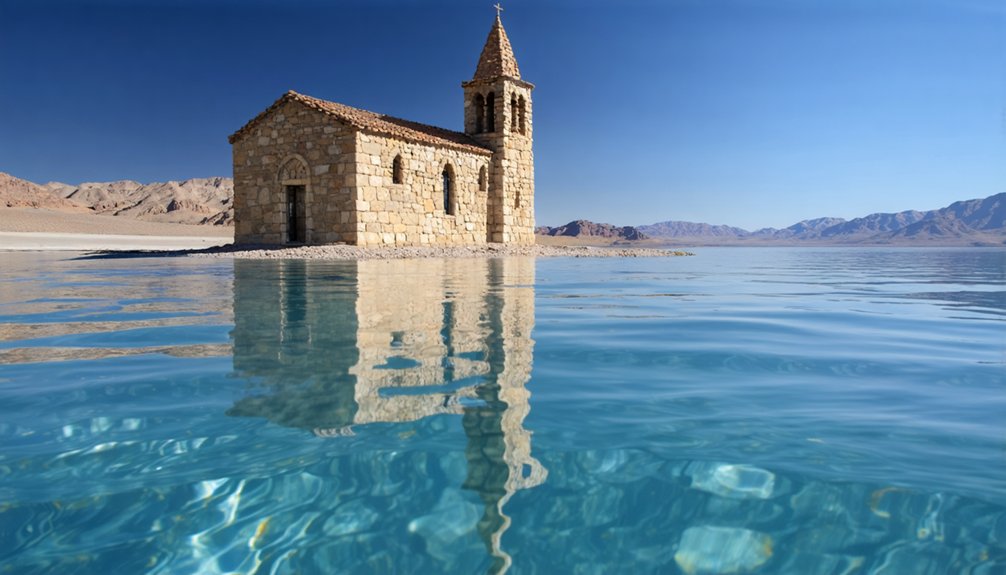
America’s ambitious dam-building era of the mid-20th century created essential infrastructure at an enormous cultural cost, as hundreds of towns vanished beneath rising waters.
You’ll find forgotten histories in places like Quabbin Valley, Massachusetts, where Dana, Enfield, Greenwich, and Prescott were disincorporated in 1938, with immigrant “woodpeckers” demolishing 175 buildings.
Similarly, eleven Washington communities, including Kettle Falls and Inchelium, disappeared beneath Lake Roosevelt following Grand Coulee Dam’s construction.
Native communities bore particular hardship—Elbowoods, North Dakota submerged under Garrison Dam represents countless submerged cultures erased by federal projects. The creation of “New Town” in 1954 became the reluctant home of MHA Nation after their ancestral lands were flooded.
Throughout Appalachia, towns like Proctor and Loyston were sacrificed for reservoirs, while Western communities such as St. Thomas, Nevada now periodically emerge during Lake Mead’s drought—silent testimonies to communities displaced for progress. The town once served travelers along US 91 highway and was known for producing quality cantaloupes before its submersion in 1938.
Once-Thriving River Ports Now Submerged in History
Beneath rippling waters lie the remnants of once-bustling commercial centers that flourished along major waterways before succumbing to catastrophic natural events or deliberate flooding.
You’ll find Port Royal, Jamaica—where two-thirds of the vibrant trading hub slid into the Caribbean after a 1692 earthquake—now rests 40 feet underwater.
Similarly, Thonis-Heracleion, Egypt’s primary international port before Alexandria, gradually disappeared beneath Abu Qir Bay through earthquakes and soil liquefaction.
These forgotten waterways once channeled global commerce through elaborate systems of wharves and harbors.
China’s Shicheng, submerged in 1959, displaced nearly 300,000 residents to create an artificial lake for hydroelectric power.
The world’s oldest known submerged city, Pavlopetri, offers a complete Bronze Age town plan preserved 10-13 feet underwater.
Its interconnected streets and structures document ancient Greek maritime trade networks.
These submerged trade centers, accessible only to specialized archaeological expeditions, continue revealing remarkably preserved artifacts like Port Royal’s pocket watch—frozen at the moment disaster struck.
In Italy, the medieval village of Fabbriche di Careggine occasionally emerges when the lake is periodically drained, offering rare glimpses of its 13th-century ruins.
Modern Communities Facing Submersion as Climate Changes
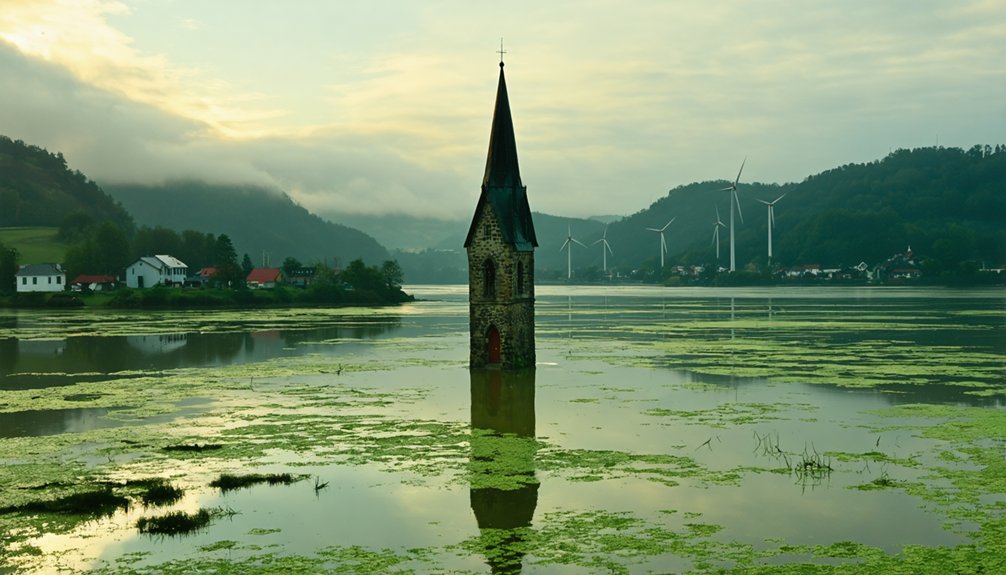
While ghost towns of the past succumbed to singular catastrophic events, today’s vulnerable communities face a slower but equally relentless submersion as climate change intensifies global flooding patterns.
You’re witnessing this transformation in real time: urban areas with impervious surfaces are particularly susceptible, with 17% of major global cities experiencing “climate whiplash” between floods and droughts.
The statistics are sobering—projected flood losses will increase 5-13% globally by 2050, with some U.S. counties facing staggering increases exceeding 700%. The economic impact is already severe, with average annual losses from riverine floods totaling USD 388.4 billion globally, including significant damage to critical infrastructure.
Communities in Western Asia, Melanesia, and Eastern Africa will bear disproportionate burdens.
By 2025, nearly one-fourth of the global population—approximately 1.81 billion people—will face significant flood risks.
Effective climate adaptation requires rethinking urban planning fundamentals—recognizing that concrete jungles amplify flooding risks while aging infrastructure in rural communities compounds vulnerability.
Your freedom to choose where to live increasingly intersects with these hydrological realities.
Frequently Asked Questions
Can Tourists Legally Explore Underwater Ruins of These Towns?
You’re legally restricted in underwater exploration of these towns, as most require permits, certified diving credentials, and adherence to site-specific regulations protecting historical artifacts and ensuring visitor safety.
What Happened to the Displaced Residents After Relocation?
Across displaced communities, you’ll find residents rebuilt lives in nearby towns, facing relocation challenges while preserving community bonds. They often followed employment opportunities, with many successfully transplanting their cultural heritage despite governmental upheaval.
Were Any Valuable Artifacts Recovered From Submerged Towns?
You’ve uncovered hidden legacies beneath the waves! Numerous artifact discoveries from submerged towns include pottery, obsidian tools, coins, sculptures, and architectural relics that reveal ancient economic networks and cultural submerged treasures.
Do Indigenous Communities Have Historical Claims to These Underwater Lands?
Yes, you’ll find indigenous communities hold profound land rights to these submerged territories through ancestral occupation, treaty agreements, and cultural heritage connections spanning countless generations before government-mandated flooding occurred.
Are There Preservation Efforts to Document These Towns Before Complete Disappearance?
Like time travelers preserving shadows of the past, you’ll find extensive historical documentation efforts underway. Underwater archaeology teams, government agencies, and community volunteers meticulously record these towns before they’re forever claimed by rising waters.
References
- https://www.thewanderingappalachian.com/post/the-underwater-towns-of-appalachia
- https://wicproject.com/lifestyle/7-southern-towns-that-were-abandoned-after-natural-disasters/
- https://www.frrandp.com/2018/07/lost-and-dammed-areas-before-and-after.html
- https://en.wikipedia.org/wiki/List_of_flooded_towns_in_the_United_States
- https://www.youtube.com/watch?v=pinIgUFWDT0
- https://www.loveproperty.com/gallerylist/93458/20-towns-being-slowly-swallowed-by-the-sea
- https://www.youtube.com/watch?v=ffzJ2lHljl8
- https://www.islands.com/1977921/proctor-north-carolina-great-smoky-mountains-ghost-town-war-history-fishing-destination/
- https://wlos.com/news/local/north-carolina-fontana-lake-proctor-town-submerged-underwater-history-100-years-ancestors-families-shorelines-world-war-2-lee-woods-historian
- https://www.atlasobscura.com/places/proctor-lost-ghost-town-hazel-creek