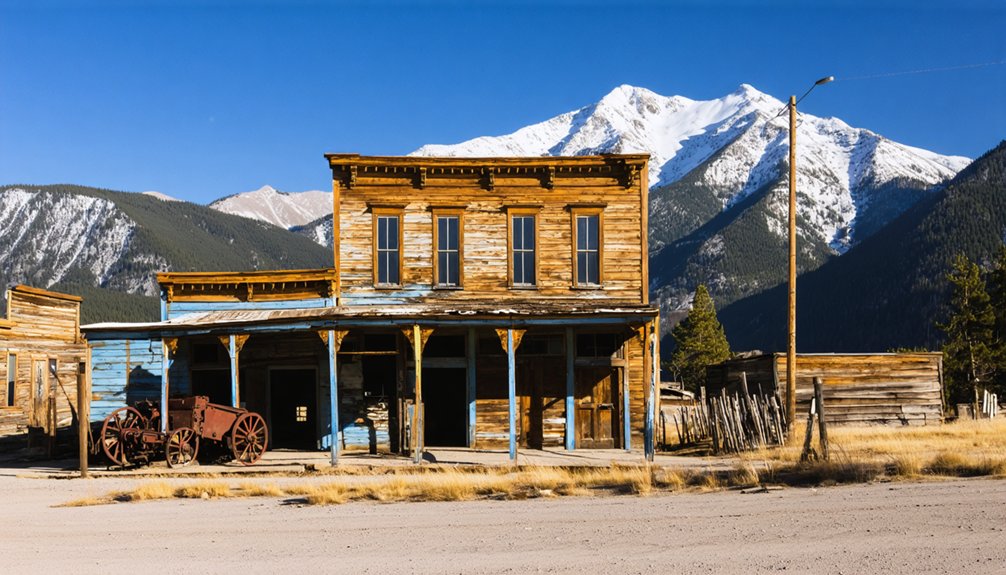
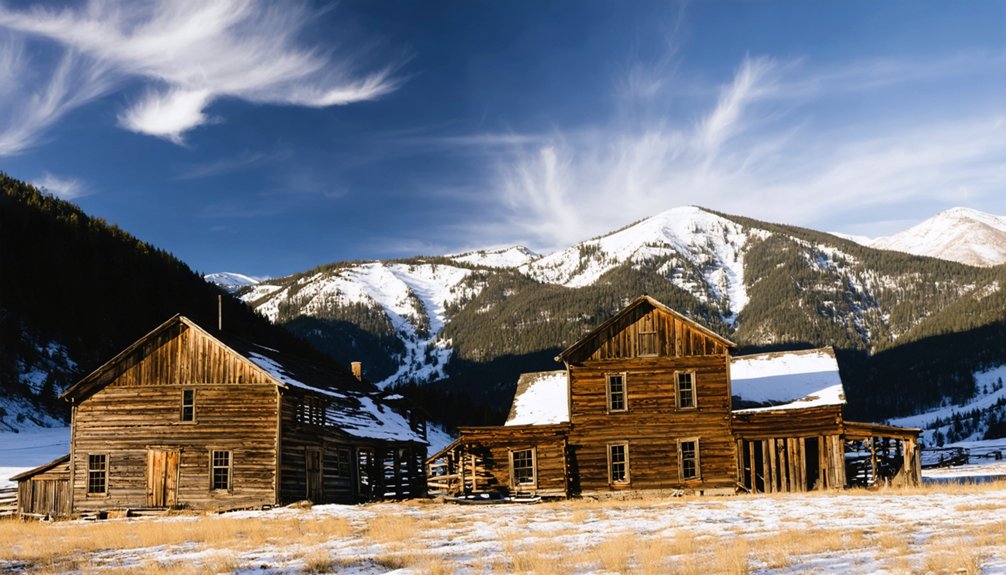
You’ll discover Colorado’s remarkable ghost mining towns scattered across the state’s high country, where silver and gold rushes created thriving communities that reached populations of 2,000 residents before vanishing within decades. St. Elmo, Ashcroft, and Independence represent some of the most preserved examples, with Animas Forks sitting at an extreme 11,200 feet elevation. These boom-and-bust settlements faced harsh winters, avalanches, and economic crashes that transformed bustling mining centers into the haunting remnants you can explore today.
Key Takeaways
- St. Elmo and Ashcroft were major silver mining boom towns that peaked at 2,000 residents each during the 1880s.
- Animas Forks, located at 11,200 feet elevation, faced extreme winters with 25-foot snow depths and devastating avalanches.
- Independence became Colorado’s highest mining town at 10,900 feet before declining rapidly when shallow veins were exhausted.
- Ashcroft transformed from prosperity to ghost town when residents migrated to Aspen after the 1884 silver strike.
- Vicksburg and Winfield serve as preserved twin ghost towns showcasing Colorado’s classic boom-and-bust mining cycles.
St. Elmo: From Forest City to Mining Boom
When prospectors Abner Wright and John Royal struck silver in Chalk Creek Canyon‘s Mary Murphy Mine in 1875, they launched what would become one of Colorado’s most storied mining districts.
You’ll find St. Elmo history began as Forest City near the mine site in the late 1870s. Griffith Evans surveyed the settlement in spring 1880 through six feet of snow, renaming it St. Elmo after postal objections.
The Denver South Park & Pacific Railroad’s arrival in 1880 transformed everything.
By 1881, you’d witness the Mary Murphy Mine’s peak production—extracting 70-100 tons of ore daily while employing over 250 men. Advanced mining techniques included mountaintop trams hauling 75 tons daily to Alpine smelters.
At its 1881 peak, the Mary Murphy Mine extracted up to 100 tons of ore daily with over 250 workers.
The town’s population swelled to nearly 2,000 residents during the silver rush‘s prime years. St. Elmo featured sawmills, hotels, and a newspaper during its bustling heyday. The mining district encompassed 150 patented claims throughout the surrounding area, though few beyond the major operations proved profitable.
Animas Forks: High Altitude Hardships and Avalanches
You’ll find Animas Forks perched at an extraordinary 11,200 feet above sea level in the San Juan Mountains, making it one of Colorado’s highest mining settlements.
The town’s extreme elevation subjected residents to brutal winters with snow depths exceeding 25 feet, forcing them to construct connecting tunnels between buildings for survival.
This harsh alpine environment proved devastating in March 1877 when a massive avalanche destroyed the San Juan smelting works, sawmill, and three cabins, causing $30,000 in damages. Despite these challenges, the settlement thrived during its peak in the 1880s when over 450 summer residents called this remote mountain town home.
The community achieved significant infrastructure development when Otto Mears built a crucial toll road in 1877, connecting Animas Forks with neighboring mining towns and improving access to this isolated high-altitude settlement.
Extreme Elevation Challenges
Perched at an extraordinary 11,200 feet above sea level, Animas Forks stands as one of the highest mining settlements ever established in the American West.
You’ll find this ghost town sits more than two miles above sea level, where elevation sickness challenged every newcomer who dared to establish roots in this rugged terrain.
The mining challenges at such extreme altitude proved relentless. Workers battled thin air while extracting ore, and the 1884 blizzard dumped 25 feet of snow during a 23-day storm.
You’d have needed tunnels between buildings just to survive winter’s grip. By fall, residents routinely fled to Silverton’s lower elevations, acknowledging that nature’s harsh realities at 11,200 feet made year-round habitation nearly impossible for all but the most determined souls. The devastating 1877 snow slide destroyed the San Juan smelting works, saw mill, and cabins, causing losses estimated at $30,000. Today, this remote location draws over 100,000 visitors annually who come to explore its haunting remains and experience the challenges of high-altitude exploration.
Natural Disaster Impact
Beyond the constant battle against thin air and extreme cold, Animas Forks faced an even more devastating threat from the mountains themselves.
In March 1877, a massive avalanche released catastrophic destruction across the settlement. The snow slide obliterated the San Juan smelting works, destroyed the saw mill, and demolished three cabins in a single devastating event. Property losses reached $30,000—a staggering sum that crippled the town’s industrial foundation.
You’d find survival at 11,200 feet meant adapting to snow depths exceeding 25 feet each winter. Residents carved tunnels connecting buildings to navigate their buried community during months of winter isolation. Despite these challenges, the community’s mining and processing mills continued to fuel growth through the early 1880s.
The steep terrain and exposed location in the Animas River forks amplified these dangers, making avalanche destruction an ever-present threat that ultimately contributed to the town’s abandonment by the 1920s.
Ashcroft: The Silver Rush That Rivaled Aspen
You’ll discover that Ashcroft’s silver boom transformed a remote valley into Colorado’s most explosive mining success story within just three years.
The town’s population swelled to 2,000 residents by 1883, actually surpassing nearby Aspen’s size during its peak prosperity. Originally founded by prospectors Charles B. Culver and W.F. Coxhead in 1880, the settlement quickly established the infrastructure of a thriving mining community.
However, you’ll find that shallow silver deposits and Aspen’s subsequent rise led to Ashcroft’s rapid abandonment, leaving behind one of Colorado’s most well-preserved ghost towns. The town’s historical significance was officially recognized when Ashcroft became a Nationally Registered Historic Site in 1974.
Rapid Silver Boom Growth
When prospectors Charles B. Culver and W.F. Coxhead struck silver in Castle Creek Valley during 1880, you’d witness one of Colorado’s most spectacular mining frenzies unfold. Their initial silver ore yielded an astounding 14,000 ounces per ton, igniting a five-year boom that transformed the wilderness into a bustling hub.
You’d see the camp evolve from Castle Forks City into Ashcroft by 1882, complete with thirteen saloons serving thirsty miners.
The mining frenzy attracted hundreds of fortune-seekers who quickly established a courthouse, laid out streets, and formed a Protective Association. By 1883, this remote silver camp reached its population peak of about 2,000 residents, actually surpassing nearby Aspen in size.
You’d observe Ashcroft functioning as the transportation center for the upper valley’s mining operations. H.A.W. Tabor’s involvement in the Montezuma and Tam O’Shanter Mines brought additional investment and prestige to this remote silver camp.
Peak Population Surpasses Aspen
By 1883, Ashcroft’s population had swelled to approximately 2,000 residents, making it larger than neighboring Aspen during the height of Colorado’s silver rush.
You’d witness intense population dynamics as prospectors flooded the remote mountain settlement, drawn by silver deposits yielding 14,000 ounces per ton.
Mining rivalries between the two camps intensified when Ashcroft’s summer population peaked around 2,500, while the town boasted superior infrastructure including six hotels, twenty saloons, two newspapers, and telegraph service.
Ashcroft’s strategic location closer to Crested Butte’s railroad gave it competitive advantages over Aspen until 1887.
However, the 1884 silver strike in Aspen shifted fortune’s favor. Railroad developers ultimately chose Aspen, triggering mass migration from Ashcroft.
This decision sealed Ashcroft’s fate, transforming a thriving metropolis into today’s ghost town.
Exodus and Abandonment
As shallow ore veins exhausted their promise by 1883, Ashcroft’s meteoric rise crumbled with devastating swiftness.
You’d witness mining decline accelerate as profitable operations ceased, leaving hundreds without work or purpose. The promised rail line to Crested Butte never materialized, crushing hopes for sustained commerce.
An economic shift struck the final blow when Aspen’s rich silver discovery in 1884 drew investors and workers away.
You’d see entire families loading cabins onto wagons, literally moving their homes fifteen miles downvalley. The Denver & Rio Grande Railroad’s 1887 route to Aspen cemented this exodus.
Alta: Gold Mining Legacy in the San Juan Mountains
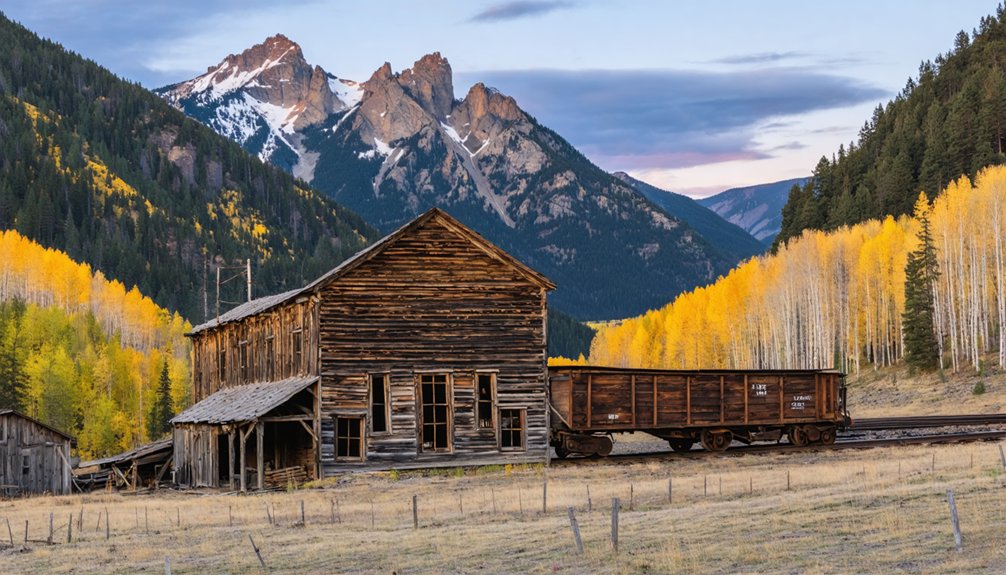
High in the rugged San Juan Mountains at nearly 12,000 feet, three prospectors—Pat Cullen, Frank Dimik, and Thomas Knott—struck gold when they discovered the Alta vein in Gold King Basin during 1877.
Jack Mann’s Gold King mine followed in 1878, launching operations that’d span seven decades.
You’ll find Alta mining operations weren’t ordinary. Engineers carved the highest Alta Lake and installed mile-long pipelines, while the town became Colorado’s first to harness Tesla’s AC transmission system.
The 1898 Black Hawk tunnel stretched 9,000 feet into Silver Mountain, intersecting multiple veins.
Alta’s historical significance peaked with a two-mile aerial tramway constructed in 1909, dropping 1,800 feet to Ophir Loop.
The mines produced over $5 million in ore before devastating fires ended operations in 1948.
Vicksburg and Winfield: Twin Towns of Clear Creek Canyon
Twenty-four years after Colorado’s initial gold rush, prospectors ventured into Clear Creek Canyon‘s remote reaches in 1861, setting the stage for two remarkable mining settlements.
Vick Keller established Vicksburg around 1867 after Leadville miners discovered promising float in the creek. The 1879 silver boom transformed Vicksburg into a thriving community of 600-700 residents with forty buildings, including hotels, saloons, and essential services. Vicksburg history reflects Colorado’s classic boom-and-bust mining cycles.
Four miles deeper into the canyon, Winfield’s townsite emerged in 1881, eventually housing 1,500 people by 1890.
Winfield significance stems from its complete preservation as a ghost town after the 1893 silver crash ended habitation. Today, you’ll find both settlements accessible via County Road 390, offering authentic glimpses into Colorado’s mining heritage through preserved buildings and outdoor museums.
Independence: Gateway to the Roaring Fork Valley
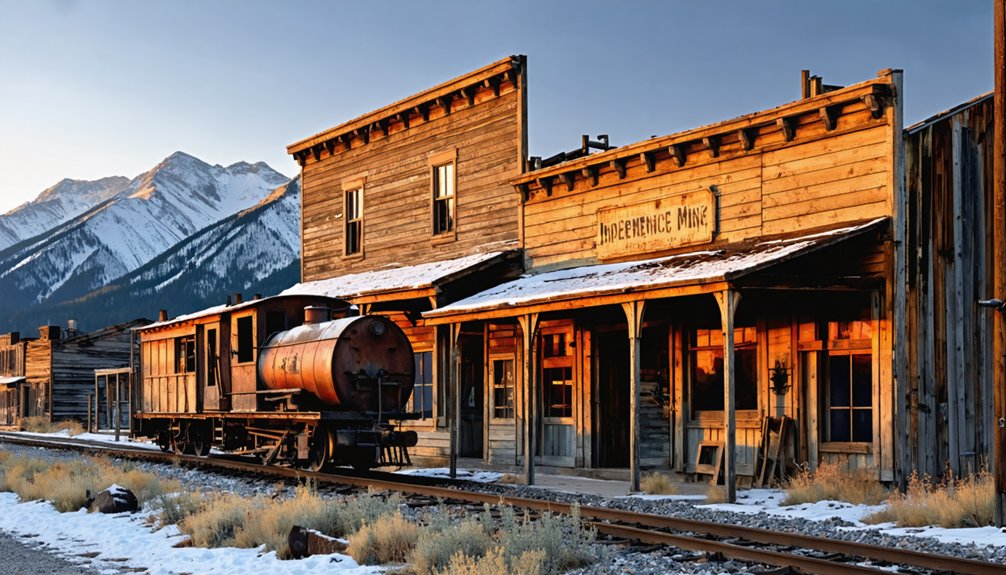
Three prospectors struck gold on America’s Independence Day in 1879, discovering the Independence Gold Lode that would transform a remote tent camp into Colorado’s highest mining town.
You’ll find this remarkable Independence history unfolding at 10,900 feet elevation, where determined miners built the Roaring Fork Valley’s first settlement despite brutal conditions.
By 1882, you’d witness 1,000 residents supporting 40 businesses along Aspen Avenue. The Farwell Gold Mill processed ore from multiple claims, generating $190,000 during peak years.
At its peak, Independence bustled with 1,000 residents and 40 thriving businesses while the Farwell Mill generated substantial wealth.
However, shallow veins meant quick exhaustion—production plummeted to $2,000 by 1883.
Today, you can explore this preserved mining legacy via Highway 82, discovering authentic structures and interpretive trails.
Independence’s gateway position launched valley exploration, establishing the foundation for Aspen’s later silver boom.
Frequently Asked Questions
Are Any of These Ghost Towns Safe to Visit Year-Round?
You can visit St. Elmo and Ashcroft year-round with proper preparation, though ghost town safety requires avoiding all buildings. Year round accessibility depends on road conditions and winter weather challenges at high altitudes.
Can Visitors Still Find Gold or Silver in These Abandoned Areas?
Your treasure hunting dreams won’t strike it rich through gold panning in these picked-over sites. Historical records show complete depletion by the 1920s, leaving only educational artifacts for modern visitors exploring Colorado’s mining heritage.
Which Ghost Town Offers the Best Preserved Buildings for Photography?
St. Elmo offers you the best preserved buildings for photography with 43 original structures featuring authentic 1880s wood-frame architecture. You’ll capture detailed storefronts, building details, and dusty streets perfect for photography tips.
Do Any of These Towns Have Guided Tours Available?
You’ll discover extensive tour availability across Colorado’s ghost towns. Guided experiences range from Ouray’s high-altitude jeep adventures to Central City’s underground mine explorations, Aspen’s archaeological walks, and Breckenridge’s supernatural encounters.
What Should Visitors Bring When Exploring These Remote Mining Sites?
You’ll need exploration essentials like hard hats, steel-toed boots, and flashlights for safety gear. Pack three days’ water, food, maps, and first-aid supplies since these isolated sites lack cell service and emergency access.
References
- https://www.denver7.com/news/local-news/colorado-ghost-towns-their-past-present-and-future-in-the-rocky-mountains
- https://thedyrt.com/magazine/local/colorado-ghost-towns/
- https://en.wikipedia.org/wiki/List_of_ghost_towns_in_Colorado
- https://www.coloradolifemagazine.com/blog/post/11-colorado-ghost-towns
- https://www.colorado.com/articles/colorado-ghost-towns
- https://alissapeterson.com/blog/discover-the-spookiest-colorado-ghost-towns
- https://www.uncovercolorado.com/ghost-towns/
- https://westernmininghistory.com/state/colorado/
- https://westernmininghistory.com/towns/colorado/st-elmo/
- https://www.historynet.com/ghost-town-st-elmo-colorado/