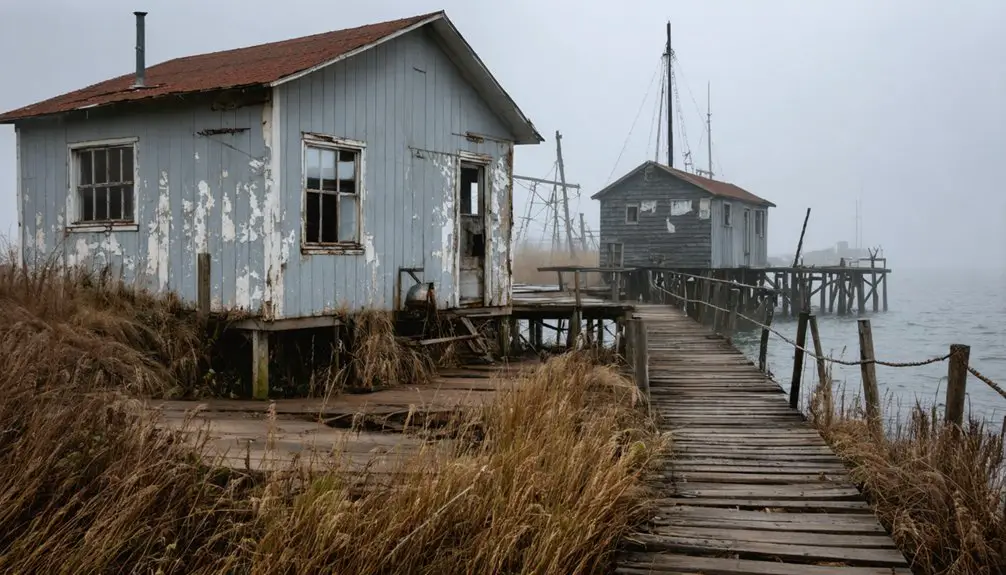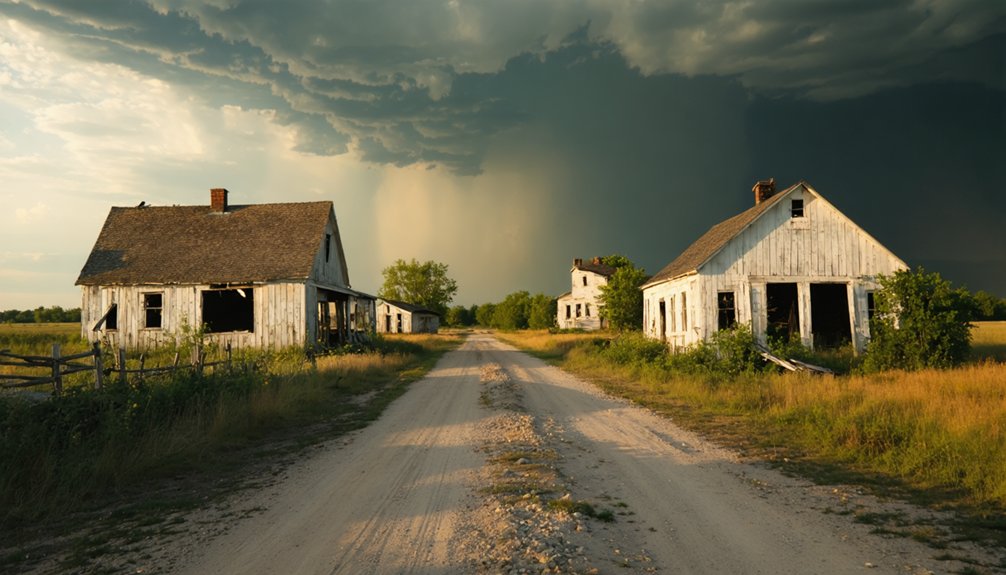
Dover, Wisconsin is a ghost town that barely left a trace. Founded in 1844 by British settlers, it thrived briefly before the railroad chose nearby Mazomanie as its depot, and the town vanished by 1870. Today, you’ll find only a roadside marker along Highway 14 and a quiet, weathered cemetery. Pack your camera, drive east from Arena, and if you want to make the most of your trip, there’s plenty more to uncover ahead.
Key Takeaways
- Dover, Wisconsin, founded in 1844, was abandoned by 1870 after the Milwaukee Road railroad chose Mazomanie over Dover as its depot.
- The site sits along Highway 14, roughly halfway between Arena and Mazomanie, marked by a historic roadside marker.
- No structures remain; only a small cemetery and roadside marker exist as remnants of the former settlement.
- Bring water, a camera, insect repellent, sturdy shoes, and a first aid kit, as no nearby services exist.
- Fall is the best season to visit, offering comfortable temperatures, scenic views, and favorable photography conditions.
What Was Dover, Wisconsin?
Before Wisconsin even became a state, Dover was already taking shape. Founded in 1844 within the Wisconsin Territory, this small but ambitious town attracted nearly 700 settlers from the British Temperance and Emigration Society in Liverpool, England. You’d have found saloons, hotels, blacksmith shops, general stores, and even copper mines within its borders.
Dover thrived briefly, representing genuine frontier promise. However, when the Milwaukee Road railroad chose nearby Mazomanie over Dover as its depot site, families packed up and left.
By 1870, Dover’s population had dropped to zero.
Today, historical preservation efforts include a roadside marker and a small cemetery — the town’s only surviving remnants. For travelers seeking unique tourist attractions beyond the ordinary, Dover offers something rare: an entire community reclaimed by silence and time.
How One Railroad Decision Erased Dover From the Map
When the Milwaukee Road railroad bypassed Dover in favor of nearby Mazomanie, it didn’t just redirect a train line — it redirected the entire future of a community. Railroad history is filled with these defining moments, and Dover’s story is one of the starkest examples of town abandonment you’ll find anywhere in Wisconsin.
Once the depot went to Mazomanie, families packed up and followed the opportunity. Saloons, hotels, blacksmith shops, general stores — all of it vanished within years. Copper mining couldn’t compensate for losing direct rail access.
By 1870, Dover’s population had dropped to zero.
You’re fundamentally standing at the intersection of ambition and economic reality when you visit. One railroad decision dismantled everything those 700 British settlers had built from scratch.
What’s Left at the Dover Site Today
After 150 years of neglect, Dover doesn’t offer much in regards to visible remains — but what’s there carries real weight. You won’t find abandoned structures or historical artifacts scattered across the landscape. The town erased itself quietly, leaving almost nothing behind.
What you’ll find is a small cemetery with a few graves, silent markers of lives once rooted here. A historic roadside marker stands halfway between Arena and Mazomanie, giving you the full story of Dover’s rise and rapid collapse.
Bring your camera. The open rural setting creates a striking backdrop, and the marker itself photographs beautifully. You’re fundamentally reading history from a field — no buildings, no foundations, just land that once held an entire community’s ambitions.
How to Find the Dover Historic Marker
You’ll find the Dover historic marker sitting right along the highway, roughly halfway between Arena and Mazomanie.
If you’re coming from Arena, head east about two miles and keep your eyes open, since the marker appears quickly.
Pull off carefully onto the road’s shoulder, as there’s no dedicated parking lot, and you’ll have a clear view of the sign without blocking traffic.
Marker Location On Highway
Finding the Dover historic marker is straightforward once you know where to look: it sits along the highway roughly halfway between Arena and Mazomanie in southwestern Wisconsin. Local legends surrounding Dover’s mysterious disappearance make this stop genuinely compelling, not just a roadside curiosity.
Follow these steps to reach it efficiently:
- Head east from Arena approximately two miles along the main highway.
- Watch for the historic marker on the roadside before reaching Mazomanie.
- Pull over safely and read Dover’s documented history, separating fact from fiction.
- Walk nearby to explore cemetery history, where a few graves silently mark where nearly 700 settlers once built their lives.
You’re standing where a thriving community existed, then vanished. That kind of raw, documented history hits differently than any legend ever could.
Starting your approach from Arena makes the whole trip feel intentional rather than accidental. Head east on Highway 14, and you’ll cover roughly two miles before spotting the historic marker on your right.
It stands as a quiet tribute to historical preservation, marking ground where nearly 700 British settlers once built something real.
Don’t rush past it. Pull over, read the marker, and let the silence do its work. Local legends sometimes blur Dover’s story with fictional places, but standing here grounds you in documented truth.
You’re looking at actual history, not folklore.
From Arena, the drive is straightforward and rural, so keep your tank full and your camera ready. The marker won’t find you — you’ve got to seek it out deliberately.
Parking Near The Marker
Once you’ve pulled off Highway 14, parking is straightforward — the shoulder widens near the marker, giving you enough room to stop safely without blocking traffic. There aren’t any formal visitor amenities here, so you’re exploring this stop independently, which suits the spirit of ghost town exploration perfectly.
Keep these parking tips in mind before you arrive:
- Pull completely onto the gravel shoulder to stay clear of passing vehicles.
- Turn on your hazard lights if you’re stopping for extended photography.
- Avoid parking during poor visibility conditions like fog or heavy rain.
- Leave no trace — pack out everything you bring.
The site rewards self-sufficient travelers who come prepared. Bring water, a charged phone, and your camera, because no services exist nearby.
Why Dover Is Worth the Drive
Though little remains of Dover beyond a few graves and a historic marker, the drive itself makes the journey worthwhile. Rolling through Arena and Mazomanie, you’ll pass landscapes that haven’t changed much since 700 British settlers first carved a life here in 1844.
Little remains of Dover, but the drive through Arena and Mazomanie makes every mile worthwhile.
Dover rewards curious travelers who appreciate history without velvet ropes or admission fees. You move at your own pace, read the marker on your terms, and photograph what you find.
Local legends surrounding the town add mystery to an already compelling story, while quiet preservation efforts guarantee the cemetery and marker remain accessible.
This isn’t a polished tourist destination — it’s raw, honest history sitting roadside in rural Wisconsin. That freedom to discover it yourself is exactly what makes Dover worth the drive.
Ghost Towns Near Dover Worth the Detour
Dover doesn’t have to be your only stop. Wisconsin’s backroads hide several ghost towns that reveal the same railroad impact and historical myths that shaped Dover‘s fate. Each site tells a raw, unfiltered story of ambition and abandonment.
Extend your road trip with these nearby stops:
- Mazomanie – Two miles east, this town absorbed Dover’s displaced residents after the railroad chose it over Dover.
- Cooksville – Rock County’s preserved 19th-century village, founded by John Cook, offers rare standing structures.
- Fort Crawford – A military outpost frozen in frontier history near Prairie du Chien.
- Fort Howard – Another abandoned military settlement layered with documented colonial-era significance.
Each destination rewards the curious traveler willing to navigate rural roads independently.
What to Pack for the Dover Road Trip
Packing smart makes the difference between a frustrating rural detour and a rewarding ghost town experience. Dover’s site offers no services, so you’ll need to bring everything yourself. Load up on water, snacks, and a printed or downloaded map since cell service gets spotty along rural Wisconsin roads.
Your packing essentials should include sturdy walking shoes, insect repellent, and a first aid kit. The terrain around the cemetery and historic marker is uneven and overgrown in spots.
Don’t forget your photography gear. The weathered graves and open countryside create striking compositions worth capturing properly. Bring a wide-angle lens, extra batteries, and a tripod for low-light shots near dusk.
A notebook helps you record marker inscriptions before they fade from memory entirely.
The Best Time of Year to Visit Dover
Once your gear is packed and ready, knowing when to make the drive matters just as much as what you bring. Dover’s rural setting rewards visitors who choose their timing wisely.
Timing your visit matters just as much as packing the right gear — Dover rewards those who plan wisely.
- Spring (April–May): Mild weather conditions make rural roads accessible after winter thaw.
- Summer (June–August): Long daylight hours give you maximum time for photography and exploration.
- Fall (September–October): Seasonal foliage transforms the landscape, adding dramatic color to cemetery and marker shots.
- Winter (November–March): Harsh weather conditions create icy, unpaved roads that can cut your trip short.
Fall remains the strongest choice overall. The seasonal foliage frames the historic marker beautifully, and cooler temperatures keep the experience comfortable.
Check local forecasts before you leave, and you’ll own every mile of that road.
Frequently Asked Questions
Is Dover, Wisconsin Ever Confused With the Mythical Town Called Doveland?
Yes, you’ll find that Dover’s real history often gets tangled with Doveland’s local folklore. Unlike that mythical town, Dover boasts authentic historic landmarks and documented roots, so don’t let conspiracy theories cloud your adventurous exploration!
What Conspiracy Theories Are Associated With Doveland, and How Do They Differ?
You’ll find Doveland’s conspiracy theories involve urban legends like sinkholes, mass hallucinations, and secret societies conducting Project Sanguine experiments. Unlike Dover’s documented history, these wild theories fuel speculation about a fictional military town that mysteriously vanished.
Were the Original Dover Settlers Part of a Temperance Movement Organization?
Coincidentally, yes! The Dover settlers you’re curious about actually came from the British Temperance and Emigration Society in Liverpool, England. Nearly 700 members of this temperance movement organization made Dover their new home in 1844.
Did Copper Mining in Dover Ever Produce Significant Commercial Quantities of Copper?
You won’t find records of copper mining history yielding major commercial significance in Dover. While mines initially supported the town, they couldn’t sustain it long-term, and the railroad’s bypass ultimately sealed Dover’s fate before mining ever truly flourished.
Are There Any Guided Tours Available for Visiting the Dover Ghost Town Site?
You’ll explore Dover entirely on your own — guided tour options simply don’t exist here. Your visitor experience is yours to craft freely, maneuvering rural roads independently, capturing haunting cemetery photos, and uncovering this remarkable ghost town’s forgotten history yourself.
References
- https://www.frrandp.com/2020/03/a-town-bypassed-dover-wisconsin.html
- https://usghostadventures.com/haunted-stories/the-legend-of-doveland-wisconsin-the-vanishing-town/
- https://www.facebook.com/groups/333827440359540/posts/1584610491947889/
- https://www.youtube.com/watch?v=fvvWrzRaTQU
- https://www.youtube.com/watch?v=kG-k_9O1OTE
- https://en.wikipedia.org/wiki/List_of_ghost_towns_in_Wisconsin