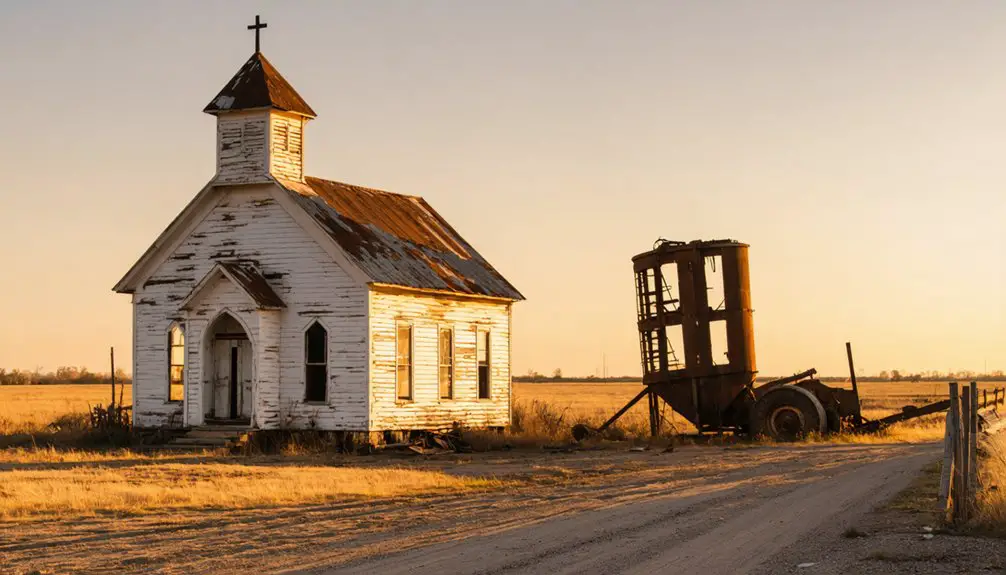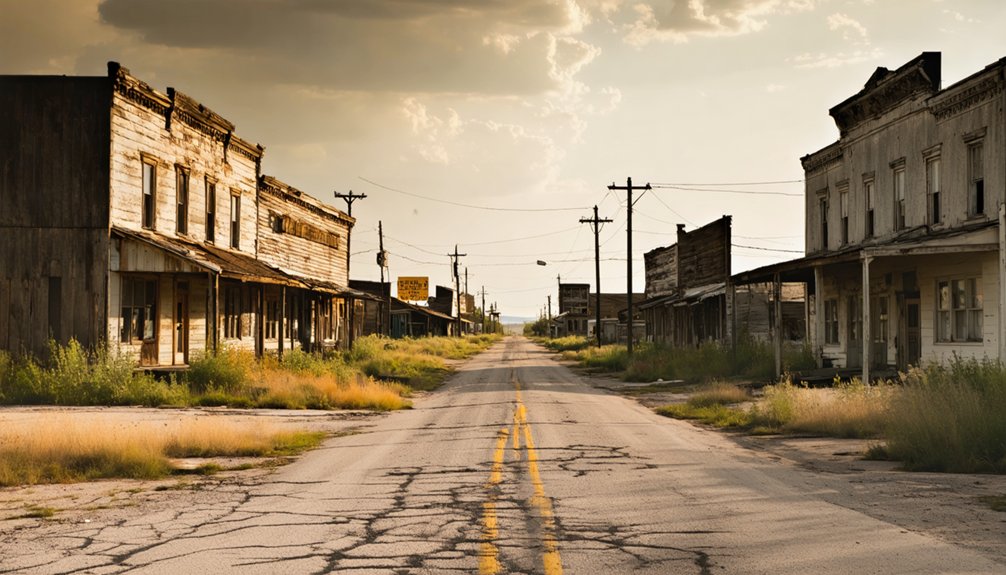
Foraker, Oklahoma is a true ghost town with only 18 residents left after the railroad shut down in 1968. To get there, you’ll drive about 25 miles from Pawhuska via rural County Road N3610 through rolling Osage County prairie. Fuel up before you leave — there’s no gas, food, or cell signal out here. Bring offline maps, pack supplies, and expect unpaved roads. Everything you need to plan a respectful, memorable visit is ahead.
Key Takeaways
- Foraker, Oklahoma, once home to 415 residents, is now a remote ghost town with roughly 18 residents and no available services.
- Drive approximately 25 miles from Pawhuska via County Road N3610, navigating rural, unmarked roads through Osage County’s rolling prairie landscape.
- Fuel up, pack food and water, and download offline maps before departing, as Foraker has no gas stations or cell signal.
- Spring and fall are the best seasons to visit, offering mild weather and scenic prairie conditions ideal for exploration.
- Respect private property, stay on public roads, and watch for wildlife hazards, especially at dusk and dawn.
Why Foraker, Oklahoma Qualifies as a Ghost Town
Once a thriving rail town of over 400 residents, Foraker, Oklahoma has dwindled to just 18 people — and that’s precisely what earns it the ghost town label.
When the Midland Valley Railroad abandoned its line in 1968, it took the town’s economic heartbeat with it. Before that, local history tells a story of agricultural booms, oil shipping, and a bustling downtown that simply vanished once the trains stopped running.
Today, you’ll find sparse streets, scattered residences, and a quiet that speaks louder than words. The scenic views of rolling Osage County prairie surrounding the town add an almost cinematic quality to its abandonment.
Foraker isn’t technically deserted, but its commercial life is gone — and that hollow stillness is exactly what ghost town road trippers chase.
How to Drive to Foraker From Pawhuska
Start your drive in Pawhuska, the closest town with reliable services and easy highway access.
From there, you’ll head approximately 13 miles north and 12 miles west, traveling County Road N3610 through Osage County’s rolling prairie landscape.
Keep your gas tank full and your map handy, since rural roads and sparse signage can make the route tricky to follow.
Starting Point In Pawhuska
Pawhuska serves as your natural launching point for the drive to Foraker, sitting roughly 13 miles southeast of the ghost town. Stock up on fuel and supplies here before heading into the rural landscape, since Foraker offers no local amenities.
Before leaving Pawhuska, consider these three priorities:
- Fuel your vehicle — no gas stations exist along the route or in Foraker itself.
- Research historical preservation efforts — Osage County archives hold maps and records documenting Foraker’s 1906 layout.
- Honor community memory — locals in Pawhuska can sometimes share firsthand stories about Foraker’s railroad era.
Pawhuska’s position as Osage County’s seat makes it your best resource hub.
Once you’re ready, head northwest along County Road N3610 toward the open plains.
Route Along County Roads
With supplies loaded and your tank full, the drive northwest from Pawhuska to Foraker covers roughly 13 miles of open Osage County road. You’ll head north before cutting west along County Road N3610, where rolling prairie stretches wide in every direction.
There’s a quiet freedom out here that’s hard to find elsewhere.
As you approach Foraker, the sparse street grid and remaining structures hint at historical architecture that once supported a thriving rail community. Local legends surrounding the town’s boom-and-bust cycle add weight to the landscape — you’re driving through a story, not just a road.
Keep your speed measured on rural roads, watch for unmarked intersections, and let the emptiness sink in. Foraker rewards those willing to seek it out deliberately.
What You’ll Actually Find When You Arrive in Foraker?
When you roll into Foraker, don’t expect a preserved downtown or roadside attractions — you’ll find sparse streets, a handful of surviving residences, and a quiet atmosphere that speaks louder than any historic marker.
The town’s skeletal street grid still hints at what a 415-person rail community once looked like, making it easy to mentally reconstruct its early 20th-century footprint.
You’ll also want to stop at Foraker Cemetery, which stands as one of the most tangible connections to the town’s longer human history.
Sparse Streets And Residences
Arriving in Foraker, you’ll notice almost immediately that the streets are sparse and the silence runs deep. The sparse street grid, once designed for a bustling rail town of 415 residents, now hosts just 18 people. Rural landscapes stretch endlessly around you, interrupted only by scattered homes and abandoned structures standing as quiet reminders of busier days.
Here’s what defines the streetscape today:
- Faded residential lots — scattered homes sit well apart from each other, reflecting decades of population loss.
- Vacant commercial spaces — where businesses once thrived along rail lines, empty plots remain.
- Unmarked roads — County Road N3610 connects you through terrain that feels genuinely untouched.
You’re not touring a museum here — you’re moving through living history on your own terms.
Cemetery And Historic Layout
What you’ll actually find when you reach Foraker centers on two things: the cemetery and the ghostly imprint of a town that once had real commercial ambition. The Foraker Cemetery stands as one of the most tangible connections to the community’s past, offering a quiet space where cemetery preservation efforts keep local history visible. Walk the grounds and you’re reading the story of families who built something here.
Beyond the cemetery, the sparse street grid reveals traces of historical architecture that once supported a rail-era economy. A 1906 insurance map confirms Foraker had real structure and scale.
Today, those bones remain faintly readable in the land itself. You’re fundamentally steering through an open-air archive, where the layout speaks louder than any standing building could.
Why Foraker Cemetery Is Worth the Detour
Though Foraker’s commercial district has long gone quiet, the town cemetery gives you a tangible reason to make the detour. It connects you directly to the people who built this once-thriving rail town from the ground up.
Here’s why it deserves a stop on your route:
- Cemetery restoration efforts preserve headstones dating back to Foraker’s early 1900s peak, letting you read the town’s human story firsthand.
- Historical markers provide context about Osage County’s settlement era, grounding the ghost-town atmosphere in real events.
- The burial records reflect Foraker’s demographic shifts, from its 1910 population high of 415 residents down to near-abandonment.
You’ll leave with a sharper sense of what this prairie community once meant and why its quiet streets still carry weight.
No Gas, No Food, No Cell Signal: Planning Your Foraker Visit
Before you turn off the pavement toward Foraker, understand that you’re leaving behind every modern convenience you’d normally take for granted. There’s no gas station, no local cuisine, and no corner store waiting on the other side. Cell signal drops fast once you’re deep into Osage County’s rolling plains.
Fill your tank in Pawhuska or Shidler before heading out. Pack your own food and water — enough for the full day. That self-sufficiency is the trade-off for real freedom: empty roads, open sky, and genuine wildlife viewing across undisturbed prairie.
Download offline maps beforehand and share your route with someone. Foraker rewards the prepared traveler. Show up ready, and the quiet isolation becomes the experience rather than the obstacle.
Osage County Ghost Towns to Pair With Foraker
Foraker holds up well on its own, but Osage County rewards the traveler who strings together a few stops into one deliberate route. The county’s rolling plains hide several forgotten communities worth tracking down, each carrying local legends and faded histories you won’t find on mainstream itineraries.
Hunt down historic photographs before you leave home so you can compare what once stood against what remains.
Consider pairing Foraker with these nearby stops:
- Shidler – The closest town with a post office, offering context for how rural commerce survived where Foraker’s didn’t.
- Pawhuska – Your practical base for fuel and food, plus Osage Nation heritage sites.
- Osage County cemeteries – Scattered burial grounds that document entire vanished communities through names and dates alone.
The Best Season to Visit Foraker and Osage County Ghost Towns
Timing your visit to Foraker and the surrounding Osage County ghost towns can make the difference between a rewarding road trip and a frustrating one. Spring and fall offer the most comfortable conditions for exploring rural roads and absorbing the atmosphere around what remains of Foraker’s historical architecture.
Mild temperatures let you linger without battling summer heat or icy winter roads on County Road N3610. Fall adds golden prairie scenery that sharpens the ghost-town mood considerably.
Summer works if you’re prepared, but the Oklahoma heat can cut your exploration short. Winter visits feel isolating in ways that go beyond the usual ghost-town quiet.
Whatever season you choose, come curious about local legends tied to the railroad era — they add texture to a landscape that history nearly swallowed whole.
Road Conditions and Local Rules to Know Before You Go
Knowing when to visit only gets you so far — you also need to know what you’re driving into. County Road N3610 is a rural route where local road maintenance isn’t always predictable, so check conditions before leaving Pawhuska.
- Watch for wildlife hazards — deer and livestock can appear suddenly on open prairie roads, especially at dusk and dawn.
- Drive a capable vehicle — unpaved stretches can turn rough after rain, and a higher clearance helps you stay mobile and independent.
- Respect remaining private property — Foraker still has residents, so stay on public roads and don’t assume abandoned-looking structures are open to explore.
Fuel up before you leave Pawhuska, since Foraker offers no services and the nearest post office is in Shidler.
Frequently Asked Questions
Who Was Senator James B. Foraker, and Why Was the Town Named After Him?
You’ll find the town’s named after Ohio Senator James B. Foraker, a historical landmark of political history. Local legends suggest his prominence inspired early settlers, honoring his legacy as they built their frontier community.
What Was Foraker’s Economy Like During Its Peak Population Years?
During its peak, you’d have found Foraker thriving on agriculture and oil shipping, fueled by the Midland Valley Railroad. Today, those historic landmarks make it a compelling ghost town tourism destination that’ll spark your sense of adventure.
Are There Any Annual Events or Gatherings Still Held in Foraker Today?
With only 18 residents, you won’t find local festivals or community gatherings in Foraker today. The town’s ghost-town silence defines your visit, offering raw, unfiltered freedom far from crowded events.
Is Foraker Officially Incorporated, or Does It Lack Municipal Government?
You won’t find an active municipal government in Foraker — it lacks official incorporation. Yet you can still explore its historic landmarks, uncover local legends, and feel the liberating spirit of Oklahoma’s open, untamed prairie.
What Happened to the Midland Valley Railroad After It Abandoned the Foraker Line?
Like a train vanishing into the horizon, the Midland Valley Railroad’s abandonment in 1968 left Foraker’s railroad history as a ghost town tourism relic. You’ll find its absence shaped the town’s quiet, forgotten streets forever.
References
- https://www.okhistory.org/publications/enc/entry?entry=FO016
- https://en.wikipedia.org/wiki/Foraker
- https://pt.abcdef.wiki/wiki/Foraker
- https://www.fitzvideo.com/skysurfing2/2013/10/15/cowboy-country-a-flight-to-foraker-oklahoma-by-brian-fitzgerald/
- https://www.ghosttowns.com/states/ok/ok.html
- https://www.okhistory.org/publications/enc/entry?entry=TA008
- https://okgenweb.net/books/other/ghost.htm
- https://ro.abcdef.wiki/wiki/Foraker
- https://www.travelok.com/articles/osage-county-genealogy-resources
- https://www.therockerbox.com/osage_county_ok_ghost_towns.htm