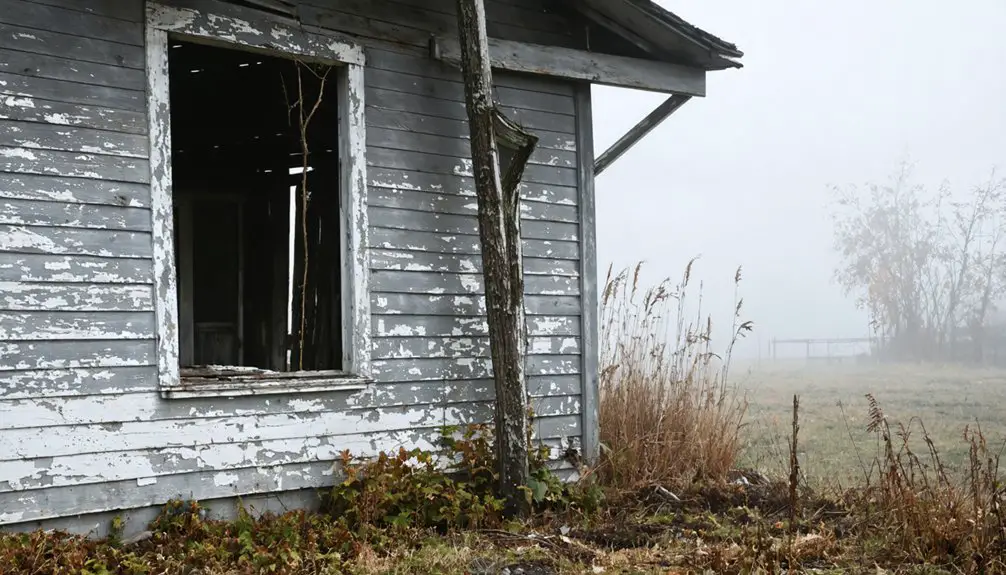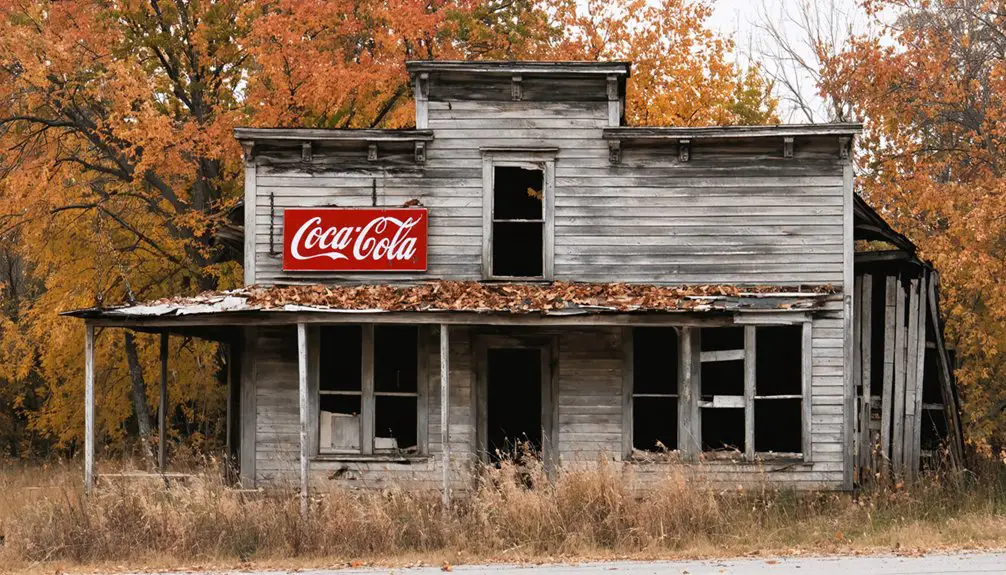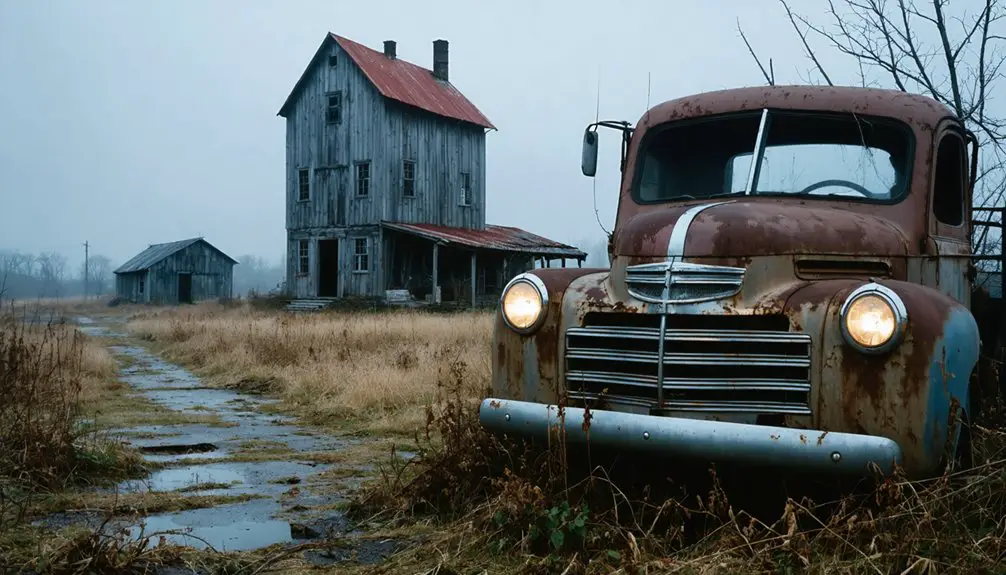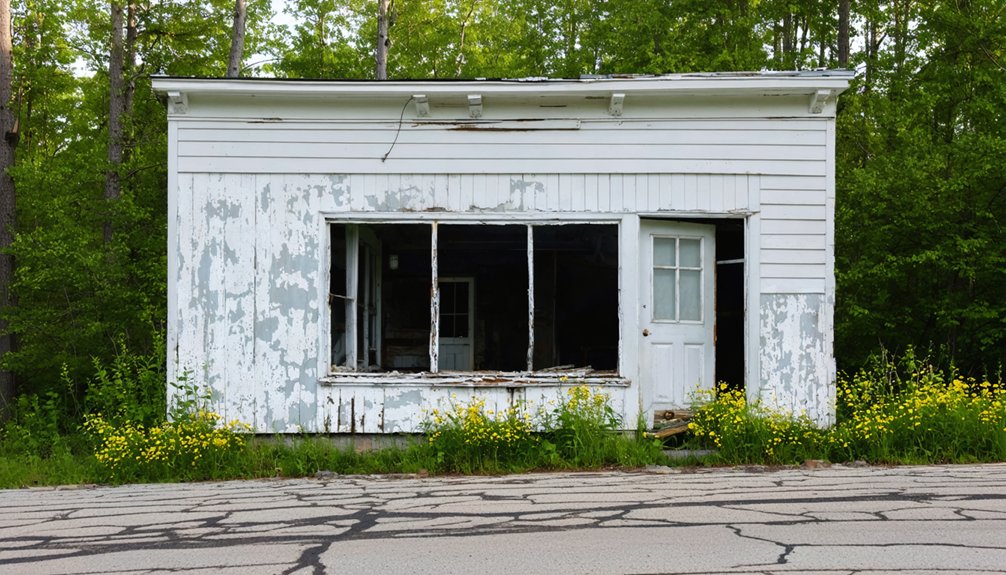
If you’re planning a ghost town road trip, Jennings, Michigan is your destination. Nestled on Crooked Lake’s west shore in Missaukee County, this former lumber boomtown once housed 2,000 residents before timber depletion collapsed the economy around 1905. Today, you’ll find crumbling foundations hidden beneath forest reclamation, quiet roads tracing the old town layout, and scattered remnants of a community built and abandoned within a single generation. There’s far more to this story than meets the eye.
Key Takeaways
- Mitchell, Michigan is a ghost town located on the west shores of Crooked Lake in Missaukee County, accessible via US-131 from Cadillac.
- The town peaked at 2,000 residents during the lumber boom, driven by sawmills and the Cadillac Chemical Company.
- Timber depletion caused collapse around 1905; by the 1930s, only a few residents remained after the sawmill was dismantled in 1922.
- Visitors can explore crumbling foundations and tree-covered lots with no formal preservation, offering an authentic, undisturbed ghost-town experience.
- Extend your road trip to nearby ghost towns Deward and Raber for a fuller picture of Michigan’s lumber-era history.
Why Jennings Is Michigan’s Largest Ghost Town
When you think of ghost towns, you might picture the dusty, tumbleweed-blown streets of the American West — but Michigan has its own haunting version of that story, and Jennings is its largest chapter.
Sitting on the west shores of Crooked Lake in Missaukee County, this former lumber boomtown once housed around 2,000 residents at its peak. You’ll find traces of historical architecture hidden among the trees, where foundations of former homes quietly mark what thriving streets once looked like.
Though preservation efforts remain minimal, the contrast between Jennings’ booming past and its current stillness is exactly what draws ghost-town enthusiasts. It’s not fully abandoned — a handful of residents still live there — but it carries the unmistakable weight of a town that time largely left behind.
Where Jennings Is and How To Get There
You’ll find Jennings sitting on the west shores of Crooked Lake in Missaukee County, roughly west of Lake City and northeast of Cadillac.
If you’re driving from Cadillac, head northeast and you’ll reach the site without much trouble, making it an easy addition to any northern Michigan road trip.
The surrounding region gives you quick access to other lumber-era history, so you can build a full day around the ghost towns that once powered Michigan’s logging boom.
Jennings Location Overview
Tucked along the west shores of Crooked Lake in Missaukee County, Jennings sits in a quiet stretch of northern Michigan that’s easy to miss if you’re not looking for it. You’ll find it west of Lake City and northeast of Cadillac, positioned between two better-known destinations but largely overlooked by passing travelers. That obscurity is part of its appeal.
Local legends tie the area to the Mitchell brothers’ lumber empire, and fragments of historical architecture still emerge from the surrounding woods if you know where to look. The landscape feels deliberately unhurried, offering you the kind of open, uncrowded exploration that’s hard to find elsewhere.
If you value moving at your own pace through forgotten history, Jennings rewards that instinct completely.
Missaukee County Coordinates
Knowing where Jennings sits is one thing; actually getting yourself there takes a bit more deliberate planning. The settlement rests on the west shores of Crooked Lake in Missaukee County, west of Lake City and northeast of Cadillac. Those two anchor towns make solid navigation checkpoints when you’re charting your route.
Local folklore ties the land deeply to Michigan’s logging era, so arriving with that context sharpens everything you’ll observe. Once you reach the Crooked Lake shoreline, you’ll find a quiet landscape where historical preservation efforts — informal as they’re — keep the memory of the old boomtown alive through surviving foundations and scattered remnants.
Pull up a county map, mark your waypoints, and give yourself enough daylight to explore the surrounding woods properly.
Driving Routes Nearby
Getting to Jennings means routing yourself toward Missaukee County, where the settlement sits on the west shores of Crooked Lake. You’ll find it west of Lake City and northeast of Cadillac, making either town a practical base for your approach.
From Cadillac, head northeast along US-131 before cutting east toward the lake. From Lake City, you’re already close — drive west and follow local roads toward Crooked Lake’s shoreline.
Once you arrive, don’t rush. The historical architecture has largely faded, leaving foundations and scattered remnants worth exploring on foot.
Local legends about the lumber era give the quiet landscape a charged atmosphere.
Pairing Jennings with other Missaukee County stops lets you build a fuller road trip around Michigan’s vanished logging communities.
Jennings at Its Peak: Mills, Chemicals, and 2,000 Residents
When you picture Jennings at its height, you’re looking at a town built on the muscle of Crooked Lake’s mills, which drove employment and shaped the entire settlement.
The mills didn’t work alone, though — the Cadillac Chemical Company pulled in hundreds of additional workers to produce charcoal shipped out to Michigan’s smelting plants.
Together, these two industrial forces pushed Jennings to a peak population of around 2,000 residents, making it a genuine boomtown by any measure.
Mills Driving Town Growth
Once the mills started running on Crooked Lake, Jennings didn’t stay small for long. Lumber operations pulled workers in fast, and urban development followed almost immediately. You can picture the pace of it — sawdust in the air, timber moving, and a town taking shape around the demand for labor.
The mills weren’t just cutting wood; they were building an entire economy. Every new structure added to the settlement reflected a community investing in itself, and historical preservation efforts today help you trace those original footprints. Foundations, property lines, and old growth patterns still tell part of that story.
At its height, the mill operations supported a population that climbed toward 2,000 residents — remarkable for a settlement carved out of Michigan’s northern woods.
Chemical Plant Employment Boom
The mills weren’t the only employer pulling people into Jennings. The Cadillac Chemical Company transformed this lumber settlement into a diversified industrial hub, hiring hundreds of workers and shipping charcoal directly to Michigan’s smelting plants.
For a road tripper chasing historical architecture and authentic tourist attractions, understanding this industrial peak explains why Jennings swelled to nearly 2,000 residents. Here’s what that boom actually looked like:
- Hundreds of chemical plant workers flooded the town
- Charcoal production ran alongside active sawmill operations
- Demand supported hotels, doctors, dry goods stores, and a livery stable
- The combined workforce created Michigan’s largest ghost town footprint
That layered economy made Jennings remarkable — and makes its eventual collapse even more striking to witness today.
How the Logging Bust Turned Jennings Into a Ghost Town
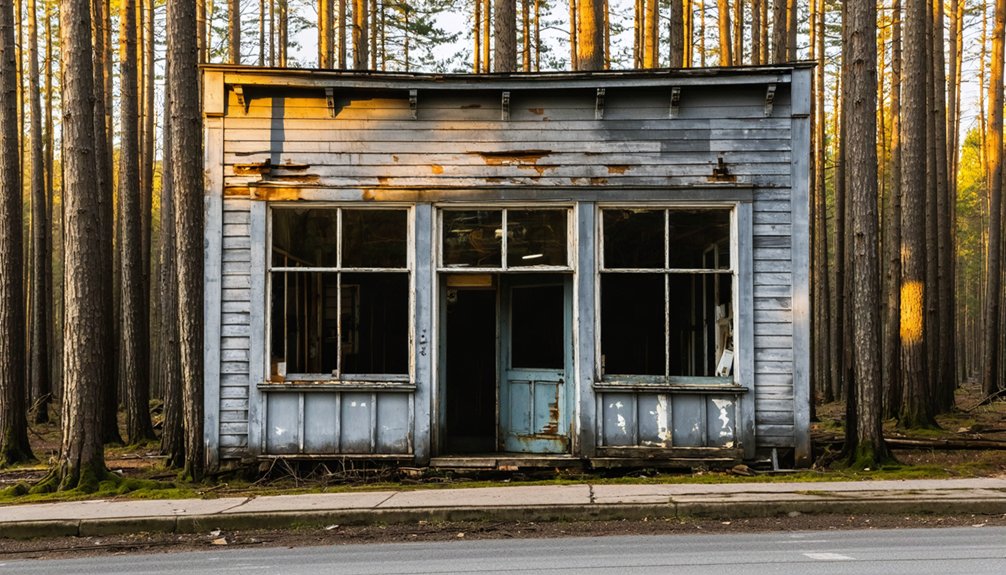
As long as the timber lasted, Jennings thrived—but once loggers stripped the surrounding forests bare, the town’s economy collapsed almost overnight.
By 1905, the population had already fallen from roughly 2,000 residents to around 500. A brief rebound tied to lake ice harvesting and small-timber cleanup pushed numbers back toward 1,200 by 1917, but that recovery didn’t last.
By 1905, Jennings had shrunk from 2,000 to 500 residents—a brief rebound followed, but it never held.
The Mitchell brothers left in 1922, the sawmill came down, and the commercial district quietly disappeared.
By the 1930s, only a handful of residents remained.
Today, historical preservation efforts are minimal, leaving the landscape to speak for itself.
For you as a traveler, that raw, unhurried emptiness is exactly what makes Jennings one of Michigan’s most honest tourist attractions—no reconstruction, just the silence a boomtown leaves behind.
What Survives at Jennings Today: Foundations, Homes, and Quiet Roads
What’s left of Jennings won’t announce itself—you’ll need to look closely. The commercial district is gone, but the landscape still holds evidence of what stood here during the lumber boom.
Historical preservation isn’t formal here; it’s accidental, written in crumbling foundations and tree-swallowed lots.
Here’s what you can still find:
- Stone and brick foundations hidden in surrounding woods
- Scattered residential structures mixed among newer summer homes
- Quiet roads tracing the original town grid
- Crooked Lake’s western shoreline, unchanged since the Mitchell era
Modern restoration hasn’t touched Jennings much, which makes it feel raw and honest. You’re not walking through a curated exhibit—you’re reading a landscape that the forest is slowly reclaiming on its own terms.
Other Michigan Ghost Towns Near Jennings Worth the Detour
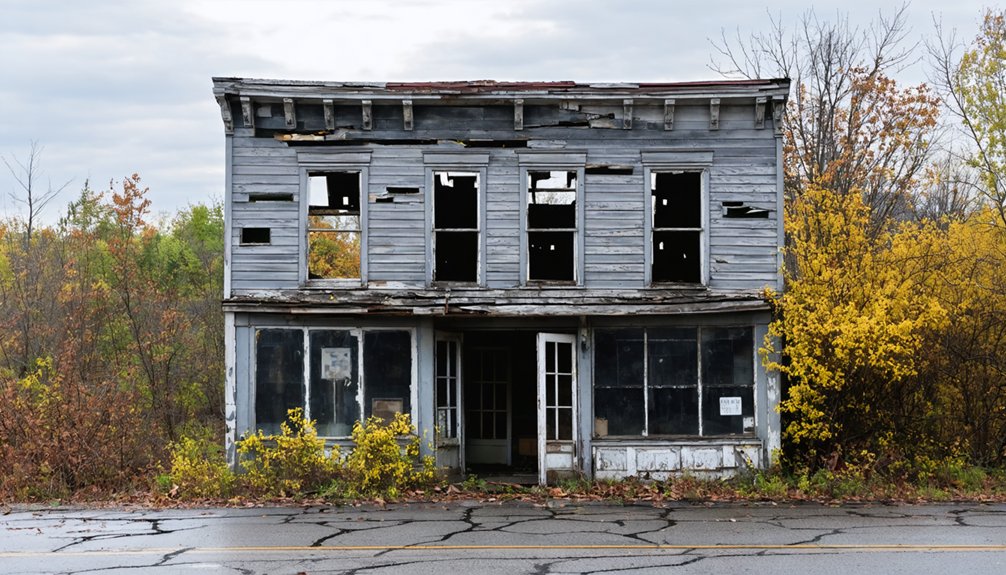
Jennings sits in the heart of a region that the logging era built and then quietly abandoned. So if you’re already making the drive to Missaukee County, it makes sense to extend the trip and chase a few more ghost towns scattered across northern Michigan’s lumber belt.
Towns like Deward in Kalkaska County and Raber up near the Upper Peninsula carry their own local legends of boom-and-bust cycles that mirror Jennings almost exactly. Deward still offers fragments of historic architecture and cellar holes tucked into second-growth forest.
Each stop rewards curious travelers willing to leave the main road behind. Together, these sites paint a fuller picture of how Michigan’s lumber economy shaped, populated, and ultimately emptied entire communities within a single generation.
Frequently Asked Questions
Is Jennings on Private Property or Open to the Public?
The knowledge doesn’t clarify private property or access restrictions for Jennings, so you’ll want to research current land ownership before you wander those quiet, foundation-scattered woods to make sure you’re exploring freely and legally.
Are There Guided Ghost Town Tours Available Near Jennings?
No guided tours are confirmed near Jennings, but you’ll find local historians who’ll share haunted legends and ghostly stories. You’re free to explore independently, soaking in the eerie lumber-era atmosphere at your own pace.
What Is the Best Time of Year to Visit Jennings?
Like nature revealing forgotten secrets, summer’s your best bet—you’ll find clear photography opportunities among Jennings’ remaining foundations and woods. Fall’s golden hues enhance historical preservation efforts beautifully, letting you freely explore this haunting lumber-era landscape at your own pace.
Are There Accommodations or Camping Near the Jennings Ghost Town Site?
You’ll find camping amenities at nearby Lake City campgrounds, where you can explore Jennings’ historic preservation efforts by day. The area’s natural freedom lets you immerse yourself fully in Michigan’s fascinating lumber-era ghost town experience.
Can You Combine a Jennings Visit With Other Missaukee County Attractions?
You’ll easily combine Jennings with Missaukee County’s other attractions. Explore Lake City’s historical preservation sites, chase local legends through nearby trails, and embrace the freedom of discovering Michigan’s lumber-era past across one adventurous, unforgettable road trip.
References
- https://99wfmk.com/jennings-2021/
- https://www.nailhed.com/2017/10/the-ghost-town-that-moved.html
- https://www.facebook.com/groups/upperpeninsulatravel/posts/27227387356862412/
- https://en.wikipedia.org/wiki/List_of_ghost_towns_in_Michigan
- https://wrkr.com/this-lost-village-near-lake-city-michigan-is-the-largest-ghost-town-in-the-state/
- https://www.nps.gov/slbe/learn/historyculture/ghosttowns.htm
- https://books.google.com/books/about/Ghost_Towns_of_Michigan.html?id=3dzhAAAAMAAJ
- https://99wfmk.com/jenningsghosttown2018/
- https://privatelandswildlife.com/ghost-towns-michigan/