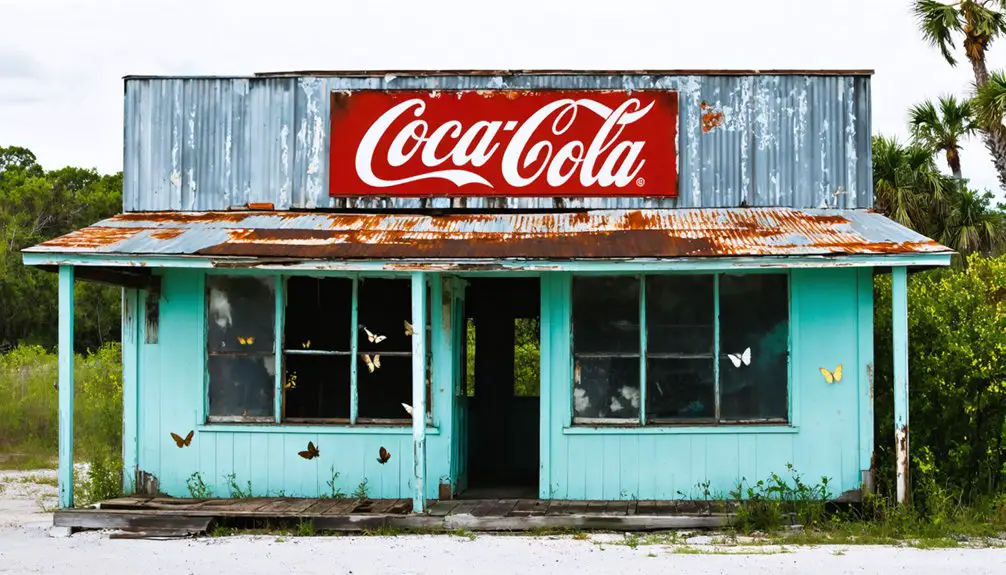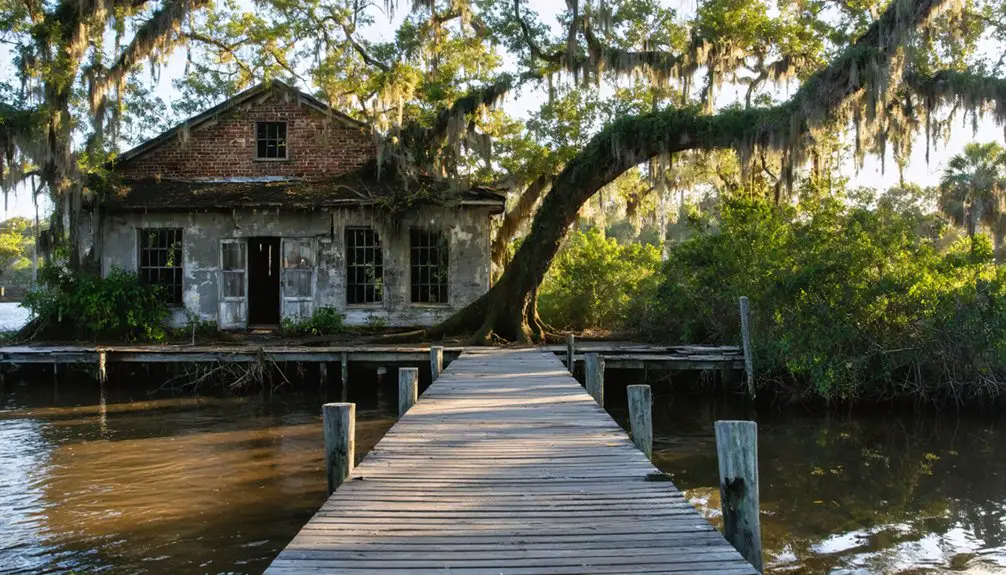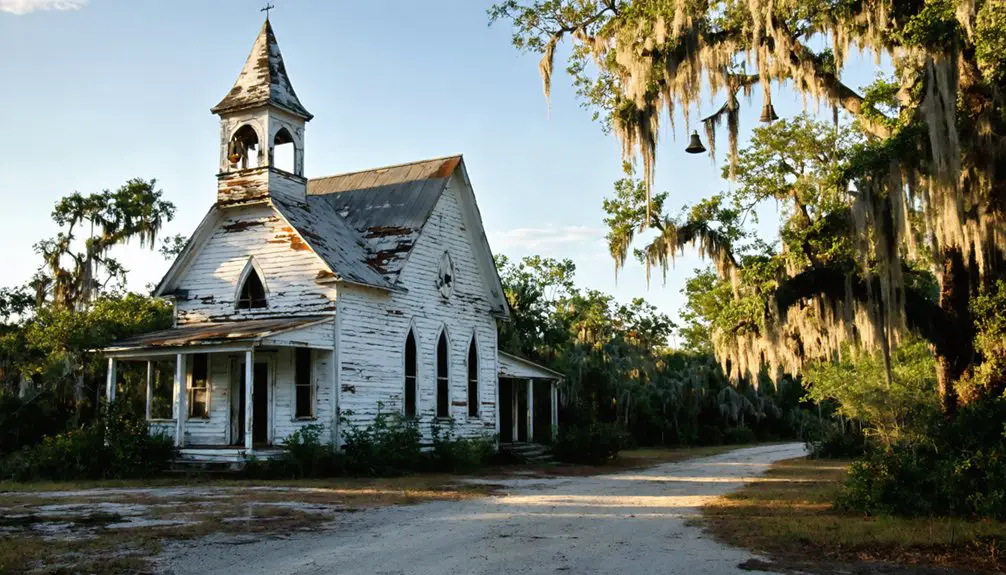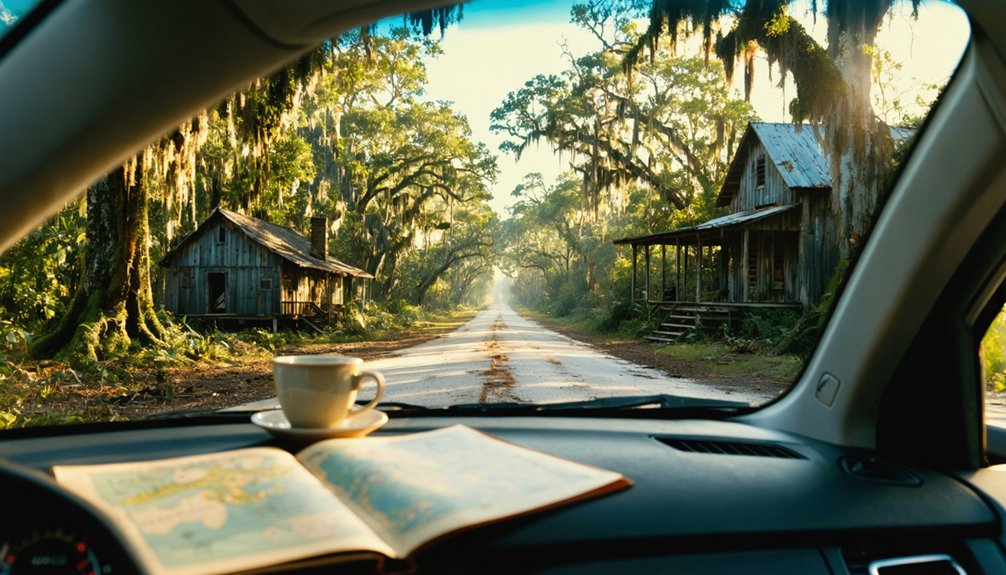
Montbrook, Florida sits along U.S. Route 41 in Levy County, offering you two extraordinary timelines in one raw, unfiltered destination. You’ll explore the ghost town remnants of a once-thriving 1918 lumber community and walk above one of North America’s most significant fossil beds, where nearly 80,000 specimens dating back 5.5–6 million years have been unearthed. Bring sturdy footwear, water, and a paper map, because cell signal is unreliable. There’s far more to this site than first meets the eye.
Key Takeaways
- Montbrook is located along U.S. Route 41 in Levy County, Florida, with coordinates 29°21’21″N, 82°28’18″W near Williston.
- Visit during spring or summer, bring water, sturdy footwear, a paper map, camera, and sun protection for exposed terrain.
- The site features a historic cemetery, subtle structural remnants, and embedded artifacts revealing Montbrook’s 19th-century lumber town history.
- Montbrook also sits near a major fossil deposit containing nearly 80,000 prehistoric fossils dating back 5.5–6 million years.
- Nearby stops include Cedar Key, Manatee Springs State Park, and Williston, enriching your overall Levy County heritage road trip.
What Is Montbrook and Why Visit This Florida Ghost Town?
Tucked along U.S. Route 41 in Levy County, Florida, Montbrook is a ghost town that rewards the curious traveler. Once a thriving lumber hub with hotels, sawmills, and three general stores, it’s now a quiet echo of its former self.
Along U.S. Route 41, Montbrook stands as a ghost town that once hummed with sawmills, hotels, and commerce.
You won’t find vintage postcards sold at a gift shop here — you’ll find raw landscape, a surviving cemetery, and local legends tied to Montholon Brooks, the farmer who gave this place its final name.
The site also sits near one of North America’s most significant Neogene fossil deposits, making it scientifically compelling beyond its historical identity.
If you crave destinations that feel unfiltered and genuinely forgotten, Montbrook delivers exactly that kind of freedom.
How Montbrook Went From Lumber Boomtown to Ghost Town
Montbrook’s rise began with lumber, as 2 sawmills, 3 general stores, a hotel, and livery stables fueled a population that hit 500 by 1918, making it the most extensive lumber town in the region.
A catastrophic sawmill fire then gutted the town’s economic engine, triggering a post office closure and a population collapse to 250 by 1925.
Montbrook’s Lumber Boom Years
At its peak, Montbrook wasn’t just a dot on the map — it was the most extensive lumber town in the area, humming with 2 sawmills, 3 general stores, a hotel, livery stables, a barber, several churches, a public school, and a post office.
By 1918, the population had climbed to 500, supporting the Davis Hotel and naval stores operations that fueled daily commerce.
Community events drew residents together, reinforcing Montbrook’s identity as a self-sufficient settlement deep in Levy County.
Local cuisine likely flowed through its hotel dining room and general stores, feeding a workforce that kept the sawmills roaring.
You’re looking at a town that once commanded serious economic weight — not a sleepy rural outpost, but a thriving, independent frontier community carved from Florida’s timber landscape.
Fire, Decline, And Abandonment
What brought Montbrook to its knees was fire — a sawmill blaze that tore through the town’s economic core and triggered a collapse the community never recovered from. The post office shuttered somewhere between 1892 and 1900, and by the 1925 Gazetteer, population had halved to 250.
The 1935–1936 Industrial Directory of Florida listed zero Montbrook entries — total erasure from the commercial record. Mail eventually rerouted to Williston, and the Montbrook post office closed permanently in the 1960s.
When you visit today, don’t expect mining relics or intact historic architecture lining former streets. What survives is sparse — a cemetery holding generations of local families, scattered landscape evidence, and the quiet coordinates of a place that once called itself the most extensive lumber town in the region.
How to Get to Montbrook, Florida
Getting to Montbrook is straightforward: head to Levy County, Florida, and follow U.S. Route 41 just outside Williston. The road conditions are 2WD-friendly, so you don’t need a heavy-duty vehicle — just a reliable car and a curious mind. Coordinates 29°21’21″N, 82°28’18″W will pin you precisely on target.
Plan your visit during spring or summer for the most comfortable experience. Summer’s warmth fuels excellent wildlife observation opportunities across the surrounding rural landscape, and local cuisine in nearby Williston keeps you fueled between explorations.
Winter chills make the trip less inviting, so timing matters.
Once you arrive, you’ll find sparse remains, but the landscape itself tells a vivid story of a once-thriving lumber community swallowed quietly by time and fire.
What’s Left to See at the Montbrook Town Site?
Once you’ve parked and stepped onto the Montbrook town site, expect minimal standing structures — time, fire, and overgrowth have erased most of what once made this one of Levy County’s most extensive lumber communities.
Time, fire, and overgrowth have claimed nearly everything — what remains whispers of Levy County’s most ambitious lumber era.
The sawmill fire that devastated the town left little for preservation efforts to work with, and the 1935–1936 Industrial Directory confirmed the community had effectively vanished from commercial records.
What you *will* find is the village cemetery, where generations of local families rest beneath weathered markers.
Local folklore ties many of these names to Montholon Brooks and the farming families who shaped eastern Levy County.
Landscape evidence — subtle depressions, cleared corridors, and boundary remnants — rewards sharp-eyed explorers.
Bring a map, your curiosity, and respect for what little survives.
The Montbrook Village Cemetery: Who’s Buried There and Why It Matters
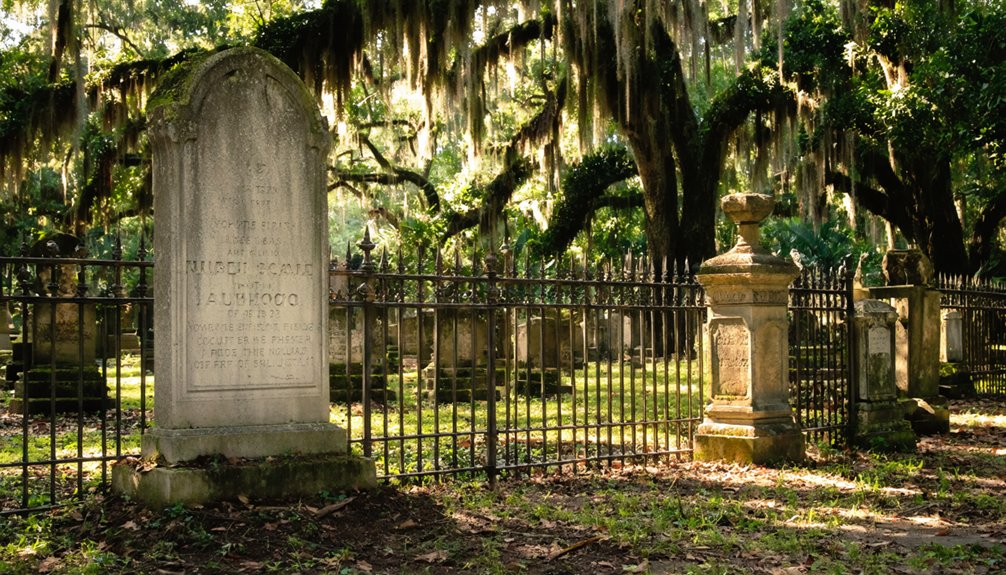
When you step into the Montbrook Village Cemetery, you’re walking through a multigenerational burial record that outlasted the town’s hotels, sawmills, and post office.
You’ll find graves spanning multiple family generations, making it one of the most tangible pieces of evidence that a real, thriving community once existed here.
It matters because it’s not just a collection of headstones — it’s the closest thing to a living document that Montbrook left behind.
Cemetery’s Multigenerational Burial History
Though little remains of Montbrook’s bustling lumber economy, the village cemetery endures as the town’s most telling artifact. Walk its grounds and you’ll encounter generations of the same family names, layered across decades of births, hardships, and sawmill-era ambitions.
These multigenerational burials reveal a community that ran deep, not just wide.
Local legends suggest certain graves belong to families who witnessed Montbrook’s dramatic collapse firsthand. Ghost stories tied to the cemetery persist among longtime Levy County residents, adding an eerie texture to your exploration.
But beyond folklore, the burial patterns offer genuine historical data — tracking settlement timelines, kinship networks, and population shifts that no gazetteer fully captures. You’re fundamentally reading the town’s biography in stone, one weathered inscription at a time.
Why The Cemetery Matters
Because the post office logs and gazetteer entries eventually go silent, the Montbrook Village Cemetery steps in as a primary source — one that doesn’t fade with bureaucratic neglect. Unlike architectural ruins that collapse or historical artifacts that scatter, headstones hold their ground. They document real people across real generations, anchoring Montbrook’s identity when paper records can’t.
You’ll find family names repeating across rows, each marker confirming that this wasn’t a temporary settlement — it was a rooted community. When you walk the grounds, you’re reading a compressed social history. The cemetery doesn’t romanticize the town’s decline; it simply records survival and loss with stone precision.
For any serious road tripper, it’s the most honest thing left standing at Montbrook.
The Montbrook Fossil Site: One of North America’s Most Significant Paleontology Finds
While you’re exploring the ghost town remnants of Montbrook, you’re also standing near one of North America’s most remarkable paleontology discoveries. The fossil site, dating to the latest Miocene–earliest Pliocene roughly 5.5–6 million years ago, has yielded nearly 80,000 fossils.
Researchers have uncovered gomphotheres, sabretooth cats, flamingos, otters, and swans — creatures that once roamed this very landscape. Scientists rank it among the continent’s most significant Neogene fossil sites.
Local legends surrounding Montbrook’s historical architecture often overshadow this extraordinary scientific treasure buried beneath the soil. You’re fundamentally walking a dual timeline here — one shaped by 19th-century settlers and another by prehistoric ecosystems.
For adventurous travelers craving both human history and deep Earth history, Montbrook delivers far beyond a typical ghost town experience.
Levy County Heritage Stops Worth Combining With Your Montbrook Visit
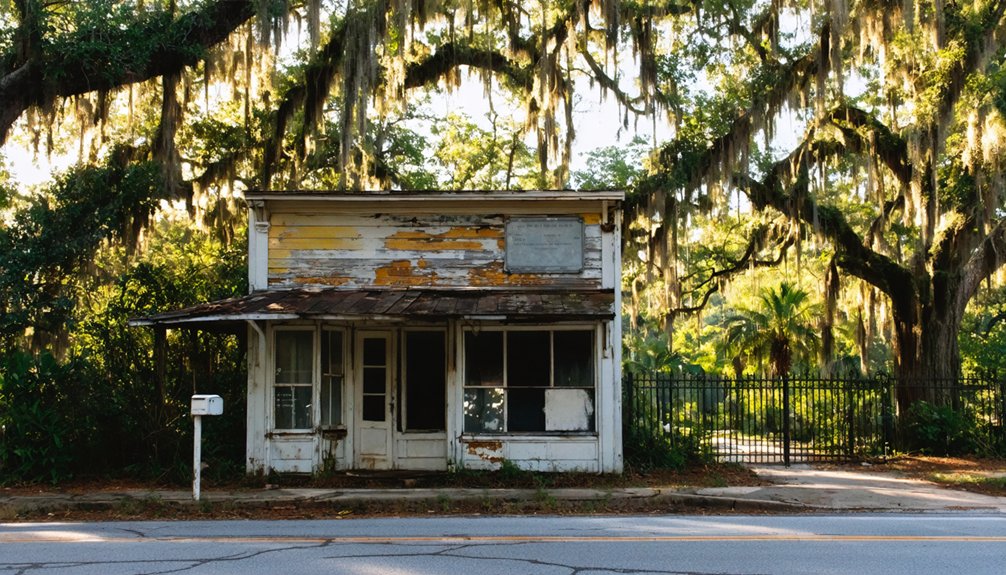
Levy County rewards curious travelers with heritage stops that pair naturally with a Montbrook ghost town visit. Drive into Williston to explore its small-town character, sample local cuisine at roadside diners serving fresh Florida fare, and check historical markers that trace the region’s timber and agricultural past.
Cedar Key, roughly an hour west, offers salt marshes ideal for wildlife observation — scan the shallows for roseate spoonbills, ospreys, and bottlenose dolphins. The Cedar Key Museum State Park documents the island’s sponge-harvesting and pencil-manufacturing industries with precise archival detail.
Manatee Springs State Park delivers another layer of geological and ecological context, where first-magnitude springs discharge into the Suwannee River. Stack these stops strategically, and you’ll transform a single ghost town detour into a full Levy County expedition.
Best Time of Year to Visit Montbrook
Spring and summer claim the title of best seasons for exploring Montbrook, though each demands a different kind of preparation. Spring delivers milder temperatures ideal for cemetery exploration and landscape reading.
Meanwhile, local flora emerges in full succession, sharpening the contrast between overgrown history and living terrain. Wildlife observation peaks during these warmer months, giving you genuine encounters with the ecological layers surrounding the ghost town’s footprint.
Summer intensifies everything — heat, humidity, and biological activity surge simultaneously, so hydrate aggressively and start early.
Winter falls short; chilly conditions suppress both local flora vibrancy and wildlife observation opportunities, dulling the sensory richness the site rewards.
You’ll extract the most from Montbrook when the land itself is active, responsive, and fully alive beneath your boots.
Roads, Terrain, and What to Bring for a Montbrook Day Trip
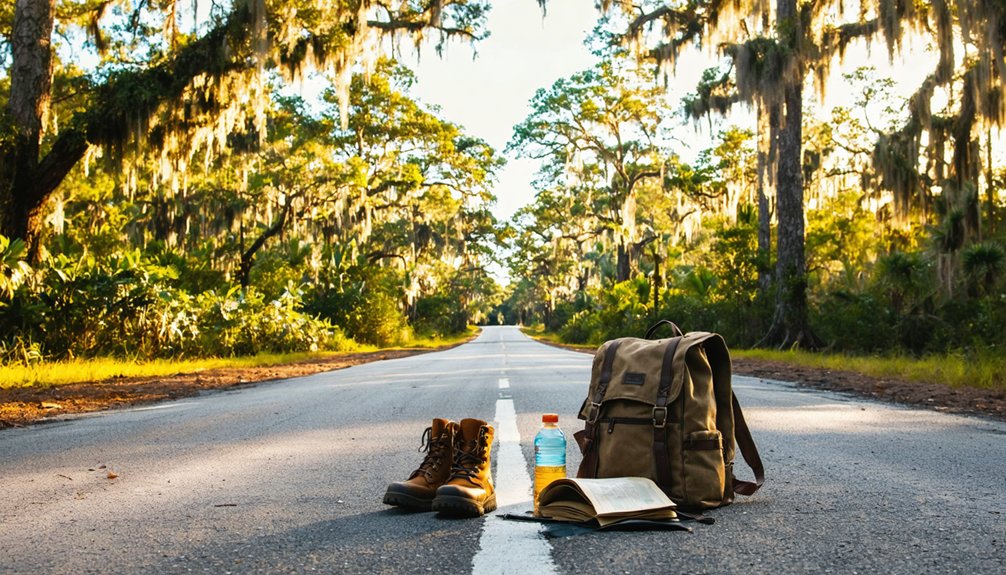
Reaching Montbrook demands no specialized vehicle — the site sits off U.S. Route 41 on 2WD-accessible roads, making it straightforward for any standard car. You’ll navigate flat Levy County terrain, so heavy boots aren’t mandatory, though sturdy footwear helps when you’re moving through overgrown parcels near the cemetery.
Pack water, a paper map, and a camera. Signal can be unreliable in rural Florida’s interior. Bring a notebook — local legends surrounding the sawmill fire and the town’s dramatic decline reward careful documentation. You may also encounter historical artifacts embedded in the landscape, from structural remnants to grave markers spanning multiple generations.
Sun protection is non-negotiable. The exposed terrain offers little shade. Arrive prepared, move deliberately, and you’ll extract every detail this vanished community still holds.
Frequently Asked Questions
Is Montbrook Officially Recognized as a Ghost Town by Florida Authorities?
Florida doesn’t officially classify Montbrook as a ghost town, but you’ll find its historical significance undeniable. Local legends and ghost-town compilations actively recognize it, and you’re free to explore its fascinating, scientifically rich, abandoned landscape yourself.
Can Visitors Legally Take Fossils Found Near the Montbrook Site Home?
Want to pocket a fossil? You can’t. Legal restrictions protect the Montbrook site strictly — fossil collection isn’t permitted. You’ll need to leave every ancient treasure exactly where you discover it, preserving history for future explorers.
Are There Any Guided Tours Specifically Focused on Montbrook’s Ghost Town History?
No dedicated guided tours exist, but you’ll uncover historic landmarks and local legends independently. Explore the cemetery, trace vanished structures, and let Montbrook’s raw, untamed history fuel your adventurous spirit on your own terms.
Has Montbrook Ever Appeared in Any Films, Documentaries, or Television Programs?
Drawing a blank here — no films, documentaries, or television programs featuring Montbrook’s local legends or historic landmarks appear in available records. You’ll find this ghost town’s story waiting for you to uncover it firsthand.
Are There Any Active Preservation or Restoration Efforts Currently Underway at Montbrook?
No confirmed active preservation efforts exist, but you’ll find the village cemetery maintained across generations. Explore local legends tied to historic architecture remnants — you’re free to investigate, document, and champion Montbrook’s forgotten story yourself!
References
- https://www.ghosttowns.com/states/fl/montbrook.html
- https://en.wikipedia.org/wiki/List_of_ghost_towns_in_Florida
- https://www.floridamuseum.ufl.edu/montbrook/blog/why-montbrook/
- https://www.fox13news.com/news/fossil-site-near-gainesville-offering-clues-to-floridas-past
- https://www.nwf.org/Magazines/National-Wildlife/2024/Summer/Conservation/Elephant-Graveyard-Gomphothere-Climate
- https://www.floridamuseum.ufl.edu/montbrook/
- https://cccourthouse.org/wp-content/uploads/2023/12/Ghost-towns-and-Cemeteries-of-Citrus-County.pdf
- https://www.journaloffloridastudies.org/0102ghosttowns.html