Quay, Oklahoma sits on the boundary of Pawnee and Payne counties, accessible via County Roads E0590 and N3530. You’ll want a high-clearance vehicle, offline maps, and plenty of water since no services exist nearby. This prairie ghost town once packed over 5,000 people into its streets during an oil boom, only to collapse from fires, declining production, and the Great Depression. Stick around to uncover the full story behind Quay’s dramatic rise and fall.
Key Takeaways
- Quay straddles the Pawnee and Payne county line in Oklahoma, accessible via rural County Roads E0590 and N3530 with GPS recommended.
- Bring a high-clearance vehicle, water, fuel, and offline maps, as no nearby services exist and roads alternate between pavement and gravel.
- Visit during daylight hours to safely navigate red clay roads, which become dangerously slick after rain.
- Quay boomed from 150 to 5,000 residents during a 1914 oil rush, then collapsed due to fires, declining oil, and the Great Depression.
- Nearby ghost towns along the same railroad corridor allow visitors to build a multi-stop historical loop drive through the region.
Quay, Oklahoma: A Ghost Town That Once Held 5,000 People
Few places in Oklahoma capture the boom-and-bust arc of early statehood quite like Quay, a ghost town straddling the boundary between Pawnee and Payne counties. When oil struck in 1914, this quiet agricultural community exploded from roughly 150 residents to over 5,000 practically overnight.
Few places capture Oklahoma’s boom-and-bust story like Quay, where oil transformed 150 residents into 5,000 practically overnight.
Hotels, restaurants, a movie theater, and oil supply firms stretched across nearly three-quarters of a mile of bustling streetfront. You’d have witnessed historical architecture rising fast and local legends forming faster.
Then two devastating oil field fires tore through the business district in the 1920s, and the Great Depression finished what the flames started. By 2000, Quay officially disincorporated.
Today, only a handful of structures remain, but the story they carry makes the drive absolutely worth your time.
Where Quay Sits: Pawnee County, Payne County, and County Road Access
Quay sits right on the boundary line between Pawnee and Payne counties, so you’re technically visiting two counties at once when you stop there.
To reach the site, you’ll navigate County Roads E0590 and N3530, a detail worth plugging into your GPS before you leave pavement behind.
Keep your directions handy, because the rural grid roads in this part of Oklahoma can look deceptively similar as you close in on the site.
Dual County Boundary Location
Straddling the boundary between Pawnee and Payne counties, this small Oklahoma community sits at the intersection of County Roads E0590 and N3530—a detail worth noting before you set out, since traversing rural county road grids can catch unprepared travelers off guard.
That dual-county position isn’t just a quirk on a map; it shaped Quay’s cultural heritage from the beginning, pulling settlers, oil workers, and commerce from two different jurisdictions into one restless place.
Today, locals and road-trippers alike trade local legends about boom-era fortunes made and lost along these same dirt corridors.
Download an offline map, confirm your route before you lose cell service, and embrace the freedom of orienteering Oklahoma’s back-road grid on your own terms.
The county line itself becomes part of the experience.
County Road Access Points
Getting to Quay means committing to Oklahoma’s rural county road grid, where the pavement occasionally gives way to gravel and the signage assumes you already know where you’re going. Your target intersection is County Roads E0590 and N3530, straddling the Pawnee and Payne county line. Drop that coordinate into your GPS before you lose signal, because you won’t find highway markers guiding you in.
The freedom of this drive is real — open sky, rolling Oklahoma terrain, and almost no traffic. What little historical architecture survives sits quietly along these roads, easy to miss if you’re moving too fast.
Locals carry their own version of the town’s story, and those local legends often fill gaps that no roadside marker ever will. Slow down and look carefully.
Quay’s Railroad Origins: How a Land-Run Settlement Became a Real Town
Before the railroad arrived, Quay was little more than a cluster of farms and ambitions planted in the Oklahoma soil after the land runs of the 1890s.
Then the Eastern Oklahoma Railway pushed through between 1900 and 1904, running its line from Newkirk to Pauls Valley, and everything changed.
The town even earned a new name on February 24, 1903, rechristened “Quay” after Pennsylvania Senator Matthew Quay.
By statehood in 1907, you’d have found a bank, cotton gin, grain elevator, and public school anchoring the community.
Local legends credit the railroad as the town’s true birthplace, and the historical architecture that once lined its streets grew directly from that rail connection.
The train didn’t just pass through — it built something real here.
The Oil Boom That Transformed Quay Into a Prairie Boomtown
When oil was discovered in the area in 1914, Quay didn’t just grow — it exploded. The population surged from around 150 residents to over 5,000 almost overnight, with oil camps swelling the surrounding countryside.
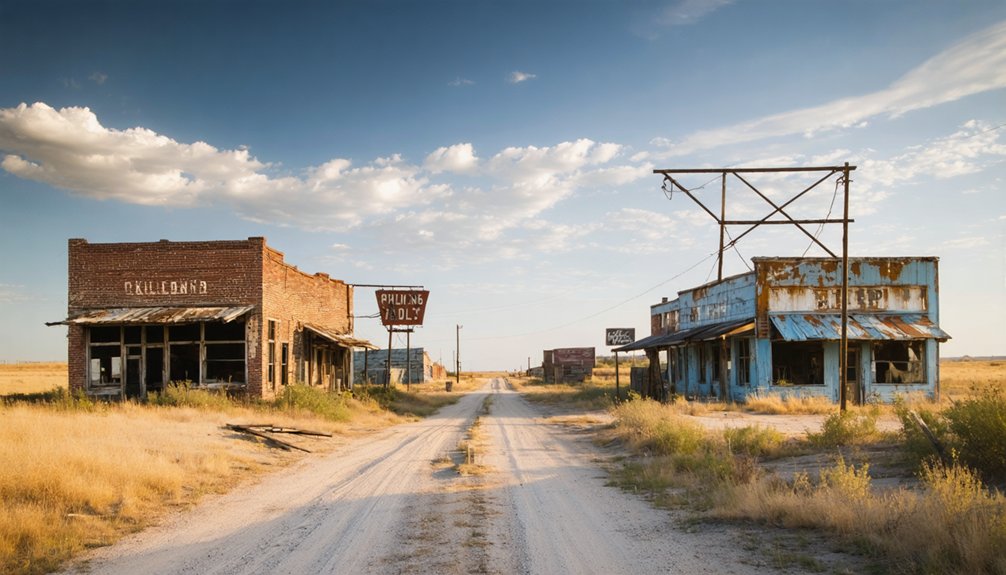
By 1919, the business district stretched over three-quarters of a mile, packed with hotels, restaurants, a movie theater, retail stores, and oil supply firms. The historical significance of that era is hard to overstate — Quay briefly rivaled established Oklahoma towns in size and energy.
You can almost picture the chaos and opportunity that defined those years when you drive through today.
Unfortunately, preservation efforts never fully captured that boom-era story. Two oil field fires in the 1920s wiped out much of the district, and the town never recovered.
What remains is silence — and open road.
What Destroyed Quay: Field Fires, Declining Oil, and the Depression
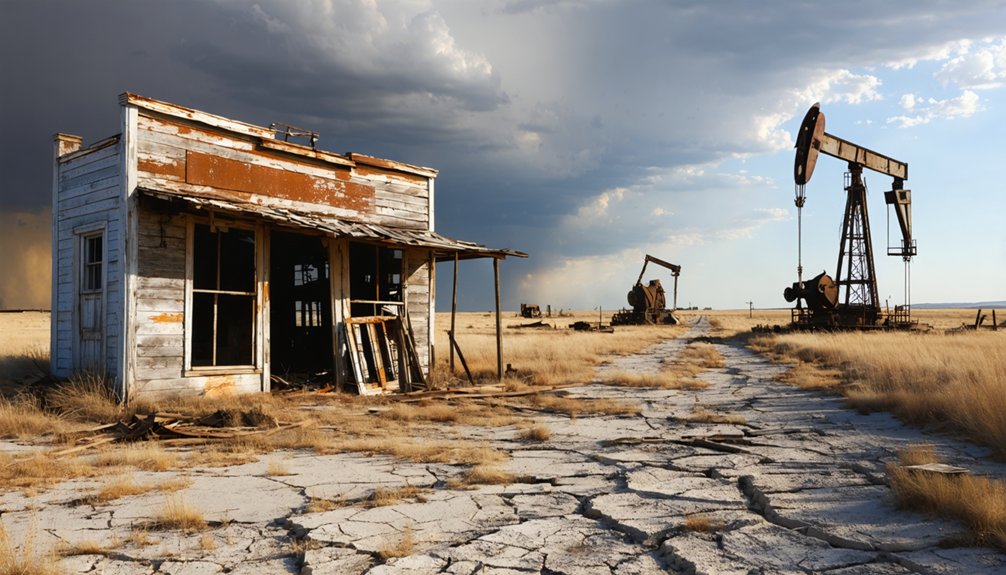
When you look at what brought Quay down, you’ll find a brutal sequence of disasters hitting one after another.
Two oil field fires tore through the business district in the 1920s, wiping out the commercial core that had taken years to build.
Falling oil production then drained the town’s economic lifeblood.
And the Great Depression delivered the final blow, pushing the population from thousands to just 186 by 1930.
Oil Field Fires Strike
Though Quay had survived the boom’s chaos, it couldn’t outlast the fires. Two devastating oil field fires tore through the business district in the 1920s, reducing much of Quay’s historical architecture to ash and memory. Buildings that once lined three-quarters of a mile of active commerce simply vanished.
Hotels, supply firms, and storefronts that defined the town’s identity were gone almost overnight.
Local legends still carry whispers of those fires — the heat, the loss, the silence that followed. For a town already stretched thin by the pressures of a maturing oil field, the destruction proved irreversible.
You’re not just visiting a quiet crossroads when you stop at Quay; you’re standing where fire permanently interrupted a community’s future. The decline that followed was swift and unforgiving.
Production Decline Deepens
The fires gutted Quay’s bones, but declining oil production finished the job. Once the wells dried up, the economic decline hit fast and hard. Businesses that survived the flames had no customers left to serve. The First State Bank of Quay packed up and relocated to Webb City in 1927, signaling that the money had moved on.
The Great Depression buried whatever hope remained. Population decrease turned from a trend into a freefall. The federal census counted 186 residents in 1930, then 104 in 1940, and just 70 by 1950. You can almost feel the town exhaling its last breath through those numbers.
Quay wasn’t dying slowly — it was emptying out, building by building, family by family, until almost nothing remained.
Depression Seals Fate
By the time the Great Depression arrived, Quay had almost nothing left to lose. Two devastating oil field fires in the 1920s had already gutted the business district. Declining production drained what remained.
In 1927, the First State Bank of Quay packed up and relocated to Webb City — a quiet but telling signal that institutional confidence in the town was gone.
Census numbers tell the rest brutally: 186 residents in 1930, dropping to 104 by 1940. Community legends about Quay’s oil-boom glory days survived longer than the town itself did.
Historical preservation efforts now carry the weight of keeping those stories alive. When you drive out here, you’re not visiting a failure — you’re witnessing what unchecked boom-and-bust cycles actually cost real people.
What Remains at Quay, Oklahoma Today
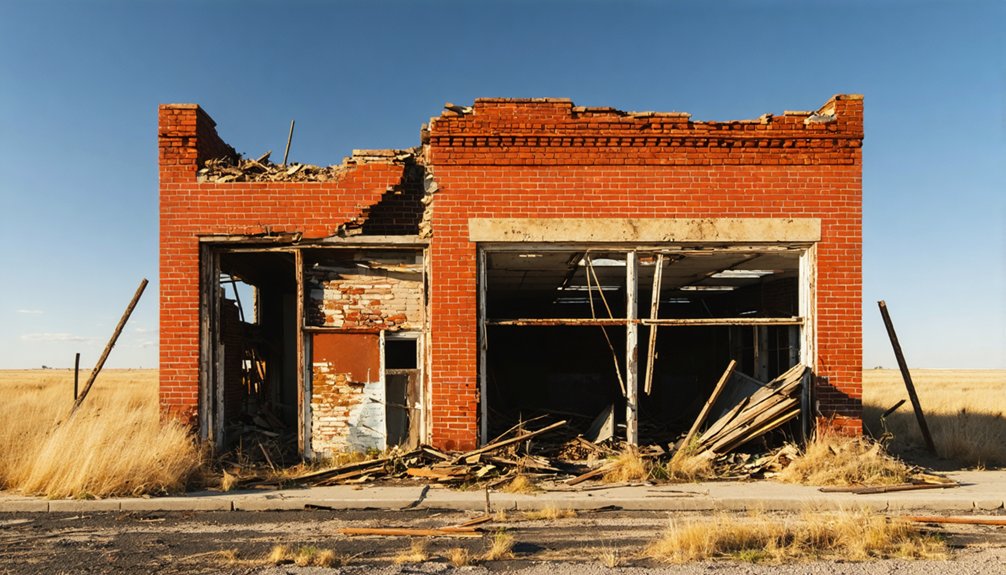
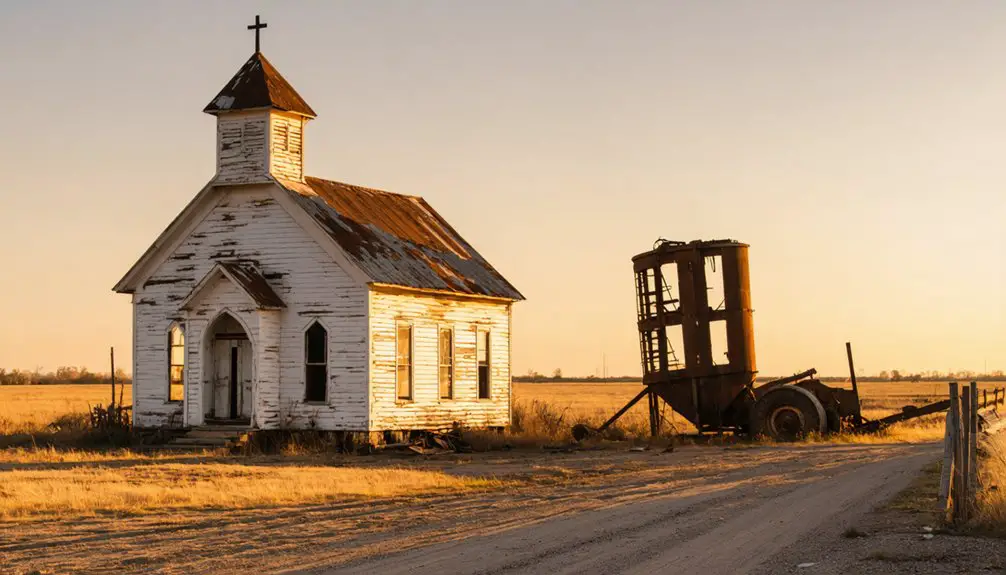
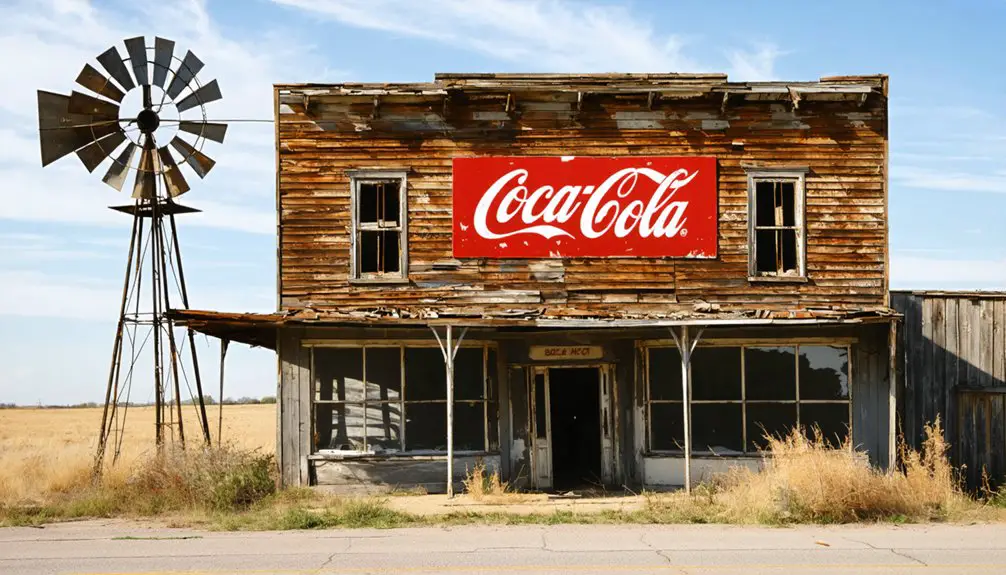
Once a booming oil town with a business district stretching nearly a mile long, Quay today offers little more than a quiet rural landscape with few structures still standing. You’ll find no museums, no tourist centers, just open Oklahoma sky and the faint echoes of local legends tied to oil rushes and vanished fortunes.
Drive out along County Roads E0590/N3530, straddling the Pawnee and Payne county line, and you’ll experience the town as it truly exists — a historical landmark frozen in decline.
The 2020 census counted just 39 residents. Quay officially disincorporated in 2000, and the post office closed decades before that.
It’s a raw, unfiltered stop for road trippers who prefer honest history over polished attractions.
Ghost Towns Near Quay Worth Adding to the Drive
Quay sits in a region of Oklahoma where ghost towns cluster close enough together to string into a single rewarding drive. Pawnee and Payne counties hold scattered historical landmarks that reward anyone willing to follow county roads off the main routes.
Towns that once thrived on the same railroad line connecting Newkirk to Pauls Valley offer their own local legends, forgotten cemeteries, and crumbling foundations worth photographing. You can build a loop that moves through several communities in a single afternoon, each one adding another layer to the broader story of Oklahoma’s land-run and oil-boom era.
Research your stops before you leave, mark your coordinates, and carry water. Out here, the freedom is real, but the gas stations aren’t always.
Road Conditions and What to Expect Before Visiting Quay
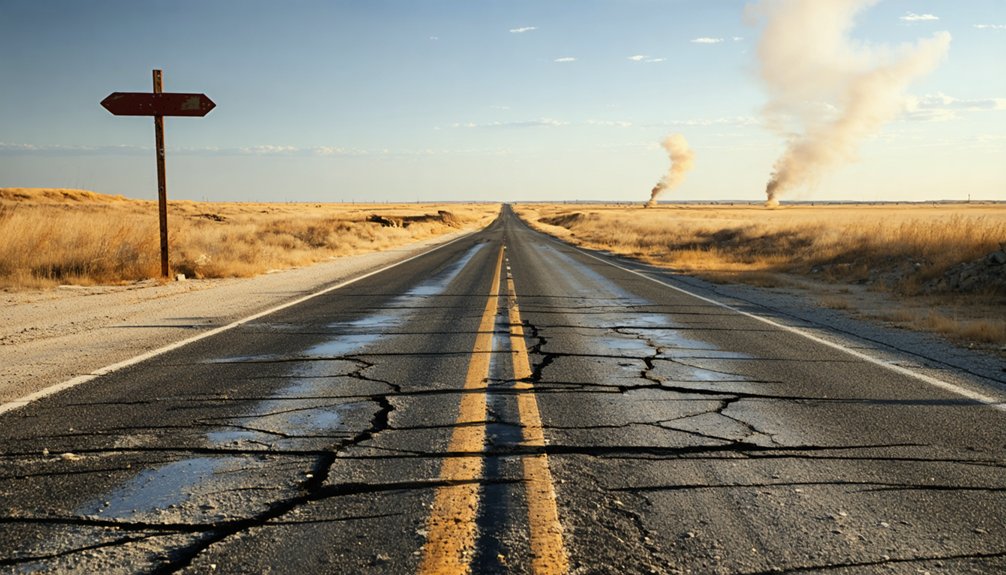
Getting to Quay means steering County Roads E0590 and N3530, and you’ll want to arrive knowing that rural Oklahoma roads can shift dramatically with the seasons. Rain turns red clay into a slick challenge, and summer heat bakes ruts into the surface.
Red clay roads shift with every season — Quay demands respect before it rewards discovery.
Before you chase the historical architecture and local legends still whispered about this once-booming oil town, prepare yourself:
- Check weather forecasts — gravel roads flood and dry unpredictably
- Drive a high-clearance vehicle — low-profile cars struggle on uneven surfaces
- Bring water and fuel — no services exist nearby
- Download offline maps — cell coverage drops fast out here
- Go during daylight — few structures remain, and shadows hide road hazards
You’re trading comfort for freedom, and Quay delivers exactly that.
Frequently Asked Questions
When Did Quay Officially Lose Its Incorporated Town Status?
Like a flame snuffed out, Quay officially lost its incorporated status on August 23, 2000. You’ll find its historical landmarks and local legends still whispering through the few weathered structures that remain standing.
What Senator Was the Town of Quay Named After?
You’ll discover Quay’s name honors Pennsylvania Senator Matthew Quay, a historical landmark in itself! Local legends tie this 1903 renaming to political influence, connecting your free-spirited road trip to a fascinating chapter of Oklahoma’s past.
Did Quay Ever Have Its Own Operating Bank?
Where there’s oil, there’s money — Quay’s bank history proves it. You’ll find that the First State Bank of Quay once thrived here, sharing the town naming era, before relocating to Webb City in 1927.
When Did Quay’s Post Office Permanently Close Its Doors?
You’ll find that Quay’s post office permanently closed its doors in 1957, leaving behind historical landmarks steeped in local legends. That closure marked another quiet chapter in the town’s long, fascinating fade into Oklahoma ghost town history.
What Were the Population Figures Recorded After Quay Disincorporated?
After Quay disincorporated in 2000, you’ll find the historical population trends tell a fading story — 47 residents in 2000, no recorded figures in 2010, and only 39 souls counted among these ghost town attractions by 2020.
References
- https://www.youtube.com/watch?v=EY1g87tzZdI
- https://www.facebook.com/groups/OklahomaAbandoned/posts/2696911597272284/
- https://en.wikipedia.org/wiki/List_of_ghost_towns_in_Oklahoma
- https://www.okhistory.org/publications/enc/entry?entry=GH002
- https://www.youtube.com/watch?v=MKlhvtRiSDE
- https://en.wikipedia.org/wiki/Quay
- https://www.travelok.com/articles/oklahomaghosttowns
- https://www.youtube.com/watch?v=pnypSASsuBY
- https://www.youtube.com/watch?v=Feg7eRGaoAE