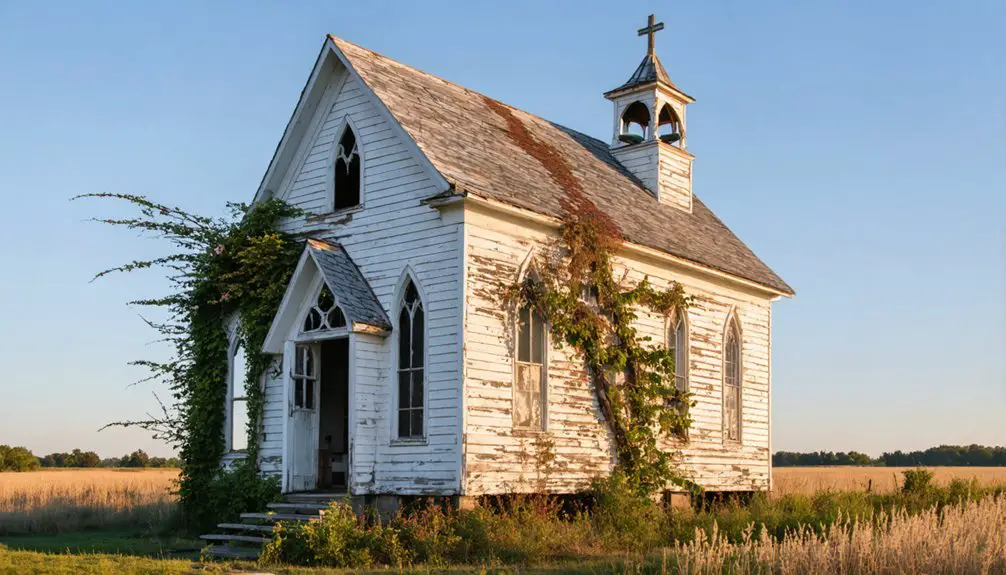
Your ghost town road trip to Cotton Gin Port begins at the intersection of U.S. 278 and Cotton Gin Road near Amory, where a 1997 historical marker guides you to the vanished settlement’s location along the Tombigbee River. You’ll find overgrown foundations, a 1924 DAR monument beneath the legendary magnolia tree, and the bluff where Chickasaw chief Levi Colbert’s home once stood. The Amory Municipal Museum houses artifacts from this frontier trading post that thrived with 500 residents before the railroad’s 1887 arrival sealed its fate, and there’s much more to uncover about this Mississippi mystery.
Key Takeaways
- Start at the intersection of U.S. 278 and Cotton Gin Road near Amory, using coordinates 33° 58.967′ N, 88° 31.91′ W.
- Visit the 1997 Mississippi historical marker and 1924 DAR monument beneath the famous magnolia tree at the site.
- Explore overgrown foundations and the bluff where Levi Colbert’s home and the first cotton gin once stood.
- View artifacts from Cotton Gin Port at the Amory Municipal Museum to understand the settlement’s complete history.
- Plan extra time to locate the site, as minimal structures remain and research or maps are essential.
The Rise and Fall of a Frontier Trading Post
Long before Cotton Gin Port appeared on any map, the high bluff overlooking the Tombigbee River drew people to its banks. You’ll find artifacts dating to 600 B.C. here, and a massive Mississippian mound built by Chickasaw ancestors still marks the landscape. These early Chickasaw connections established the site as a natural river crossing where Indian trails converged.
The U.S. government’s 1801 cotton gin sparked transformation—though it mysteriously burned shortly after construction. By 1816, white settlers claimed the land following Chickasaw cession, and traders like James Ederington built thriving businesses. The town incorporated in 1838, peaking at 500 residents with twenty stores by 1848. But when the railroad bypassed Cotton Gin Port in 1887, lost settlement patterns repeated themselves—another community vanished into history.
What Remains at the Abandoned Site Today
Though Cotton Gin Port once bustled with twenty stores and 500 residents, nature has reclaimed almost everything. You’ll find overgrown foundations disappearing into the woodlands between the Tenn-Tom Waterway and Tombigbee River. The eerie stillness tells you this was once a thriving community, though minimal remnant structures remain standing today.
You won’t discover much driving by—locating the site requires research and maps. West of town, you can seek out the bluff where Levi Colbert’s home once stood, near the massive oak that served as a council tree for tribal elders. The settlement’s first cotton gin was built here.
Most artifacts now reside at Amory Municipal Museum rather than on-site. This National Register location maintains its ghost town status: population zero.
Key Historical Landmarks and Monuments to Visit
Despite Cotton Gin Port’s physical disappearance, several markers and monuments preserve its compelling history. You’ll find the 1997 Mississippi historical marker near Amory, commemorating the federally-built cotton gin from 1801.
Beneath the famous magnolia tree—transported by steamboat from Mobile—stands the 1924 DAR monument marking the gateway to white settlement. Seek out the Council Tree, where Chickasaw elders gathered near Chief Levi Colbert’s home, reportedly hosting Tecumseh in 1811.
The Gaines Trace Road, constructed 1811-1812, once crossed the Tombigbee here, linking Tennessee River settlements to Fort Stoddert. These landmarks tell stories of economic factors in port decline and environmental impacts on port viability—flooding and railroad competition that ultimately claimed this once-thriving river settlement.
Notable Figures Who Shaped Cotton Gin Port’s Legacy
Before American settlers claimed this Tombigbee River crossing, French explorers Jean-Baptiste Le Moyne de Bienville and Vaudreuil led expeditions through the site in 1736 and 1752, recognizing its strategic position where vital Indian trails met the waterway. This early European exploration preceded U.S. development by decades.
Chickasaw chief Levi Colbert embodied the region’s Chickasaw tribal influence, residing near the sacred council tree where tribal elders gathered. Indian Agent John McKee built his cotton gin here in 1801, attempting to transform Chickasaw culture through agriculture.
Eli Thames and Robert Coil brought their families in 1817, establishing permanent settlement with Thames’s ferry and blacksmith shop. Peter Knowles planted the town’s legendary magnolia, while his neighbor William Philip King later died defending the Alamo at sixteen, forever linking this remote crossing to Texas history.
Planning Your Route Through Monroe County
The journey to Cotton Gin Port begins where U.S. 278 intersects Cotton Gin Road, your gateway to Mississippi’s forgotten frontier. You’ll find the historical marker at coordinates 33° 58.967′ N, 88° 31.91′ W, guiding you toward the east bank of the Tombigbee River.
Follow this route just one mile below where Town Creek merges with the river, near Amory. The natural landscape features—riverbanks and wooded traces—remain largely unchanged since steamboats dominated commerce here.
Gaines Trace once connected these waters to Tennessee settlements and Gulf coast points, making this junction essential for accessing Indian country. The Kansas City Railroad‘s 1887 arrival triggered the economic activity decline, transforming this once-thriving port into today’s atmospheric remnant worth exploring.
Frequently Asked Questions
Is Cotton Gin Port Safe to Explore or Are There Access Restrictions?
You’ll find public historical markers welcoming exploration, though ghost town safety demands caution on uneven terrain. While no official restrictions exist, private property concerns may apply to certain areas—always respect boundaries while discovering this hauntingly accessible ruin.
What’s the Best Time of Year to Visit the Abandoned Town Site?
Spring and fall offer ideal weather patterns for exploring Cotton Gin Port’s ruins. You’ll enjoy mild temperatures, vibrant wildflowers or foliage as seasonal attractions, fewer crowds, and comfortable conditions for photographing remnants without summer’s oppressive heat or winter’s limitations.
Are There Guided Tours Available at Cotton Gin Port Ruins?
No guided tours availability exists at Cotton Gin Port Ruins—you’ll explore independently through historical preservation efforts that maintain interpretive markers. For structured cotton history tours, you’ll need to visit nearby Frogmore Plantation or Dockery Farms instead.
Can You Camp Overnight Near the Cotton Gin Port Historical Area?
Ironically, you won’t find camping availability at Cotton Gin Port’s ruins themselves—public accessibility remains limited at this ghost town. However, you’ll discover authentic overnight stays at nearby Stovall Store and Gin Complex, where Muddy Waters’ legend lives on.
How Long Should I Plan to Spend Exploring Cotton Gin Port?
You’ll need about 30-45 minutes to explore the markers and riverside ruins. While historical preservation efforts remain minimal, the potential tourist attractions are limited to interpretive signs and viewing artifacts later at Amory’s museum.