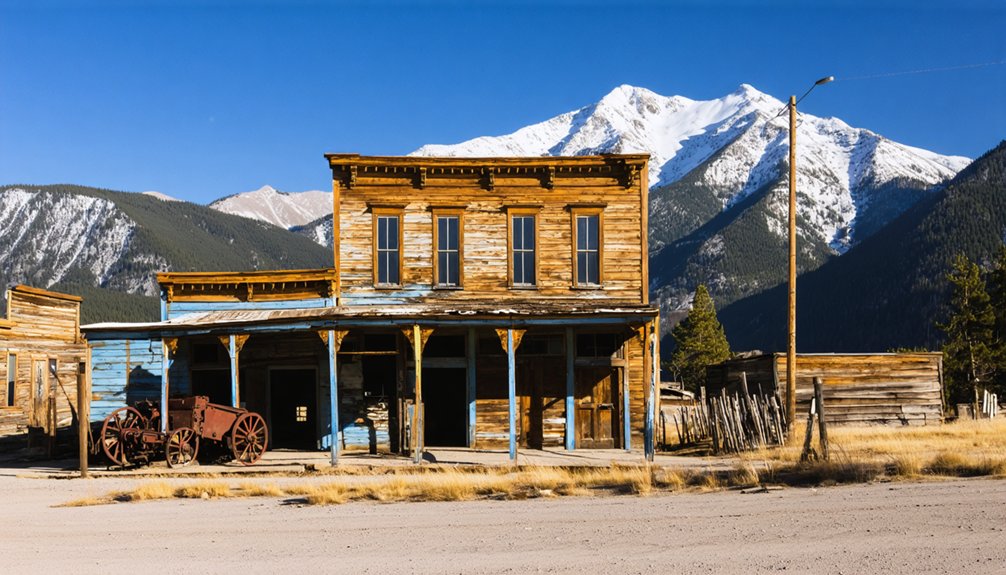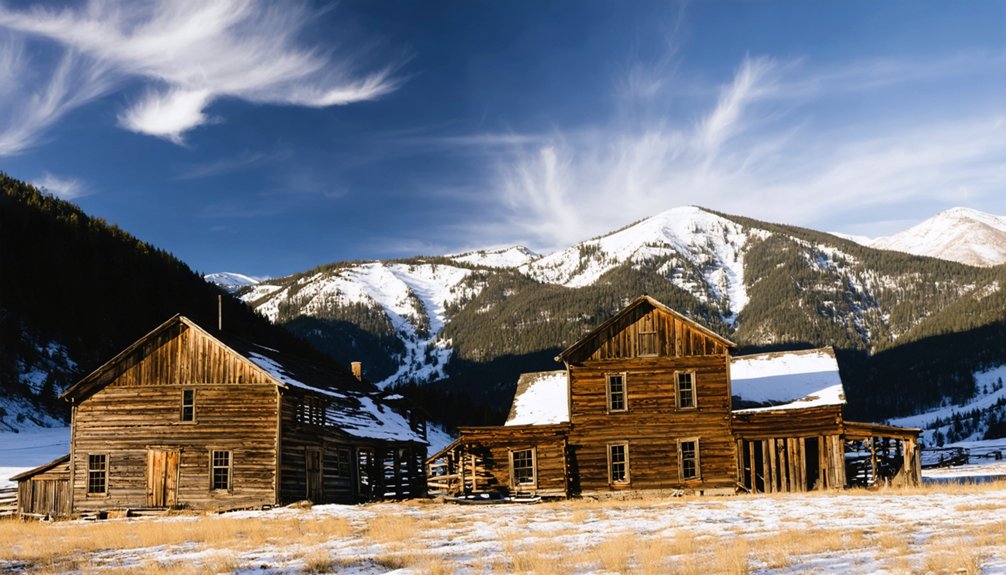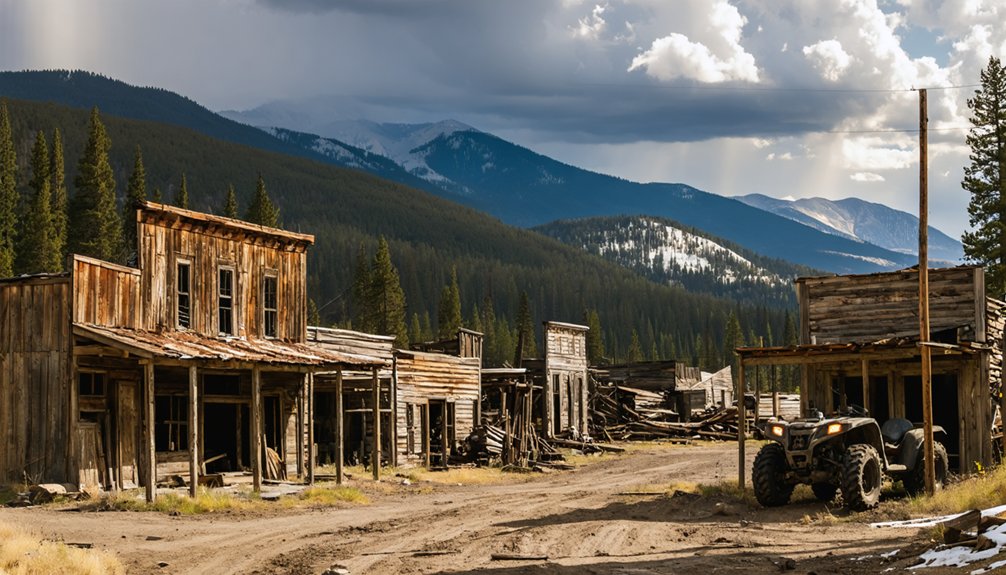
You can explore Colorado’s most spectacular ghost towns by ATV, including Animas Forks at 11,185 feet with its historic Gold Prince Mill, St. Elmo’s perfectly preserved 1880s wooden storefronts and operational general store, and Carson at 12,000 feet straddling the Continental Divide. Alta stands as the state’s highest accessible ghost town at 11,800 feet, while Tomboy offers remote mining ruins above Telluride. These high-altitude adventures require high-clearance 4WD vehicles to navigate rugged mountain terrain and discover authentic Wild West history.
Key Takeaways
- St. Elmo at 9,961 feet offers well-preserved 1880s architecture and accessible trails for high-clearance 4×4 vehicles and ATVs.
- Animas Forks sits at 11,185 feet elevation, featuring historic mining ruins accessible via challenging ATV trails through rugged terrain.
- Carson Ghost Town at 12,000 feet requires high-clearance 4WD via Wager Gulch for access to Continental Divide mining remnants.
- Tomboy Ghost Town above Telluride needs high-clearance 4×4 vehicles to navigate five miles of Tomboy Road to historic ruins.
- Alta Ghost Town at 11,800 feet is Colorado’s highest accessible ghost town with twenty original 1870s buildings via 4WD trails.
Animas Forks: High-Altitude Mining History at 11,500 Feet
At 11,185 feet above sea level, Animas Forks stands as one of Colorado’s most spectacular high-altitude ghost towns, where you’ll discover the preserved remnants of a once-thriving silver and gold mining community.
Located 12 miles northeast of Silverton along the Alpine Loop, this remote destination offers unparalleled Animas history dating back to 1873.
You’ll explore mining structures that produced over 2 million troy ounces of gold and 51 million ounces of silver.
The massive Gold Prince Mill, built in 1904-1905, processed 500 tons daily before operations ceased in 1917.
High altitude mining presented extreme challenges—snow depths reached 25 feet, forcing residents to dig tunnels between houses. The town’s peak population of 450 was reached by 1883, though many residents would migrate to Silverton during the harsh winter months.
The San Juan County Historical Society has raised over $12 million to preserve these historical structures for future generations.
Your ATV adventure leads through rugged San Juan Mountains terrain to this well-preserved monument of Colorado’s mining heritage.
St. Elmo: Well-Preserved Wooden Storefronts and General Store
You’ll find St. Elmo’s remarkably preserved wooden storefronts standing like frozen sentinels at 9,961 feet, where the Stark family’s decades-long preservation efforts created Colorado’s most authentic ghost town experience.
The historic general store anchors this collection of 43 original structures, its weathered boards and vintage signage offering glimpses into 1880s mining life that you can explore up close. The store operates seasonally from May through October, maintaining its role as a functioning piece of the town’s living history.
During the town’s peak, St. Elmo supported 150 patented mine claims that drove its bustling economy and substantial population.
The well-maintained road from Nathrop makes this treasure easily accessible by ATV, letting you ride directly into living history without the treacherous climbs required at other abandoned settlements.
Historic General Store Features
The weathered wooden facade of St. Elmo’s historic general store beckons you into a preserved slice of Colorado’s mining past.
Originally converted from a saloon, this family-operated establishment has anchored the ghost town since 1880, creating a rich store history that unfolds through authentic artifacts and friendly staff insights.
Your visitor experiences here include:
- Browsing antique treasures from the mining era alongside modern souvenirs
- Sampling old-school candy and ice cream while feeding chipmunks
- Discovering unique items like steel mugs depicting St. Elmo scenes
- Learning town stories from knowledgeable staff who share local history
You’ll find reasonable prices and genuine hospitality in this seasonal operation, open May through September. The town’s population dwindled significantly after the last train departed in 1922, leaving behind this authentic glimpse into Colorado’s mining heritage. The Stark family, who operated the general store along with other businesses, were the last to leave in 1958, marking the end of permanent residency in this historic town.
The store’s inventory spans from practical snacks to decorative yard art, making it your perfect basecamp for exploring Colorado’s high-altitude frontier spirit.
Preserved Wooden Architecture Details
Beyond the general store’s inviting entrance, St. Elmo reveals forty-three surviving nineteenth-century structures that’ll transport you back to Colorado’s mining heyday.
You’ll discover an extraordinary collection of log and balloon-frame buildings showcasing 1880s and 1890s wood frame architecture in its purest form. The remarkable Iron City Cabin catches your eye immediately—a two-story wonder featuring a Queen Anne style second floor perched atop an original miner’s cabin from around 1890.
These compact, rectangular wooden structures tell stories of hasty construction and frontier determination.
You’ll notice fire resistant features added after devastating 1890s blazes, including masonry additions that served as protective barriers. Each building displays unique characteristics: peeled logs with saddle notches, rough-hewn boards, and clapboard exteriors that’ve weathered decades virtually unchanged. The preserved Town Hall museum stands as a testament to the community’s civic pride during the mining boom years. Frederick W. Brush’s commercial and residential buildings demonstrate the skilled craftsmanship that defined St. Elmo’s architectural legacy.
Accessible Road Conditions
Multiple routes deliver you to St. Elmo’s preserved storefronts, with Tincup Pass Trail offering the most adventurous approach. This 12.4-mile full-width road challenges your skills while maintaining excellent trail maintenance standards throughout the season.
Your route planning should prioritize road safety given these conditions:
- Sharp summit rocks threaten tire integrity on the narrow shelf road section
- Snow coverage persists into early July, limiting early season access
- Embedded rocks on the west side slow progress considerably
- Five-hour traversals require fuel planning and daylight management
The Taylor Pass connection expands your exploration options, linking St. Elmo to Crested Butte’s extensive ATV network. The trail reaches its high point at 12,154 feet elevation.
High-clearance 4×4 vehicles with skid plates handle the terrain best, though 50-inch ATVs navigate successfully. The trail features no gate closures, providing unrestricted access throughout the open season.
Summer and fall provide ideal conditions for your ghost town adventure.
Ironton: Weathered Cabins Near Red Mountain Pass
Perched at 9,800 feet along the Million Dollar Highway, Ironton stands as Colorado’s most accessible ghost town, where weathered cabins and crumbling foundations tell the story of a once-thriving mining hub.
You’ll discover original structures scattered along Red Mountain Creek, remnants of a community that housed over 1,000 residents during its 1880s silver boom. The town’s strategic location between Ouray and Silverton made it a vital supply point for surrounding mines like Yankee Girl and Orphan Boy.
You can explore Ironton’s ruins via the easy 0.5-mile Abandoned Townsite Trail, complete with interpretive signs explaining the settlement’s rise and fall.
Located just seven miles south of Ouray on Highway 550, this ghost town offers an authentic glimpse into Colorado’s mining heritage without requiring specialized vehicles.
the history of dearfield, colorado, is a fascinating narrative of resilience and opportunity. Founded in the early 20th century, this community thrived during the era of rapid westward expansion, attracting settlers keen on farming and establishing roots in this rugged landscape. Today, remnants of its past serve as a testament to the dreams and struggles of those who once called it home.
Carson: Continental Divide Settlement at 12,000 Feet
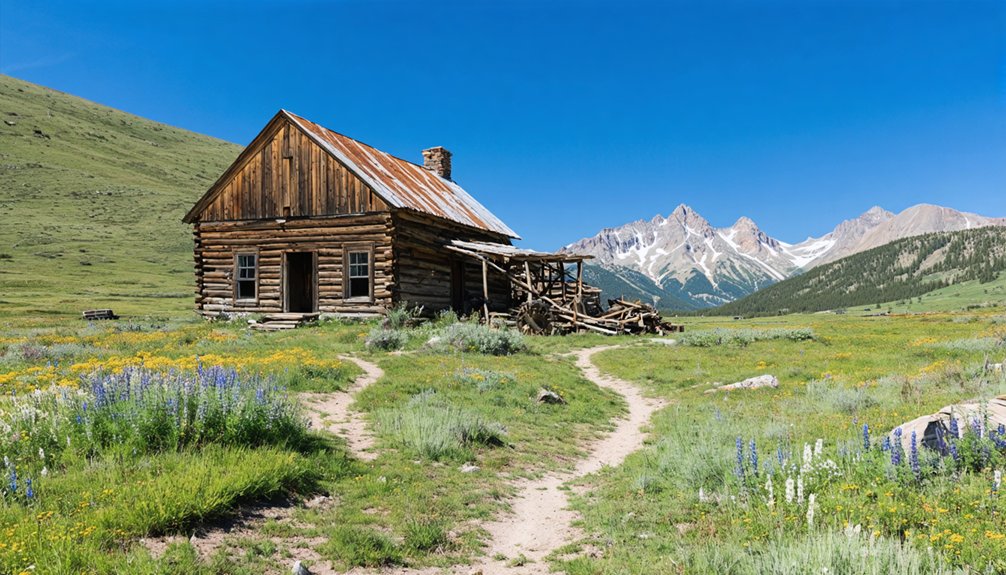
Straddling the Continental Divide at a breathtaking 12,000 feet, Carson offers one of Colorado’s most challenging and rewarding ghost town adventures, where you’ll navigate rough mountain terrain to reach a settlement that once thrived on both sides of America’s great watershed.
Carson history begins with John Christopher Carson’s 1876 discovery, leading to a booming mining district by 1882. You’ll need high-clearance 4WD to access this split settlement via Wager Gulch’s demanding route.
What Makes Carson Extraordinary:
- Dual Location – Old Carson on Pacific side, Bachelor Cabins on Atlantic side
- Mining Legacy – St. Jacob mine alone produced over $1 million in ore
- Elevation Views – Panoramic vistas of Weminuche Wilderness from 12,000 feet
- Preserved Ruins – Well-maintained saloon and cabins with reinforced roofs
Respect private property boundaries while exploring this remarkable high-altitude ghost town.
Tomboy: Remote Mining Relics Above Telluride
Towering above Telluride at 11,500 feet, Tomboy delivers one of Colorado’s most spectacular high-altitude ghost town experiences, where you’ll navigate treacherous switchbacks and cliff-hugging roads to reach the remnants of what was once the Telluride mining district’s second-largest producer.
Your high-clearance 4×4 will tackle five grueling miles on Tomboy Road, climbing through loose rock and narrow passages to reach Savage Basin’s glacial cirque.
Five miles of bone-jarring switchbacks and razor-thin ledges separate you from Tomboy’s high-altitude treasure trove.
Here, Tomboy Mine’s ruins sprawl across alpine terrain where 900-2,000 residents once called home. You’ll discover crumbling miner cabins, the general store foundation, and mining structures that produced millions in precious metals from 1894 to 1927.
Pack jackets, water, and sturdy boots—this summer-only adventure rewards the bold with breathtaking views and authentic Wild West history.
Alta: National Register Ghost Town With Alpine Lakes Access

You’ll discover Alta’s remarkable preservation as a National Register ghost town where twenty original buildings from the 1870s silver boom still stand at 11,800 feet elevation.
The historic mining camp offers you authentic glimpses into Colorado’s industrial past, including the site where alternating current electricity was first used industrially in 1891.
Your ATV adventure extends beyond ghost town exploration to the pristine Alta Lakes, where you can camp, hike, and mountain bike amid stunning alpine scenery with views of 14er Wilson Peak.
Historic Mining Camp Preservation
Nestled at an extraordinary 11,800 feet above sea level, Alta stands as Colorado’s highest accessible ghost town and represents one of the state’s most significant mining camp preservation success stories.
This National Register site protects authentic remnants of America’s mining heritage from 1877 to 1948, offering you an unfiltered glimpse into Colorado’s industrial past.
Alta’s historic preservation showcases remarkable surviving structures:
- Two-story boardinghouse – Built in 1939 from salvaged materials, it’s one of Colorado’s last major mining camp boardinghouses.
- Original miners’ cabins – Weathered but standing proof of high-altitude living conditions.
- Company town foundations – Remnants of the general store, school, and recreation hall.
- Mill site ruins – Evidence of the town’s $2-million wartime production through WWII.
Alpine Lakes Recreation Access
Beyond preserving Colorado’s mining heritage, Alta delivers exceptional alpine recreation opportunities that convert your ghost town exploration into a complete high-country adventure.
You’ll discover the nearby Alta Lakes provide pristine fishing spots where cutthroat trout thrive in crystal-clear mountain waters. These alpine gems sit perfectly positioned for casting lines between exploring abandoned cabins and mine structures.
The surrounding terrain offers extensive alpine trails that wind through aspen groves and across rocky meadows at 11,800 feet elevation.
You can easily shift from photographing historic buildings to hiking scenic routes that showcase the San Juan Mountains’ dramatic peaks.
Swimming in the frigid lakes provides invigorating relief after dusty ATV rides, while the high-altitude setting delivers that untamed wilderness experience you’re seeking beyond civilization’s reach.
Planning Your ATV Adventure Through Colorado’s Mining Past
When planning your ATV expedition through Colorado’s abandoned mining settlements, you’ll need to take into account elevation, terrain difficulty, and vehicle requirements before hitting the trails.
These ghost towns sit at extreme altitudes—some exceeding 12,000 feet—demanding high-clearance four-wheel drive vehicles and experienced handling skills.
Essential preparation steps include:
- Secure proper equipment – Rent ATVs from general stores near St. Elmo or contact Durango Rivertrippers for reliable machines and route guidance.
- Research trail ratings – Imogene Pass rates 4/5 difficulty, while Bachelor Loop offers easier terrain for beginners.
- Plan multi-day routes – The Alpine Loop spans 65 miles requiring over four hours to complete.
- Practice trail etiquette – Follow off-road guidelines to preserve these historical sites for future adventurers.
Short wheelbase vehicles handle narrow alpine paths best, avoiding full-size trucks on challenging terrain.
Frequently Asked Questions
What ATV Rentals Are Available Near Colorado Ghost Towns?
You’ll find ATV rental options through local shops like Leadville ATV Tours, Adventure Times Rentals in Frisco, and Durango/Silverton operators. These outfitters provide direct trail access to Colorado’s historic mining towns and abandoned settlements.
Are There Camping Facilities Near These Ghost Town Locations?
Like scattered stars across wilderness, camping spots exist through dispersed forest service sites near these ghost towns. You’ll find primitive backcountry options but minimal local amenities, requiring self-sufficient preparation for true off-grid adventures.
What Safety Equipment Is Required for ATV Ghost Town Exploration?
You’ll need essential safety gear including DOT helmets, eye protection, sturdy boots, and gloves. Follow riding regulations requiring headlights, taillights, brakes, and spark arrestors for unrestricted ghost town adventures across Colorado’s rugged terrain.
Which Ghost Towns Allow Overnight Camping on the Property?
Don’t count your chickens before they hatch—most ghost towns prohibit overnight stays. You’ll find camping regulations restrict on-site sleeping at St. Elmo and Carson, while ghost town amenities remain limited for overnight adventurers seeking true freedom.
What Are the Best Months for ATV Access to High-Altitude Towns?
June through September offer your best window for high-altitude ATV summer exploration. You’ll avoid dangerous snow conditions and enjoy stable weather considerations, giving you the freedom to reach 12,000-foot ghost towns safely.
References
- https://www.durangorivertrippers.com/blog/exploring-colorado-ghost-towns/
- https://kekbfm.com/colorado-ghost-towns-accessible-by-car/
- https://www.visitouray.com/ghost-towns
- https://www.colorado.com/articles/colorado-ghost-towns
- https://www.longmontleader.com/colorado/explore/20-must-visit-ghost-towns-in-colorado-for-an-eerie-adventure-10192944
- https://axlengear.com/1150-2/
- https://ouraymountainadventures.com/blog/four-wheeling-routes-in-ouray/
- https://www.youtube.com/watch?v=99MEDdHbn7c
- https://coloradocrosscountry.com/resources/colorado-ghost-towns
- https://westernmininghistory.com/towns/colorado/animas-forks/