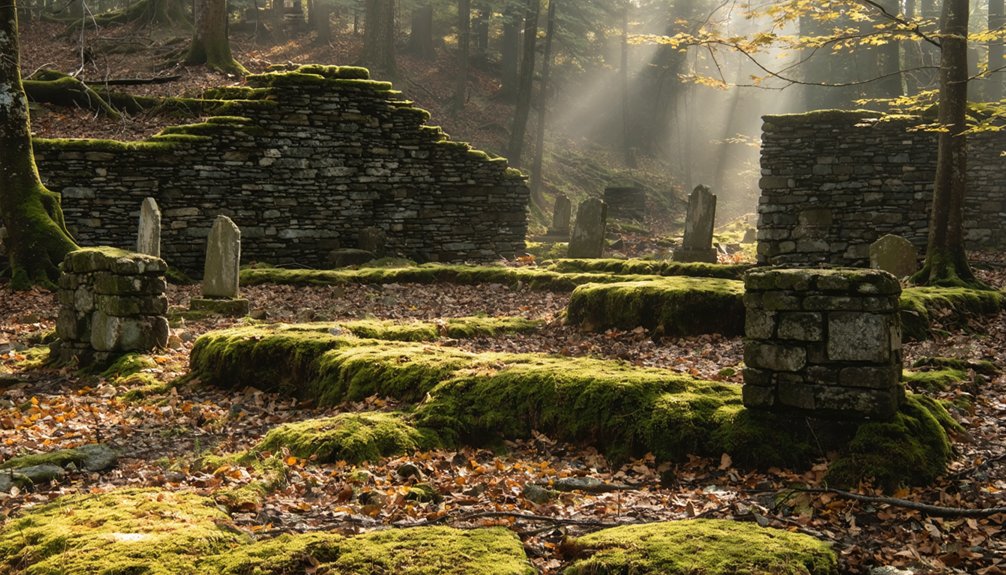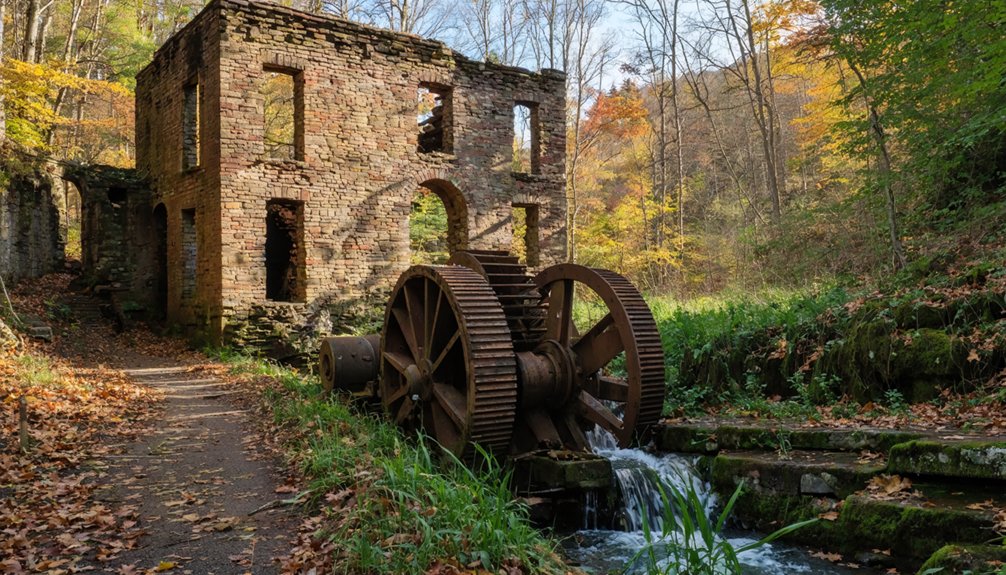
You can explore Connecticut’s ghost towns by ATV at several accessible locations including Johnsonville Village’s preserved Victorian mill town, Gay City State Park’s 21.5 miles of trails through abandoned settlements, and Bara-Hack’s crumbling foundations from 1778. The Saugatuck Reservoir area reveals submerged Valley Forge Village during droughts, while Pleasure Beach requires parking your ATV and continuing by boat. Proper safety gear, navigation tools, and trail permits are essential for these adventures. Discover the complete exploration guide below.
Key Takeaways
- Johnsonville Village in East Haddam offers 62 acres of preserved Victorian mill town ruins with authentic ghost town atmosphere.
- Gay City State Park features 21.5 miles of interconnected ATV trails through former Methodist mill town with crumbling ruins.
- Bara-Hack provides access to 1778 settlement foundations and cemetery ruins, but requires landowner permission for ATV exploration.
- Saugatuck Reservoir Area contains submerged Valley Forge Village remains that become visible during drought years for unique exploration.
- Pleasure Beach requires parking ATVs in Stratford and continuing by boat, as vehicle bridge access was lost in 1996.
Johnsonville Village: Victorian Mill Town Adventure
While most ghost towns require rugged off-road vehicles to reach their crumbling remains, Johnsonville Village sits just off paved roads in East Haddam, making it accessible for riders looking to explore Connecticut’s most complete abandoned Victorian mill town.
Unlike remote ghost towns requiring four-wheel drive adventures, Johnsonville Village offers easy paved road access to Connecticut’s best-preserved Victorian mill town ruins.
You’ll discover a 62-acre preserved landscape where Neptune Mill once dominated twine production during the Industrial Revolution. The three-story mill with its distinctive steeple burned in 1972, but you can still explore the Emory Johnson Homestead, Victorian chapel, relocated schoolhouse, and worker tenements that Raymond Schmitt assembled in the 1960s.
Pack your camera for this industrial heritage site featuring millponds, lamp posts, and hitching posts. The village has been abandoned for nearly 20 years, creating an authentic ghost town atmosphere frozen in time. Iglesia ni Cristo purchased the property in 2017 for $1.85 million and is currently renovating the aging structures.
While historic preservation efforts stalled after Schmitt’s death, this hauntingly beautiful ghost town offers unmatched Victorian-era atmosphere without demanding extreme off-road capabilities.
Gay City State Park: Forest Trail Exploration
Deep in eastern Connecticut’s forests, Gay City State Park offers ATV riders 21.5 miles of interconnected trails winding through the haunting remains of a Methodist mill town that vanished after the Civil War.
You’ll navigate the wide Shenipsit/Gay City Connector Trail, a former road that bisects the park’s 1,569 acres with minimal elevation changes perfect for your machine.
The Outer Loop’s five-mile circuit takes you past crumbling mill ruins where woolen and paper mills once thrived.
You’ll discover grass-filled cellar holes and historic foundations scattered throughout the forest, remnants of the 1796 settlement.
Silent tombstones mark forgotten lives while stone foundations tell stories of prosperity lost to war and fire. The original settlement was established by a religious sect led by Elijah Andrus in what was initially called Factory Hollow.
After the town’s decline, the land was designated as a state park in 1944 when nature had fully reclaimed the abandoned settlement.
These moderate trails accommodate ATV exploration through Connecticut’s most accessible ghost town adventure.
Bara-Hack: Remote Wilderness Discovery
Beyond Mashomoquet Brook’s rushing waters, you’ll discover Connecticut’s most mysterious ghost settlement where Welsh families once broke bread in harmony before vanishing into legend.
Bara Hack history traces back to 1778 when Obadiah Higginbotham and Jonathan Randall led families from Rhode Island to establish this remote community. The settlement thrived until post-Civil War abandonment left only stone foundations and weathered graves.
Bara Hack hauntings draw paranormal enthusiasts seeking the “Village of Lost Voices.” Your wilderness exploration reveals:
- Crumbling stone foundations where families once gathered
- Randall-Botham Cemetery’s moss-covered headstones
- Ancient stone walls threading through dense forest
- Mill ruins beside the babbling brook
Many visitors report paranormal experiences at this haunted location, adding to its mysterious reputation. The site remained continuously occupied until the final residents departed in 1890, marking the end of over a century of settlement. Remember you’ll need landowner permission—this private property’s heavily monitored.
Pack GPS coordinates and respect posted boundaries while experiencing Connecticut’s most haunting backcountry mystery.
Dudleytown: Ancient Woods Expedition
You’ll need to scout alternative access routes since Dark Entry Forest remains strictly off-limits to ATVs and trespassers face enforcement patrols.
Pack your GPS unit and emergency gear because the surrounding Cornwall backcountry offers challenging terrain where riders report unexplained equipment failures and compass malfunctions.
The dense canopy creates an eerie midday darkness that’ll test your headlight systems and nerve as you navigate the network of old logging roads that once served this cursed settlement.
Modern riders exploring these backcountry routes follow paths that parallel the area where General Heman Swift reportedly lost his sanity after returning from the Revolutionary War, adding an unsettling historical dimension to your off-road adventure.
Local folklore traces the area’s dark reputation to Edmund Dudley’s beheading in the early 1500s, which supposedly cursed his descendants and the land they eventually settled in Connecticut.
Trail Access Points
While Dudleytown’s ruins lie tantalizingly within Dark Entry Forest‘s 800-900 acres, you’ll face significant access challenges due to strict private ownership restrictions.
The Dark Entry Forest Association prohibits visitors and maintains heavy police patrols, making ATV access impossible. However, understanding the terrain helps you appreciate this forbidden landscape’s allure.
Trail conditions around Dudleytown reveal why ATVs would struggle here anyway:
- Rocky, mountainous terrain with steep grades unsuitable for most recreational vehicles
- Narrow former roads now reduced to hiking-only trails through dense forest
- Stone foundations and cellar holes creating hazardous ground obstacles
- Limited sunlight penetration due to high valley walls affecting visibility
The nearby Mohawk Trail offers your closest legitimate approach, though accessing Dudleytown’s actual ruins remains off-limits to freedom-seeking adventurers. Originally established by the Dudley family from England in the mid-18th century, the settlement grew due to the iron industry before its eventual abandonment. This place name disambiguation exists because multiple locations share the Dudleytown designation across different regions.
Paranormal Activity Reports
Though Dudleytown’s trails remain off-limits to ATVers, the paranormal reports from this cursed settlement continue drawing adventurers who dream of exploring Connecticut’s most haunted ruins.
You’ll discover a haunted history dating back to Edmund Dudley’s 1510 execution, with the family curse allegedly following descendants to Cornwall.
Paranormal sightings escalated after Ed and Lorraine Warren’s 1970s investigation declared the site demonically possessed.
Modern explorers report wispy apparitions, mysterious lights, and overwhelming terror among the cellar holes.
You can’t legally ride here, but nearby trail networks offer access to equally mysterious abandoned sites.
Pack your camera gear and headlamps—Connecticut’s ghost towns deliver spine-chilling adventures for riders seeking supernatural thrills beyond conventional trails.
Saugatuck Reservoir Area: Submerged Settlement Sites
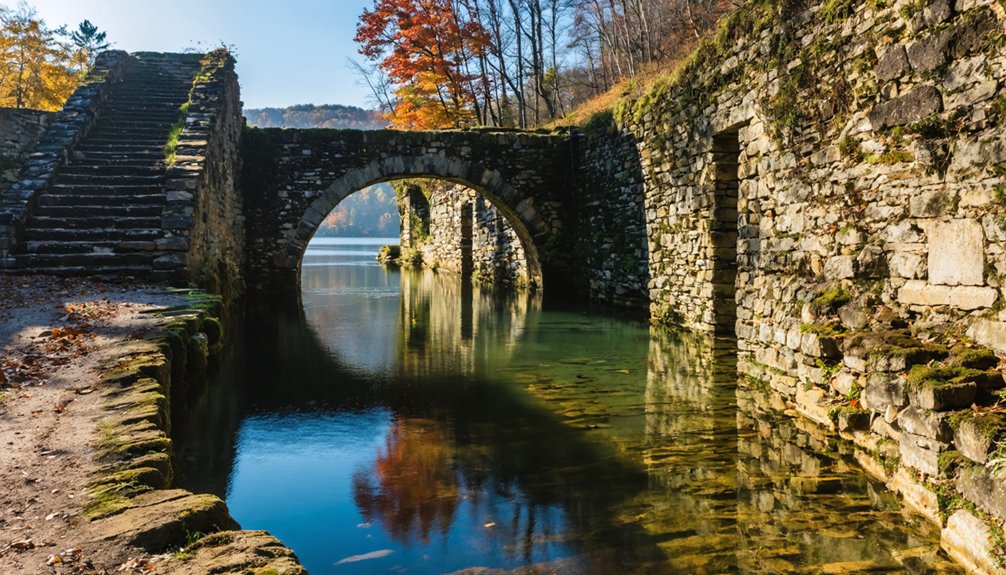
Beneath the dark waters of Saugatuck Reservoir lies Valley Forge Village, a complete 18th-century Welsh settlement that’s been submerged since 1945.
You’ll need to time your ATV expedition perfectly—drought years reveal this submerged history when water levels drop dramatically. The lost infrastructure emerges like a time capsule, showing you authentic glimpses of pre-industrial America.
What you’ll discover during low-water periods:
- Stone foundation walls of homes and the original iron plow manufacturing buildings
- Historic hitching posts still standing where horses once waited
- Original roadways that connected this thriving hamlet to surrounding towns
- Mill remnants from Wales’ most successful early manufacturing operation
Access the area via watershed trails connecting to Trout Brook Valley’s extensive trail system, but respect the protected Class 1 designation.
Pleasure Beach: Peninsula Ghost Town Access
Connecticut’s largest ghost town sits isolated on a peninsula where your ATV can’t follow—but that doesn’t mean you should skip this legendary destination.
Pleasure Beach lost its bridge connection in 1996, cutting off all vehicle access to this once-thriving amusement park community. While ATV access remains impossible due to the severed mainland link, you can park your machine in nearby Stratford and continue by boat or kayak.
This former Steeplechase Island housed carousel rides, theaters, and seasonal cottages until fires and abandonment claimed everything.
The 2014 reopening allows exploration of remaining structures like the Polka Dot Theatre, though all residential buildings are gone. Protected bird refuge status further restricts motorized access, making this a foot-exploration destination after your ATV adventure ends.
Essential ATV Equipment for Ghost Town Exploration

You’ll need proper safety gear and reliable navigation tools before heading out to Connecticut’s remote ghost towns on your ATV.
Your helmet, goggles, and gloves aren’t just recommendations—they’re essential protection against branches, debris, and weather you’ll encounter on overgrown trails leading to abandoned settlements.
Pack GPS coordinates, emergency communication devices, and backup navigation methods since cell service often disappears in these isolated areas where towns once thrived.
Safety Gear Requirements
Before you fire up your ATV and head toward Connecticut’s abandoned settlements, you’ll need the right safety gear to protect yourself from both terrain hazards and regulatory violations. Connecticut’s OHV areas demand DOT-certified helmets with integrated eye protection, while protective clothing shields you from brush and debris common around ghost town ruins.
Essential safety gear requirements include:
- DOT-certified helmet with full face shield cutting through morning mist as you navigate overgrown cemetery paths
- Long-sleeved shirt and pants deflecting thorny vines reaching from collapsed homestead foundations
- Over-the-ankle boots gripping loose stones scattered around abandoned mill sites
- Protective gloves maintaining handlebar control while dodging low-hanging branches on forgotten forest trails
Your ATV must feature functioning brakes, front/rear lights, reflectors, and a spark arrester to prevent wildfires in these historic areas.
Getting lost among Connecticut’s forgotten settlements can transform an exciting ghost town expedition into a dangerous ordeal, making reliable navigation and communication equipment your lifeline to civilization.
Your GPS Tools arsenal should include downloaded offline maps and pre-loaded waypoints since Connecticut’s backcountry often lacks cell service near abandoned settlements. Apps like onX Offroad provide trail difficulty ratings and property boundaries essential for legal access to ghost town sites.
Keep paper maps as backup when technology fails in dense forests surrounding these historic locations.
Your Communication Devices become vital when exploring with groups—two-way radios maintain contact when cell towers can’t reach remote valleys. Pack a compass, notebook for recording coordinates, and consider satellite communicators for emergency situations.
These tools guarantee you’ll return safely from Connecticut’s most isolated ghost town adventures.
Safety Considerations for Off-Road Adventures
While Connecticut’s ghost towns offer thrilling destinations for ATV exploration, your safety depends on proper preparation and adherence to essential off-road protocols.
Essential ATV maintenance tips include completing your T-CLOC checklist before each ride—inspecting tires, controls, lights, oil, and chassis components. Check tire pressure and wheel torque while testing brakes and throttle response.
Practice proper riding etiquette by maintaining safe distances from other riders and staying on designated trails.
Here’s your safety preparation checklist:
- Gear Up: Don DOT-compliant helmet, goggles, long sleeves, boots, and gloves
- Scout Ahead: Walk unfamiliar terrain to identify obstacles and drop-offs
- Pack Essentials: Carry first-aid kit, water, snacks, and communication device
- Ride Smart: Avoid alcohol, match ATV size to your capabilities, supervise young riders
Never attempt stunts or exceed your machine’s capabilities on these historic adventures.
Best Times to Visit Connecticut’s Abandoned Communities
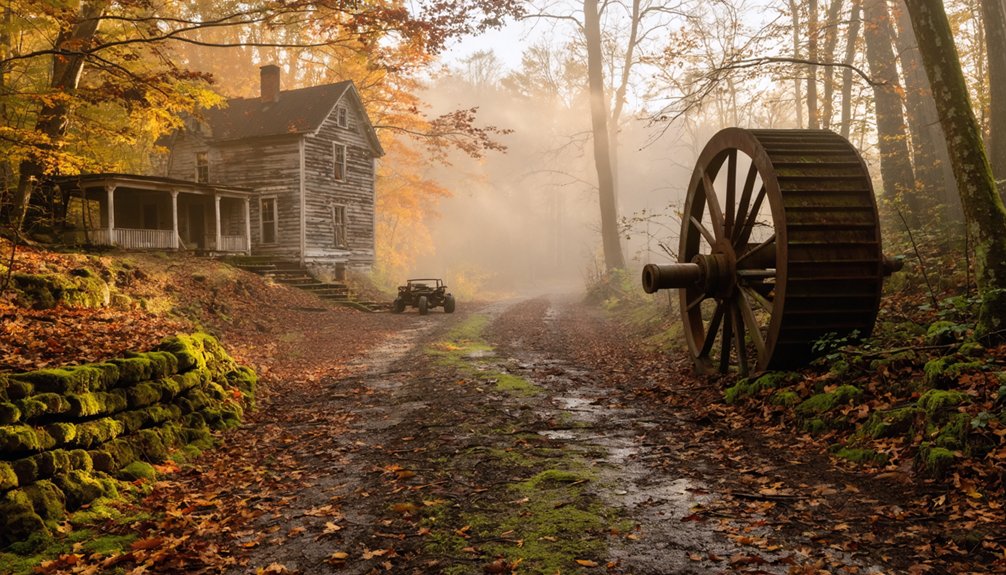
Throughout Connecticut’s changing seasons, timing your ghost town expeditions can dramatically impact your exploration experience and ATV accessibility.
Spring delivers ideal weather conditions with 50-60°F temperatures, minimal crowds, and clear sight lines through bare forests to ruins in Gay City and Johnsonville.
Summer’s extended daylight maximizes visibility at Dudleytown and Holy Land USA, while drought years expose submerged Valley Forge structures when reservoir levels drop.
Fall represents the best visiting seasons for photography, combining spectacular foliage with cooler 50-65°F temperatures and dry trail conditions perfect for accessing remote Fluteville remnants.
Winter offers complete solitude with frozen ground firming ATV trails, though short daylight limits exploration windows to essential gear-loaded expeditions.
Frequently Asked Questions
Do I Need Special Permits to Ride ATVS on Private Ghost Town Property?
Ready to explore abandoned settlements? You’ll need written permission from private property owners plus ATV registration for ghost town adventures. These riding regulations protect landowners while ensuring you’re legally equipped for trail exploration.
You’ll need long-travel suspension upgrades with 10+ inches of travel and aggressive tire choices like knobby treads. Add skid plates, reinforced A-arms, and high-flotation tires for Connecticut’s unforgiving rocky terrain.
Are There Guided ATV Tours Available for Connecticut’s Abandoned Communities?
Ironically, while Connecticut’s forests hide abandoned settlements perfect for ghost town exploration, you won’t find guided tours leading you there. You’ll need to blaze your own trails to discover these forgotten communities independently.
If you’re willing to venture beyond Connecticut, there are also fascinating ghost towns in New Hampshire that offer a glimpse into the past. Many of these locations are tucked away in the White Mountains, where nature has reclaimed its territory. Exploring these eerie remnants can be both an adventure and a reminder of the transient nature of human settlements.
How Do I Find Legal ATV Parking Areas Near Ghost Town Trailheads?
Check trailhead maps at state forest entrances for designated ATV parking zones. You’ll find marked staging areas with proper signage. Contact local ranger stations for current parking regulations and seasonal restrictions before heading out.
What’s the Penalty for Illegal ATV Use on State Conservation Land?
You’ll face up to $250 fines plus impoundment when penalty enforcement catches illegal riding. Conservation regulations prohibit ATV use on state land without written permission—your machine gets confiscated and auctioned off.
References
- https://earlybirdonthetrail.com/haunted-hikes-in-connecticut/
- https://www.williampitt.com/johnsonville-connecticuts-hauntingly-beautiful-ghost-town/
- https://www.atlasobscura.com/things-to-do/connecticut/ghost-towns
- https://en.wikipedia.org/wiki/List_of_ghost_towns_in_Connecticut
- https://www.youtube.com/watch?v=RODeJvoS7NE
- https://www.ctinsider.com/projects/2025/lost-ct-towns/
- https://i95rock.com/mystery-of-dudleytown-ct/
- https://i95rock.com/the-abandoned-ghost-town-of-johnsonville-ct-then-now/
- https://www.atlasobscura.com/places/johnsonville-village
- https://johnsonville.omeka.net/exhibits/show/tour/johnsonvilleroad/mill