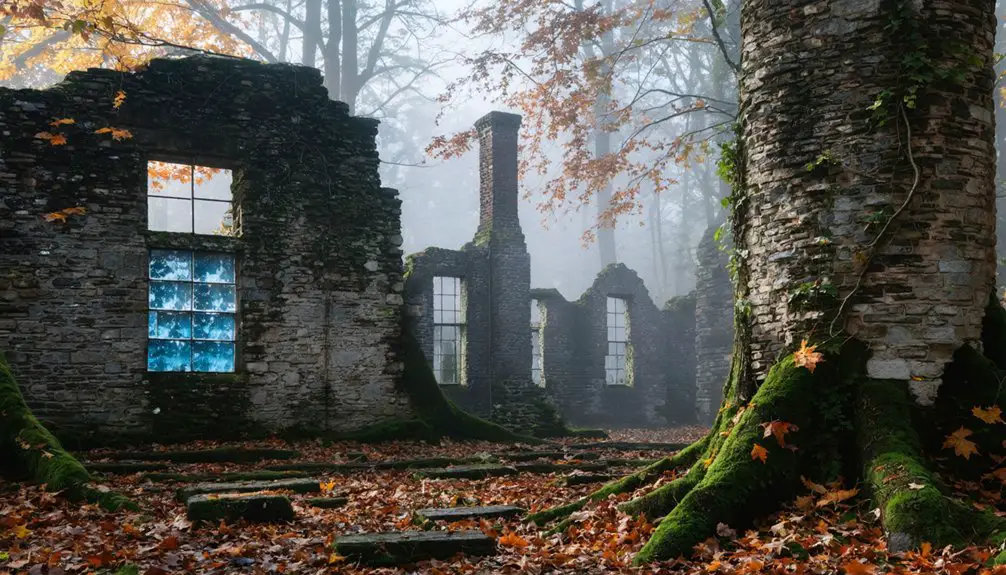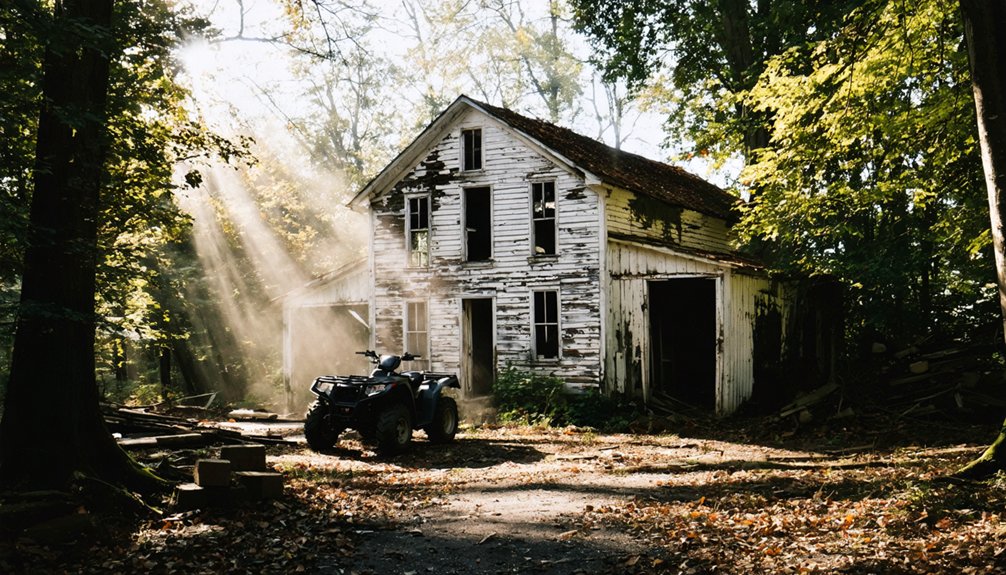
You’ll find incredible ghost town adventures in Massachusetts, where your ATV can tackle overgrown trails leading to Norton Furnace’s 19th-century industrial ruins, Dogtown’s mysterious pirate-era settlement, and paths near Quabbin Reservoir’s submerged communities. These sites require serious off-road capabilities due to muddy conditions and dense vegetation. Prime riding locations include Beartown State Forest, October Mountain, and Pittsfield State Forest, offering 25-30 miles of challenging terrain. Proper gear and Massachusetts registration are essential for exploring these haunting historical destinations.
Key Takeaways
- Norton Furnace in Bristol County requires ATV access due to overgrown trails and muddy conditions around the abandoned iron works.
- Dogtown’s 3,600 acres contain numbered ruins from an 1641 settlement, accessible through challenging terrain suited for off-road vehicles.
- Quabbin Reservoir area offers trails around submerged towns where four communities were flooded in 1938 for Boston’s water supply.
- October Mountain State Forest provides 30 miles of expert-level ATV trails across 16,000 acres with required registration and permits.
- Beartown State Forest features 25 miles of intermediate to expert OHV trails spanning three towns with seasonal access restrictions.
Norton Furnace: Bristol County’s Industrial Past
When you fire up your ATV and head two miles south of Norton in Bristol County, you’ll discover the forgotten remains of Norton Furnace, a once-thriving industrial settlement that’s now accessible only through the overgrown trails of L.A. Foster Wildlife Refuge.
Deep in Bristol County’s wilderness lies Norton Furnace, a forgotten industrial ghost town waiting to be rediscovered through muddy ATV trails.
This ghost town’s industrial heritage dates back to 1825 when Annes A. Lincoln, Jr. established an iron furnace at the junction of Wading River and Three Mile River.
You’ll navigate trails where 65 workers once produced $90,000 worth of hollowware and castings during the 1865 peak.
The historical significance becomes clear as you explore remnants of 25 houses, a railroad station, and copper works that operated until the 1890s. Norton Furnace was originally one of seven villages that formed the incorporated town of Norton in 1711. The site features stone and brick construction typical of 19th-century industrial architecture that has withstood decades of abandonment.
Pack your gear for muddy conditions—these overgrown paths require serious traction and ground clearance.
Dogtown: a Settlement Born From Pirate Fears
You’ll find Dogtown’s rocky trails tell the story of 80 families who fled inland around 1641 to escape pirate raids along Gloucester’s coast.
After the Revolutionary War ended those maritime threats, residents abandoned this highland settlement for better opportunities at the harbor, leaving behind only foundation stones and cellar holes. The area then attracted outcasts and drifters who squatted in the abandoned homes until 1839.
Wild dogs roamed the deserted streets as nature began reclaiming the abandoned buildings, giving the settlement its enduring nickname.
Pack your GPS and explore over 3,600 acres where numbered ruins mark what was once Cape Ann’s most prosperous inland community.
Pirate Protection Origins
While coastal pirates terrorized Gloucester’s harbor in the early 1600s, determined families carved out a rocky refuge five miles inland that would become one of Massachusetts’ most haunting ghost towns accessible by ATV today.
Around 80 families fled devastating pirate raids between 1641-1693, establishing Common Settlement on strategically chosen highland terrain. You’ll discover how these settlers prioritized inland safety over convenience, using rocky outcrops as natural fortifications against attacking ships and hostile forces.
The settlement’s defensive positioning shielded vulnerable women and children from bombardments that plagued coastal areas through the Revolutionary War.
Smart location choice—pine forests provided building materials while poor soil supported livestock rather than crops. These pioneer families understood survival meant trading harbor access for protection, creating a fortress community that thrived until pirate threats finally ended after 1812. At its peak in the mid-to-late 1700s, the community had grown to include around 75 homes housing over 100 families across approximately 5 square miles. Located at Cape Ann’s geographic center, the settlement became the primary route connecting Gloucester to Rockport and surrounding areas.
Post-War Abandonment Pattern
After the Revolutionary War ended, Common Settlement’s protective purpose vanished as quickly as morning fog lifts from Cape Ann’s granite shores.
You’ll find this classic post war migration pattern repeated across New England’s backcountry. Returning soldiers discovered their inland refuge had become a liability—deforested land couldn’t sustain families when new roads bypassed the settlement entirely for Gloucester’s thriving fishing industry.
The War of 1812 accelerated rural depopulation as families fled to better-defended coastal settlements. By 1814, only six houses remained standing from the original eighty.
You’re witnessing America’s first ghost town emergence here. The final residents—war widows, freed slaves, and squatters—clung on until 1830 when the last inhabitant died in Gloucester’s poorhouse. Among these final inhabitants were approximately 60 widows of Revolutionary War soldiers who struggled with the area’s economic decline. Roger Babson later donated 1,000 acres of this abandoned settlement to Gloucester for watershed protection in 1930.
Today’s ATV trails wind through these forgotten cellar holes.
Current Foundation Remains
Dogtown’s stone foundations tell a different story than Common Settlement’s gradual decline—this rocky highland refuge was born from terror of the seas.
You’ll discover numbered cellar holes scattered across 3,600 acres of preserved trails, marking where 75 homes once sheltered families from pirate raids. These current remains reveal the historical significance of America’s most unusual ghost town—a settlement that thrived on fear, then vanished when safety returned to Gloucester’s harbors.
Pack your GPS and trail map; the foundation markers guide you through dense woods where Revolutionary War widows once scraped survival from rocky soil. The landscape features giant boulders and unique rock formations carved by ancient glacial activity that shaped this elevated terrain.
Each numbered stone foundation tells of families who chose isolation over coastal vulnerability. Your ATV can access multiple trail entrances, leading to this elevated sanctuary where desperation built community.
Quabbin Reservoir’s Submerged Communities
Beneath the waters of Quabbin Reservoir lie the remnants of four Massachusetts towns that vanished overnight in 1938. Enfield, Greenwich, Dana, and Prescott were sacrificed for Boston’s water supply, forcing over 2,500 residents to abandon their homes forever.
You can’t ride your ATV through these submerged towns, but understanding this Quabbin history adds depth to your explorations around the reservoir’s perimeter.
The flooding consumed 39 square miles, swallowing entire communities—60 summer camps, 14 mills, schools, and churches all disappeared beneath 412 billion gallons of water. The massive project required exhuming and reinterring 7,500 bodies from local cemeteries before the flooding began.
While exploring nearby trails, you’re riding above a drowned civilization where descendants of Revolutionary War veterans once farmed. These submerged towns remain Massachusetts’ most dramatic example of progress demanding sacrifice from rural communities.
Beartown State Forest OHV Trail System
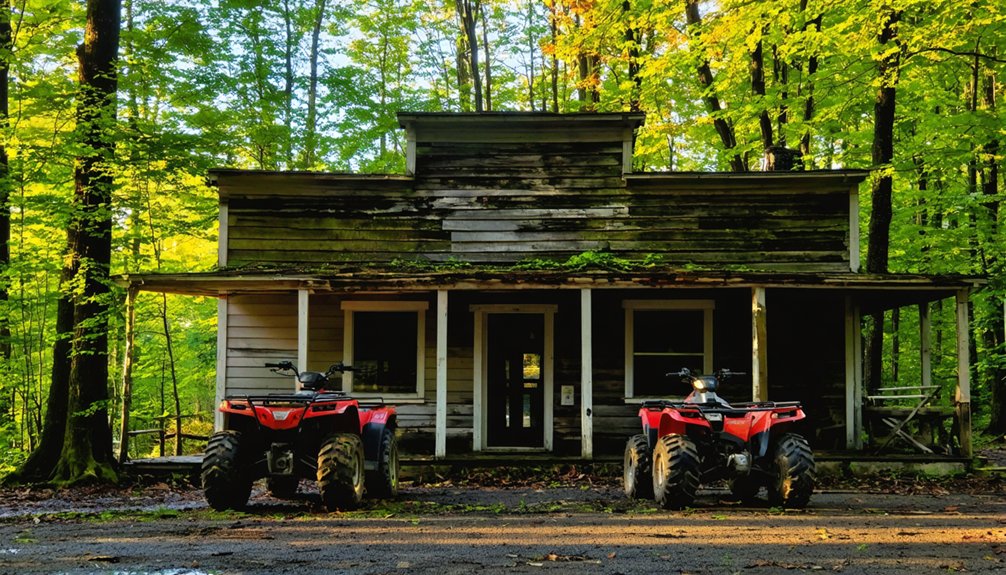
Beartown State Forest delivers 25 miles of punishing OHV terrain that’ll test your machine and your mettle across 12,000 acres of Berkshire County wilderness.
Beartown’s 12,000 acres of Berkshire wilderness serve up 25 miles of brutal OHV trails that separate riders from pretenders.
These Beartown trails span Lee, Great Barrington, and Monterey, offering serious ATV challenges for intermediate to expert riders only.
You’ll navigate loose rock, chunk obstacles, mud puddles, and gnarly tree roots while conquering steep climbs and descents across 16.4 miles of technical terrain.
The trail system demands respect and skill.
Key details for your adventure:
- Season runs May 1st through November’s last Sunday
- 2,000-pound vehicle weight limit strictly enforced
- Parking fees: $8 MA residents, $30 non-residents (Memorial Day through Labor Day)
- Sunrise to sunset riding hours only
Your freedom awaits on trails maintained by Berkshire Trails Council and local clubs.
October Mountain State Forest ATV Access
You’ll find October Mountain State Forest’s 30 miles of OHV trails aren’t for beginners—these challenging routes demand intermediate to expert riding skills across 16,000 acres of mixed hardwood terrain.
Before you load your ATV onto the trailer for transport through the campground, you’ll need to understand the registration requirements and obtain proper permits for legal trail access.
The forest’s partnership with Berkshire Trails Council guarantees well-maintained trails, but you’re restricted to designated routes during daylight hours only.
Trail Difficulty Levels
When you’re sizing up October Mountain State Forest‘s ATV trail system, you’ll quickly discover this isn’t beginner territory. The terrain challenges here demand serious riding skills, with most trails designed for expert-level riders who crave technical obstacles.
Trail suitability breaks down into distinct categories that’ll determine your ride experience:
- Expert terrain dominates – Most trails push experienced riders to their limits
- Limited intermediate sections – Some moderate challenges for developing skills
- Minimal beginner options – Novice riders should look elsewhere
- Overall challenging classification – System-wide difficulty exceeds most expectations
You’ll find 345 documented OHV riders tackled these trails during the recent season, proving the appeal for hardcore enthusiasts.
The combination of steep grades, technical sections, and demanding navigation makes this destination perfect for riders seeking freedom through challenging backcountry adventures.
Registration and Permits
Before you fire up your ATV for October Mountain’s challenging trails, Massachusetts demands proper paperwork that’ll keep you legal on these expert-level routes. Your registration requirements start with Massachusetts Environmental Police – out-of-state plates won’t cut it here. You’ll need your ATV Massachusetts-registered specifically for October Mountain access.
Daily riding permits are free from DCR, but nonresidents face steeper permit fees: $33 annually or $44 for two years at October Mountain. The permit program tracks rider data for trail management, so you’re contributing to future access.
Riders under 18 must complete safety training before hitting these technical trails. Don’t forget daily parking fees – $8 for Massachusetts residents, $30 for out-of-staters. Reservations are mandatory; no walk-ins allowed.
Pittsfield State Forest Off-Road Routes
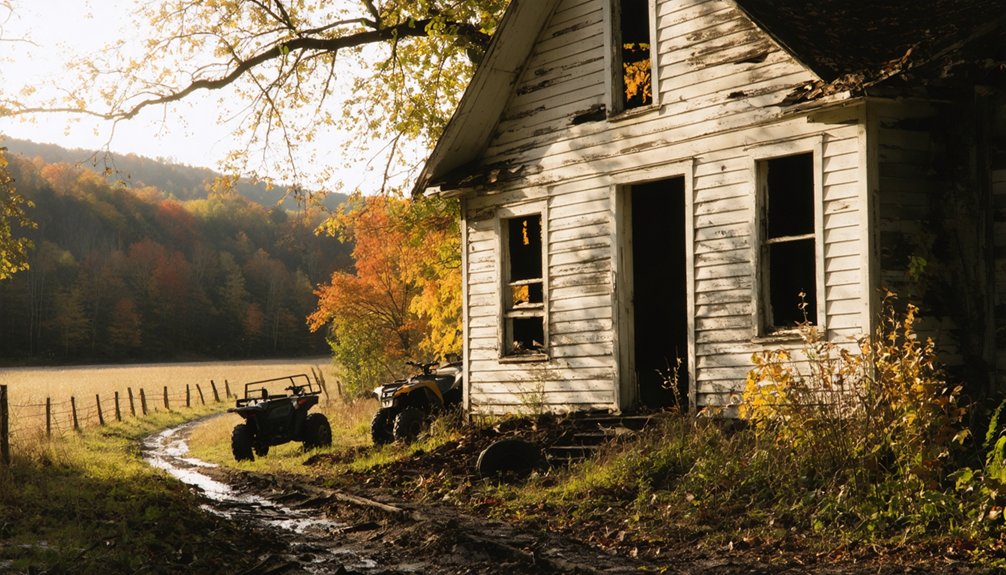
The rugged terrain of Pittsfield State Forest delivers 14-16 miles of challenging OHV trails that’ll test your riding skills across 11,000 acres of Western Massachusetts wilderness.
These off road adventures wind through mixed hardwood forests with fast, smooth sections perfect for intermediate to expert riders seeking scenic routes through the Taconic Range.
Your trail access requires proper preparation:
- Free OHV permit plus Massachusetts registration for your machine
- Designated parking at Potter Mt. Road Trailhead or Rt. 20 in Hancock ($5 MA residents, $20 non-residents during peak season)
- Sunrise to sunset riding hours strictly enforced
- Trailer transport required when moving between trail sections
The Berkshire Trails Council maintains these challenging paths featuring large rocks and dirt surfaces that demand respect and skill.
Tolland State Forest Motorcycle Trails
While ATVs no longer roam these trails, Tolland State Forest‘s 15-mile network still welcomes street-legal dual-sport motorcycles across its sprawling terrain in Otis, Blandford, and Tolland.
You’ll discover diverse riding surfaces from wide forested paths to crushed stone sections, perfect for adventure-seeking riders craving unrestricted exploration.
Motorcycle Access remains straightforward via Route 23—follow West Shore Road past East Otis village, then turn left onto Tolland Road.
The Tolland Trails offer varied challenges, including Alan Road’s sustained 5-10% grades that’ll test your machine’s capabilities.
You’ll parallel the West Branch Farmington River, accessing remote expanses where wildlife thrives.
Contact forest headquarters for current motorized use regulations before riding.
This terrain connects you to Massachusetts’ backcountry freedom, where dual-sport bikes reveal paths through pristine Berkshire wilderness.
Planning Your Ghost Town ATV Adventure

Success on Massachusetts’ ghost town trails demands smart preparation and route selection that’ll keep you riding legally while maximizing your adventure potential.
Smart preparation and strategic route selection unlock Massachusetts’ ghost town adventures while ensuring legal compliance and maximum exploration potential.
Your ghost town ATV expedition requires strategic planning to navigate permit requirements while accessing historically significant areas.
Essential preparation steps include:
- Secure proper permits – Obtain free OHV permits for Pittsfield State Forest and verify road registration requirements for Copicut-Quanapoag Connector
- Check trail maintenance status – Contact Berkshire Trails Council for current conditions on Beartown and Pittsfield routes
- Plan sunrise-to-sunset rides – Respect operating hours at Pittsfield and Freetown-Fall River State Forests
- Research historical significance – Study ghost town locations near Quabbin Reservoir and Norton Furnace before departure
You’ll maximize your adventure by combining legal trail access with Massachusetts’ rich abandoned settlement history.
Frequently Asked Questions
What Safety Equipment Is Required for ATV Riding to Ghost Towns?
You’ll need DOT-approved helmets, adequate brakes, mufflers, and lighting after sunset when exploring. Safety gear and riding regulations require eye protection, gloves, and over-ankle boots for your ghost town adventures.
Are Camping Facilities Available Near Massachusetts Ghost Town ATV Trails?
Like scattered campfire embers, camping amenities remain elusive near Massachusetts ghost town ATV trails. You’ll find limited facilities at state forests, but nearby attractions offer alternative lodging for your freedom-seeking adventures through forgotten territories.
Exploring abandoned towns in New Hampshire can lead to fascinating discoveries and a chance to connect with the past. Many visitors are drawn to the remnants of old buildings and the stories that linger in these forgotten places. As you navigate through the ruins, you might stumble upon scenic hiking trails that provide a perfect backdrop for adventure photography.
What Are the Permit Fees for Accessing State Forest OHV Trails?
You’ll pay $44 for a 2-year resident registration or $33 annually as non-resident for your permit application. This covers trail access to designated state forest OHV routes where adventure awaits.
Can Children Ride ATVS on Massachusetts Ghost Town Trail Routes?
Children can’t ride ATVs on most Massachusetts ghost town routes due to strict ATV age restrictions. You’ll find limited family friendly trails, requiring direct adult supervision and safety gear for riders under eighteen.
Which Ghost Town Locations Offer the Easiest ATV Trail Difficulty Levels?
You’ll find absolutely zero ghost town locations with easy ATV trails! Historical significance doesn’t guarantee beginner-friendly paths. Trail maintenance focuses on intermediate-expert routes at Beartown and Pittsfield, demanding serious gear and skills.
References
- https://www.traillink.com/stateactivity/ma-atv-trails/
- https://www.onxmaps.com/offroad/beginner-offroad-trails-near-me/methuen-town-ma
- https://www.mass.gov/info-details/find-a-state-park-ohv-riding-trail
- https://patch.com/massachusetts/boston/only-massachusetts-ghost-towns-bay-state
- https://www.beverlyma.gov/1096/Beverly-Commons
- https://www.tripadvisor.com/Attractions-g28942-Activities-c61-t211-Massachusetts.html
- https://www.atvrider.com/story/ride/where-to-ride-atvs-massachusetts/
- https://www.mass.gov/locations/kenneth-dubuque-memorial-state-forest
- https://wnaw.com/october-mountain-state-forest-massachusetts/
- https://www.wikiwand.com/en/articles/Norton_Furnace