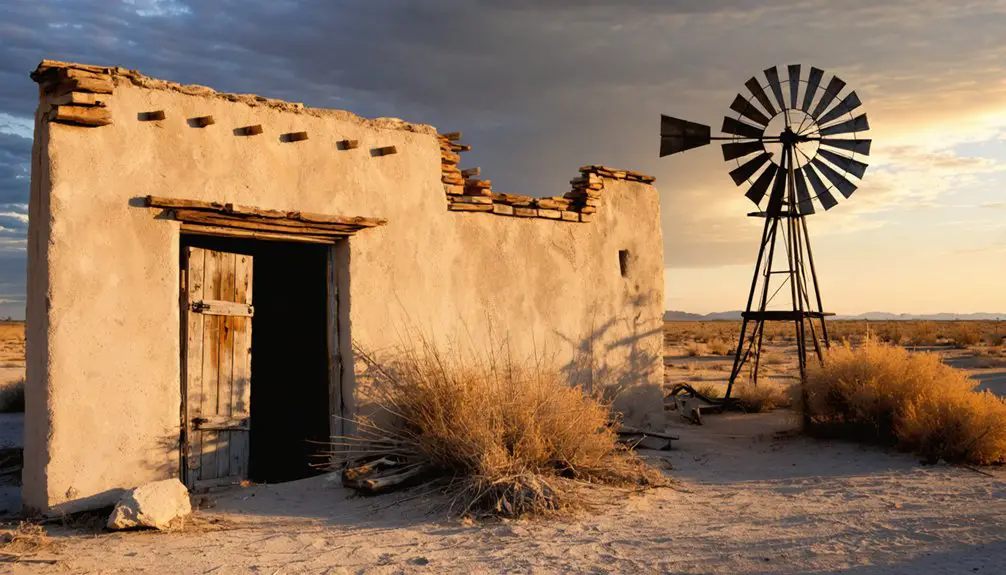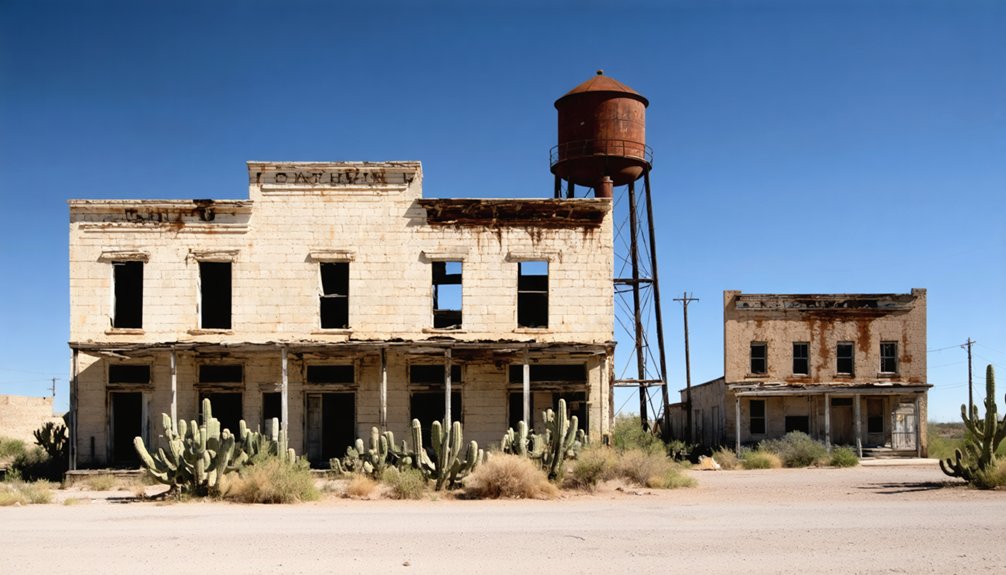
West Texas’s ghost towns emerged rapidly during the 1880s-1910s railroad and resource booms before collapsing just as quickly. You’ll find Medicine Mound’s sacred Comanche hills turned 1908 railroad town, destroyed by 1932 fire; Lobo’s 1882 cotton depot revived as an art colony; Tascosa’s 1876 cowboy capital now housing Boys Ranch; Thurber’s unionized coal empire supplying half the U.S. soft coal by 1911; and Stiles’s 1894 ranching community abandoned after railroad denial. Each settlement’s remnants—stone courthouses, electrified infrastructure, Boot Hill cemeteries—reveal how single decisions about rail routes or resources determined entire communities’ fates.
Key Takeaways
- Medicine Mound was platted as a railroad town in 1908, peaked at 500 residents by 1929, then fire destroyed it in 1932.
- Lobo began as an 1882 railroad depot and cotton hub before economic collapse in the 1980s from irrigation costs and well depletion.
- Tascosa emerged as a cowboy capital in 1876 following cattle drives but declined by 1887 due to barbed wire and railroad bypasses.
- Thurber was founded in the mid-1880s as a coal mining town, becoming America’s first completely unionized municipality before declining after 1910.
- Stiles was founded by sheep ranchers in 1894, thrived briefly after 1903, but declined after railroad denial in 1912 and oil discovery elsewhere.
Medicine Mound: From Sacred Ceremonial Grounds to Forgotten Settlement
Rising 200 to 350 feet above the West Texas plains, four conical dolomite hills mark a landscape where Comanche spiritual tradition converged with the forces that would eventually erase a frontier settlement.
The sacred significance of these mounds, where healers performed vision quests and Quanah Parker himself conducted ceremonies, predated the railroad town platted in 1908.
You’ll find Medicine Mound peaked at 500 residents and 22 businesses by 1929, fueled by cotton and cattle production.
Yet the 1932 fire that destroyed most structures, combined with Depression-era drought and sandstorms, triggered irreversible economic decline.
By the 1980s, fewer than 50 people remained.
Today, you’ll discover only cobblestone ruins where autonomy-seeking pioneers once built their lives.
The remaining buildings were constructed with round cobble stones from the Wichita Mountains, replacing the wooden structures lost to flames.
The mounds themselves are composed of dolomite remnants from ancient oceanic sediment, their poor soil preserving them from agricultural development while sheltering the unique flora historically used in Comanche healing practices.
Lobo: The Railroad Stop That Became an Art Installation
While Medicine Mound’s decline stemmed from fire and environmental catastrophe, Lobo’s transformation illustrates how economic miscalculation and resource depletion can convert a settlement into something entirely different from its founders’ vision.
Economic missteps and depleted resources can reshape a town into something unrecognizable from its original purpose.
You’ll find a town that began as an 1882 railroad depot, survived as a cotton hub, then collapsed when irrigation costs soared and wells dried from over-pumping in the 1980s.
What makes Lobo unique isn’t its historical significance as a failed agricultural settlement—it’s the artistic revival that followed. German investors purchased the abandoned town in 2001, transforming seven acres into a private venue for experimental film and music festivals. The town hosted the Desert Dust Cinema Festival for several years, drawing artists and filmmakers to this remote West Texas location.
You can’t visit without invitation, but Lobo demonstrates how ghost towns needn’t remain frozen memorials. For over a century, it served as a thriving railroad watering stop before its last residents departed in 1991.
Tascosa: Where Cattle Drives Ended and Boys Ranch Began
Unlike Lobo’s quiet fade into artistic obscurity, Tascosa’s trajectory spans from violent cattle-trade epicenter to charitable institution—a transformation that required both economic collapse and philanthropic intervention.
You’ll find Tascosa emerged as the Panhandle’s cowboy capital following Charles Goodnight’s cattle drives in 1876, rivaling Dodge City by the 1880s.
Five years without law enforcement created Boot Hill Cemetery, where outlaws like Billy the Kid walked streets lined with 24-hour salons.
Barbed wire and railroad bypasses sealed its fate by 1887—only fifteen residents remained by 1915.
The town developed distinct sections, with Upper Tascosa and Lower Tascosa known as Hogtown serving different populations.
The March 1886 gunfight left four men dead, including an innocent bystander, marking both the peak and decline of cattle syndicate conflicts in the region.
Julian Bivins’s 1939 donation created Cal Farley’s Boys Ranch, establishing a ranch legacy that replaced gunfights with opportunity.
The sandstone courthouse became a family home, then part of a working settlement where underprivileged boys found training and purpose.
Thurber: The Coal Boom Town That Fueled an Empire
When the Johnson brothers discovered bituminous coal deposits in northwestern Erath County during the mid-1880s, they inadvertently created what would become Texas’s most ambitious company town.
After Eastern investors acquired the operation in 1888, Thurber transformed into a coal mining powerhouse, eventually supplying half of all soft coal mined in the U.S. by 1911.
The town became America’s first completely unionized municipality under the United Mine Workers, though this achievement followed years of repressive working conditions for its largely immigrant workforce.
Thurber’s hard-won union status masked a darker history of exploitation endured by its immigrant miners.
When the Texas & Pacific Railroad converted to oil after 1910, Thurber’s fate was sealed.
The company established a large brick plant in 1897, which operated separately from the mining operations and continued production until 1930.
Labor strikes erupted in 1921 and 1926-1927 as mines closed, and by 1930, the once-thriving community had effectively vanished.
Thurber’s infrastructure included a 24-hour electric plant, making it one of the first fully electrified towns in Texas.
Stiles: Adobe Ruins of a Failed Ranching Community
The weathered adobe ruins scattered across Reagan County’s windswept plains mark the site of Stiles, a frontier settlement that rose and fell with the fortunes of West Texas ranching before succumbing to infrastructure politics and petroleum economics.
Founded in 1894 by Gordon Stiles and fellow sheep ranchers, you’ll find this former county seat thrived briefly after Reagan County’s 1903 formation. Its proud stone courthouse, completed in 1911, symbolized frontier ambition.
However, Stiles history took a devastating turn when a landowner refused railroad right-of-way in 1912, forcing the Kansas City, Mexico and Orient Railroad twenty miles south to Big Lake.
The ranching decline accelerated after Big Lake’s 1923 oil discovery. You’ll discover that by 1925, Stiles lost its county seat status, its population dwindling from 191 to just sixteen residents by 1990. After abandonment, the stone courthouse served as a community center for local gatherings and road maintenance operations through the 1960s. The courthouse itself suffered an attempted arson in 1999 and now stands gutted behind a security fence.
Frequently Asked Questions
What Caused Belle Plain to Lose Its County Seat to Callahan City?
You’re mistaken—Belle Plain didn’t lose its county seat to Callahan City. Belle Plain lost the county seat to Baird in 1883 after the railroad bypassed Belle Plain, routing through Baird instead in 1880.
Are Any West Texas Ghost Towns Legally Accessible to Visitors Today?
Picture dusty pathways through crumbling ruins—you’ll find Terlingua Ghost Town offers free, unrestricted access with parking and amenities. Ghost town tours operate legally there, though visitor regulations vary elsewhere, with some sites requiring external viewing only.
How Did the Railroad Route Decisions Affect Multiple Ghost Town Populations?
Railroad impact devastated towns through bypasses and relocations. You’ll find population decline resulted from track rerouting (Helena), new settlements draining existing towns (Belle Plain to Baird), and bypassed county seats (Sherwood) losing residents to railroad-accessible locations.
What Preservation Efforts Exist for Historic Ghost Town Cemeteries in Texas?
You’ll find cemetery preservation through community-led initiatives like Cementerio Del Barrio de los Lipanes, county historical commissions maintaining markers, and organizations offering free gravestone restoration demonstrations. These historic site efforts honor burial traditions while ensuring public access.
Can You Stay Overnight in Any of These Abandoned West Texas Towns?
You can’t stay overnight in most abandoned West Texas towns due to private ownership restrictions. However, Terlingua offers overnight accommodations near its ghost town ruins, and some properties provide ghost town tours with camping options through platforms like Hipcamp.
References
- https://www.hipcamp.com/journal/camping/texas-ghost-towns/
- https://texashighways.com/travel-news/four-texas-ghost-towns/
- https://en.wikipedia.org/wiki/List_of_ghost_towns_in_Texas
- https://www.county.org/county-magazine-articles/summer-2025/ghost-towns
- https://www.mikecoxauthor.com/p/the-history-of-every-old-west-ghost
- https://www.youtube.com/watch?v=_ndTmBBAC1I
- https://tpwmagazine.com/archive/2018/jan/wanderlist_ghosttowns/
- https://www.youtube.com/watch?v=6u47HvHWZXM
- https://www.texasescapes.com/TOWNS/Texas-Ghost-Towns-4-West-Texas.htm
- https://mix931fm.com/texas-ghost-towns-history/