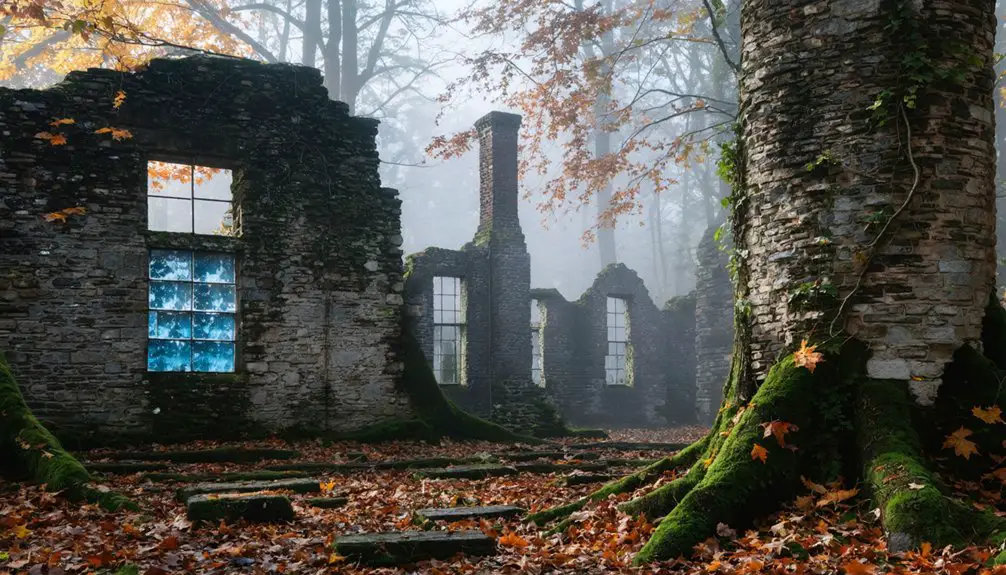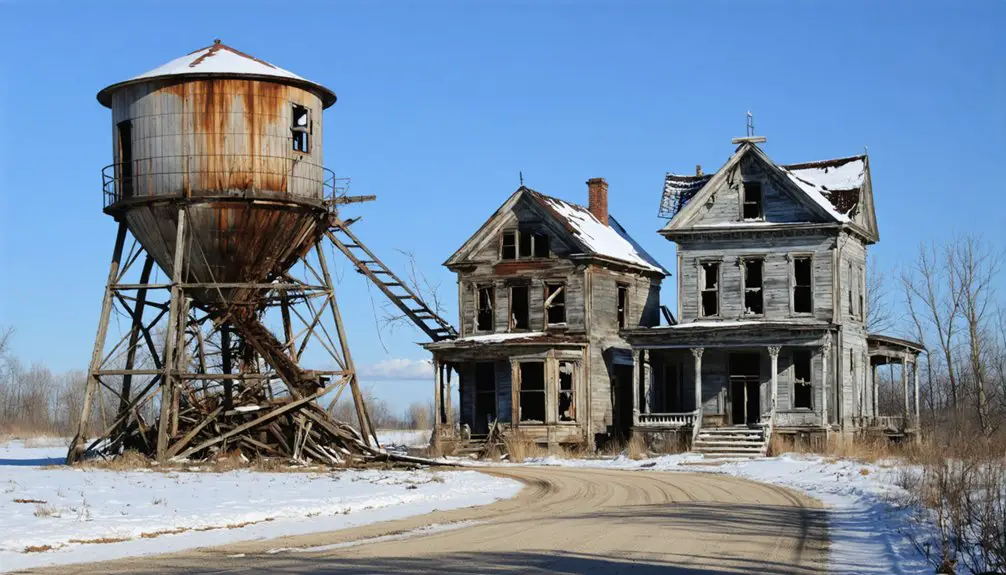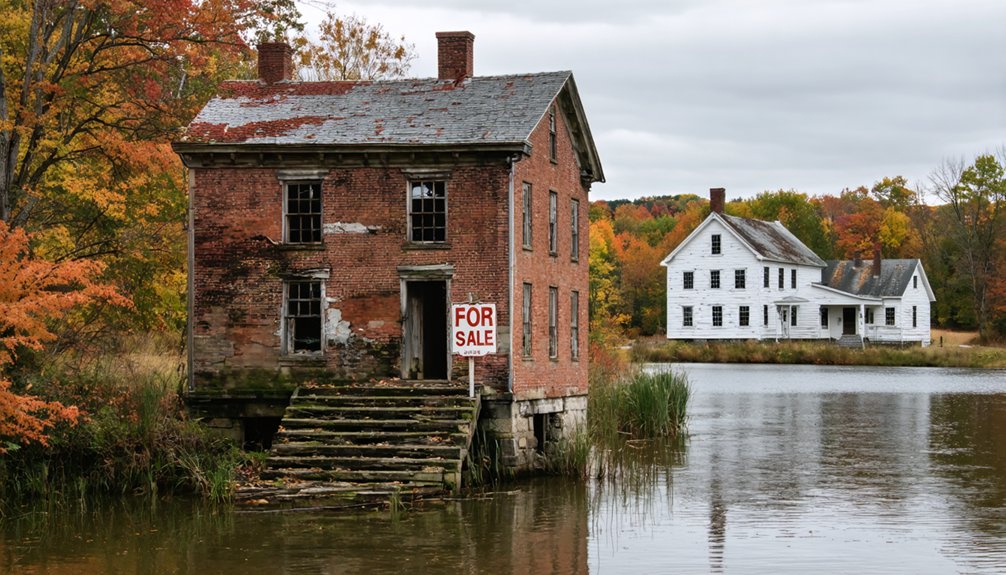
You won’t find traditional ghost towns for sale in Massachusetts, but documented alternatives exist through abandoned mill villages and historic settlements. Notable properties include Johnsonville, Connecticut’s 19th-century village at $1,900,000, while Massachusetts offers National Register properties under $50K and vintage homes ranging from $330,000 to $13,200,000. The state maintains 2.7 million acres of undeveloped land, with farmland averaging $96,168 per acre. Historic estates like Bramble Hill Mansion provide authentic revival opportunities that preserve New England’s architectural heritage while offering unique investment pathways.
Key Takeaways
- Massachusetts has no active ghost town listings, but New England offers abandoned mill communities like Johnsonville, Connecticut, priced at $1,900,000.
- Historic properties under $50K and National Register listings provide affordable alternatives to traditional ghost towns for investment buyers.
- Abandoned settlements from mill and railroad closures offer unique revitalization opportunities through heritage tourism and hospitality ventures.
- Massachusetts has 2.7 million undeveloped acres with remote parcels reaching $100,000 per acre for potential development projects.
- Specialized agents help buyers find properties with preserved architecture and authentic histories suitable for tourism-focused investments.
Understanding the Ghost Town Market in New England
While Massachusetts itself currently lacks active ghost town listings, the broader New England market reveals a fascinating niche in abandoned mill communities available for purchase.
You’ll find authentic 19th-century properties like Johnsonville, Connecticut—a 62-acre mill town priced at $1,900,000—offering tangible investment opportunities in regional ghost town dynamics.
These abandoned settlements primarily emerged from economic decline when mills and railroads shuttered during the shift from industrial heyday.
Resource depletion and lumber mill closures left entire communities vacant, preserving original 1800s-1900s structures you can acquire today.
The ghost town market presents unique prospects for economic revitalization.
Ghost towns offer investors distinctive opportunities to breathe new life into forgotten communities with rich architectural and historical value.
You’re buying blank canvases suitable for brewpubs, farm-to-table restaurants, or community redevelopment projects.
Properties span diverse price points—from Connecticut’s multi-building complexes to smaller parcels—each documented with authentic architectural heritage and sweeping landscapes.
Some properties include historic features like tunnels and jails that reflect their original industrial or civic purposes.
Johnsonville’s history includes transformation into a Victorian village recreation in the 1960s, complete with period-appropriate structures like chapels, post offices, and general stores.
Historic Property Alternatives Available Across Massachusetts
You’ll find Massachusetts offers documented alternatives to ghost towns through its National Register properties, including 18th-century Capes and Federal homes catalogued across 38 pages of inventory.
The state’s archives reveal affordable structures under $50K alongside oceanfront properties reduced to $99K, providing investment opportunities beyond abandoned settlements.
These historic listings demonstrate tourism potential similar to the Lizzie Borden House, where documented dark histories have transformed residential properties into profitable bed-and-breakfast operations. Properties with paranormal activity may have lower asking prices, creating opportunities for buyers willing to embrace supernatural elements.
Before purchasing any historic property, research zoning laws and county regulations to ensure your intended use aligns with local requirements and restrictions.
Antique Homes Statewide
Massachusetts maintains an extensive inventory of 5,971 vintage homes across its diverse regions, offering substantive alternatives to ghost town acquisitions.
You’ll find vintage listings spanning $330,000 to $13,200,000, with properties refreshed every 15 minutes on major platforms. Architectural styles range from Colonial-era saltboxes on the North Shore to Victorian estates throughout Greater Boston.
The Berkshires feature mid-1700s antiques in Williamstown and Stockbridge, while Cape Cod preserves historic properties in zip codes 02631-02657.
Boston’s median sits at $949,000, Cambridge at $1,175,000, and Lexington at $2,424,950. Notable properties include Newburyport’s 71 Middle St (4 beds, 2,926 sq ft) and New Marlboro’s 764 East Hill Road ($4,995,000).
Current listings feature homes averaging approximately 4,000 sq.ft., with properties distributed across urban centers like Boston and Cambridge, suburban communities including Newton and Lincoln, and coastal areas throughout Cape Cod. Buyers can utilize filtering tools by price, square feet, beds, and baths to narrow their search criteria.
These documented alternatives provide tangible ownership opportunities without ghost town complications.
Undeveloped Rural Land
Beyond restored historic structures, undeveloped rural land represents another tangible alternative to ghost town acquisitions in Massachusetts.
You’ll find 2.7 million acres—52% of the state—neither developed nor protected, offering substantial opportunities for rural land use development. The state’s 61.7% rural land mass provides access to undeveloped acreage averaging $563,228 per listing, with large parcels reaching $100,000 per acre in remote areas.
From 2012-2017, open land actually increased by 6,800 acres despite development pressures. Agricultural properties average 68 acres, while hay farms span 104 acres typically. Conservation efforts have focused on critical wildlife habitats and natural areas, with 76% of newly protected land falling within the Green Infrastructure Network.
Undeveloped land plays a crucial role in reducing greenhouse gas emissions and building climate resilience across the state. These documented statistics reveal genuine land ownership possibilities outside traditional ghost town frameworks, letting you establish independent homesteads or agricultural operations across Massachusetts’s extensive undeveloped territories.
Investment and Tourism Potential
When traditional ghost towns remain unavailable, Massachusetts’s historic properties offer documented investment returns through heritage tourism development.
You’ll find National Register listings like the Lizzie Borden House proving how dark history converts to profitable hospitality ventures. Properties under $50K provide low-barrier entry points, while restored Colonial Revivals and Federal homes command premium rates for overnight stays.
Haunted tourism drives year-round bookings, transforming stigmatized properties into revenue-generating assets. The Lizzie Borden House model demonstrates how paranormal reputations create sustainable business frameworks.
You can capitalize on similar opportunities through Spencer’s lakefront estates at $995,900 or Berkshires cabins at $155K. Specialized agents track these listings for tourism-focused buyers seeking investment returns through preserved architecture, authentic history, and established legends that outperform standard real estate metrics. Educational programs enhance visitor experiences while adding revenue streams beyond overnight accommodations.
Undeveloped Land Parcels With Revival Potential
Among Massachusetts’ forgotten landscapes, a 58.5-acre parcel at 0 Pond Lane in West Concord represents the complexities of reviving abandoned properties.
You’ll find mostly protected wetlands here, with only eight acres suitable for residential land development near MBTA tracks along the Assabet River. The Rappoli family trust has owned this property for three years, weathering two failed deals due to financing issues and housing limits.
Revival prospects face significant obstacles. You’ll encounter trails littered with debris—an abandoned car, snowmobile, mattress, and crashed drone mark the site’s neglect. Similar challenges affected historical settlements like Haywardville, which declined by 1870 and was eventually transformed into parkland by 1894.
Years of abandonment have left their mark—discarded vehicles, furniture, and equipment scatter across overgrown trails throughout the property.
Yet town meetings continue discussing its potential. While some developers express concerns, others view it as an amazing asset, demonstrating how Massachusetts’ undeveloped parcels balance environmental protection with opportunities for those seeking autonomy through strategic investment.
Notable Antique Estates and Rare Homesteads
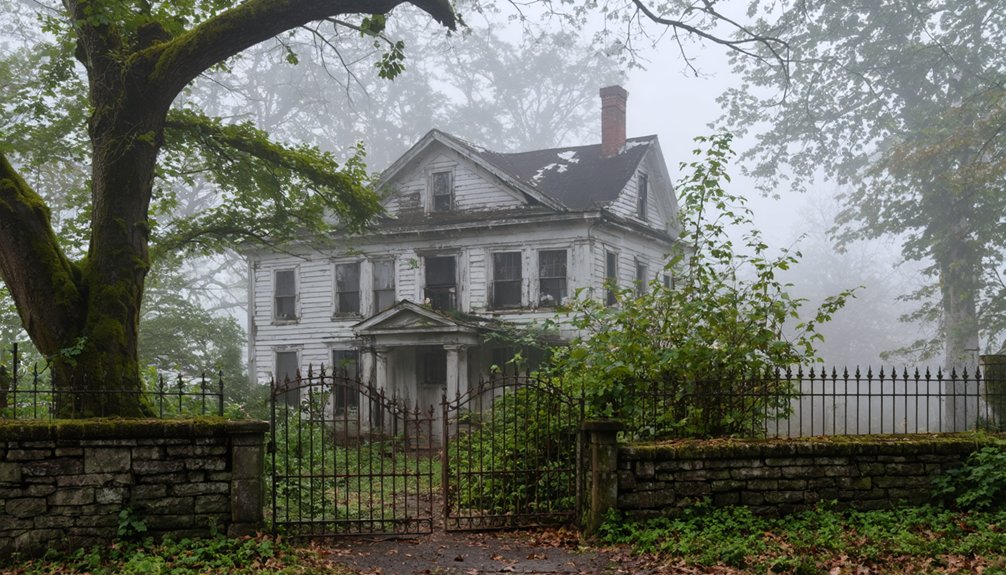
You’ll find Massachusetts preserves an exceptional collection of pre-Revolutionary properties, with documented examples like the 1729 Running Fox Farm in Westford offering 4 beds across 2,637 square feet at $1,295,000.
The state’s antique inventory spans 5,971 listings, ranging from modest Colonial homesteads to sprawling estates such as 775 Monument Street in Concord—an 8,030-square-foot Federal-era property commanding $8,995,000.
Self-sufficient farming estates remain particularly rare, with properties like the Westford barn-and-paddock configuration representing authentic agricultural architecture that’s survived centuries of development pressure.
18th-Century Architectural Gems
Massachusetts preserves some of the nation’s most significant architectural treasures from the 18th and 19th centuries, with documented estates and civic buildings that shaped American history.
The Old State House exemplifies Georgian architecture, opening in 1713 at 206 Washington Street where the Declaration of Independence was proclaimed from its east balcony in 1776.
You’ll find Victorian influences throughout the region, like the Solomon Spaulding House’s 1880s stickwork porch addition and the Windsor Road Eclectic House blending Queen Anne and Tudor Revival elements.
The William Cullen Bryant Homestead at 207 Bryant Road represents significant 19th-century literary estates, while the Custom House Tower demonstrates Greek Revival design.
These properties showcase shifting Federal styles and documented craftsmanship that defined American architectural independence.
Federal and Colonial Revivals
Following the 1876 U.S. Centennial Exposition, you’ll find that Colonial architecture sparked a nationwide movement rejecting Victorian excesses.
These estates represent authentic independence from cookie-cutter development, offering documented historical integrity you won’t find elsewhere.
Key architectural elements you’ll discover:
- Symmetrical five-bay facades with Palladian windows, classical columns, and period-accurate proportions refined by early 1900s
- Federal style townhomes like Charles River Square’s 21 red brick units (1910), featuring off-center entrances and stone belt courses
- Georgian Revival mansions including Belmont’s 1918 Atkins House, showcasing authentic craftsmanship and colonial detailing
- First Period reproductions with jetty overhangs and angled chimneys, exemplified by the 1927 Parker Hamilton House
These properties persist throughout Greater Boston’s historic districts, offering genuine architectural freedom from modern conformity.
Self-Sufficient Farming Properties
Beyond the architectural heritage of estate properties, Massachusetts farmland represents another path to documented independence—one grounded in agricultural self-sufficiency rather than colonial aesthetics.
You’ll find 14 homesteads currently listed at an average of $1,527,970, translating to $96,168 per acre. These properties enable sustainable agriculture through practical implementation: western Massachusetts hosts established operations including a 9-acre biodynamic community, a 31-acre no-till permaculture site, and a 10-acre farmstead producing 80% of its caloric needs.
Homesteading practices here integrate rainwater collection, solar infrastructure, and agroforestry systems on parcels ranging from 5 to 10 acres. For those seeking sovereignty through land stewardship, these documented properties offer measurable self-reliance—where your autonomy derives from productive soil rather than merely preserved structures.
Investment Opportunities in Historic Massachusetts Real Estate
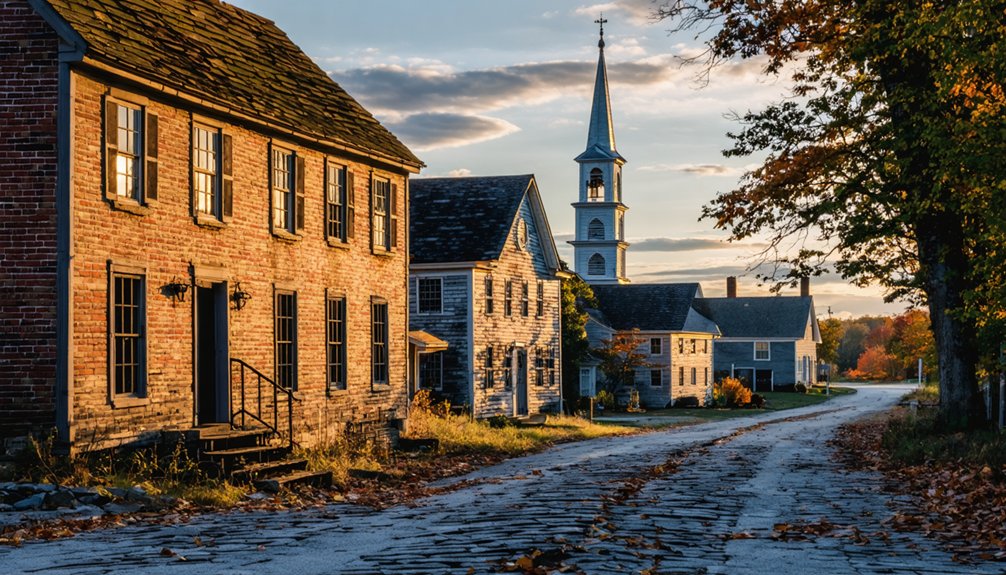
While genuine ghost towns in Massachusetts remain in public ownership or preservation trusts rather than on the open market, the commonwealth’s historic real estate sector offers analogous investment opportunities in abandoned and endangered properties from similar eras.
You’ll find documented examples establishing market parameters for historic renovations:
- Bramble Hill Mansion – Worcester’s endangered 1906 estate acquired for $820,000 in 2018, demonstrating institutional-scale investment potential.
- Oceanfront time capsule – c.1956 property reduced to $99,000, offering low-barrier coastal entry.
- Berkshires cabin – $155,000 for 4.1 acres, targeting rural development in Massachusetts’ western corridor.
- National Register listings – Sub-$100k fixer-uppers preserving 18th-century Colonial and Federal architecture.
These properties parallel ghost town characteristics—abandonment, historical significance, restoration potential—while remaining privately transferable through conventional real estate channels.
Creating Your Own Ghost Town Experience on Rural Properties
Since Massachusetts lacks commercially available ghost towns, you can engineer analogous experiences through strategic acquisition of rural properties containing historical structures.
Target abandoned mill complexes, defunct farming communities, or 19th-century industrial sites with documented heritage. Ghost town preservation begins with thorough archival research—examine property records, historical societies, and National Register listings to verify architectural significance.
You’ll need capital for structural rehabilitation, as demonstrated by Cerro Gordo’s five-year restoration timeline. Rural community engagement proves essential; collaborate with local historical commissions and preservation groups to secure funding and expertise.
Consider adaptive reuse strategies that balance authentic restoration with practical functionality. Document everything—photographs, building materials, artifacts—to maintain historical integrity.
Your investment creates tangible legacy while offering escape from centralized control, establishing sovereign space rooted in regional heritage.
Frequently Asked Questions
What Legal Restrictions Apply to Operating Ghost Town Attractions in Massachusetts?
Legal permits mandate your ghost town obtain building inspector approval, meet Fire Code 527 CMR requirements, secure amusement device licenses with $1,000,000 liability coverage, and follow attraction regulations governing special amusement buildings under state standards.
How Do Massachusetts Property Taxes Compare to Western Ghost Town States?
You’ll find Massachusetts property tax comparisons reveal considerably higher rates than western ghost town states, where rural tax incentives often reduce burdens. Historical records document western properties enjoying greater tax freedom, typically charging half Massachusetts’ average municipal rates.
Can Historic Preservation Grants Help Fund Ghost Town Restoration Projects?
Yes, you’ll find historic grants and preservation funding available for documented sites on the National Register. State programs support restoration of eligible structures, though Massachusetts currently offers no accessible ghost town properties requiring such funding.
Are There Zoning Challenges When Converting Rural Land Into Tourist Attractions?
Yes, you’ll face significant zoning challenges converting rural land into tourist attractions. Massachusetts zoning regulations require special permits, rezoning applications, and documented compliance with dimensional standards that often restrict rural tourism development in agricultural districts.
What Maintenance Costs Are Typical for Preserving 1800s-Era Structures?
You’ll face $300-650+ per square foot for restoration techniques depending on project scope, with pre-1850 structures requiring specialized materials. Proper maintenance budgeting includes window repairs ($625+), siding replacement ($105-150), and weatherstripping to preserve historical integrity.
References
- https://www.realtor.com/news/unique-homes/buy-a-ghost-town-or-live-near-one/
- https://www.ezhomesearch.com/blog/towns-for-sale-in-the-usa/
- https://www.verani.com/ma-real-estate/antique
- https://www.havenlifestyles.com/11-rare-opportunities-for-sale-in-massachusetts/
- https://www.land.com/Massachusetts/undeveloped-land/
- https://lindorealtygroup.com/popular/south-shore-antique-historical-homes/
- https://www.landsearch.com/historic/massachusetts
- https://www.oldhousedreams.com/state/massachusetts/
- https://www.homes.com/massachusetts/homestead/
- https://www.williampitt.com/johnsonville-connecticuts-hauntingly-beautiful-ghost-town/