You won’t find traditional ghost towns for sale in Rhode Island because the state’s dense colonial settlement patterns and continuous economic development prevented their formation. Unlike western states with boom-and-bust mining cycles, Rhode Island’s interconnected communities absorbed failing villages rather than abandoning them. However, you’ll discover 860 vacant properties in Providence alone, plus thousands of historic structures statewide that offer similar investment opportunities. The Ocean State’s foreclosure market and tax-delinquent listings present alternative pathways to acquiring properties with comparable character—and understanding these dynamics reveals unexpected advantages.
Key Takeaways
- Rhode Island has no traditional ghost towns due to dense colonial settlement patterns and continuous economic development since 1636.
- Approximately 860 vacant historic properties exist in Providence, offering alternatives to ghost town acquisitions for preservation investors.
- Foreclosed historic properties sell roughly 15% below median values, with median home values at $483,318 statewide.
- Repair costs for vacant properties range from $24,200 to $48,300, plus Providence’s 10% non-utilization tax on assessed values.
- Rural parcels like Coventry’s 31-acre lot at $100,000 provide development opportunities without traditional ghost town characteristics.
Understanding Rhode Island’s Historic Property Landscape
While Rhode Island may lack true ghost towns in the Old West sense, the state grapples with a substantial inventory of vacant and deteriorating historic properties that tell a different story of abandonment.
You’ll find over 50,000 surveyed historic structures statewide, with approximately 20,000 listed on preservation registers. Providence alone identified 860 vacant properties as of April 2019, concentrated west of Interstate 95. The foreclosure crisis decimated neighborhoods, leaving landmark buildings like the Industrial Trust Building empty since 2013.
Rhode Island’s preservation crisis deepens as hundreds of historic buildings stand vacant, victims of foreclosure and decades of neglect.
Historic preservation efforts face significant challenges, with just 50% of housing predating 1960. These forgotten sites have sparked growing interest in urban exploration, particularly after the 2008 recession. Abandoned locations range from former psychiatric institutions to derelict industrial complexes, each offering a haunting glimpse into the state’s past.
You’re witnessing a market-driven transformation where architectural heritage meets investment opportunity. The EveryHome program works to revitalize these abandoned properties through early identification of potential vacancies and direct support to residents facing housing challenges.
Why Traditional Ghost Towns Don’t Exist in Rhode Island
You won’t find traditional ghost towns in Rhode Island because the state’s dense colonial settlement pattern created interconnected communities rather than isolated outposts.
Unlike Western expansion that spawned remote mining camps and railroad towns prone to sudden abandonment, Rhode Island’s development centered on clustered mills, farms, and trading posts that gradually faded or merged into neighboring areas.
The state’s small geographic footprint and continuous coastal-to-interior settlement meant failing villages were absorbed or repurposed rather than left as intact abandoned towns.
Even Hanton City, abandoned in the early 1800s, left behind only stone foundations as its wooden structures rotted away in the Smithfield woods.
The Ramtail Factory, once operated by the Potter family, closed due to its haunted reputation after strange events followed the death of night guard Peleg Walker.
Geographic Settlement Pattern Differences
Rhode Island’s 1,214-square-mile footprint creates a geographic impossibility for traditional ghost towns to emerge.
You won’t find abandoned settlements here because geographic constraints forced continuous occupation from day one. With 1,097 people per square mile, there’s simply nowhere for a town to die unnoticed.
The state’s settlement patterns reveal why: Providence anchored growth from 1636, spinning off satellite towns like Scituate and Glocester by 1730 rather than creating distant outposts.
Narragansett Bay dominates the landscape, concentrating development along coasts and rivers. Mid-20th century highways integrated every village into Providence’s metro area, eliminating isolation completely. The royal charter of 1663 unified Rhode Island and Providence Plantations under a General Assembly with legislative powers, creating administrative cohesion that prevented the fragmentation seen in western territories. Maps illustrate the continuous settlement since colonial days, connecting the city to its historical roots and preventing the abandonment patterns seen elsewhere.
Where Western states feature hundreds of miles between population centers, Rhode Island’s entire width spans just 37 miles—you can’t escape development long enough for abandonment to take root.
Dense Colonial Development History
From its 1636 founding, Providence operated as a dense colonial hub that left no room for settlements to fail in isolation.
You’ll find that Roger Williams’ initial colonial settlement on Narragansett land sparked continuous development rather than scattered, vulnerable outposts. Newport’s status as the fifth-largest British colonial city guaranteed concentrated growth, while water-powered mills along the Blackstone River created unbroken industrial corridors by the 1800s.
This urban density intensified as population surged from 68,825 in 1790 to 428,556 by 1900. By 1920, one-third of the population consisted of foreign-born residents, further cementing the state’s urban character and preventing the isolation necessary for ghost town formation.
Unlike western territories where towns collapsed after resource depletion, Rhode Island’s interconnected communities sustained each other through commerce and manufacturing. The state’s approximately 776,957 acres of total area meant settlements remained geographically close, reinforcing economic and social ties that prevented abandonment.
Western Expansion Created Abandonment
While Rhode Island’s compact geography prevented the dispersal necessary for ghost towns, the state’s eastern seaboard location fundamentally excluded it from the abandonment patterns that created them elsewhere.
You won’t find traditional ghost towns here because Rhode Island never experienced the frontier dynamics that generated them.
Western states saw boom-and-bust cycles driven by Manifest Destiny, gold rushes, and transcontinental railroad construction—forces that created isolated outposts vulnerable to sudden abandonment.
Rhode Island’s settlement patterns followed an entirely different trajectory. Established coastal communities like Providence (1636) and Newport grew continuously through stable trade and agriculture, not depletable mineral extraction.
The state’s Royal Charter of 1663 unified existing towns into a cohesive colony, fostering permanent governance rather than speculative ventures.
No homestead acts or mining strikes prompted the mass relocations that left western ghost towns behind.
Samuel Slater’s establishment of the first U.S. textile mill in Pawtucket in 1790 sparked industrialization that further anchored communities through sustained manufacturing employment rather than boom-and-bust extraction. Newport became the fifth largest colonial city before the American Revolution, establishing economic stability that prevented abandonment.
Alternative Historic Investment Opportunities in the Ocean State
Although Rhode Island lacks abandoned ghost towns on the market, investors can access 24 historic properties averaging $1,948,096 each, alongside 211 land parcels offering alternative entry points into the state’s heritage real estate sector.
You’ll find Victorian cottages, Colonial homes with original wide-plank floors, and National Register properties that deliver cultural significance without the abandonment premium.
Historic renovations transform farmhouses and inns into bed-and-breakfasts or vacation rentals, generating income while preserving architectural legacy.
Wooded land listings—36 properties currently available—offer development freedom on rural parcels.
One Coventry lot spans 31 acres for just $100,000, positioning you below the $312,199 per-acre average.
These undeveloped sites let you control restoration timelines and design choices, bypassing regulatory constraints tied to established ghost town purchases while maintaining access to Rhode Island’s historic character.
Newport’s Preserved Colonial Architecture and Restoration Projects
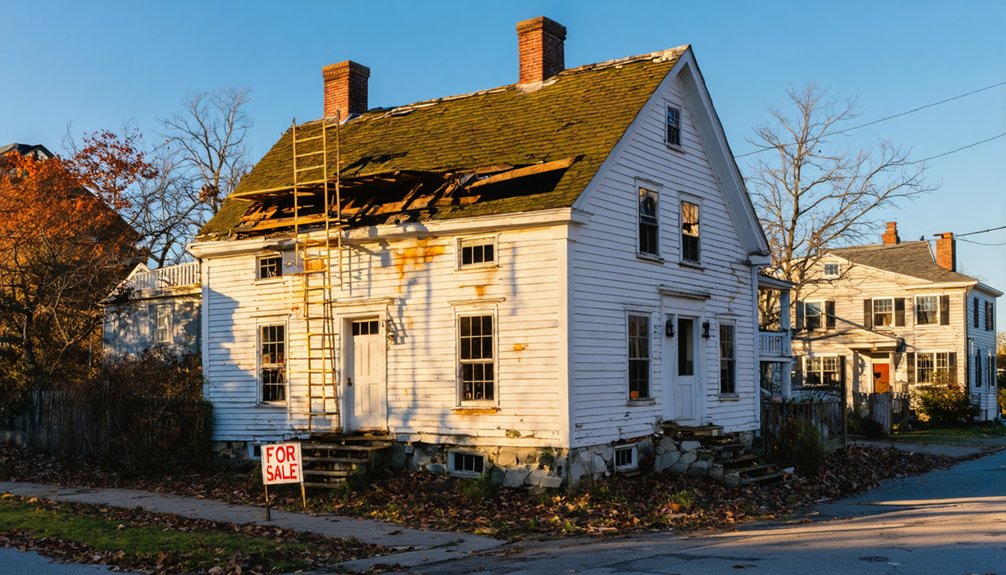
Newport’s colonial preservation market centers on the Newport Restoration Foundation‘s 73-property portfolio, the nation’s largest collection of 18th-century vernacular architecture available through tenant-steward arrangements rather than conventional sales.
You’ll find colonial architecture dating from 1675’s Wanton-Lyman-Hazard House through properties like the Dayton-James House (1757/1758), restored in 2015. The tenant-steward program requires you to maintain your residence in exchange for professional restoration support and below-market rent—accessing historic properties without traditional ownership.
Doris Duke’s 1968 preservation efforts countered 1960s redevelopment threats that destroyed countless colonial homes during America’s Cup Boulevard construction.
Today’s 300+ surviving Colonial Era structures demonstrate viable alternatives to conventional real estate investment. The Point and Hill neighborhoods offer direct participation in ongoing restoration projects, positioning you within America’s most concentrated colonial housing market.
Comparing Ghost Town Prices Across Different States
You’ll find ghost town prices vary dramatically across states, from South Dakota’s $250,000 Swett property to California’s $6.6 million Campo listing—a 2,540% difference that reflects location, acreage, and development potential.
Regional markets show clear investment tiers: budget properties under $500K concentrate in the Midwest and rural South, mid-range offerings ($900K-$2M) dominate Western states with recreational features, while premium listings above $3M appear in high-demand regions like California and coastal areas.
Your revenue potential depends on state-specific factors including tourism traffic, zoning flexibility, and proximity to metropolitan markets—Michigan’s Hell commands $900K largely due to its established visitor base, while Connecticut’s 62-acre Johnsonville sold for $1.85M based on commercial redevelopment opportunities.
Regional Price Variations Explained
Ghost town prices across the United States reveal dramatic disparities that stem directly from geographic location and regional real estate dynamics.
You’ll discover significant regional pricing differences that directly impact your investment potential:
- Western premium markets: Montana and California properties command $800,000 to $6.6 million, reflecting established tourist infrastructure and mountain appeal.
- Great Plains affordability: South Dakota’s Swett represents budget entry at $250,000 for six acres ($41,667 per acre).
- International context: Spanish ghost towns start at $87,800, making U.S. properties appear 10-60 times more expensive.
- Northeast premiums: Connecticut’s Johnsonville reached $1.85 million for 62 acres despite abandoned status.
These investment trends demonstrate how state-specific real estate valuations, development potential, and tourist accessibility create vastly different opportunities for prospective ghost town owners seeking alternative property investments.
Investment Tiers and Categories
Market analysis reveals three distinct investment tiers when comparing ghost town acquisitions nationwide.
You’ll find entry-level properties like South Dakota’s Swett at $250,000, offering minimal structures on compact acreage.
Mid-tier investment tiers range from $360,000 to $1.4 million, exemplified by Montana’s Pray and North Carolina’s Henry River Mill Village, which provide established rental income streams and substantial infrastructure.
Premium property categories command $1.2 to $6.6 million, including Connecticut’s Johnsonville and California’s Campo, featuring extensive acreage, historic filming locations, and multiple restored buildings.
Your investment decision hinges on acquisition budget, revenue potential, and preservation commitment.
Smaller parcels deliver immediate ownership freedom, while larger estates require significant capital but offer diversified income opportunities through vacation rentals, event hosting, and commercial development potential.
Revenue Potential by Location
Geographic pricing disparities create vastly different revenue scenarios for ghost town investors across American regions.
You’ll find Henry River Mill Village generating $280.50 nightly in North Carolina after a $360,000 purchase, while Story, Indiana commands $3.8 million but delivers immediate event venue revenue.
These revenue trends reveal critical investment strategies:
- Western states offer authentic 1800s structures in Nevada, Colorado, and Montana requiring restoration before income generation.
- Rhode Island historic properties average $1.6 million with established infrastructure across 174 active listings.
- European alternatives like Spanish fincas start at $87.8k, providing lower-cost entry points.
- Mid-range properties ($1-3M) balance acquisition costs with existing tourist infrastructure.
Your location choice directly impacts capital requirements versus immediate cash flow potential, with restoration projects demanding patience while turnkey operations generate returns immediately.
Converting Historic Properties Into Revenue-Generating Assets
When Jacqueline Nuñez purchased the Conjuring House for $1.5 million in 2022, she demonstrated how historic properties with cultural cachet can transform into revenue-generating assets through ghost tours and overnight stays.
You’ll find three distinct pathways for monetizing these properties: paid attractions like museum tours and guided ghost hunts, rental models that preserve authenticity while adding modern conveniences, or strategic redevelopment that balances historic renovations with contemporary amenities.
The Newport Restoration Foundation’s approach proves instructive—71 Colonial homes generate steady rental income post-restoration.
For tourism strategies, you’re looking at leveraging cultural connections that drive year-round visitor traffic. Properties tied to film franchises or paranormal history attract global audiences willing to pay premium rates.
Strategic investors can enter through foreclosure sales or tax-delinquent listings, lowering acquisition costs while maximizing upside potential.
Western Ghost Towns as Out-of-State Investment Alternatives
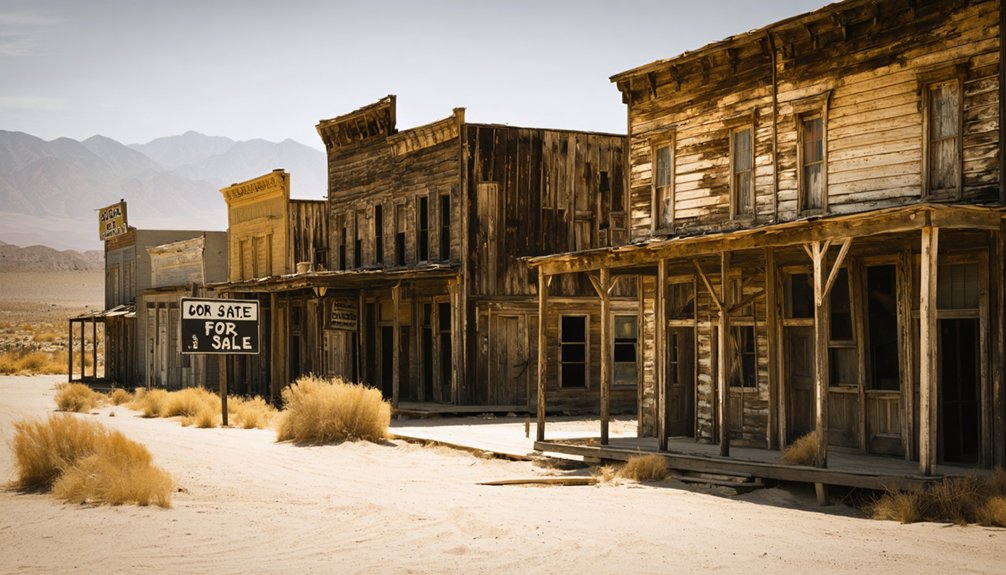
Rhode Island’s limited ghost town inventory pushes serious investors to examine Western states, where Nevada, Colorado, Montana, and California hold the nation’s highest concentration of abandoned settlements.
These western investment opportunities deliver authentic mining-era structures you won’t find in New England’s compact geography.
Ghost town comparisons reveal substantial price variations:
- Villa de la Mina in Terlingua, Texas: 62 acres with 20 buildings at $1.95 million
- Swett, South Dakota: 6 acres including tavern and house starting at $250,000
- Cerro Gordo area parcels: 62-acre lots near operational silver mines achieving cash flow
- Montana’s Frontier Town: complete with saloon, cabins, and jail (recently sold)
You’ll access properties near national parks like Arches and Canyonlands, creating immediate tourism potential that Rhode Island’s developed landscape can’t match.
Budget Considerations for Historic and Abandoned Property Purchases
Historic property acquisitions demand extensive financial planning beyond initial purchase prices, particularly in Rhode Island’s constrained real estate market.
You’ll face repair costs averaging $24,200 to $48,300 for foreclosed properties, with budget breakdowns directly correlating to vacancy duration and previous owner neglect.
Providence’s 10% non-utilization tax on assessed values creates additional financial pressure for abandoned structures. Renovation challenges intensify when properties require contractor assessments to determine after repair value before resale.
Foreclosure auctions demand cash payments, eliminating traditional financing options. However, you’ll find foreclosed homes selling approximately 15% below Rhode Island’s $483,318 median value.
Bank-owned properties average $336,000, with acquisition timelines reaching 48 days. Factor in Rhode Island’s one-year redemption period before foreclosure completion when calculating total investment horizons.
Frequently Asked Questions
What Legal Restrictions Apply to Purchasing Abandoned Properties in Rhode Island?
You’ll face requirements including annual registration in Warwick’s vacant database, adherence to zoning laws, property maintenance standards, and potential adverse possession claims if you don’t occupy openly. State custody sales offer clear title free from prior claims.
Do Ghost Town Purchases Include Mineral or Water Rights?
Ghost town purchases typically don’t include mineral rights or water rights—most U.S. sales convey only surface rights to buildings and land, leaving you free to negotiate subsurface assets separately if they’re available.
How Do Property Taxes Compare Between Historic Homes and Ghost Towns?
Ghost towns typically face higher tax burdens due to commercial or vacant land classifications, while historic homes receive lower residential rates and potential tax incentives through preservation programs, making property valuation assessments critically different for your investment strategy.
Can Foreign Investors Purchase Historic Properties or Ghost Towns in America?
You can purchase historic properties or ghost towns, but you’ll face strict foreign ownership restrictions and investment regulations if you’re from designated “countries of concern” like China, Russia, Iran, North Korea, Cuba, or Venezuela.
What Insurance Requirements Exist for Abandoned or Partially Restored Historic Properties?
You’ll face stringent requirements: minimum $100,000 water damage deductibles, MNC-rated construction standards, and full sprinkler systems. Insurance coverage demands agreed-value policies covering restoration liability, plus compliance with historic preservation regulations before insurers approve abandoned properties.
References
- https://www.bobvila.com/articles/towns-for-sale/
- https://www.loveproperty.com/gallerylist/51810/entire-villages-and-towns-for-sale-that-you-can-actually-buy
- https://www.ezhomesearch.com/blog/towns-for-sale-in-the-usa/
- https://www.hoganassociatesre.com/historic-homes-for-sale-newport.php
- https://circaoldhouses.com/old-houses-for-sale-in-rhode-island-ri/
- https://www.realtor.com/realestateandhomes-search/Rhode-Island/with_woodedland
- https://www.landsearch.com/historic/rhode-island
- https://www.zillow.com/ri/land/
- https://www.oldhousedreams.com/state/rhode-island/
- https://www.browndailyherald.com/2019/04/05/providences-abandoned-property-problem-persists/