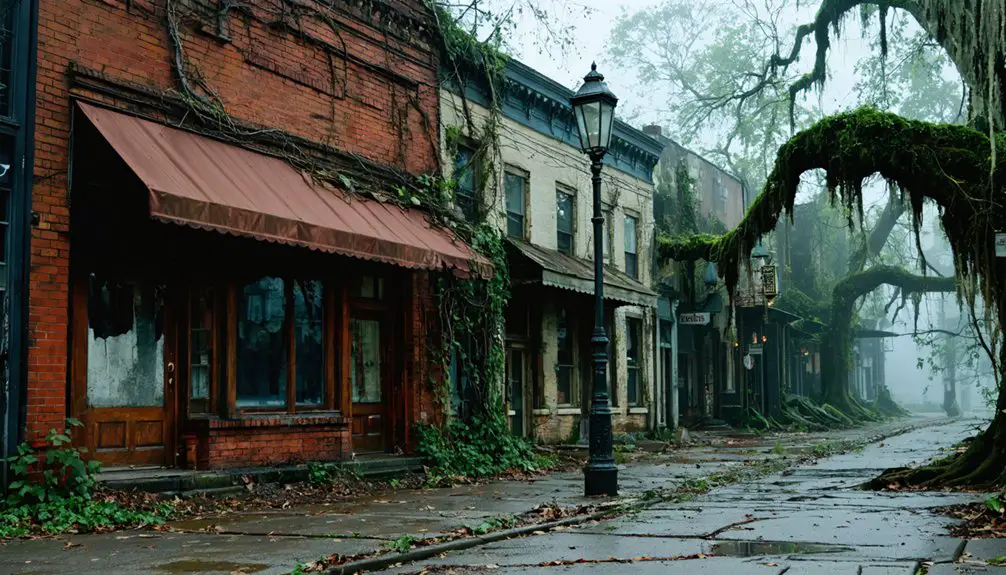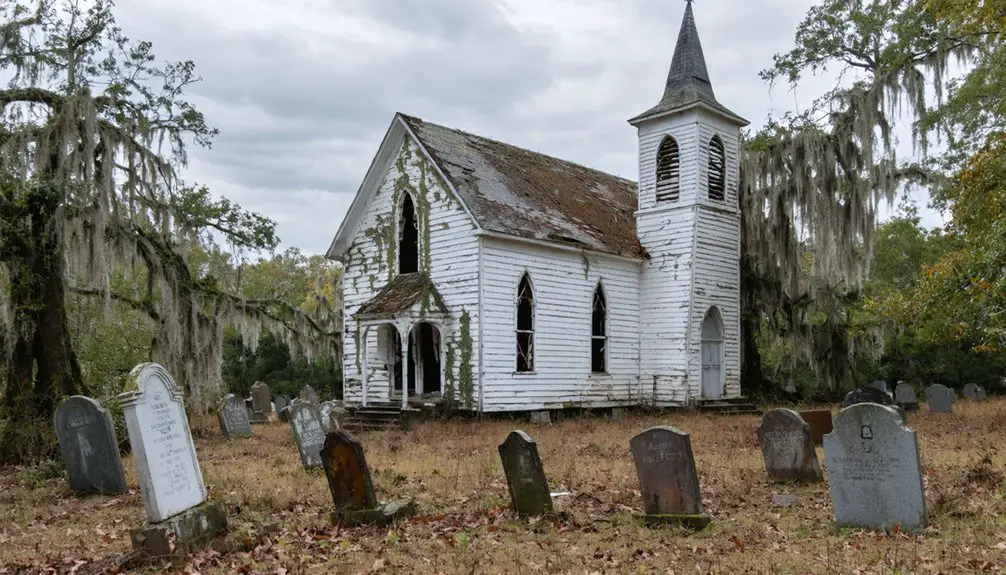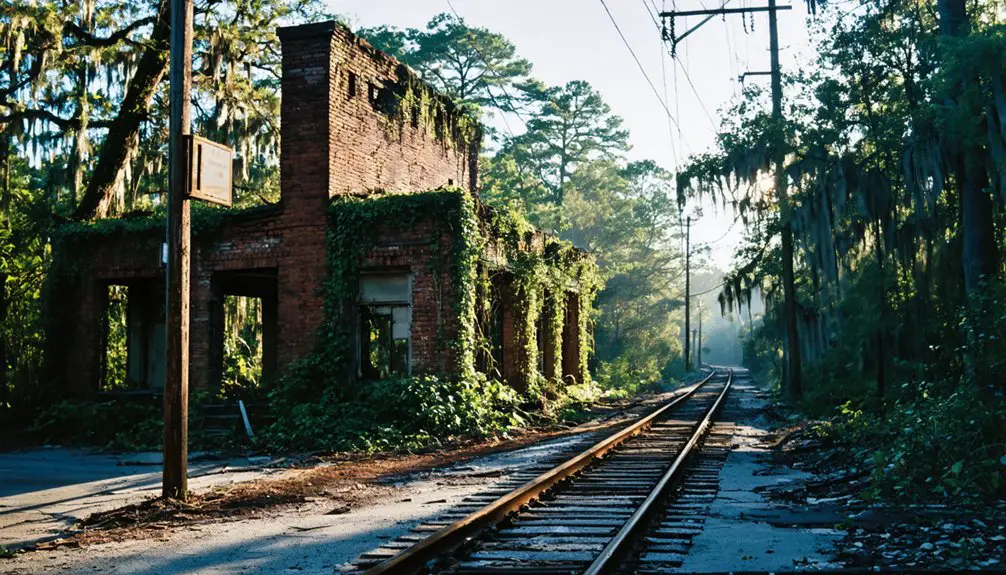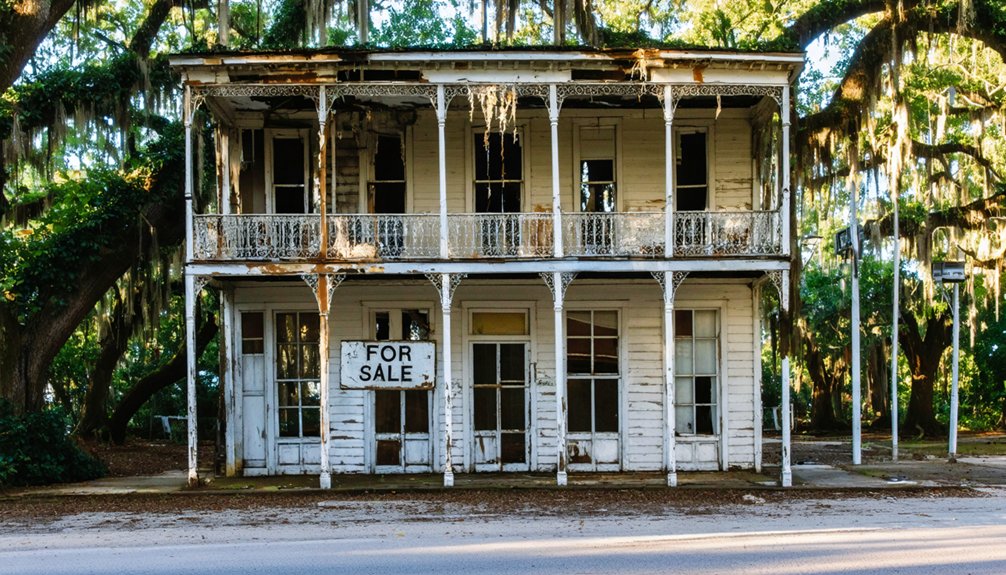
You’ll find South Carolina’s ghost town market fundamentally differs from Western states, as most abandoned settlements resulted from government displacement for Cold War infrastructure rather than economic collapse. Ellenton’s 6,000 relocated residents for Savannah River Plant exemplify this pattern, while Hickory Nut Gorge’s Ghost Town Cliffs represents failed commercial development now secured for public access. Purchasing these properties requires extensive documentation review, title searches, and understanding forced relocation histories that create unique legal complexities. The following sections reveal specific opportunities, legal requirements, and profitable conversion strategies.
Key Takeaways
- South Carolina has few traditional ghost towns; most result from government displacement like Ellenton’s 6,000 relocated residents.
- Distressed properties include abandoned mill villages and railroad stops available through county tax office foreclosure listings.
- Legal due diligence requires notifying previous owners, researching liens, and reviewing title histories before purchasing abandoned properties.
- Historic preservation easements may restrict renovation plans, with restoration costs typically exceeding initial purchase prices.
- State grants fund up to 40% of preservation costs for historic structures converted into vacation rentals.
Understanding South Carolina’s Historic Ghost Town Market
Few documented examples of true ghost towns exist within South Carolina‘s borders, a scarcity directly attributable to the state’s sustained population density throughout its post-colonial history.
Unlike Western counterparts with tumbleweeds and abandoned saloons, you’ll find South Carolina’s ghost town demographics reflect forced governmental displacement rather than economic collapse.
Ellenton stands as the primary example, where 6,000 residents faced mandatory relocation when the Savannah River Plant required 210,000 acres. The government’s $19 million purchase drastically undervalued the land—timber alone warranted $28 million.
Andersonville disappeared beneath Lake Hartwell’s waters, while Chappells maintains abandoned structures along its former Main Street.
These settlements retain profound historical significance despite lacking the dramatic abandonment narratives characterizing Montana’s Bannack or Arizona’s Jerome. While South Carolina’s vacancy patterns differ from national ghost towns, areas with high vacancy rates nationwide often share common characteristics including economic decline and population loss. South Carolina recorded a 43.8% increase in zombie foreclosure properties, ranking among the nation’s most affected states.
You’re examining displacement documentation, not romantic frontier mythology.
Ghost Town Cliffs in Hickory Nut Gorge: The $1 Opportunity
While documented ghost towns within South Carolina remain scarce, North Carolina’s Hickory Nut Gorge presents an entirely different species of “ghost town”—one defined by abandoned commercial development rather than displaced communities.
Ghost Town Cliffs, positioned at Round Top Mountain’s 1,800-foot granite faces, earned its designation from a failed amusement park operation. When developers subsequently proposed 40 house sites in the early 2000s, the environmental impact threatened this climbing resource permanently.
Access Fund and Carolina Climbers Coalition’s 16-acre purchase for symbolic funding secured climbing access to North Carolina’s largest crack collection—over 50 routes across 400-foot walls. The acquisition followed a 25-year effort by the climbing community to protect these dramatic cliffs above Chimney Rock Village.
Nearby Silver City Ghost Town, built by former TV cowboy Sunset Carson, operated as a tourist attraction featuring wild west shows accessed by chair lift before its eventual abandonment.
This acquisition represents freedom preserved: world-class terrain rescued from privatization, establishing public domain where commercial ventures once restricted movement through southeastern geology’s most distinctive formations.
What to Expect When Purchasing Abandoned Properties in South Carolina
Legal responsibilities extend beyond purchase price.
Sellers must demonstrate due diligence: written notice to last known owners within 120 days preceding State Treasurer reports, certified mail to lien holders for mobile homes.
Forfeited Land Commissions assign properties rejected at tax sales.
The SC Treasurer’s Office administers surplus proceeds and unclaimed funds.
Non-compliance nullifies transactions or triggers liability claims.
You’re purchasing documentation chains, not guaranteed assets.
For land returned to the State Treasurer due to forfeiture, clerks of court must publish notice in county newspapers the first week of every month for six months to give relatives an opportunity to claim the property.
Property valued at $500 or less can be disposed of without legal procedures.
Distressed and Historic Properties Available Across the State
South Carolina’s distressed property market reveals few true “ghost towns” in the Western sense, but rather a constellation of deteriorating historic settlements documented in county deed books and State Historic Preservation Office records.
You’ll find abandoned mill villages, defunct railroad stops, and forgotten agricultural communities scattered across rural counties—properties requiring extensive documentation review before purchase.
These distressed sites demand thorough title searches and environmental assessments.
Historic preservation easements may restrict your renovation plans, while property restoration costs often exceed initial acquisition prices.
County tax offices maintain foreclosure listings, though most lack the extensive infrastructure of traditional ghost towns.
Your research should focus on courthouse records, historical society archives, and SHPO databases.
Among the state’s historic offerings, Cedar Knoll Estate in Camden stands as a preserved example from 1830, featuring 7 bedrooms across 8854 square feet.
Currently, 90 historic properties are available for sale across South Carolina, with an average listing price of $968,435.
These properties offer autonomy from restrictive covenants, provided you navigate complex ownership histories and zoning requirements independently.
Turning Ghost Towns Into Profitable Vacation Rentals
Acquisition records from the past five years show investors converting distressed South Carolina properties into vacation rental operations, with deed transfers increasingly noting “tourism development” as intended use.
You’ll find restoration strategies ranging from minimal intervention preservation to thorough modernization, with costs documented between $75,000 and $2.5M depending on structural integrity and amenities required.
Revenue opportunities multiply through staged approaches: initial camping permits during construction phases, followed by glamping installations, then full accommodation launches.
Properties near Caesars Head and Table Rock command $200-400 nightly rates during peak seasons. State grant programs fund up to 40% of qualified preservation costs for historically significant structures.
Documentation shows successful operations diversifying income through climbing permits, photography sessions, and educational tours beyond standard lodging fees. International examples include traditional Spanish fincas requiring full renovation on nearly an acre of land, demonstrating opportunities across various price points. Comparable developments like Ghost Town Village in neighboring North Carolina span 250 acres of development land with multiple buildings across tiered elevations, demonstrating the scale potential for tourism-focused acquisitions.
Frequently Asked Questions
What Permits Are Required to Restore Historic Buildings in South Carolina?
You’ll need a Certificate of Design Approval and building permit for historic restoration work. Projects must comply with Secretary of Interior’s Standards and local historic preservation ordinances while meeting current building codes and obtaining proper state approvals.
Are Property Taxes Higher for Designated Historic Sites in South Carolina?
No, you’ll find historic preservation actually reduces your property taxes through exemptions and credits. Tax incentives include up to 75% relief for eight years on rehabilitated properties, plus state credits reaching $500,000 for income-producing sites.
Can I Legally Subdivide a Ghost Town Property for Individual Sales?
You’ll navigate mountains of paperwork, but yes—you can legally subdivide if you meet zoning regulations, respect property boundaries, secure planning commission approval, and record the final plat with your county’s Register of Deeds office.
What Insurance Coverage Is Available for Abandoned or Deteriorating Structures?
You’ll find abandoned property insurance through specialized carriers offering structural damage coverage for deteriorating buildings. However, you must document vacancy duration, maintain minimum property standards, and verify South Carolina’s specific regulatory requirements before securing coverage.
Do Ghost Town Purchases Include Mineral or Water Rights?
Ghost town purchases vary—you’ll need to verify deed documentation for each property. Mineral rights often transfer separately from surface ownership, while water rights require independent confirmation. Historical disputes, like Clementia’s spring access conflicts, demonstrate these complications.
References
- https://www.ezhomesearch.com/blog/towns-for-sale-in-the-usa/
- https://www.loveproperty.com/gallerylist/51810/entire-villages-and-towns-for-sale-that-you-can-actually-buy
- https://hiddenhistorian.com/adventures/f/hunger-games-district-12-village-for-sale—own-a-ghost-town?blogcategory=Book
- https://www.zillow.com/sc/victorian_att/
- https://www.realtor.com/realestateandhomes-search/South-Carolina/type-farms-ranches
- https://www.landsearch.com/distressed/south-carolina
- https://www.oldhousedreams.com/state/south-carolina/
- https://theforgottensouth.com/abandoned-moseley-store-salters-south-carolina/
- https://carolinaclimbers.org/node/1284
- https://247wallst.com/special-report/2018/11/02/30-american-ghost-towns-3/