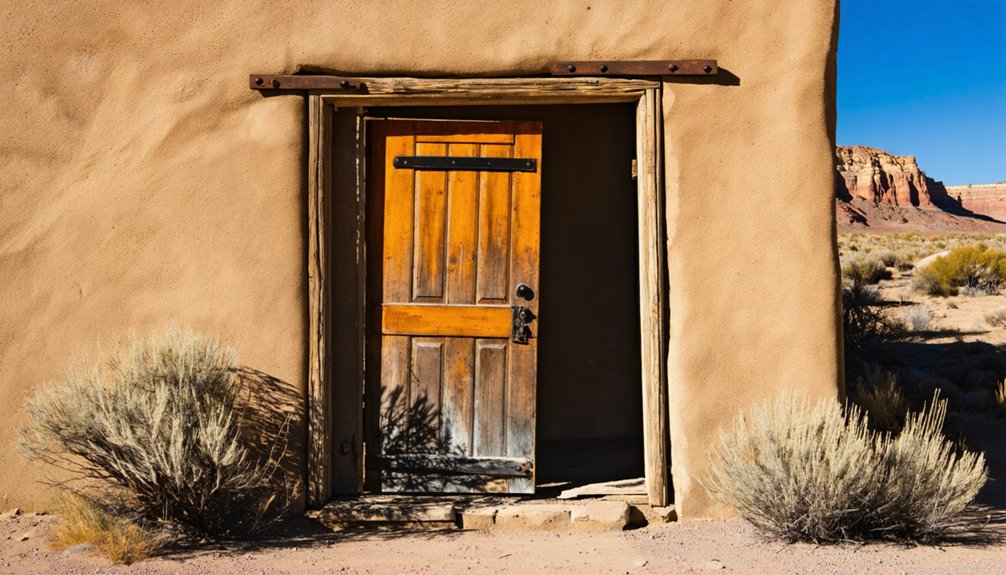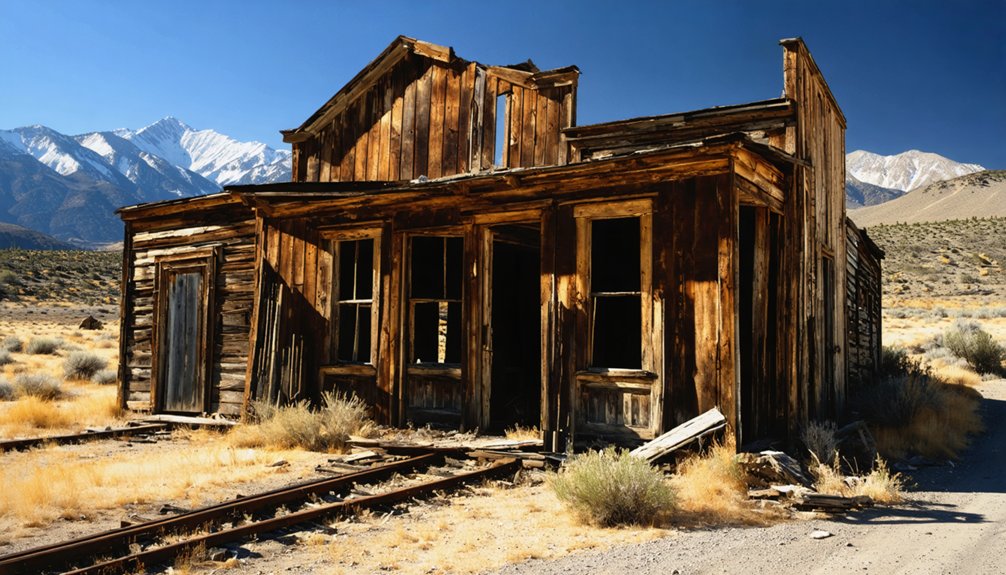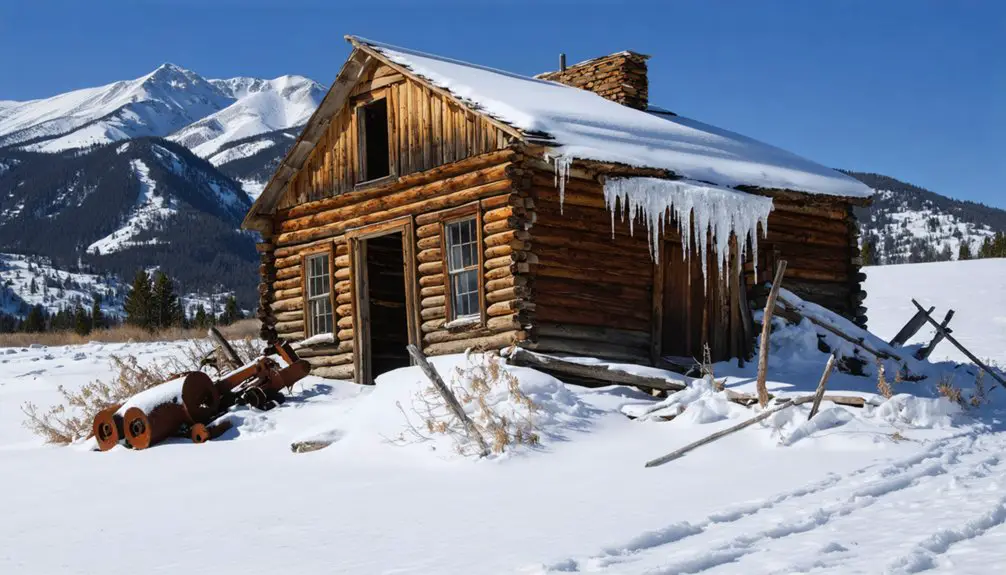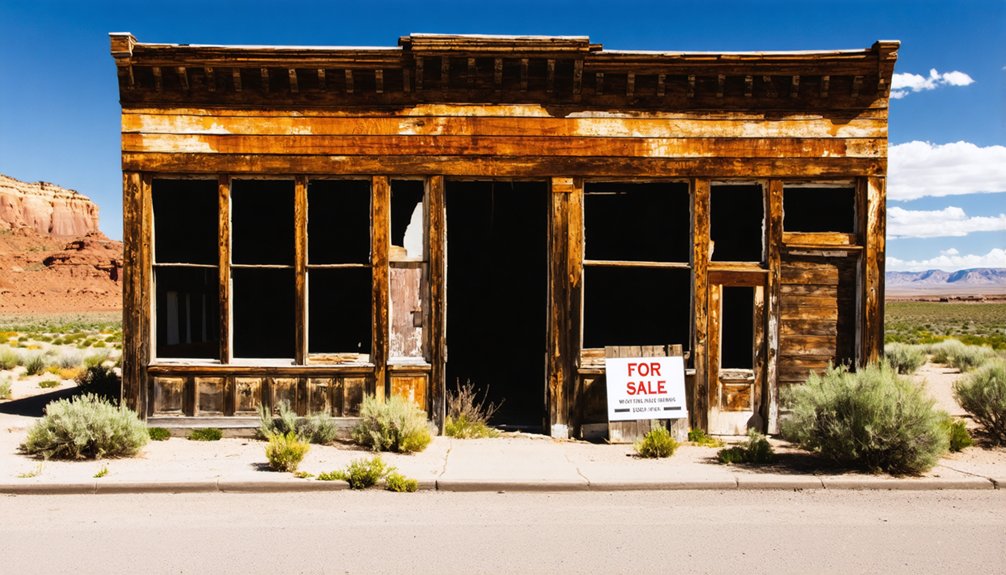
You can purchase entire Utah ghost towns, from Maple Creek Mine’s 154 acres of mining history at $225,000 to Woodside’s 700-acre railroad settlement with a cold-water geyser listed at $4 million. Smaller parcels start under $50,000 through Utah Trust Lands Administration auctions held twice yearly. Properties include historic structures, mining equipment, and unique features like tramways and railroad infrastructure. Expect to handle extensive due diligence, title searches, and infrastructure development, though flexible financing options exist with some sellers offering payment plans starting at $1,000 down. Below, you’ll find detailed breakdowns of available properties and essential purchase considerations.
Key Takeaways
- Maple Creek Mine offers 154 acres with mining history for $225,000, featuring a 3,500-foot tramway and historical artifacts.
- Woodside includes over 700 acres for $4 million with railroad infrastructure, a cold-water geyser, and Spanish gold mine legends.
- Utah Trust Lands Administration holds biannual auctions in June and November, requiring registration for bidding on abandoned settlements.
- Financing options include $1,000 down payments, 10-15 year payment plans, no credit checks, and monthly installments starting at $400.
- Buyers must conduct title searches, environmental assessments, verify zoning regulations, and budget for properties lacking functioning utilities.
Maple Creek Mine: A Historic Mining Town Opportunity
Nestled in Spring Canyon between the former coal camps of Latuda and Standardville, Maple Creek Mine offers 154 acres of authentic Utah mining history at 6000 W Spring Canyon Rd in Helper.
Listed at $225,000, this Carbon County property represents over a century of mining heritage, operating intermittently from 1927 to 1955 under various companies including Maple Creek Coal Company and Hudson Coal Company.
A rare opportunity to own 154 acres of authentic Utah coal mining history spanning nearly three decades of intermittent operation.
You’ll find remnants of dozens of buildings and countless artifacts scattered across the site, creating exceptional historical restoration opportunities.
The property’s 3,500-foot tramway once transported coal to a tipple destroyed by fire in 1931.
The Spring Canyon district once housed over 2,000 miners and their families across six mining camps, with each camp featuring its own post office and grade school.
The site features numerous buildings that survived the mine’s closure, presenting unique possibilities for preservation enthusiasts.
Today, it stands peacefully abandoned, offering you the chance to preserve an authentic piece of Utah’s coal extraction past while owning a significant chunk of untamed Western history.
Woodside: Railroad Ghost Town With Gold Mine Included
You’ll find Woodside 25 miles north of Green River along Highway 6, where this 1881 railroad water stop once housed 300 residents before operations shifted to Helper in Carbon County.
The property includes a cold-water geyser that historically erupted 75 feet high every 40 minutes—originally drilled by railroad workers seeking fresh water for steam engines—though vandalism reduced its performance by 1970. The carbon dioxide driven geyser erupts from an old well similar to Crystal Geyser.
This ghost town package comes with the deteriorated geyser, remaining structures including a fenced service station, and a cemetery on site. The over 700 acres of land straddle state Route 6 and are listed at nearly $4 million.
Railroad History and Location
Today, you’re looking at authentic railroad infrastructure and buildings along a major transportation corridor—the exact combination that built thriving communities throughout the West. Woodside featured both a railroad hotel and depot at its peak, serving as a vital livestock loading station that connected local ranchers to distant markets. The town also boasted a unique geyser behind one of its stores, adding to the distinctive character of this railroad community.
Dead Gold Mine Feature
The asking price for Woodside includes more than weathered railroad buildings—you’re buying a piece of Utah’s most persistent treasure hunt.
Local mine legends trace back to Henry H. Hutchinson, who arrived in 1881 and allegedly discovered a Spanish gold mine nearby. Since then, treasure seekers have descended on the area clutching maps, searching remote canyons for the elusive shaft that’s never been publicly confirmed.
The property listing emphasizes these historical mining remnants, though no active extraction occurs.
You’ll find yourself stewarding unverified claims that enhance the site’s mystique rather than guaranteed mineral rights. The mine’s location remains unknown, preserving the Wild West allure that draws international visitors.
Like Mercur, which was literally mined out of existence by 1930, some Utah gold towns vanished completely beneath the industry that created them.
Two free-range llamas come with your purchase, guardians of secrets the canyon country refuses to surrender. Unlike Terrace, which peaked at about 500 residents in 1869 before abandoning by the early 20th century, Woodside’s story centers on elusive riches rather than railroad fortunes.
Current Asking Price Details
At $3.9 million, Woodside represents Utah’s most unusual real estate offering—more than 700 acres of railroad history straddling the Price River in Emery County.
The asking price reflects the property’s “as is” condition, meaning you’ll inherit abandoned trailers, weathered shacks, and a service station shell alongside legitimate Old West infrastructure.
Current owner Roy Pogue, 63, is selling because maintenance has become overwhelming.
Realtor Mike Metzger acknowledges the property condition presents challenges—it’s dusty, rocky terrain beneath the Book Cliffs.
But you’re not just buying barren dirt. The deal includes water and mineral rights, plus a functioning gold mine.
The property also features a cold-water geyser, though the current state shows weeds growing and the geyser has been neglected.
Located three hours southeast of Salt Lake City between Price and Green River, this nearly $4 million package offers something money rarely buys: complete isolation with investment potential.
The property even includes two free-range llamas as part of the sale.
Kelton Area: Expansive Acreage Near Historic Ghost Town
North of the Great Salt Lake in Box Elder County’s remote Park Valley area, you’ll find extensive acreage opportunities surrounding Kelton, a Class 3 ghost town that once served as a critical junction on America’s first transcontinental railroad.
This land connects you to authentic Kelton history while offering off-grid potential in an area accessible within four hours by modern vehicle.
Properties near this historic site position you along the legendary Kelton Road, where stage coaches once traveled 42 hours between terminals.
Ghost town preservation efforts maintain visible remnants including:
- Original railroad grade from the 1869 Central Pacific line
- Stage route markers from John Hailey’s 1863 Boise connection
- GPS-accessible coordinates featured in modern RV camping videos
- Authentic Western landscape unchanged since the 1884 decline
You’ll claim genuine frontier territory where railroad workers and stockmen once carved civilization from Utah’s wilderness.
Cisco: Former Artist Colony Finds New Owner
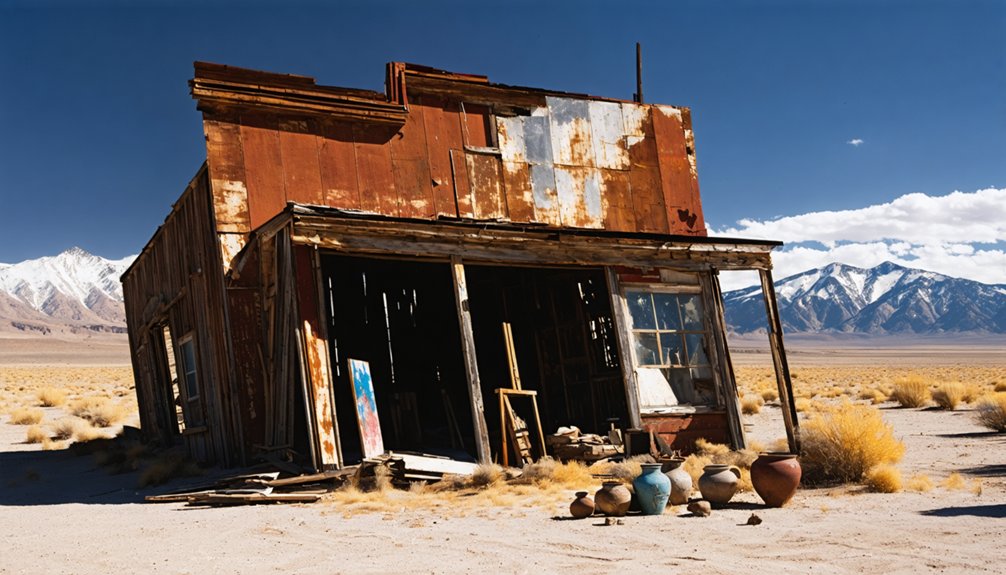
Moving east from Box Elder County’s railroad remnants, Cisco offers a different ghost town ownership model—one where the entire town has changed hands twice in less than a decade.
Eileen Muza purchased abandoned Cisco in 2015 for used-car pricing after discovering it during a Canyonlands vacation. She relocated from Chicago as the town’s sole resident, launching an artist residency called Home of the Brave.
Her property transformation included restored 1880s structures, quirky additions like a teepee sauna and snake sculpture skatepark, plus basic amenities—outhouses and outdoor shower.
Persistent harassment from trespassing tourists prompted Muza’s December 2024 sale to Kara Bard, who’ll restart the artist residency in fall 2025.
The one-acre property sits 45 miles from civilization with La Sal Mountain views—ideal for those embracing extreme isolation.
Utah Trust Lands Administration Auctions
For buyers seeking parcels rather than complete townships, the Utah Trust Lands Administration operates a state-run marketplace where abandoned settlements and rural acreage reach the auction block twice yearly.
The auction schedule runs June 5-10, 2026, online, with November dates following. Bidder registration is mandatory before participating.
Online bidding opens June 5-10, 2026, with a second auction in November—registration required for all participants.
Recent Widtsoe townsite sales demonstrate market potential:
- Block 25, Lot 1: sold $35,500 on $20,000 minimum (1 acre, Garfield County)
- Gordon Creek Parcel A: sold $201,000 on $145,000 minimum (280 acres, Carbon County)
- East Gunnison: sold $201,000 on $83,000 minimum (10 acres, Sanpete County)
- Beryl North: sold $304,000 on $206,000 minimum (111 acres, Iron County)
You’ll fund schools and universities through purchases—the administration generated $2.07 billion for beneficiaries since 1996.
Contact Diane Lund for property notifications.
Lucin Area: Affordable Land Near Ghost Town Site
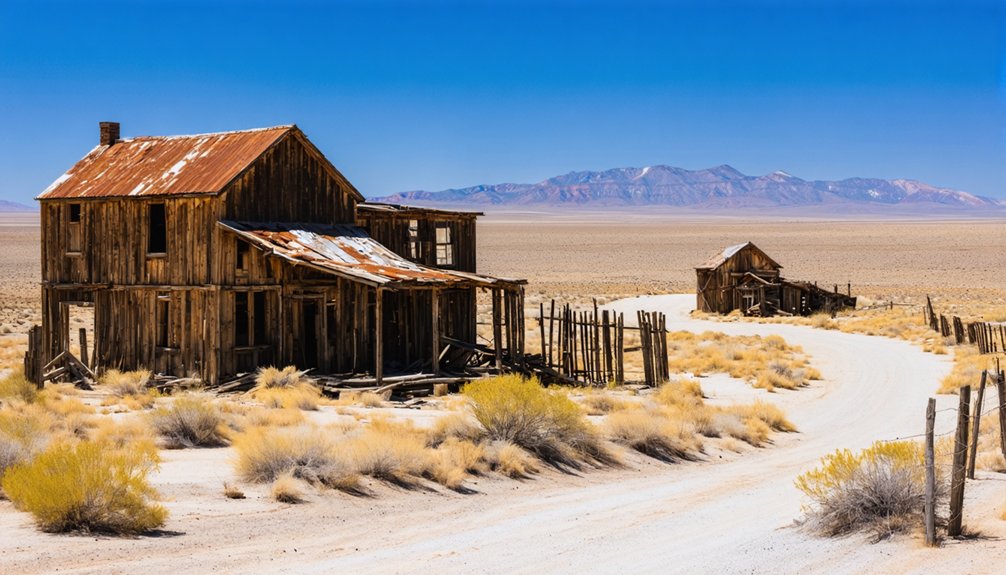
Beyond state auction parcels, Box Elder County’s remote northwestern corner offers entry-level opportunities near Lucin, a railroad ghost town 190 miles from Salt Lake City on the Nevada border.
While specific property pricing data isn’t publicly aggregated for this isolated area, land availability exists through private sellers and occasional county tax sales. You’ll need to research directly with Box Elder County records and contact local landowners about off-market parcels.
The extreme remoteness works in your favor—fewer buyers mean motivated sellers. Lucin’s location along I-80 provides the only amenity: highway access.
No utilities, services, or infrastructure exist here. You’re buying raw desert for minimal investment, accepting total self-reliance.
Contact Box Elder County Assessor’s office for ownership maps and delinquent tax lists revealing potential acquisition targets.
What to Expect When Buying Ghost Town Property
You’ll need to hire a real estate attorney and conduct thorough title searches to verify ownership, uncover any liens, and confirm whether mineral rights convey with the sale.
Expect significant infrastructure gaps—abandoned Utah ghost towns typically lack functioning utilities like water, sewer, and electricity, requiring costly installations or alternative solutions.
Budget for professional inspections of all structures and environmental assessments, particularly in flood-prone areas like those near the Price River.
Legal Due Diligence Required
When purchasing a ghost town in Utah, your legal due diligence begins with verifying a clear chain of title through county records and historical deeds—a process complicated by decades of dormancy, unrecorded mining claims, and potential heir disputes.
The legal implications extend beyond standard title verification to include escheatment risks and competing claims from prior miners or their descendants.
Your essential due diligence checklist includes:
- Securing quitclaim deeds from potential claimants to eliminate adverse possession risks
- Conducting Phase I environmental assessments for mining-related contamination like asbestos and heavy metals
- Confirming compliance with historic preservation overlays that restrict alterations
- Obtaining title insurance that specifically addresses abandonment-related defects and unrecorded liens
You’ll need to navigate Utah’s abandonment protocols, including proper notification procedures and state reporting requirements for properties dormant beyond statutory periods.
Infrastructure and Utility Challenges
Ghost town properties in Utah present extreme infrastructure deficits that’ll cost you hundreds of thousands before the land becomes habitable.
Water accessibility remains your biggest hurdle—Westwater’s Navajo community drilled deep into bedrock for 40 years, while Sego’s coal boom stalled without steady supply. You’re looking at expensive drilling and hauling operations.
Waste management infrastructure doesn’t exist. Cisco’s property offers only outhouses with zero septic systems.
You’ll build everything from scratch while maneuvering through county codes.
Road access varies wildly—State Line requires 20 miles of rough dirt roads, while Grafton demands crossing a 1924 one-lane bridge.
Power grids don’t reach these locations. You’re investing in solar arrays, generators, or battling utility companies for extensions.
Peak-season Gateway towns prove infrastructure right-sizing creates costly year-round maintenance for seasonal use.
Zoning and Development Considerations for Ghost Towns
Before purchasing a ghost town in Utah, you’ll need to navigate the state’s zoning framework, which varies greatly by municipality and county. Understanding zoning regulations is critical since they control permissible land uses, building construction, and development types.
Another intriguing aspect to consider is the history of hebron ghost town, which showcases the remnants of a once-thriving mining community. Many visitors are drawn to its eerie atmosphere and the stories of those who lived there during its peak. Delving into its past can provide invaluable insights for potential buyers looking to invest in the area.
Utah’s zoning framework varies significantly by municipality and county, making thorough research essential before any ghost town purchase.
You’ll require a land use permit before commencing any land development or property modifications.
Key zoning considerations include:
- Official zoning maps define district boundaries and allowable uses specific to your location.
- Land use decisions determine whether your planned activities comply with current regulations.
- Nonconforming use status may protect existing structures but limits expansion.
- Amendment processes require Planning Commission review and public hearings for rezoning.
Development standards address setbacks, fire safety, flood hazards, and access requirements.
Each municipality enforces different restrictions, so you’ll want thorough due diligence before committing to any ghost town purchase.
Preserving Historical Features and Artifacts
Once you’ve secured the necessary permits and approvals, your focus shifts to protecting the historical assets that give your ghost town its value and character.
Historical preservation starts with immediate stabilization—foundations crumble without emergency repairs, like those needed at Castleton’s Rock Castle. You’ll need professional artifact conservation to maintain structural integrity while preventing further deterioration.
Protect your investment by enforcing strict visitor guidelines. Metal detecting damages archaeological sites on federal land, and campfires inside historic cabins destroy irreplaceable wood structures. Modern graffiti erases original inscriptions from early settlers.
Your preservation efforts increase property value—Grafton’s well-maintained structures attracted Hollywood productions, while Spring City’s intact 19th-century buildings earned National Register eligibility.
Quality workmanship, like the 1916 Blacks Fork Commissary’s original chinking, demonstrates what proper maintenance preserves.
Financing Options for Unique Utah Properties
Buying a Utah ghost town requires creative financing since traditional mortgage lenders won’t touch properties lacking utilities, comparable sales, or appraisal standards.
You’ll need alternative financing strategies for these unique properties:
- Owner financing through Mountains West Ranches – Start with just $1,000 down and pay over 10-15 years with no credit checks.
- Cash payment plans – Pay $3,500 total for mining claims with flexible monthly installments as low as $400.
- Quick-close arrangements – Ghost town properties like Lucin sell under $18,500 with in-house mortgages.
- Cash discounts – Get 0% interest by paying your balance within 90 days.
No prepayment penalties mean you’re free to own outright whenever you choose, bypassing banks entirely while securing your piece of Utah’s frontier history.
Frequently Asked Questions
Are There Any Property Taxes on Ghost Town Land in Utah?
Yes, you’ll face property tax implications on ghost town ownership in Utah. All real property is assessed at 100% fair market value annually, though remote locations often have lower assessments than developed areas, reducing your tax burden.
Can I Relocate Buildings From Other Ghost Towns to My Property?
Appropriating structures isn’t straightforward—you’ll need ownership rights, building relocation permits, and local zoning approval. Utah’s nonconforming use rules and historical preservation laws complicate moving ghost town buildings to private property without proper authorization.
What Utilities Are Typically Available in Remote Ghost Town Locations?
You’ll typically find minimal utilities at remote ghost town locations. Most lack electrical connections entirely, relying instead on historical water sources like springs, creeks, or ditches. You’ll need to develop your own off-grid power and modern water systems independently.
Do Ghost Town Properties Require Special Insurance Coverage?
You’ll absolutely need specialized vacant property insurance since standard homeowners policies won’t cover these unoccupied structures. Remote Utah ghost town locations face unique insurance requirements, with coverage options varying based on building age, security measures, and wildfire proximity.
Are There Restrictions on Charging Admission to Historical Ghost Town Sites?
You can’t charge admission fees on private ghost town property without considering historical preservation obligations. If your site contains National Register Eligible resources, you’ll need UTSHPO coordination and proper permits before commercializing access to archaeological features.
References
- https://www.10news.com/ghost-towns-sale-us/
- https://www.lindasellsmoore.com/blog/ghost-towns-buy/
- https://trustlands.utah.gov/work-with-us/surface/land-sales/
- https://www.nhpr.org/2012-08-01/utah-town-pop-2-llamas-for-sale-3-9-million
- https://usdreamland.com/listings/79-25-acres/
- https://www.landandfarm.com/property/40-acre-scenic-utah-lot-with-creek-and-incredible-views-12003919/
- https://www.realtor.com/news/unique-homes/cisco-utah-ghost-town-buyer/
- https://utahrails.net/utahcoal/spring-canyon-mines.php
- https://patch.com/us/across-america/5-ghost-towns-you-can-buy-right-now-if-you-dare
- https://candysdirt.com/2018/05/30/yes-you-can-own-a-whole-town-in-utah-for-225k/