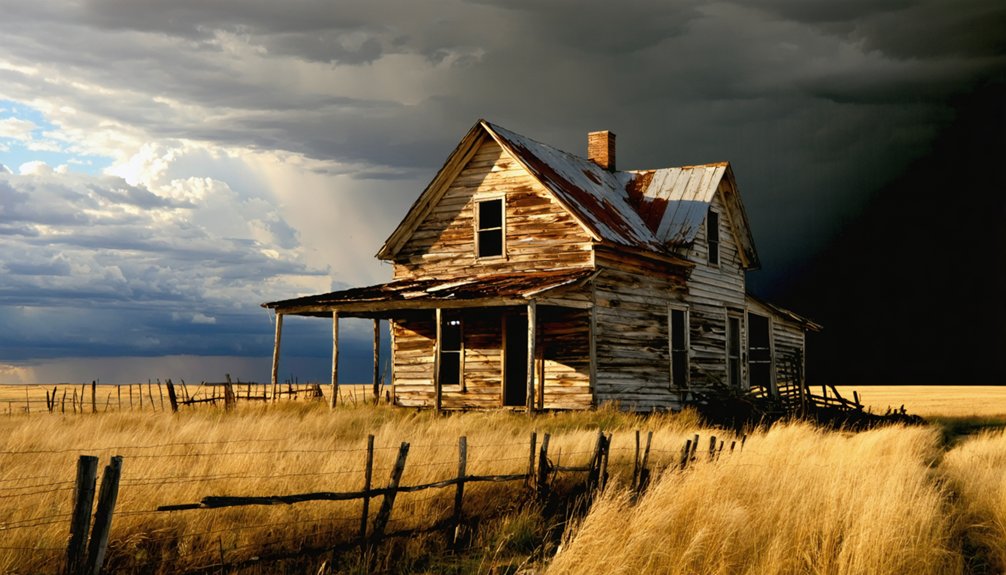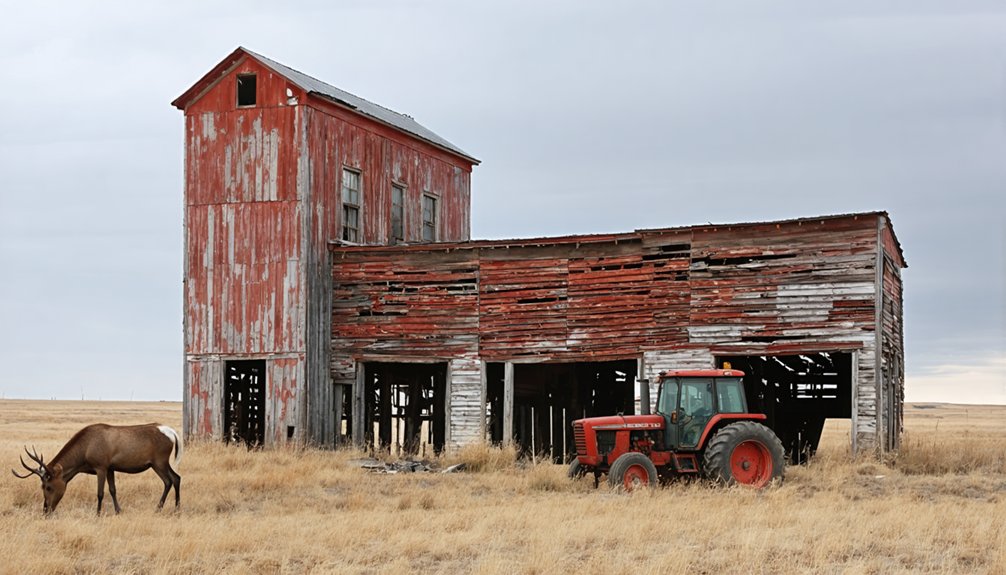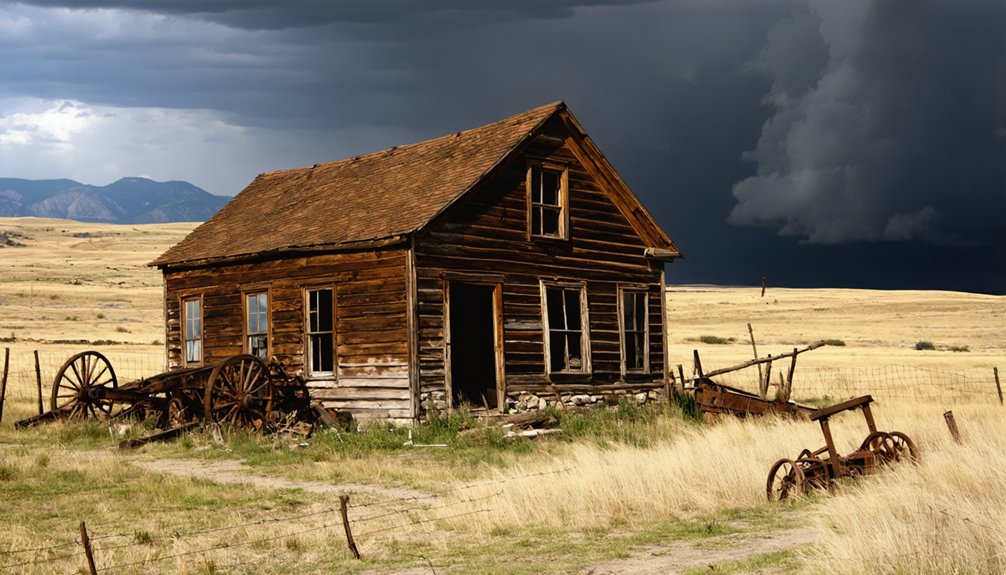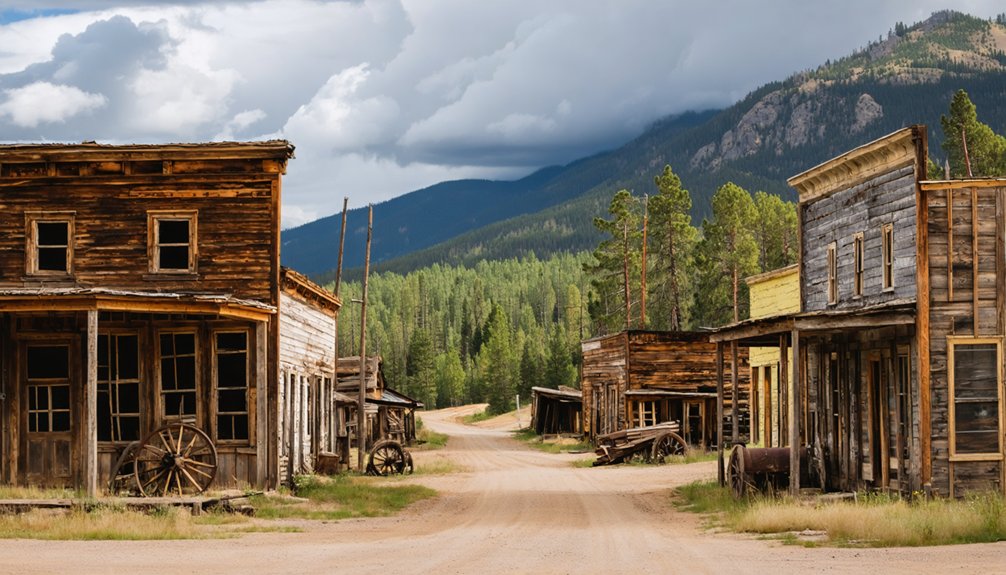
You’ll find over two dozen ghost towns scattered across the Black Hills, remnants of the 1874 gold rush when Custer’s expedition discovered gold in French Creek and triggered a stampede of fortune-seekers. Deadwood became the region’s most famous settlement, while places like Galena, Silver City, and Spokane now stand as weathered monuments to mining dreams. The Homestake Mine near Lead—America’s richest gold vein discovered in 1876—transformed the region from placer camps to industrial operations. Continue on to discover the specific locations, hidden ATV trails, and what structures still remain standing.
Key Takeaways
- The Black Hills gold rush beginning in 1874 created mining towns like Deadwood, Central City, and camps near the Homestake Mine.
- Notable ghost towns include submerged Camp Crook, Silver City with postal service until 1964, and Galena with ATV trails.
- Spokane, abandoned by 1940, and Mystic featuring the 1900 Reduction Mill showcase visible mining artifacts and abandoned structures.
- Remote sites like Black Fox and Bismuth require off-road vehicles and are accessible only through dense forest terrain.
- Explore safely by respecting private property and avoiding unstable structures while visiting these historical mining remnants.
The Gold Rush That Built a Landscape of Abandoned Dreams
When Lieutenant Colonel George Armstrong Custer‘s expedition stumbled upon gold flakes in French Creek during the summer of 1874, prospector Horatio Ross recorded in his journal that the discovery “set men’s hearts ablaze with a fever I’d seen only once before in California.”
The initial find near present-day Custer proved disappointing—small deposits that couldn’t sustain the hundreds who’d violated the Treaty of Fort Laramie to reach them. The expedition had traveled 330 miles before arriving in the Black Hills on July 22, 1874, where miners began their search for riches just days later. Custer had led over 1,000 men from Fort Abraham Lincoln on a mission that included finding a location for an Army fort and investigating the region’s natural resources.
Notable Ghost Towns and Their Stories
You’ll find five ghost towns scattered across the Black Hills, each with distinct stories told through mining records and cemetery markers.
Camp Crook lies 150 feet beneath Pactola Lake‘s surface, while Silver City’s post office served residents until 1964—proof that some “ghost towns” refused to die quickly.
At Galena’s historic site, popular driving trails make it best explored by ATV, allowing visitors to discover homes and relics from 140 years ago.
At Galena’s Vinegar Hill Cemetery, you can visit Sarah “Aunt Sally” Campbell’s grave, the first woman to file a mining claim in these hills after cooking for Custer’s 1874 expedition.
Spokane’s fragile structure dates back to 1927 when the town was prosperous enough to fund a school, though it was completely abandoned by 1940.
Gold Rush Boom Towns
As French Creek’s waters revealed their golden secret during the 1874 Custer Expedition, prospectors transformed the southern Black Hills into a sprawling network of mining camps that would define the region’s chaotic birth.
You’ll find Deadwood emerged as the lawless epicenter when William and Alfred Gay staked claims in November 1875, naming their canyon settlement after littering dead trees.
By 1876, thousands swarmed these gulches, claiming every creek-side plot available. Central City became the northern hills’ first organized operation, where the Hidden Treasure Mine sold for $25,000 and LeBeau established the region’s original gold jewelry trade.
The Manuel brothers’ April 1876 discovery near Lead uncovered the legendary Homestake Mine—America’s richest vein, producing 10 percent of global gold supplies.
George Hearst purchased the Homestake claim for $70,000 in June 1877, securing what would become a century-spanning mining operation.
The search for gold deposits spawned settlements like Hill City, Sheridan, and Pactola as miners explored the region for promising claims.
These ghost towns preserve mining heritage through their remarkable transformation from untamed camps into today’s historic landmarks.
Mining Era Remnants
The hard rock mining industry carved the Black Hills landscape with gaping shafts and eroded tailings that still mark where prospectors chased fortune at Hornblend, Blue Lead, Bald Mountain, Flatiron, and Galena.
You’ll find abandoned structures crumbling into the ground at these sites, though mining artifacts like deteriorated shaft timbers and rusted equipment remain visible after decades of exposure.
Galena housed an estimated 600 people during the 1800s before economic decline triggered systematic depopulation by the 1900s.
At Tinton on Negro Hill, you can still explore the miner’s hall and store—remnants of a community that shifted from silver extraction in the mid-1870s to tin, tantalite, and feldspar operations by the late 1890s.
Cambria was founded on coal mining operations and stands among the ghost towns that mark the decline of mining in the region.
Rochford preserves old miners’ graves in its cemetery, offering visitors a peaceful walk through the remnants of its mining past.
These ghost towns represent your freedom to discover authentic frontier history.
Preserved Historical Sites
While scattered artifacts and rusted equipment tell part of the Black Hills mining story, several ghost towns have survived with structures intact, offering you detailed windows into frontier life.
Galena’s preserved relics include schoolhouses and homes where Sarah Campbell made history as the first woman filing a mining claim—she’s buried in Vinegar Hill Cemetery.
You’ll find Rochford’s preserved relics include schoolhouses and homes where Sarah Campbell made history as the first woman filing a mining claim—she’s buried in Vinegar Hill Cemetery.
You’ll find Rochford’s Standby Mine mill ruins brooding over Irish Gulch, accessible by ATV along the old railroad bed.
Silver City maintained its historical significance longest, operating a post office until 1964 and a convenience store into recent years.
The Gorman Brothers’ 1876 settlement outlasted 600 Black Hills ghost towns.
Spokane Ghost Town offers historical insights through its collection of old houses and abandoned structures that preserve the area’s mining heritage.
Galena, located eight miles east of Deadwood with Bear Butte Creek flowing through, hosts an annual celebration on the second Saturday of June featuring bluegrass music and historic hikes.
These sites let you walk freely through authentic structures that witnessed $144,742 profits and countless failures.
Mining Operations That Shaped These Settlements
You’ll find that the ghost towns scattered across the Black Hills owe their very existence to the change from simple placer operations to industrial hard-rock mining after 1876.
When Fred Manuel and his partners discovered the Homestake deposit on April 9, 1876, they set in motion an evolution that transformed mining camps like Galena and Pactola—where over 300 miners once worked—into settlements requiring mills, chlorination plants, and eventually cyanide processing facilities.
The change demanded capital that only partnerships like George Hearst’s could provide, funding infrastructure such as the 200-stamp Golden Star Mill and the sprawling Terraville milling complex that became the industrial heart between Deadwood and Lead.
Hard Rock Mining Boom
On April 9, 1876, Fred Manuel, his brother Moses, Hank Harney, and Alex Engh stumbled upon a gold outcropping near what would become Lead—a discovery that transformed the Black Hills from a placer mining frontier into an industrial powerhouse.
They named it the Homestake claim, and it would produce 10% of the world’s gold over 125 years.
You’ll find that hard rock mining techniques evolved rapidly here. Initially, only Homestake’s free-milling ore proved profitable through simple crushing and mercury amalgamation.
But by the 1890s, chlorination plants—like the Golden Reward’s operation—unlocked refractory ores where gold bonded chemically to rock.
The cyanide process, refined by 1900, revolutionized everything. Production doubled between 1895-1900, reviving mines at Galena, Carbonate, and Bald Mountain.
Industrial-scale mills replaced hand devices, establishing permanent settlements.
Placer to Industrial Transition
By 1880, the creeks had given up their easy riches. You’d have watched the placer mining era fade as prospectors turned toward the mother lodes buried deep within the hills.
This industrial change transformed ramshackle camps into company towns—or left them abandoned entirely.
The change reshaped everything:
- Fred Manuel’s discovery at Homestake on April 9, 1876, shifted $70,000 into George Hearst’s hands
- Free-milling ore crushed easily at Homestake while refractory deposits elsewhere demanded expensive chemical processes
- By 1890, chlorination plants dotted Lead and Deadwood’s landscape
- Cyanide processing by 1900 revived forgotten claims at Galena and Bald Mountain
- Consolidated wealth replaced individual freedom as corporations monopolized profitable ground
You’d need capital now, not just a pan and determination.
The lone prospector’s dream died with the placer deposits.
Mill and Processing Infrastructure
The hammering of stamps announced the new age before you saw the mills themselves. When Jones and Pinney commissioned their mill on December 31, 1876, at Golden Gate, they weren’t just crushing Alpha Mine ore—they were declaring independence from placer’s limitations.
You’d witness mill technology evolve from that first 5-stamp operation to Homestake’s 200-stamp Golden Star behemoth, processing tons where panners once found ounces.
Terraville became your industrial heart between Deadwood and Lead, its ore processing plants wrestling gold from increasingly stubborn rock.
When free-milling deposits played out, chlorination plants stepped in—Golden Reward’s 1889 facility proving most successful at liberating chemically-bound gold.
The Standby Mill’s 1879-1909 run showed these weren’t temporary camps but permanent industrial settlements transforming wilderness into wealth.
What You Can Still See Today
Although time and weather have claimed many structures, the Black Hills ghost towns still reveal compelling evidence of their boom-and-bust past.
Despite decades of abandonment and harsh weather, these mining settlements preserve remarkable traces of their prosperous and turbulent history.
You’ll discover authentic remnants across multiple sites:
- Mystic Trailhead attractions include the former railroad route along Mickelson Trail, where the 1900 Reduction Mill once processed ore with a $1 million investment.
- Spokane mining artifacts feature the mine manager’s house (occupied until the 1970s), rusted automobiles, root cellars, and storage tanks built into the ground.
- Maitland’s infrastructure preserves shaft houses, ore bins, and foundations too decrepit for removal.
- Trojan’s enormous cyanide vats stand scoured bright across the valley.
- Rochford’s surroundings showcase silent mines, deserted cabins, and Clover Leaf Mine remnants including bull wheels from stamp mills.
These tangible connections to mining history remain accessible for independent exploration.
Exploring Galena and Silver City
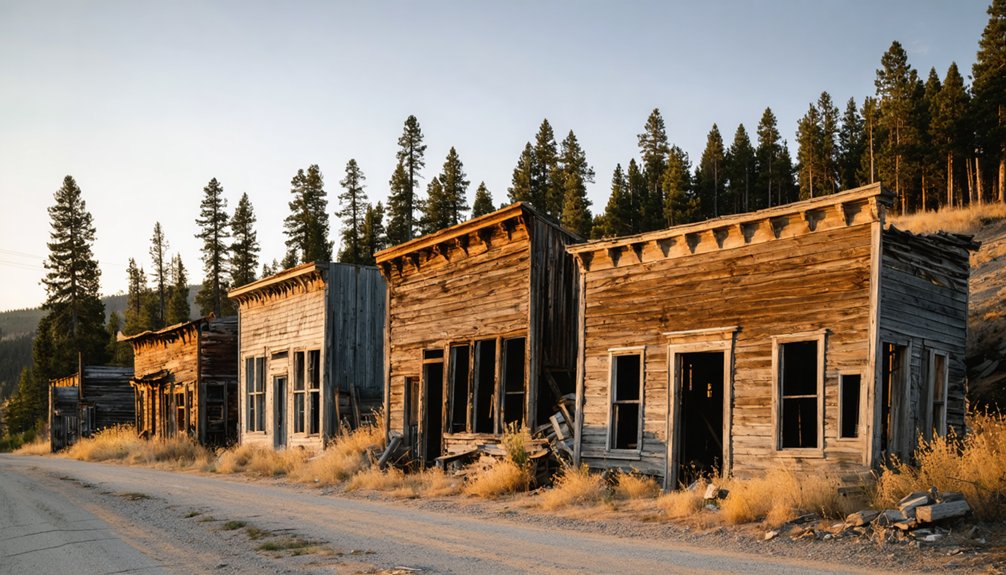
When prospectors stumbled upon galena mineral veins in a remote gulch near Bear Butte Creek in 1876, they’d been hunting for gold but found something equally valuable—rich deposits of lead and silver that would transform Vanocker Canyon into a bustling mining town.
You’ll discover Galena history through its preserved schoolhouse and cemetery, where Sarah Campbell—the first Black woman to own a Black Hills mining claim—rests alongside Civil War veterans.
At its peak, this community of 2,000 independent souls operated thirteen silver mines and establishments like the Sudden Death Saloon.
Today, fewer than twenty year-round residents maintain this settlement’s legacy. The Galena Historical Society hosts annual Ghost Town Walks each June, where you can explore authentic structures and hear firsthand accounts from descendants who refuse to let their ancestors’ dreams fade into obscurity.
Remote Locations and Hidden Ruins
Beyond the well-trodden paths to Deadwood and Lead, you’ll find ghost towns so remote that even veteran Black Hills explorers miss them on first attempts.
These hidden treasures require ATV trails and determination to reach their forgotten stories.
What You’ll Discover Off the Beaten Path:
• Spokane – Sixteen miles from Custer, this 1890s mining camp yielded gold, silver, copper, and zinc.
No prominent signs mark it—locals guard this secret jealously.
- Black Fox – Now a barren campground in Pennington County, accessible only by off-road vehicles through dense forest.
- Bismuth – Custer County’s most neglected site, where mining ruins disappear beneath pine needles.
- Hornblende – Gaping mine shafts and eroded tailings create otherworldly badlands in the Northern Hills.
- Dumont – Cattle pens outlast the railroad that abandoned this Northern Hills ranching outpost.
Planning Your Visit: Access Points and Safety Guidelines
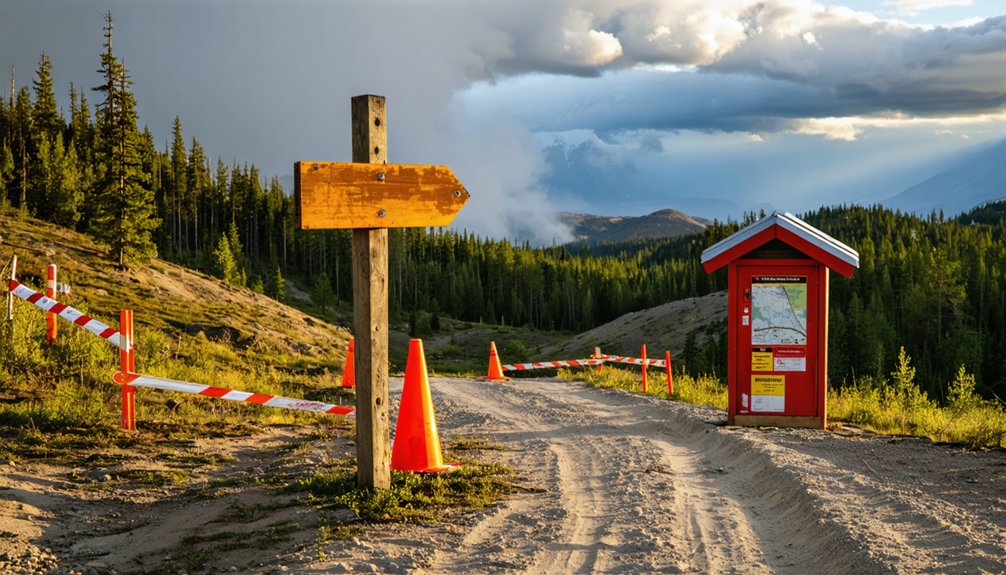
Three major corridors connect Rapid City to these vanished settlements, each revealing different chapters of Black Hills mining history.
Highway 44 west to US-385 north delivers you to Rochford and Mystic’s preserved structures.
I-90 west through Boulder Canyon winds dramatically into Deadwood’s National Register sites.
From Hermosa, SD-79 or US-16 provides 15-45 minute access routes to multiple locations.
Your exploration demands serious safety precautions.
Exploring abandoned mining sites requires vigilance—crumbling structures, hidden hazards, and unstable ground demand respect and careful preparation before venturing forth.
Don’t climb deteriorating structures—preservation depends on your restraint.
Old mills hide broken steps and unstable upper levels.
Mine entrances beckon with cold darkness, but entry requires extreme caution.
Some sites vanished completely; respect private property and Forest Service boundaries by viewing from roads only.
Summer daylight hours work best for cemeteries and outdoor ruins, while evening tours at Bullock Hotel and Adams House offer authentic spookiness for $35.
Frequently Asked Questions
Are There Any Ghost Towns in Black Hills That Allow Overnight Camping?
You can’t camp directly in most Black Hills ghost towns due to camping regulations protecting their historical significance, but you’ll find dispersed camping spots on nearby BLM land and forest roads surrounding sites like Spokane and Bear Gulch.
Which Ghost Town Is Best for Families With Young Children?
“Good things come in small packages”—Four-Mile-Old-West-Town’s your best bet. You’ll find family friendly activities throughout 40 reconstructed buildings, plus historical significance that won’t overwhelm little ones. It’s ranked #1 by fellow travelers who’ve explored there firsthand.
Can You Pan for Gold in Any of These Ghost Towns?
You can’t legally pan at Rockerville, Etta, or Spokane due to gold panning regulations, but Big Thunder Gold Mine in Keystone welcomes families to use historic mining techniques and keep whatever gold you discover.
What’s the Cell Phone Coverage Like in These Remote Ghost Town Areas?
Cell phone coverage is extremely unreliable in ghost town areas due to connectivity issues and sparse cell tower locations. You’ll need downloaded offline maps before exploring, as Verizon outperforms AT&T, though service remains spotty throughout these isolated Black Hills regions.
Are Guided Tours Available for Any Black Hills Ghost Towns?
You won’t find Wi-Fi hotspots or guided tour options at these ghost towns. They’re self-exploration sites where you’ll discover their historical significance independently, riding ATV trails through ruins where pioneers like Sarah Campbell once staked claims.
References
- https://en.wikipedia.org/wiki/List_of_ghost_towns_in_South_Dakota
- https://www.trailhoundcabins.com/ghost-towns-of-the-black-hills/
- https://www.sdhspress.com/journal/south-dakota-history-2-2/some-black-hills-ghost-towns-and-their-origins/vol-02-no-2-some-black-hills-ghost-towns-and-their-origins.pdf
- https://blackhillsatvdestinations.com/ghost-towns/
- https://www.sdpb.org/rural-life-and-history/2023-08-21/some-black-hills-ghost-towns-and-their-origins
- https://www.blackhillsbadlands.com/blog/post/old-west-legends-mines-ghost-towns-route-reimagined/
- https://www.blackhillshikingbikingandmore.com/old-mining-ghost-towns
- https://www.tripadvisor.com/Attractions-g4007682-Activities-c47-t14-The_Black_Hills_South_Dakota.html
- https://www.americanhistorycentral.com/entries/black-hills-gold-rush/
- https://blackhillsvisitor.com/learn/history/the-black-hills-gold-rush/