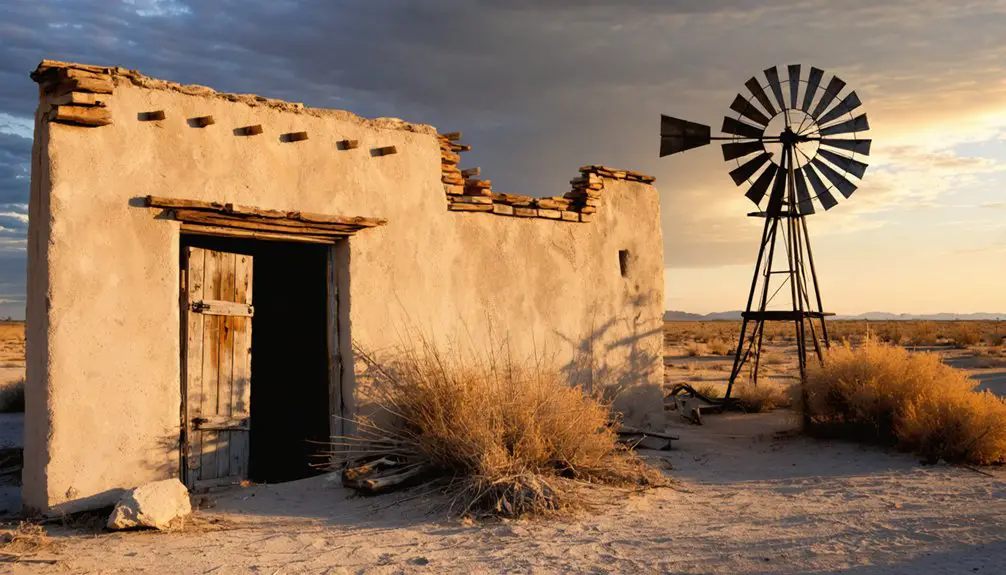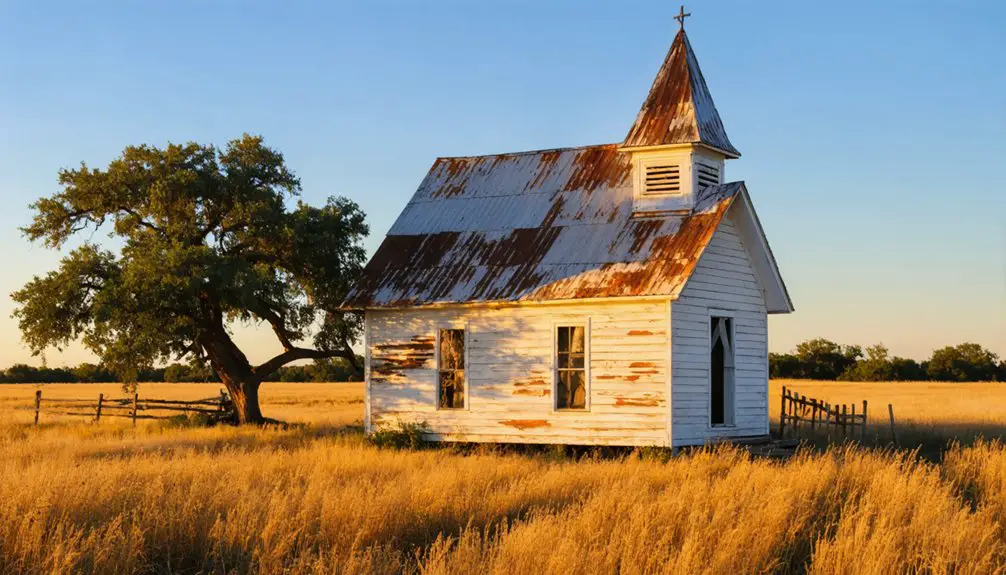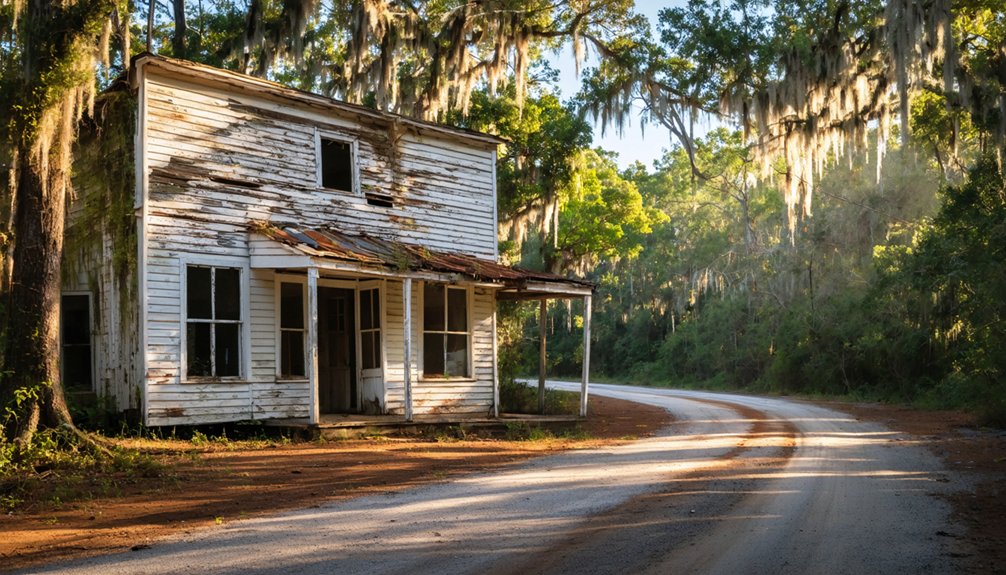
You’ll find ghost towns scattered throughout East Texas’s pine forests, from Aldridge’s standing sawmill walls in Angelina County to Old Fredonia’s vanished river port in Gregg County. These settlements thrived on timber and cotton before fires, depleted resources, and bypassed rail lines triggered their abandonment between the 1870s and 1920s. Some communities like Big Head Village and Byspot disappeared so completely they’ve been erased from official maps, leaving only cemetery stones and archival records to prove they existed—each site holding distinct stories of rebellion, industry, and forgotten heritage.
Key Takeaways
- East Texas ghost towns include Aldridge, Old Fredonia, Big Head Village, Shook’s Bluff, and Byspot, each with unique histories.
- Timber depletion, railroad bypasses, and economic shifts caused most communities to decline between the 1860s and 1920s.
- Aldridge’s sawmill walls remain the most intact logging ghost town ruins in East Texas for exploration.
- Old Fredonia sparked the 1826 Fredonian Rebellion before abandonment around 1870 when railroads bypassed the settlement.
- Visit during cooler months with GPS coordinates and physical maps; respect private property and cemetery boundaries.
Aldridge: A Lumber Boomtown Frozen in Time
Deep in the Angelina County pine forests, where the Neches River carves a sharp bend through East Texas bottomlands, Hal Aldridge saw opportunity in 1903. He’d relocated from Rockland, Texas, determined to build his fortune on longleaf yellow pine. By 1905, his wooden mill stood operational, connected by a Burr’s Ferry railway spur.
Where pine forests met ambition, one entrepreneur’s vision transformed East Texas wilderness into an industrial cornerstone of the early twentieth century.
Aldridge history reveals a town that thrived remarkably fast. Within eight years, 500 workers and their families called this place home—complete with schools, saloons, a hotel, and commissary.
The timber industry here peaked at 125,000 board feet daily by 1918, supporting up to 1,500 residents. The operation was part of a larger transformation as approximately 615 sawmills operated across Texas by 1910, marking the height of the state’s lumber bonanza. Timber crews of 40 to 60 men worked under woods bosses, enduring grueling 10-hour days in the remote forests surrounding the mill.
But fires ravaged the operation repeatedly—1911, 1914, 1919. Though Aldridge rebuilt with revolutionary concrete structures in 1912, depleted timber and persistent blazes forced closure by 1923.
Old Fredonia: The Settlement That Sparked a Rebellion
While Aldridge’s story unfolded in the early 20th century, another East Texas settlement had already risen and fallen decades earlier—one whose brief existence triggered consequences far beyond its borders.
You’ll find Old Fredonia‘s historical marker in Gregg County, where Haden Edwards founded this Sabine River port in 1825. His misunderstanding with Mexican authorities over land grants sparked the Fredonian Rebellion when his brother Benjamin seized Nacogdoches’s Old Stone Fort in December 1826.
Mexican forces crushed the revolt by January 1827.
The settlement itself thrived until 1860, supporting 276 residents, cotton warehouses, and steamboat traffic. The prosperous ferry crossing featured 40-50 buildings, including homes and warehouses that served river traffic. When railroads bypassed Fredonia around 1870, residents abandoned their homes.
Its Historical Significance endures—not for commercial success, but for igniting early Texas-Mexico tensions. The name Fredonia itself derived from the word “freedom,” reflecting the settlement’s ideological foundations.
Big Head Village: Gregg County’s Vanished Cherokee Settlement
Before railroads and oil booms reshaped Gregg County’s landscape, Big Head Village marked one of the region’s earliest pioneer settlements along the Cherokee Trace.
You’ll find its former site on the northeast rim of modern Kilgore, near where East Highway 80 meets Old Jefferson Road. The settlement’s name derives from a Cherokee word, though uncertainty remains whether indigenous people actually founded it.
Pioneer Activity began when James Earp‘s family arrived from Alabama in the 1840s, purchasing 1,031 acres by 1848.
Legal documents and maps recognized the community through the 1850s, when it operated a post office. By the 1860s, Big Head Village had vanished completely.
The Cherokee Trace, blazed by Cherokee Indians in 1821, connected Nacogdoches to White River, Arkansas, and remained significant for early settlers who established camps along its path. The discovery of the East Texas Oil Field in late 1930 would later transform this quiet rural landscape, with Longview’s population nearly tripling during the subsequent decade. Today, nothing remains of this Cherokee Origins settlement—no foundations, no markers, just archival records documenting Gregg County’s forgotten past.
Shook’s Bluff: Mystery Along the County Line
The settlement’s infrastructure reflected its economic purpose:
Every building, every structure served the mill—nothing existed here without economic justification.
- Wooden commissary anchoring commercial activity
- Fifteen to twenty worker houses clustered around mill operations
- Boarding house accommodating transient laborers
Four daily Cotton Belt Railroad passenger trains connected you to regional markets.
Spinks operated his general merchandise store two miles north at Forest, serving both mill families and public customers.
When sawmill operations ceased, economic vulnerability transformed this once-active community into another East Texas ghost town. Like many historical settlements, access to records of Shook’s Bluff now depends on digital discovery systems that help researchers explore archival collections. John N. Cravens documented these communities near the Cherokee and Angelina County line in his 1970 historical study.
Byspot: the Town That Disappeared From the Maps
If you search for Byspot in San Jacinto County today, you’ll find it exists only in ghost town archives—the U.S. Geological Survey doesn’t acknowledge it ever stood there.
Originally called Teddy on vintage maps, the settlement operated a post office under the name Byspot from 1899 to 1921 before vanishing from official records entirely.
Unlike other abandoned East Texas communities that left behind cemeteries or street traces, Byspot disappeared so completely that even the reason for its name change remains undocumented. Many East Texas towns faded away or merged with larger neighboring cities as railroads shifted routes and economic opportunities moved elsewhere.
These ghost towns represent the hidden history of Texas, offering insight into past economic and social conditions that shaped the region. Exploring forgotten places in southwest Texas allows visitors to experience the remnants of a once-thriving culture. Each site tells a story of resilience and change, revealing the layered narratives that are often overlooked in modern history. These locations serve as a reminder of the vibrant communities that once flourished in the harsh landscape of the region.
Origins in San Jacinto County
Deep in southwestern San Jacinto County, eighteen miles southwest of Coldspring, a sawmill community once thrived where Piney Woods timber fueled an entire local economy.
You’ll find Byspot’s origins tied directly to settlement patterns that followed the lumber industry’s expansion into East Texas during the late 1800s. When the post office opened in 1899 under the name Teddy, it marked the community’s formal recognition.
The town’s infrastructure centered around three key elements:
- The Conroe, Byspot, and Northern tram railroad connecting sawmill operations
- Short-line rail networks hauling timber between Conroe and Coldspring’s outskirts
- Logging operations extracting valuable Piney Woods resources
Economic decline followed the timber’s depletion, ultimately erasing Byspot from US Geological Survey maps entirely.
Removal From Official Records
Byspot’s disappearance from U.S. maps demonstrates how official erasure works in East Texas.
You’ll find no trace in modern directories, though legal papers referenced the settlement through the 1850s. When the post office closed and rail lines bypassed the site, cartographers stopped recording it.
Documentation gaps emerged as county records shifted to newer seats, leaving Byspot without official status.
The pattern mirrors Big Head Village and Elmina—once you’ve lost population thresholds and transportation links, you’re dropped from almanacs and handbooks.
Texas lists 511 ghost towns, but many East Texas sites aren’t tracked at all. You can still locate remnants if you know where to search, but bureaucratic systems have no reason to acknowledge what doesn’t serve current administrative needs. When exploring abandoned towns across Texas, one can uncover fascinating stories hidden in crumbling structures and overgrown landscapes. These sites offer a glimpse into the past and reflect a time when communities flourished, only to be left behind as modernization took hold. For those willing to venture off the beaten path, the journey through these ghostly remnants can be both haunting and enlightening.
Legacy of Rural Abandonment
When the post office shuttered in 1921, Byspot joined a wave of East Texas settlements erased by timber depletion and agricultural collapse.
You’ll find no standing structures in San Jacinto County today—just empty woods where families once built livelihoods from logging and farming. Economic shifts drove survivors toward towns with railroad access, leaving Byspot to vanish entirely by World War II.
The town’s disappearance reflects broader patterns across the piney woods:
- Similar communities like Java and Gent in Cherokee County met identical fates
- Great Depression accelerated abandonment throughout rural East Texas
- Exhausted forests couldn’t sustain timber-dependent populations
Rural nostalgia preserves Byspot in ghost town databases, though no historical marker commemorates the spot.
It symbolizes freedom lost to economic forces beyond local control.
Larissa: Harrison County’s Forgotten Community
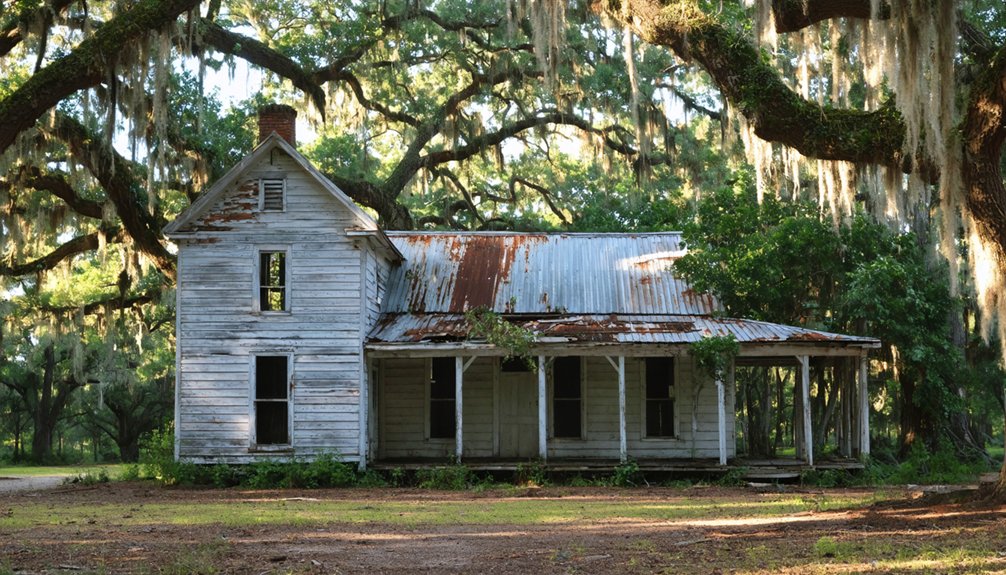
If you drive twenty miles northwest of Rusk along Farm Road 855 in Cherokee County, you’ll find the remnants of Larissa, a community founded in 1846 by Tennessee Presbyterian settlers who deliberately built their town away from whiskey-selling Talladega.
By the mid-1850s, this educational outpost boasted four stores, a salt works, and the crown jewel of Larissa College with its three-story building and dual dormitories serving East Texas frontier families.
The town’s dependence on that single institution sealed its fate—when Presbyterians withdrew support in 1866 and the college shuttered in 1870, Larissa’s economy collapsed, and a devastating 1872 meningitis epidemic scattered the survivors into history.
Early Settlement and Growth
Following the upheaval of the Civil War, former slaves of Gideon Christian established Larissa just south of the Upshur County line in Harrison County.
You’ll find this settlement emerged during Reconstruction, when freedmen claimed their independence on lands tied to their former owner’s holdings.
The community’s settlement patterns reflected typical freedmen villages:
- A central church serving as spiritual and educational hub
- Agricultural plots supporting 50-100 residents through cotton and subsistence farming
- Clustered family homesteads on a small rise
Decline and Present-Day Remnants
Like many freedmen communities across East Texas, Larissa couldn’t withstand the economic pressures that reshaped rural Harrison County after World War II.
You’ll find minimal markers of this forgotten settlement today, though its historical significance remains embedded in the region’s post-Civil War narrative. The community decay followed predictable patterns—population shifts drained what little energy remained, and descendants gradually abandoned their ancestral lands.
Unlike Jonesville, which retained its post office and general store, Larissa left almost nothing behind.
You won’t discover abandoned buildings or cemetery landmarks here. The community simply faded, its memory preserved only through archival records and oral histories.
Harrison County lists Larissa among its ghost towns, yet even that designation feels generous given how completely it vanished from the landscape.
What Caused These Communities to Disappear?
The ghost towns scattered across East Texas didn’t vanish overnight—they faded slowly as multiple forces converged to drain them of life.
You’ll find the community impact was devastating when critical industries collapsed, leaving residents without economic anchors.
The primary economic shifts that emptied these settlements included:
- Railroad rerouting and highway diversions that isolated once-thriving communities from commerce
- Lumber and oil industry exhaustion after boom periods ended and resources depleted
- Loss of essential services like post offices, hospitals, and county seats that triggered population exodus
When younger generations left for cities offering better opportunities, remaining residents faced an impossible choice: stay in dying towns or follow their children to urban centers.
Agriculture’s decline and vanishing retail operations sealed these communities’ fate.
Exploring the Remaining Structures and Ruins
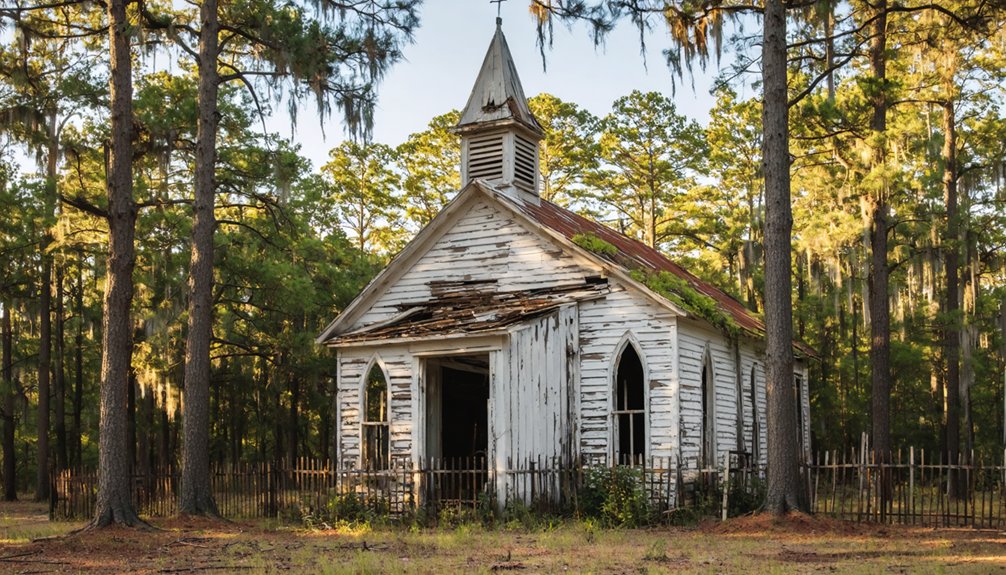
If you hike into Angelina National Forest from Boykin Springs, you’ll find Aldridge’s hand-poured concrete sawmill walls still standing, now covered in graffiti and strangled by vines.
Most East Texas ghost towns left far less behind—New Birmingham outside Rusk shows only scattered house remnants and exposed courthouse foundations, while Camden south of Longview exists solely as a cemetery.
The contrast between Aldridge’s substantial ruins and these vanished townsites reveals how quickly timber structures disappeared once the forests reclaimed abandoned settlements.
Aldridge’s Preserved Logging Structures
Deep within Angelina National Forest‘s pine-covered terrain, Aldridge’s hand-poured concrete sawmill ruins stand as East Texas’s most intact logging ghost town.
You’ll discover structures that showcase Aldridge history and early 20th-century logging techniques, built specifically to resist the fires that destroyed the original 1905 wooden mill.
The preserved complex includes:
- Reinforced concrete sawmill – processing 125,000 board feet daily at peak capacity
- Power plant and fuels building – supporting operations for 500 employees
- Dry kiln facilities – preparing yellow pine lumber for nationwide distribution
Trees now grow through hollowed buildings where workers once processed timber from surrounding Pineywoods.
You’ll find these ruins along the old Burr’s Ferry, Browndel & Chester Railway spur, accessible via a 3-mile trail from Boykin Springs Recreation Area.
Vanished Townsites and Traces
Across East Texas’s forgotten landscapes, weathered courthouse foundations and crumbling cemetery gates reveal settlement patterns that predate modern highway systems.
You’ll find Helena’s two-story courthouse still standing, preserved since 1962 by local residents who refused to let their history disappear. At low tide, New Birmingham’s courthouse foundation emerges from the water—a stone symbol to communities that chose independence over consolidation.
These vanished landmarks carry historical significance beyond mere nostalgia. Cemetery boards in Helena maintain burial grounds that outlasted every commercial structure.
Stone foundations dot former townsites, their sandstone blocks marking where neighbors gathered. In Barstow, adobe walls crumble into earth. At Aldridge Sawmill, massive concrete structures stand like monuments to industrial sovereignty.
Each ruin maps a community that existed outside today’s regulated framework.
How to Visit East Texas Ghost Towns Today
While many East Texas ghost towns have vanished entirely, several sites remain accessible to visitors willing to venture down unmarked dirt roads and overgrown trails.
Aldridge offers the most substantial remains—you’ll find vine-covered sawmill structures, a cemetery, and school building just an hour southeast of Lufkin in Angelina County.
Visiting tips for exploring these forgotten settlements:
- Bring GPS coordinates and physical maps, as cell service proves unreliable in remote locations
- Respect private property boundaries and cemetery grounds when photographing ruins
- Visit during cooler months to avoid dense undergrowth obscuring pathways
New Birmingham requires persistent searching through woods off County Road 1104A near Rusk.
The historical significance of these iron-working and timber operations reveals Texas’s industrial past, preserved only through crumbling foundations and weathered markers.
Preserving the Legacy of Abandoned Settlements
Beyond exploration lies the harder work of preservation.
You’ll find community engagement driving restoration efforts across East Texas, from Longview’s Historic Preservation Society partnering with state commissions to Cherokee County volunteers documenting vanished settlements.
These towns—casualties of oil decline, railroad shifts, and Depression-era closures—hold historical significance worth fighting for.
Each abandoned settlement represents irreplaceable chapters of Texas heritage that deserve documentation and protection before they vanish entirely.
Dialville’s churches stand as memorials to former populations of 400, while scattered cemeteries with handmade crosses mark where communities thrived during 1900s tomato and peach farming booms.
The Texas Historical Commission’s Cemetery Preservation Program provides technical assistance, helping locals maintain what remains.
Through photography, archival records, and physical restoration, you’re preventing 150 years of heritage from disappearing.
Street names in neighboring cities now serve as the only monuments to these ghost towns’ legacies.
Frequently Asked Questions
Are There Any Documented Hauntings or Paranormal Activity in These Ghost Towns?
Like searching for footprints in yesterday’s dust, you’ll find East Texas ghost towns lack documented paranormal investigations or verified haunted histories in archival records. You’re free to explore these abandoned settlements and draw your own conclusions about unexplained phenomena. Among the eerie remnants, it’s easy to imagine the tales lurking in haunted ghost towns in Texas, where the past whispers through the wind. Every corner holds a story waiting to be unearthed, from the flickering lights of long-abandoned buildings to the faint echoes of laughter that once filled the streets. Some visitors claim to have experienced unexplainable sensations, leaving them to wonder what truly lies beneath the surface of these historic sites.
Can You Legally Remove Artifacts or Relics From Ghost Town Sites?
No, you can’t legally remove artifacts without permission. Most East Texas ghost town sites sit on federal or private land, where artifact preservation laws impose serious legal consequences including fines and criminal charges for unauthorized collection.
What Wildlife Hazards Should Visitors Watch for When Exploring These Locations?
You’ll encounter deer, rabbits, and snakes throughout these abandoned sites. Take safety precautions against wildlife encounters by watching for reptiles in crumbling structures and maintaining distance from mammals roaming overgrown vegetation and desolate roads.
Were Any Famous Historical Figures Born in These East Texas Ghost Towns?
No famous residents emerged from these ghost towns based on archival research. Despite Texas having 511 ghost towns, East Texas settlements like Camden, New Danville, and Utica hold historical significance through community stories rather than notable births. For those intrigued by the past, there are opportunities to explore abandoned places in Texas that reveal the remnants of these once-thriving communities. Each location offers a unique glimpse into the lives that were once lived, urging visitors to reflect on the stories and emotions tied to these forgotten sites. As you wander through the dilapidated structures and rusted artifacts, you can almost hear the echoes of history coming to life.
Do Any Descendants of Original Residents Still Live in the Area?
You’ll find descendant stories throughout Helena and Old Waverly, where family legacies continue through preservation groups and active churches. Original settler families still maintain cemeteries, volunteer services, and multi-generational connections spanning over fifty years of dedication.
References
- https://texashighways.com/travel-news/four-texas-ghost-towns/
- https://en.wikipedia.org/wiki/Category:Ghost_towns_in_East_Texas
- https://www.county.org/county-magazine-articles/summer-2025/ghost-towns
- http://sites.rootsweb.com/~txgregg/ghosttowns.html
- https://www.youtube.com/watch?v=Zd8-gKw-5Hc
- https://hcpl.bibliocommons.com/v2/record/S203C56562
- https://www.texasescapes.com/TOWNS/Texas-Ghost-Towns-6-East-Texas.htm
- https://mix931fm.com/texas-ghost-towns-history/
- https://www.desertedtexas.org
- https://www.exploros.com/summary/aldridge-sawmill