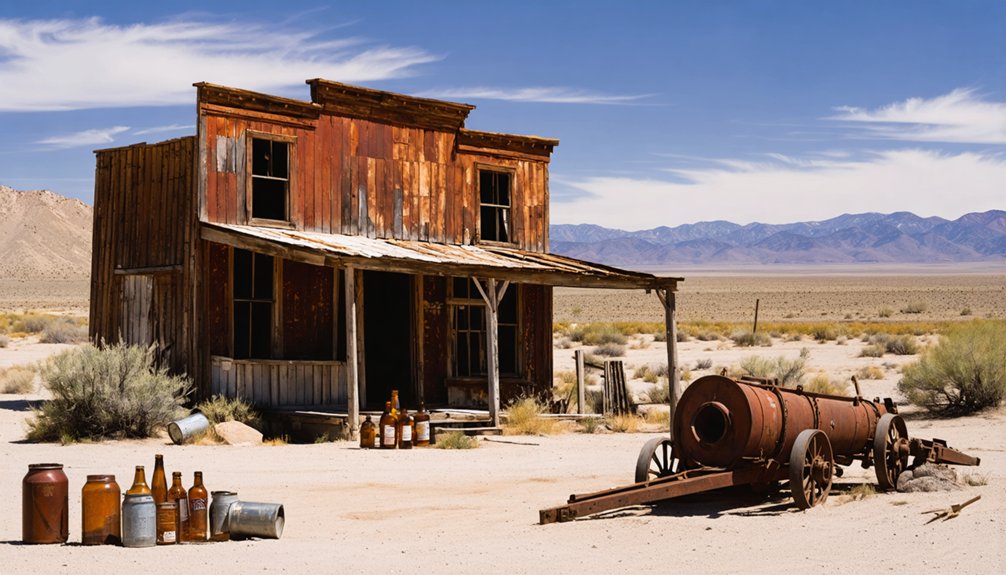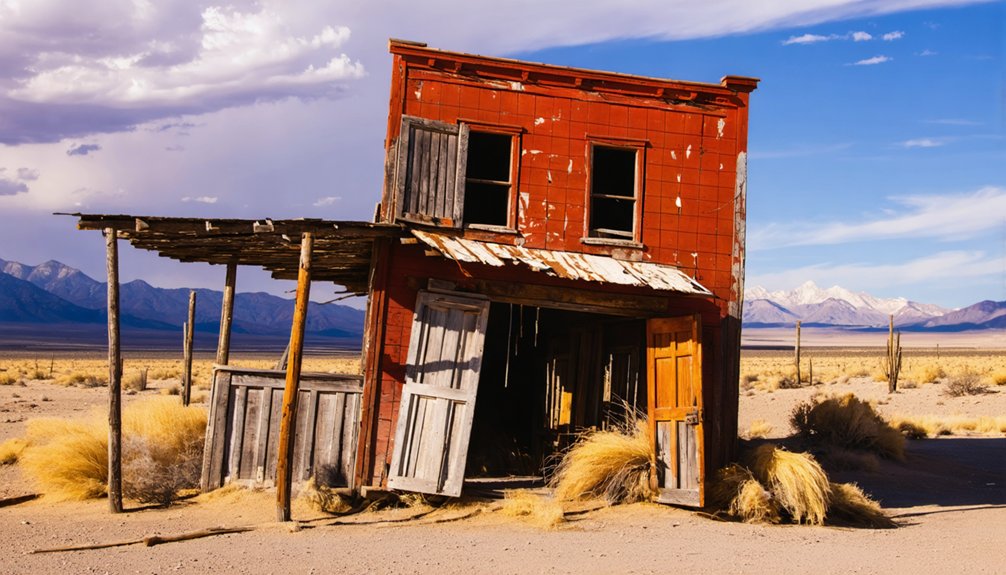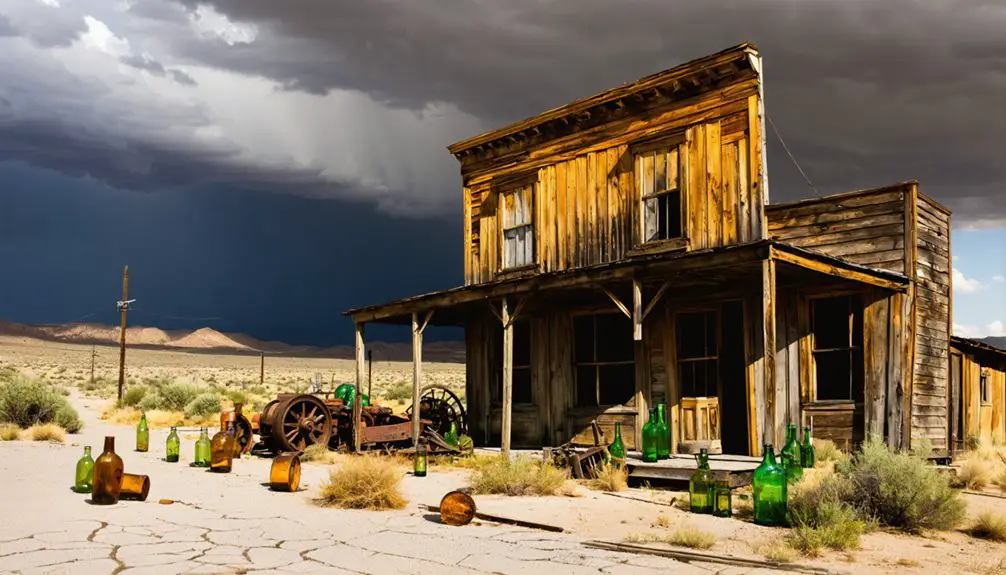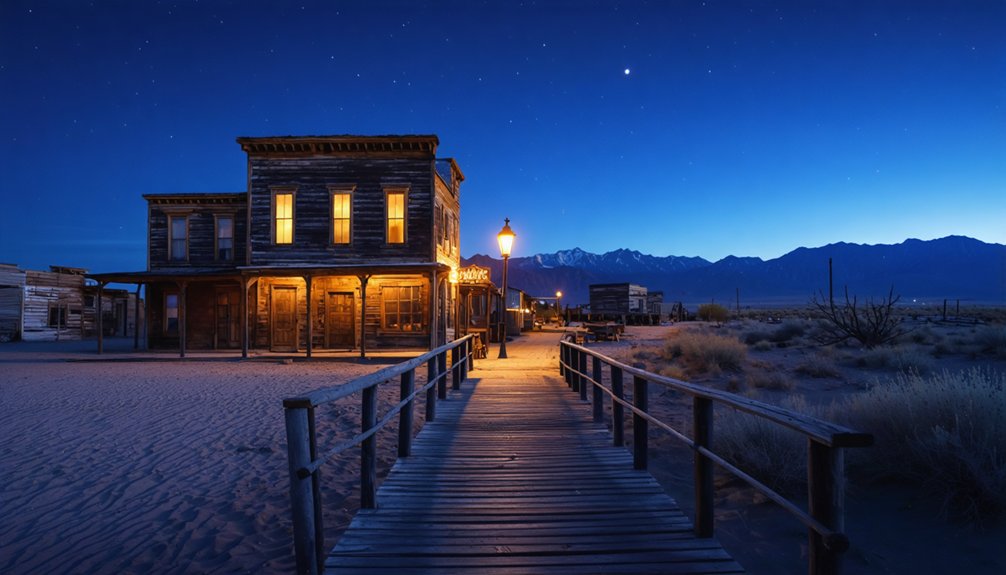
You can sleep in original miners’ cabins at Gold Point Ghost Town, where desert silence replaces the clamor of 13 saloons that once lined these streets. Vya offers pet-friendly cabins near failed homestead sites, while Paradise Ranch Castle lets you rest inside medieval suits of armor on 160 acres of ranchland. Tarantula Ranch provides glamping trailers and tent sites between Nevada’s highest peak and Death Valley. Though Rhyolite and Belmont don’t offer overnight stays, their preserved ruins and proximity to comfortable lodging make them essential stops on your ghost town journey.
Key Takeaways
- Gold Point Ghost Town offers overnight stays in original historic mining buildings with authentic desert atmosphere and stargazing opportunities.
- Vya Ghost Town provides cabin and RV accommodations with pet-friendly facilities, opal hunting, and off-road adventure access.
- Paradise Ranch Castle features medieval-themed guest rooms on 160 acres with homemade breakfast and hot springs exploration nearby.
- Tarantula Ranch offers tent sites, RV hookups, and glamping trailers as a base for Death Valley exploration.
- Rhyolite has no lodging, but nearby Beatty’s Stagecoach Hotel provides comfortable accommodations for ghost town touring.
Gold Point Ghost Town
Tucked into the desert southwest of Goldfield, Gold Point rises from the sand like a monument to Nevada’s restless mining past. You’ll walk streets where 1,000 prospectors once chased silver and gold through three name changes and a century of boom-and-bust cycles.
The mining history runs deep here—from Lime Point’s limestone beginnings in 1868 through Hornsilver’s peak with 13 saloons, to the 1942 wartime shutdown that emptied the camp. The nearest railroad never extended beyond Ralston, 15 miles away, leaving the remote camp dependent on distant supply lines.
What sets Gold Point apart are the preservation efforts that saved it from complete decay. In the late 1970s, two visionaries bought the dying town and restored its weathered buildings using Vegas jackpot winnings. Their restoration work focused on repairing roofs and interiors while keeping the weathered exteriors intact, preserving the town’s authentic ghost town character.
You can now sleep in authentic structures where miners once dreamed of striking it rich, surrounded by nothing but desert silence and stars.
Vya Ghost Town
Where the high desert of northwestern Nevada meets the California border, Vya Ghost Town stands as a proof to homesteaders’ stubborn dreams and nature’s harsh verdict.
Born from the 1909 Enlarged Homestead Act, this settlement died when drought replaced the wet years that lured families west.
Today, two weathered wooden buildings whisper stories of failed irrigation schemes and abandoned 320-acre parcels.
You’ll find remarkable visitor activities here:
- Hunt for black fire opals at nearby Virgin Valley mines
- Spot pronghorn antelope at Sheldon National Wildlife Area
- Stargaze at Massacre Rim International Dark Sky Sanctuary
- Off-road through High Rock Wilderness
Historical preservation takes a backseat to raw authenticity—this ghost town hasn’t been sanitized.
The town’s name honors Vya Wimer, daughter of early homesteaders who arrived when the post office opened in 1910.
The Old Yella Dog Ranch offers cabins and RV sites for those craving solitude. Their cozy wooden cabin sleeps up to six guests, featuring two double bedrooms, a loft with a pullout sofa, and even welcomes your dogs and horses.
Paradise Ranch Castle
Rising from Nevada’s Reese River Valley like a medieval fantasy transplanted to the high desert, Paradise Ranch Castle crowns 160 acres of ranchland twelve miles west of Austin.
This isn’t some tourist trap—it’s a genuine labor of love built by Ohio transplants Bob and Donna, who lived six months in a camper while transforming their dream into reality.
The medieval architecture houses two guest rooms where you’ll sleep surrounded by suits of armor and vintage treasures.
Castle hospitality includes homemade breakfast and full kitchen access, while the dungeon bar beckons with its pool table and jukebox.
You’re free to explore nearby Spencer Hot Springs or ancient petroglyphs, then return to star-studded skies unmarred by city lights.
The property welcomes ATV-friendly exploration across its expansive grounds, with fenced areas available for guests traveling with horses.
The sweeping Toiyabe Mountain views and remote desert setting make this castle-like retreat ideal for photographers and solitude-seekers.
Since Bob’s passing, Donna keeps this unconventional fortress open for wanderers.
Tarantula Ranch
Medieval castles give way to desert vineyards at Tarantula Ranch, where Brandon and Sunshine Schmidt traded Oregon for southern Nevada‘s most extreme landscape in 2020. Their 8-acre property sits between Nevada’s highest peak and Death Valley’s scorching basin, offering dark sky camping that’ll rewire your perspective.
Desert extremes meet family hospitality where Nevada’s highest peak and Death Valley frame an 8-acre vineyard escape under impossibly dark skies.
Choose your adventure level:
- Tent sites overlooking vines with shade walls and picnic tables
- RV hookups with power, water, and Wi-Fi connectivity
- Glamping trailers featuring queen beds and Adirondack chairs
- Bottling room suite with full kitchenette and private bathroom
This family-run desert vineyard operates as a basecamp for exploring Ash Meadows Wildlife Refuge and Death Valley’s hiking trails. The ranch’s name echoes Dutch Nick’s 1857 saloon in nearby Gold Canyon, infamous for serving “tarantula juice”—a lethal cocktail allegedly mixed with mercury, arsenic, and actual tarantulas. You’ll witness unfathomable sunsets, share outdoor kitchen spaces, and sample Mojave-grown wine under genuinely black skies. Day trips lead to Rhyolite’s remarkable Bottle House, constructed from 30,000-50,000 bottles by Tom Kelly in 1906.
Rhyolite Ghost Town
You’ll find Rhyolite’s skeletal remains four miles west of Beatty, where the three-story shell of the John S. Cook Bank building and the quirky Bottle House stand frozen in 1908.
While the ghost town itself offers no accommodations, the nearby Stagecoach Hotel in Beatty provides a comfortable base for your explorations through crumbling walls and sun-bleached boardwalks. The town’s infrastructure was so developed during its heyday that three railroads connected it to the outside world, with a well-preserved train station still standing as evidence of its former prominence. At its peak between 1907 and 1908, Rhyolite swelled to a population estimated between 8,000 and 12,000, making it one of Nevada’s largest boomtowns before its rapid decline.
From here, you’re perfectly positioned to visit multiple Nevada ghost towns, turning Rhyolite into the starting point of a haunting road trip through the state’s abandoned mining camps.
Stagecoach Hotel Nearby Lodging
Just two miles from Rhyolite’s haunting ruins, the Stagecoach Hotel & Casino in Beatty offers modern comforts that’ll feel especially welcome after a day exploring crumbling buildings and desert landscapes. You’ll appreciate the clean, quiet rooms with comfortable beds perfect for recovery after hiking through historical architecture.
The property delivers essential amenities for ghost town adventurers:
- 24-hour Denny’s restaurant and casino for late-night local dining options
- Pool and hot tub to soak trail-weary muscles
- Pet-friendly rooms with fridges and high-speed internet
- Shuttle service to Death Valley’s eastern entrance, just 16 miles away
At 3,300 feet elevation, you’ll escape Death Valley’s punishing floor heat while maintaining easy access to Rhyolite’s bottle house, railroad depot, and cemetery.
The staff’s friendliness and affordable rates keep explorers returning season after season.
Abandoned Mining Town Structures
After settling into your Beatty accommodations, the short drive to Rhyolite reveals why this site stands apart from Nevada’s dozens of ghost towns. The three-story Cook Bank Building dominates the landscape with Italian marble stairs and stained glass windows—architectural styles that transported 1907 sophistication into Death Valley’s harsh terrain.
You’ll find Tom Kelly’s ingenious Bottle House, constructed from 50,000 beer bottles cemented together, showcasing frontier resourcefulness. The concrete schoolhouse, a $20,000 investment meant for 250 children, operated barely a year before abandonment.
Today’s Bureau of Land Management maintains these ruins for historic preservation, though you’re free to wander among the crumbling walls.
Each structure tells Rhyolite’s swift rise and sudden collapse, frozen in time since 1920.
Multi-Town Road Trip Base
When planning a multi-day exploration of Nevada’s ghost town corridor, Beatty’s cluster of budget motels positions you within striking distance of a dozen abandoned settlements. You’ll wake to historic architecture at Rhyolite, then pivot to Goldfield’s crumbling courthouse or Bullfrog’s weathered cabins—all before sunset.
Local dining options in Beatty fuel these adventures without draining your wallet.
Your base camp delivers strategic advantages:
- 30-minute access to Furnace Creek and Death Valley’s deepest attractions
- 8.3-mile proximity to Rhyolite’s iconic Bottle House and train depot
- Free parking and WiFi at clean roadside motels starting at $94
- Pet-friendly rentals in Amargosa Valley with full kitchens and desert views
Launch daily expeditions from this central hub, returning each evening to air-conditioned comfort while your next ghost town awaits.
Belmont Ghost Town
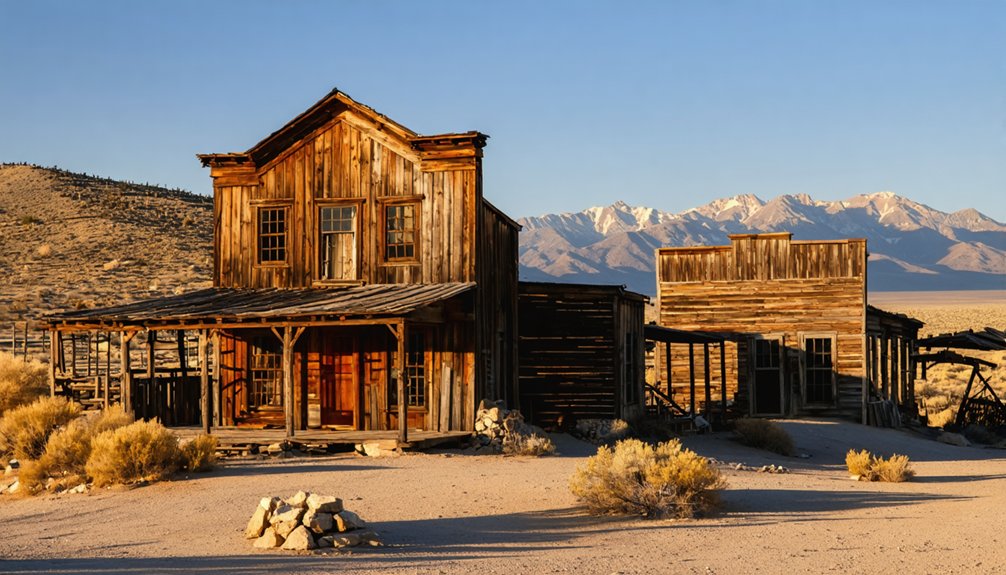
Nestled in the Toquima Range at 7,000 feet elevation, Belmont Ghost Town sprawls across a high desert valley where silver-hungry prospectors once carved out one of Nevada’s most prosperous mining camps. You’ll wander past the 1876 courthouse—a monument to historic preservation that still dominates the townscape—and explore the abandoned bank where lawmen once locked up outlaws.
The Monitor-Belmont mill’s 20-stamp remnants and towering chimney tell stories of $15 million in ore extracted from these hills.
Unlike sanitized tourist traps, Belmont lets you experience authentic mining history without guardrails or guided tours. Stone walls, crumbling cabins, and weathered timber frames dot the surrounding hillsides.
You’re free to explore at your own pace, camping among genuine relics of Nevada’s silver boom.
Frequently Asked Questions
What Should I Pack for an Overnight Stay in a Nevada Ghost Town?
Picture yourself exploring abandoned saloons at dusk—you’ll need packing essentials like layered clothing, sturdy boots, and flashlights. Follow safety tips: bring water, sunscreen, and backup power. You’ll embrace desert freedom while respecting these rugged, untamed remnants of Nevada’s wild past.
Are Pets Allowed at Ghost Town Accommodations in Nevada?
Pet policies vary by location, but you’ll find welcoming accommodations like Old Yella Dog Ranch offering dog runs and corrals. Many ghost towns embrace your four-legged companions, with accommodation amenities designed specifically for traveling pets.
Do Ghost Town Lodgings Require Advance Reservations or Accept Walk-Ins?
You’ll need advance reservations at Nevada’s ghost town lodgings—no walk-ins accepted. These historic preservation sites protecting ghost town history require pre-booking, respecting their remote locations and careful restoration efforts while ensuring your adventure’s properly planned.
What Is the Typical Cost Range for Overnight Ghost Town Stays?
You’ll find ghost town stays ranging from $94 to $312 nightly—proving luxury accommodations exist beyond modern hotels. Gold Point’s cabins start at $110, while historical tours through restored mining towns offer authentic freedom-seeking experiences without breaking your adventure budget.
Are Ghost Town Accommodations Accessible Year-Round or Seasonally Limited?
Most ghost town stays operate year-round, letting you experience historical preservation firsthand. However, some remote locations face winter road closures, affecting ghost town economies seasonally. You’ll find appointment-based options require flexibility regardless of season.
References
- https://www.bloggeratlarge.com/weird-places-to-stay-in-nevada/
- https://travelnevada.com/hotels/unique-stays/gold-point-ghost-town-bed-breakfast/
- https://www.goldpointghosttown.com/HTML_Pages/THE_EXPERIENCE_and_Accommodations.htm
- https://www.goldpointghosttown.com
- https://www.loveexploring.com/gallerylist/188812/nevadas-spookiest-places-from-eerie-ghost-towns-to-haunted-hotels
- https://www.tripadvisor.com/ShowUserReviews-g45919-d119393-r190550265-StageCoach_Hotel_Casino-Beatty_Nevada.html
- https://www.silverstaterv.com/nevada-ghost-towns-and-camps/
- https://travelnevada.com/hotels/unique-stays/
- https://www.moontravelguides.com/travel/trip-ideas/nevada-ghost-towns/
- https://downtownerlv.com/6-ghost-town-day-trips-to-take-from-downtown-las-vegas/