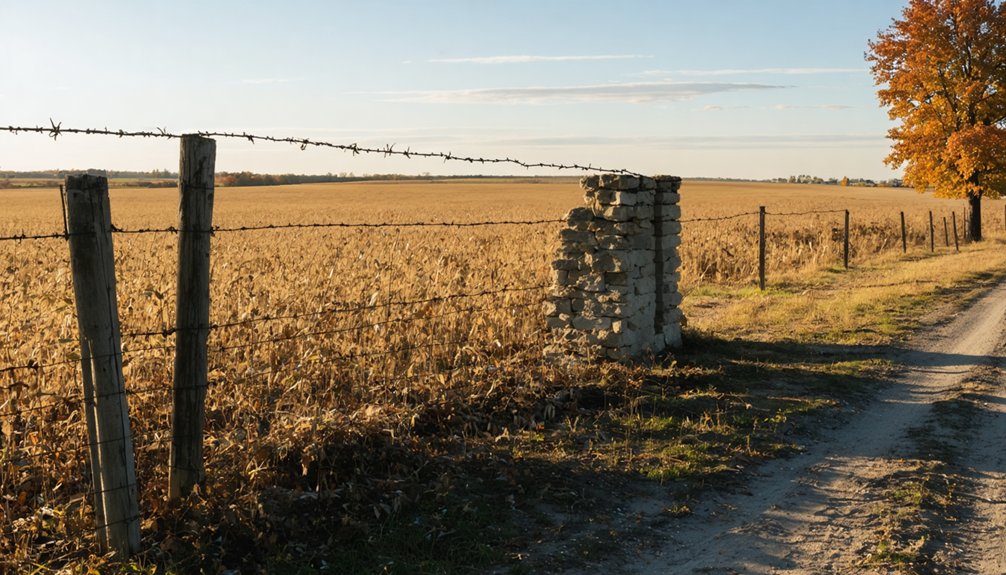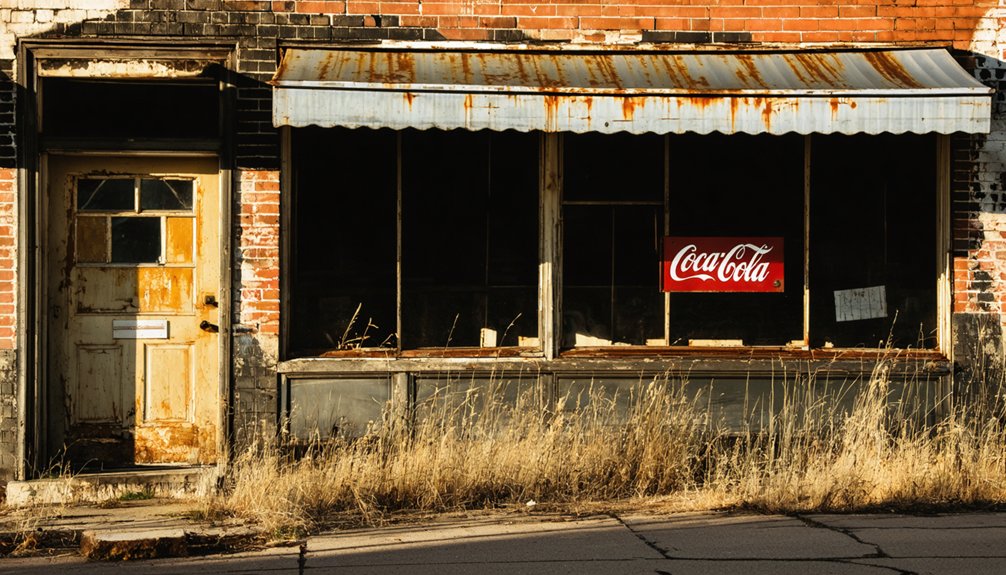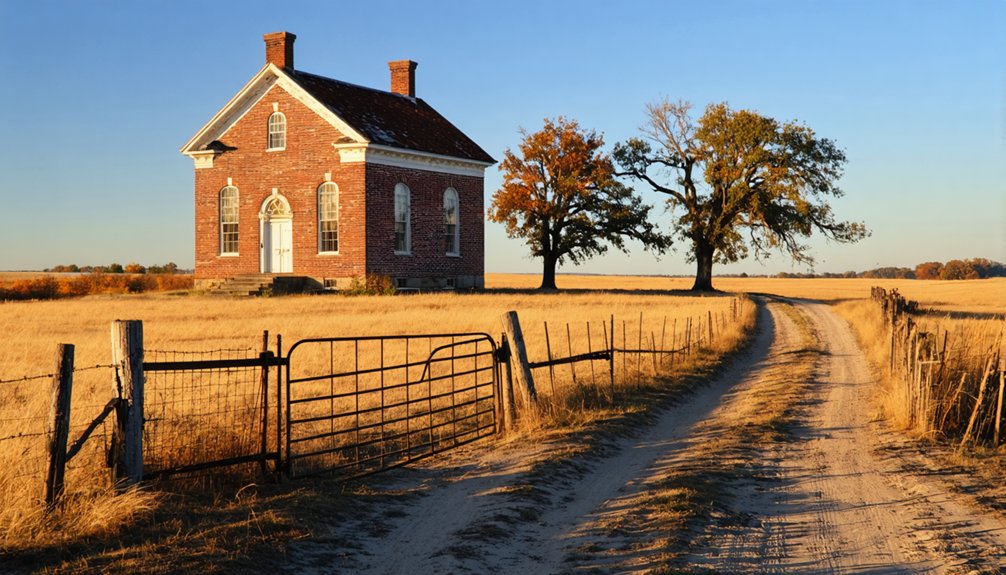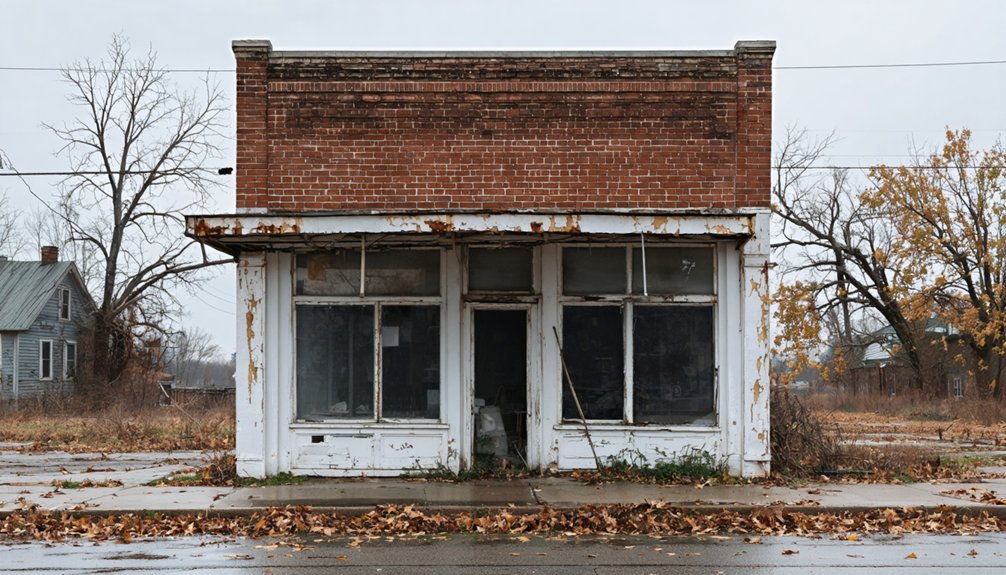
You’ll find Southern Illinois’ most compelling ghost towns along the Mississippi and Ohio Rivers, where Cairo’s population has plummeted from 15,000 to 1,700, and Old Shawneetown relocated three miles inland after the catastrophic 1937 flood. Sangamo Town vanished so completely it reverted to farmland after losing the county seat to Springfield in 1827, while Brownsville emptied when railroads shifted routes in the 1970s. The stories behind these abandoned settlements reveal how rivers, rails, and economic forces shaped the region’s forgotten communities.
Key Takeaways
- Cairo, once a commercial hub of 15,000, declined due to racial tensions and now has approximately 1,700 residents.
- Old Shawneetown relocated three miles inland after the catastrophic 1937 flood, leaving 160 residents and preserved structures behind.
- Brownsville became a ghost town in the early 1970s when railroad tracks shifted, eliminating its economic viability.
- Sangamo Town collapsed after losing the county seat to Springfield and founder Moses Broadwell’s death in 1827.
- Vishnu Springs operated as a mineral resort attracting 3,000 annual visitors before becoming a bootlegger refuge during Prohibition.
Cairo: The Living Ghost Town at Illinois’ Southern Tip
The story of Cairo begins at the confluence of the Mississippi and Ohio Rivers, where French pioneers established a settlement in 1702 after displacing Native Americans from the strategic point.
You’ll find that Cairo history transformed this strategic port into a mid-1850s commercial hub, designed for over 15,000 residents. The city served as a vital Underground Railroad stop, with tunnels beneath its streets hiding fugitives escaping north.
During the Civil War, Cairo became the Gibraltar of the West, with 12,000 Union soldiers stationed in and around the fortified city by June 1861. However, racial tensions defined Cairo’s trajectory—from the horrific 1909 lynching of Will James to violent late-1960s civil rights protests. These conflicts earned it the grim title “city that died from racism.” The 1970s brought 150 nights of gunfire as marches and protests continued to tear the community apart.
Today, you’ll encounter a semi-ghost town of roughly 1,700 residents, where elegant buildings crumble amid decades of economic decline and unchecked corruption.
Old Shawneetown: A Flood-Ravaged River Settlement
While Cairo’s demise stemmed from racial conflict and economic collapse, Old Shawneetown met its fate through a more elemental force—the relentless flooding of the Ohio River.
Founded by the Shawnee in 1793, this once-thriving settlement served as Illinois Territory’s commercial gateway. You’ll find it hosted the state’s first bank and controlled the lucrative salt-making industry. The town even welcomed Gen. Lafayette during his historic 1825 visit.
Despite constructing levees after the 1884 flood and raising them following 1913’s devastation, the town’s location sealed its doom. The catastrophic 1937 flood finally broke residents’ stubborn attachment to the riverbank, forcing relocation three miles inland.
Today, 160 residents remain among preserved structures like the 1841 bank building—testament to flood resilience and historic preservation amid nature’s unstoppable power. The nearby Shawnee National Forest offers seven different types of habitats, from oak-hickory forests to wetlands and waterfalls.
Brownsville: The Town That Moved Itself
Unlike Old Shawneetown, where residents refused to abandon their flood-prone location, Brownsville’s fate was sealed not by water but by infrastructure.
When the courthouse burned in January 1843, destroying downtown and all county records, Dr. John Logan donated twenty acres in Shieldsboro—a site better positioned for future railroad development.
You’ll find that Brownsville’s residents made a pragmatic choice: they dismantled their buildings piece by piece and hauled everything five miles east to the new county seat, which would become Murphysboro.
Founded in 1816 by Doctor Conrad Will, Brownsville had served as Jackson County’s first county seat for over two decades before its dramatic relocation.
The town’s prosperity had relied on trade via flat boats that carried goods down the Big Muddy River to New Orleans.
Railroad’s Decisive Impact
When tracks determine a town’s fate, few examples prove more dramatic than Brownsville’s complete relocation.
Starting in the early 1970s, a 30-year railroad relocation project forced this community to physically move itself. You’ll find Brownsville marked on Illinois’s 1928 rail map, evidence of its established presence before upheaval struck.
The St. Louis, Brownsville and Mexico Railway once connected residents to broader commerce networks, but when planners shifted the tracks, they triggered the town’s economic decline.
Unlike communities that gradually withered, Brownsville faced a stark choice: relocate or disappear. Most chose departure, leaving behind structures and memories.
Today’s ghost town status stems directly from engineering decisions that valued transportation corridors over settled communities—a freedom stripped by external forces. Similar to the Illinois Traction System’s influence, which provided electric passenger rail service across 550 miles of central and southern Illinois until 1956, railroads held decisive power over which settlements thrived and which faded into obscurity. The depots at West Frankfort, Johnson City, and Marion still stand as reminders of southern Illinois railroad infrastructure, while countless other communities vanished entirely.
Dr. Logan’s Generous Donation
The courthouse fire’s embers had barely cooled when Dr. John Logan seized opportunity. He offered twenty acres on his Shieldsboro farm to relocate Jackson County’s seat—a calculated move that’d reshape the region’s destiny.
You’ll recognize Dr. Logan’s Impact in how swiftly voters accepted his donation at the August 1843 election. Unlike Dr. Conrad Will’s original 1816 gift that’d anchored Brownsville near the Big Muddy’s salt works, Logan’s land occupied a central location accessible to the county’s expanding population.
The relocation wasn’t merely administrative—it represented freedom from geographic constraints that’d doomed Brownsville after Will’s 1834 death. Will had served over twenty years in the state legislature before his passing, leaving behind the town he’d helped establish. As a wealthy salt manufacturer, Will had built his fortune from the region’s natural resources before entering politics.
Brownsville’s Legacy survives in this shift: a town that literally moved itself, leaving behind empty streets where four hundred residents once conducted their flatboat commerce.
Sangamo Town: Lost to Springfield’s Rise
You’ll find Sangamo Town‘s story eight miles northwest of Springfield, where Moses Broadwell’s ambitious 1824 village once challenged the future state capital for commercial dominance along the Sangamon River.
His Revolutionary War veteran‘s vision attracted 250 residents to a settlement boasting mills, shops, and a bustling port shipping pork and hemp downriver to St. Louis and New Orleans.
After losing the county seat bid and Broadwell’s 1827 death, the town collapsed so completely that archaeologists now dig through farm fields to recover hand-forged iron and Staffordshire teacups from its forgotten pioneer streets.
Early Settlement and Growth
- Industrial infrastructure including gristmills and wool carding operations powered by oxen treadwheels.
- Commercial establishments featuring general stores, blacksmith shops, and the Broadwell Inn stagecoach stop.
- Shipping operations moving pork, hemp, lard, and flour downriver to St. Louis and New Orleans.
At its zenith, 250 residents called Sangamo Town home, representing the independent spirit of post-War of 1812 frontier expansion.
Before Springfield’s accessibility ultimately determined the region’s future.
County Seat Competition
When Revolutionary War veteran Moses Broadwell purchased his 320-acre parcel along the Sangamon River in 1819-1820, he envisioned more than a farm—he designed a future county seat.
He platted Sangamo Town with over 80 lots for residences, businesses, and government buildings eight miles northwest of Springfield. After Sangamon County’s incorporation on January 30, 1821, fierce competition erupted between settlements vying for the county seat designation.
Sangamo Town reached its zenith with 250 residents, operating gristmills, wool carding mills, blacksmith shops, and a ferry shipping pork and flour to St. Louis and New Orleans.
Yet misleading impressions given to state delegates about site accessibility doomed Broadwell’s ambitions. Springfield’s superior road access and central location won the contest, relegating Sangamo Town to history’s margins.
Complete Disappearance and Legacy
After Springfield secured the county seat designation, Sangamo Town’s fate was sealed.
Moses Broadwell’s death in 1827 left his son Charles managing unsold lots, but bankruptcy forced him out. By 1833, you’d find only mill operations where 250 residents once thrived. The last mills closed in the early 1850s, and the entire town site reverted to farmland.
Today, you won’t see any standing structures from the original settlement. What remains exists underground:
- Hand-forged iron tools from frontier workshops
- Locally made crockery and pewter spoons from family hearths
- Staffordshire teacups showing trade connections to distant markets
Robert Mazrim’s archaeological excavations uncovered these pioneer artifacts, revealing their historical significance.
The Broadwell Inn, built in 1824, stands at nearby Clayville Historic Site—your sole tangible link to this vanished community.
Benld: The Meteorite-Struck Mining Community
Benjamin L. Dorsey established this Macoupin County community in 1903, securing coal mining rights that’d shape its identity.
You’ll find Benld’s mining heritage rooted in Carpatho-Rusyn immigrants who worked the depths beneath your feet. St. Mary’s Russian Orthodox Church, standing since 1901, testifies to their enduring presence.
The town’s meteorite legacy emerged September 29, 1938, when an ordinary chondrite crashed through Edward McCain’s garage roof, embedding itself in his 1928 Pontiac coupe.
Mrs. Carl Crum stood just fifty feet away. This H6 chondrite became Illinois’ third recorded meteorite fall, now preserved at Chicago’s Field Museum.
Coal’s decline brought consequences—mine subsidence condemned Benld Elementary in 2009, displacing 700 students.
The 2017 settlement acknowledged what underground extraction costs surface communities.
Vishnu Springs: Forgotten by the Railroad
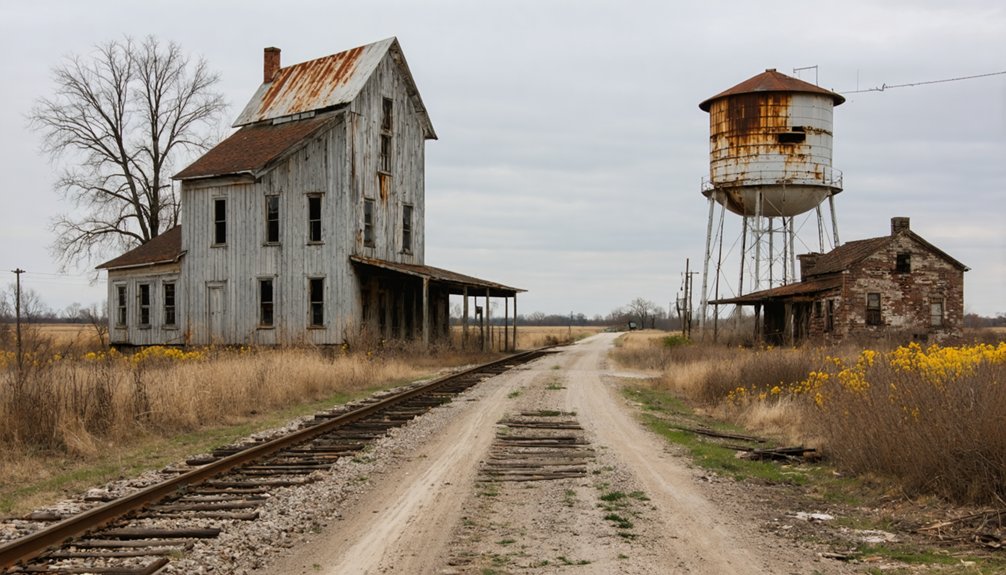
While Benld’s fate intertwined with coal’s boom and bust, Vishnu Springs in McDonough County rose and fell on promises of miraculous waters.
You’ll find Ebenezer Hicks purchased this land in the 1840s, where mineral springs allegedly cured baldness and ulcers. By 1889, his descendant Darius built a thriving resort attracting 3,000 annual visitors to its hotel, carousel, and race track.
The site’s transformation reveals three distinct chapters:
- Healing haven (1840s-1880s): Dr. Aiken commercially sold spring water
- Peak prosperity (1889-1920s): Resort boasted 30 homes, sports facilities
- Criminal refuge (1920s-1950s): Bootleggers and Al Capone frequented the crumbling resort
Today, Western Illinois University Foundation preserves this gangster history as the Post Wildlife Sanctuary—a symbol of entrepreneurial dreams abandoned when reality replaced myth.
Preserving Southern Illinois’ Abandoned Heritage
Southern Illinois’ vanishing communities face a different fate than complete abandonment—you’ll discover a network of preservationists actively salvaging their stories before the last buildings collapse.
The Southern Illinois Historic Preservation Organization leads heritage conservation efforts throughout the region, while Cairo’s Historical Preservation Project demonstrates how community revitalization intersects with site protection.
You’ll find them restoring Ward Chapel A.M.E. Church, Civil War-era Contraband Camps, and Magnolia Manor through partnerships with the National Trust and A.M.E. Church. They’ve raised over $20,000 annually through events attracting former residents from Florida and Texas.
Illinois Historic Preservation Agency’s Got Mesker? project documents abandonment architecture, while several ghost towns gained national historic landmark status in 2009 and national historic site designation in 2022.
Frequently Asked Questions
Are Any of These Ghost Towns Safe to Visit for Tourists?
You’ll find tourist safety varies by site. Vishnu Springs and Old Shawneetown offer relatively secure abandoned exploration with historic preservation. Cairo requires caution due to crime history. Old Valmeyer’s accessible ruins pose minimal threats beyond seasonal flooding.
Can You Still Find Artifacts or Relics at These Abandoned Sites?
You’ll find visible artifacts at Old Shawneetown and Cairo through respectful observation, but relic hunting isn’t permitted without permission. Artifact preservation laws protect these sites, though public displays like Benld’s meteorite-struck Pontiac remain accessible.
What Caused Southern Illinois to Have so Many Ghost Towns?
Like prosperity’s tide retreating from shore, you’ll find Southern Illinois ghost towns emerged from economic decline when the mining industry collapsed, devastating floods displaced communities, and resources dried up—forcing freedom-seeking residents to abandon their homes for survival elsewhere.
Among the most striking remnants of this decline are the abandoned towns in Illinois, where buildings stand frozen in time, echoing stories of those who once called them home. Nature is reclaiming these spaces, as vines creep up the sides of dilapidated structures, and wildlife thrives in the quiet streets. Exploring these forgotten places offers a haunting glimpse into the past and a reminder of the fragility of community and industry.
Do Any Residents Still Live in These Ghost Towns Today?
Yes, you’ll find current inhabitants in these towns—Cairo has 2,800 residents, Buda maintains 538, while Pearl, Hillview, and Nebo retain smaller communities preserving their historical significance despite severe depopulation from peak eras.
Are There Guided Tours Available of Southern Illinois Ghost Towns?
Tour availability for Southern Illinois ghost towns is extremely limited. You won’t find dedicated tour operators specifically for abandoned settlements like Cairo or Kaskaskia. Instead, you’ll need to explore independently, respecting private property boundaries and historical preservation efforts.
As you embark on your adventure, keep an eye out for abandoned sites in Illinois where nature has started to reclaim the structures. Some of these locations hold fascinating stories of the past, reflecting the rich history of the region. Documenting your findings can add to the growing interest in these hidden gems and their significance in local lore.
When exploring historic towns in Illinois, you may stumble upon beautifully preserved architecture that tells tales of yesteryear. These towns often host events that celebrate their heritage, making them ideal for history enthusiasts and visitors alike. Engaging with local historians can provide deeper insights into the unique events and prominent figures that shaped each community’s story.
References
- https://www.onlyinyourstate.com/experiences/illinois/creepy-ghost-towns-il
- https://sangamoncountyhistory.org/wp/14696/
- https://www.youtube.com/watch?v=93k0qtvzkn4&vl=en-US
- https://freepages.rootsweb.com/~gtusa/history/usa/il.htm
- https://www.freakyfoottours.com/us/illinois/
- https://www.youtube.com/playlist?list=PLS75fiYLTSRYGqgjWCX-RFC1I0O9Ag94X
- https://en.wikipedia.org/wiki/List_of_ghost_towns_in_Illinois
- https://www.onlyinyourstate.com/experiences/illinois/abandoned-town-il
- https://www.legendsofamerica.com/il-cairo/
- https://allthatsinteresting.com/cairo-illinois