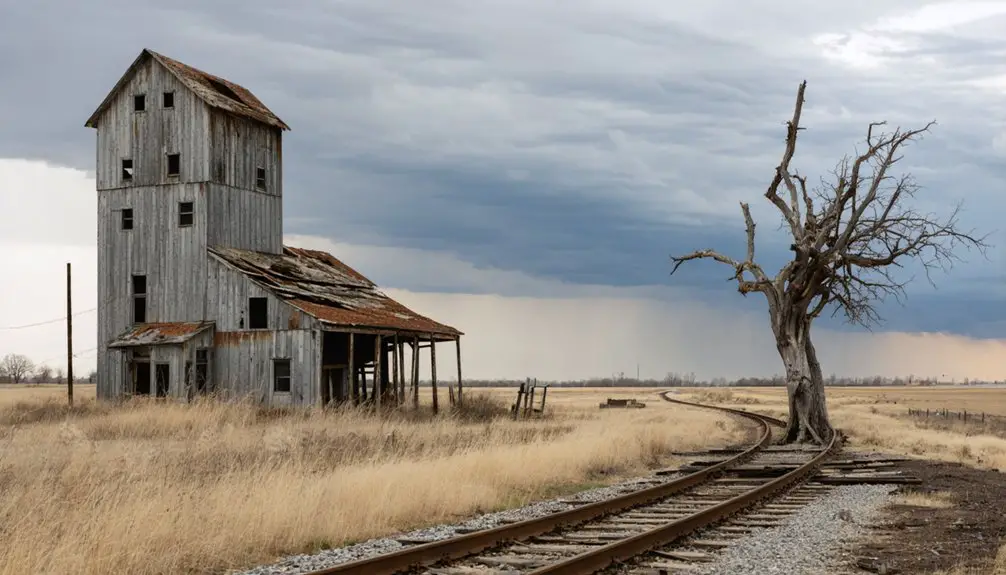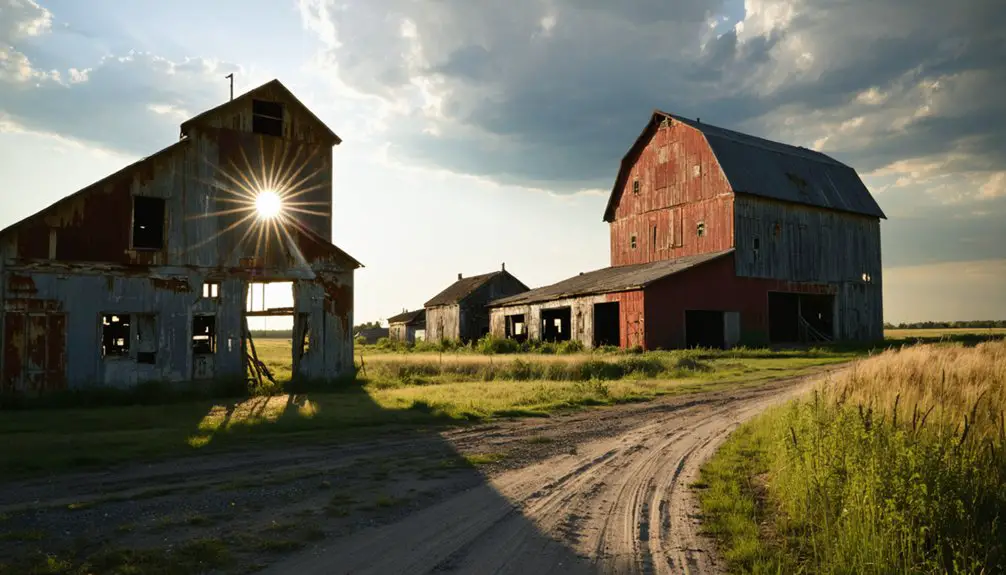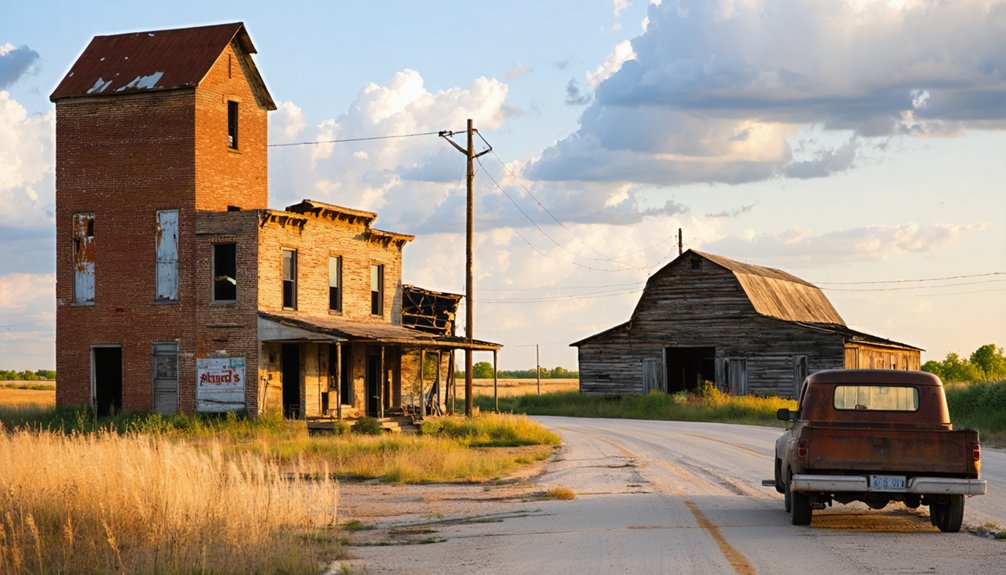
You’ll discover Southern Minnesota’s ghost towns like Forestville, where 150 residents once operated sawmills along the Root River before railroads bypassed them in the 1860s. Wasioja’s limestone recruiting station still stands, commemorating 104 Civil War volunteers. Nininger’s grand 1856 vision collapsed within eighteen months during the Panic of 1857, while West Newton vanished after locust plagues devastated crops in the 1870s. Florence and other settlements disappeared when post offices closed and rails never arrived, leaving foundations visible beneath prairie grass and forest growth that hint at stories worth exploring.
Key Takeaways
- Forestville, founded in 1853, peaked at 150 residents before decline when railroads bypassed the town in the 1860s.
- Wasioja features a preserved Civil War recruiting station where 104 men enlisted, with only 25 returning from battle.
- Nininger was established in 1856 with grand plans but collapsed after the Panic of 1857 reduced population dramatically.
- West Newton thrived in the 1870s but declined after railroad bypass and locust plagues devastated the community’s crops.
- Spring and fall offer best visibility for exploring ghost town foundations, with local historical societies providing access guidance.
Forestville: a Preserved Glimpse Into Minnesota’s Past
When Robert Foster trudged on foot from Decorah, Iowa, in the summer of 1853, he arrived at a bend in the Root River where someone named Levi Waterman had already carved his claim into an oak tree the previous fall.
By 1852, Levi Waterman had already claimed this bend in the Root River, marking an oak tree to stake his territory.
You’ll find this settlement—first called Watertown, then Forestville—thriving by the 1860s with 150 residents, sawmills, and a bustling general store.
But when the Southern Minnesota Railroad bypassed the town in 1868, Community Resilience couldn’t overcome economic reality. The population dropped to 68 by 1870, marking the beginning of Forestville’s steady decline. The Meighen family bought everything through foreclosures, transforming it into their industrial farm until closing shop in 1910.
Today’s Historical Preservation efforts by the Minnesota Historical Society let you walk through original buildings stocked with century-old goods—a time capsule demonstrating how quickly prosperity vanishes when freedom to move elsewhere beckons. The general store, once stocked with goods worth $700 in 1852, served as the town’s epicenter and remains an original building from Forestville’s peak.
Wasioja: Civil War Legacy in Dodge County
Just as Forestville’s fate hinged on railroad routes, Wasioja in Dodge County watched the Southern Minnesota Railroad bypass its limestone streets in the early 1860s—but this town’s most profound loss wasn’t economic.
Wasioja’s history centers on a small limestone building where Captain James George recruited young men for the Civil War. After his patriotic speeches in April 1861, seminary students marched to enlist, forming Company C of the Second Minnesota Volunteer Infantry.
The numbers still haunt: 104 men left this town of 1,000; only 25 returned. At Chickamauga, 59 of 60 initial recruits died.
The recruiting station stands today, purchased by Dodge County Historical Society in 1960. You’ll find it among Wasioja’s remaining pre-war structures—silent witnesses to extraordinary sacrifice. The wood-frame Baptist Church, built in 1858, is the only wooden building from the pre-Civil War era still standing. Many of the town’s buildings were constructed from high-grade limestone quarried locally, giving the community its distinctive character.
Nininger: Grand Visions Gone Awry Near Minneapolis
While Wasioja’s decline unfolded through wartime tragedy, Nininger collapsed under the weight of its own ambition.
You’ll find Ignatius Donnelly’s vision began promisingly in 1856—474 acres platted into 3,800 lots, seventeen miles south of St. Paul.
Donnelly’s vision marketed this settlement as Minnesota’s future capital, attracting Eastern speculators and European immigrants through aggressive advertising campaigns.
Within eighteen months, the population plummeted from over 1,000 to just 469 residents.
Then everything shattered:
- The Panic of 1857 bankrupted residents overnight
- Winter ice choked the Mississippi until May, isolating desperate families
- Promised railroads never materialized; tracks bypassed the town entirely
Lot buyers faced a strict improvement clause requiring $100 in property enhancements within six months, a burden most couldn’t meet after the financial collapse.
West Newton: A Vanished Community in Houston County
If Nininger fell victim to financial speculation, West Newton’s demise arrived through isolation—though you’d never guess it from the bustling river settlement that emerged along the Minnesota River in Nicollet County.
Named after Kentucky settler James Newton and a steamboat, this ferry crossing thrived by the 1870s with hotels, breweries, and Alexander Harkin’s general store anchoring community life.
You’ll find Harkin’s legacy preserved today as Minnesota’s only surviving structure from this vanished town.
West Newton’s decline began when railroads bypassed it in 1873, followed by devastating locust plagues that crushed farmers’ crops for four years.
Harkin’s account books chronicle the grasshopper devastation, revealing debts he graciously never collected.
The Scottish immigrant had arrived in West Newton in 1856, establishing a 130-acre farm with his wife Janet Crawford before opening his store a decade later.
Florence: Goodhue County’s Abandoned Settlement
Among Goodhue County‘s hilly, broken terrain, where deep valleys carve westward through the landscape, Florence emerged as a community anchored by its post office and the legacy of a Red Wing judge’s daughter.
Named for Florence Graham, this settlement joined sixty-four other post offices dotting the county’s rural expanse. Florence history reveals how your community’s survival hinged on railroad access—and Florence lost that gamble.
Florence Graham’s namesake settlement joined sixty-four county post offices, but without railroad access, this community’s fate was sealed.
Ghost town significance lives on through:
- Roadside markers where neighbors once gathered
- Fading memories of 758 township residents from 1930
- Empty valleys that once echoed with purpose
The Goodhue County Historical Society preserves these stories at 651-388-624 or info@goodhistory.org.
You’ll find Florence documented in Roy W. Meyer’s archival research, standing alongside Claybank and Crystal Springs—testaments to freedom-seeking settlers who built, thrived, then vanished. Like its namesake city founded as a Roman garrison in 59 BC, this Florence too began with purpose before fading into history. The placement of railroads determined which Minnesota towns would survive and which would become memories marked only by historical signs.
Point Douglas: Mississippi River Trading Post Lost to Time
Where Florence faded quietly into Goodhue County’s valleys, Point Douglas commanded the confluence of two mighty rivers—and for a brief, brilliant moment, it seemed destined to become Minnesota’s commercial heart.
You’ll find only fragments now—a solitary Greek Revival home from the 1840s, Point Douglas Park marking where Joseph Monjeau’s 1838 log cabin once stood.
Joseph Renshaw Brown’s trading post ruins tell stories of frontier commerce, when steamboats stopped for fuel and settlers gathered at Hertzell and Burris’s mercantile.
By 1858, this ghost town-to-be boasted two hotels, four warehouses, and ferry crossings to Wisconsin.
The sawmills hummed, military roads stretched westward, and possibilities seemed endless.
The village had been platted in 1849, named after Stephen A. Douglas for his role in creating the Minnesota Territory.
Then the lumber ran out.
The post office closed in 1903.
The rivers kept flowing, indifferent to human ambitions.
Exploring Minnesota’s Forgotten Communities Today
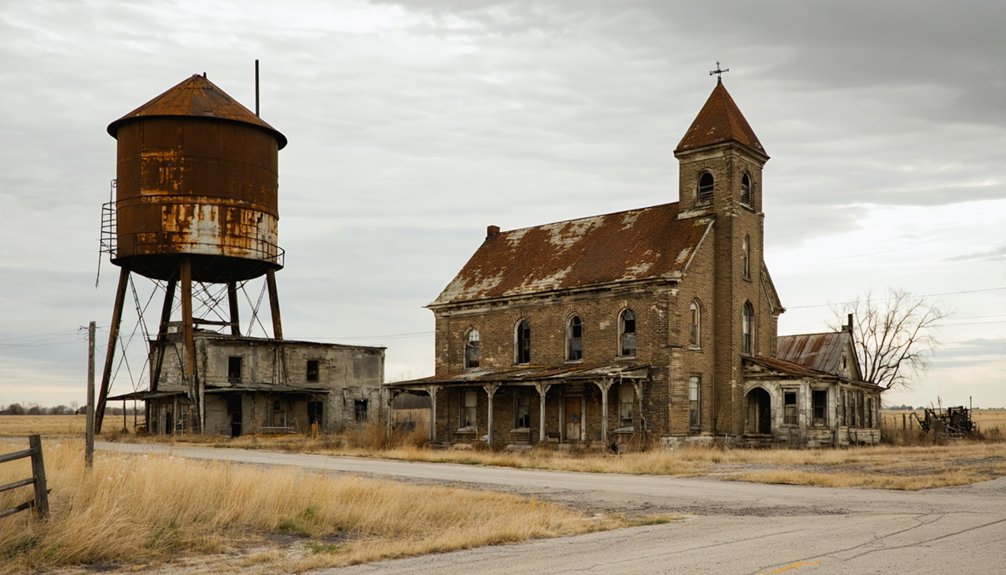
When you visit these ghost towns, you’re walking the same paths where Swedish immigrants, Civil War families, and frontier merchants built their dreams before railroads and disease reshaped the landscape.
I’ve found that spring and fall offer the clearest views of remaining foundations and cemetery markers, while winter snow can actually help you spot old building outlines at sites like Wasioja.
Before you go, check with local historical societies—they’ll share access details for private lands and point you to the safest vantage points for photographing what’s left of these vanished communities.
Accessing Historical Sites Safely
Minnesota’s ghost towns offer accessible windows into the past, though each site requires different approaches for safe exploration.
You’ll find Forestville’s historical preservation most carefully managed—the Minnesota Historical Society provides guided tours Memorial Day through October, protecting those 170-year-old original buildings and goods.
You’re free to explore Wasioja’s seminary ruins independently, connecting with Civil War-era heritage at your own pace.
Whalan welcomes you via the Root River State Trail, where preserved structures maintain authentic small-town character.
Consider these exploration options:
- Walk through Forestville’s general store where settlers traded since 1852, original items still intact
- Stand among Wasioja’s seminary ruins where young men studied before marching to war
- Cycle into Whalan along the scenic trail, discovering what remains of the 1868 milling community
You’ll experience Minnesota’s forgotten communities while respecting their fragile legacy.
Photographing Abandoned Town Remnants
Because Southern Minnesota’s ghost towns exist in various states of preservation, your photography approach must adapt to what each site offers.
At Forestville, you’ll capture intact wooden structures using wide-angle lenses that showcase the preserved streetscape’s authentic alignment. The abandoned architecture at Wasioja demands golden hour sessions—those stone seminary ruins reveal stunning textures against rolling landscapes when light hits just right.
For ghost town photography at Elcor, drone shots expose the buried grid layout beneath forest regrowth.
You’ll need macro lenses at Burschville’s converted schoolhouse to document weathered woodwork details. Bracket your exposures when shooting high-contrast scenes like Perkinsville’s scattered kiln bricks against open fields.
Pack versatile gear—these sites won’t conform to your expectations, so you’ll need creative flexibility to document what remains.
Best Seasons for Visits
Your exploration of Southern Minnesota’s ghost towns hinges on seasonal access that’ll shape what you discover.
As you venture into the ghost towns of northern minnesota, you’ll encounter remnants of communities that once thrived during the mining booms. The landscapes hold stories of abandonment and resilience, inviting you to uncover the past. Each location reveals unique characteristics that reflect the history and culture of the region.
As you plan your trip, consider the various ghost towns to explore in Minnesota, where each site offers a glimpse into a different era of American history. These towns, often tucked away in serene landscapes, will immerse you in the intriguing tales of settlers who once called these places home. Discovering these hidden gems can turn your journey into a rich tapestry of experiences, blending nature with captivating history.
Forestville’s preserved 1890s structures welcome visitors Memorial Day through October, while winter locks down most sites. Summer brings vibrant crowds and guided tours through original buildings, but fall offers something special:
- Crisp October mornings let you walk Root River trails in solitude, connecting with settlers who once carved lives from this landscape.
- Autumn colors frame abandoned structures, creating haunting tableaus perfect for contemplation.
- Cooler temperatures make Mystery Cave explorations and bike rentals comfortable while tourist crowds thin.
Spring’s Memorial Day opening provides fresh seasonal advantages before peak rushes, while winter’s November-April closure protects you from hazardous conditions but limits visitor experiences.
Choose wisely—your freedom to roam depends on timing.
Frequently Asked Questions
What Caused Most Ghost Towns in Southern Minnesota to Become Abandoned?
You’ll find that railroad bypasses caused most southern Minnesota ghost towns’ economic decline, triggering population migration. When rails skipped communities like Hennepin Village, residents couldn’t sustain businesses and moved elsewhere, leaving behind empty settlements.
Are There Safety Concerns When Visiting Abandoned Ghost Town Sites?
Yes, you’ll face risks during urban exploration. You should take safety precautions like wearing sturdy boots, bringing first aid supplies, and securing property permission beforehand. These forgotten places hold stories worth discovering responsibly.
Can Artifacts Be Collected From Southern Minnesota Ghost Town Locations?
No, you can’t collect artifacts due to legal restrictions on public lands and private property. Artifact preservation protects our shared heritage—I’ve learned through archival research that observing and photographing respects history while keeping you legally safe.
Which Ghost Towns Charge Admission Fees for Historical Site Visits?
You’ll find Forestville State Park requires a vehicle permit for admission, though grounds access is free. Most other southern Minnesota ghost towns don’t charge fees, reflecting admission policies that honor their historical significance and community heritage.
How Do Weather Conditions Affect Year-Round Accessibility to These Towns?
You’ll find seasonal accessibility varies dramatically—winter snow blocks remote sites while summer offers ideal conditions. Climate impact on unpaved roads and historic structures means spring mud and fall foliage determine your exploration freedom considerably.
References
- https://en.wikipedia.org/wiki/List_of_ghost_towns_in_Minnesota
- https://freepages.rootsweb.com/~gtusa/history/usa/mn.htm
- https://kroc.com/9-strange-ghost-towns-within-100-miles-of-rochester-minnesota/
- https://thievesriver.com/blogs/articles/ghost-towns-in-minnesota
- https://wjon.com/ghost-towns-stearns-county-towns-that-disappeared-from-the-map-our-top-five/
- https://quickcountry.com/minnesotas-abandoned-ghost-towns/
- https://www.youtube.com/watch?v=5bCG6B2rzZY
- https://metaldetectingforum.com/index.php?threads/minnesota-ghost-towns.7172/
- https://www.mngoodage.com/voices/mn-history/2019/07/a-ghost-town-turned-history-site/
- https://quickcountry.com/forestville-named-the-creepiest-and-coolest-ghost-town-in-minnesota/