You’ll find hundreds of abandoned settlements across Southwest Texas, from Terlingua’s mining ruins near Big Bend to railroad casualties like Helena and Independence. Spanish silver operations established towns in the 1600s-1700s before Apache raids and labor conflicts disrupted mining. Later, railroad bypasses and oil busts created multiple waves of abandonment throughout the 1800s-1900s. Today, you can explore accessible sites like Lobo near Marfa and Glenrio along Route 66, where adobe structures slowly crumble into the desert landscape, each revealing distinct chapters of frontier economics and survival.
Key Takeaways
- Southwest Texas ghost towns emerged from Spanish silver mining operations starting in the mid-16th century through the 1700s.
- Railroad expansion in the late 1800s created boom towns, while bypassed communities like Helena and Independence declined rapidly.
- Economic collapse occurred in four waves: silver exhaustion, mining dissolution, oil decline, and infrastructure failure after 1868.
- Terlingua near Big Bend, Lobo near Marfa, and Glenrio on Route 66 offer preserved ruins accessible to visitors today.
- Texas contains approximately 900 abandoned settlements, with the Panhandle region alone documenting at least 20 ghost towns.
Mining Boom Towns of the Chihuahua Desert
When Spanish explorers discovered silver in the southern Chihuahuan Desert during the mid-16th century, they triggered a mining frenzy that would reshape the region’s demographics and economy for centuries.
Mining operations expanded rapidly throughout the 1600s and 1700s, with the Álamos region in Sonora becoming Latin America’s northernmost Spanish silver town.
By the 1700s, Álamos in Sonora had emerged as the northernmost Spanish silver mining town in all of Latin America.
You’ll find that indigenous labor formed the backbone of these operations, as native communities were conscripted to extract precious metals and support mining settlements.
This forced exploitation sparked rebellions against taxation and servitude. Apache raids intensified during this period, eventually halting the boom and threatening Spanish enterprises.
The 1767 Jesuit mission expulsion removed significant protection, leaving mining operations vulnerable to indigenous resistance movements that persisted until late 19th-century colonization.
The region’s mining activities were intricately linked to agricultural production from native communities, creating an economic system that relied on indigenous resources beyond mineral extraction alone. These historical data presentations now serve educational purposes through digital storytelling platforms that help visitors understand the complex legacy of Southwest Texas mining communities.
Adobe Architecture and Historic Preservation
The centuries of Spanish mining operations left behind more than economic disruption—they established adobe construction techniques that would define Southwest Texas architecture for generations.
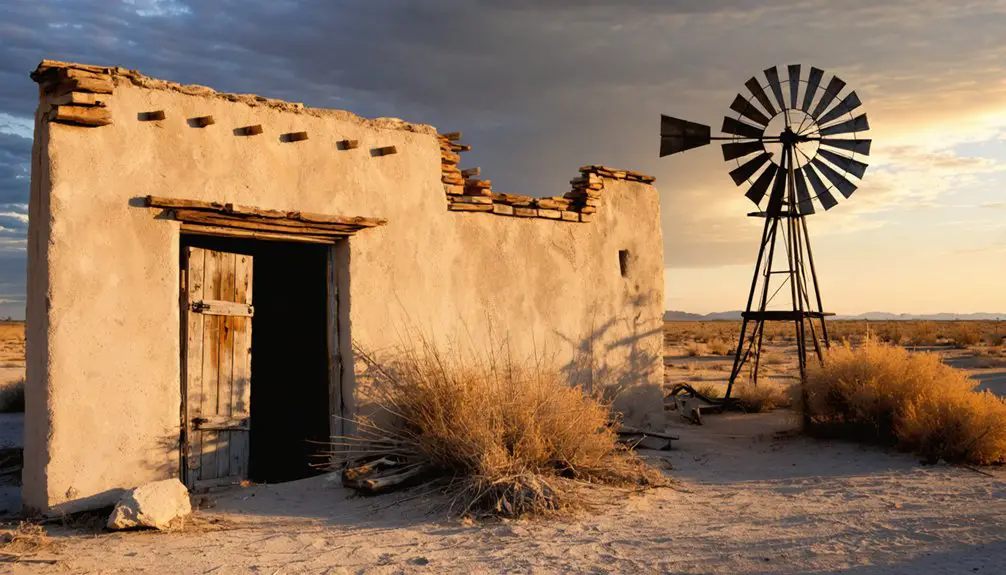
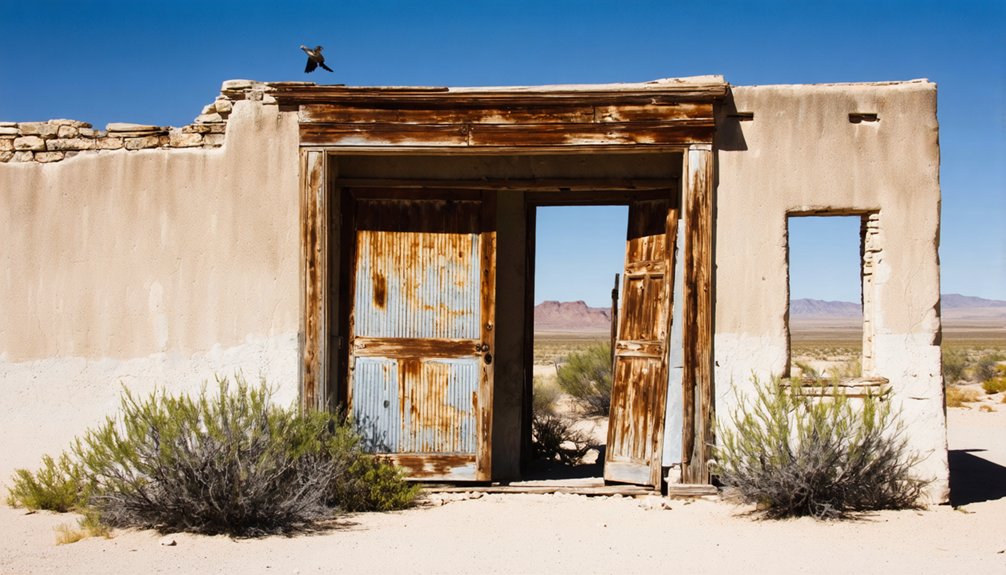
You’ll find remnants of these sun-baked structures throughout Presidio County, where Adobes Ghost Town stands as a symbol of this building tradition. Early 1900s Mexican migrants in Marfa mixed local dirt, straw, and water into blocks, pragmatically sourcing material from their backyards without the mystique attached to northern New Mexico’s adobe culture.
Adobe preservation faces unique challenges as structures disintegrate into rock foundations. The community was established in the 1870s as a farming community that raised sheep and crops from the rocky soil.
Terlingua’s 1996 revival demonstrates this architectural significance—five ruins rebuilt into functional spaces atop original foundations.
Archaeological excavations at Adobe Walls in the 1970s preceded its National Register listing, recognizing both battle sites and construction methods worth documenting. The site was designated a Texas state archaeological landmark in 1979, further cementing its preservation status.
Transportation Hubs That Shaped Settlement Patterns
Since railroad companies held the power to determine which settlements would thrive and which would wither, Southwest Texas town founders spent the late 1800s competing desperately for track placement.
You’ll find the railroad significance evident in Helena’s fate—bypassed entirely when tracks rerouted to Karnes City, creating “The Big Curve” you can still trace along Highway 181.
Independence refused the Santa Fe line and watched Baylor University relocate to Waco in 1885 as trade routes shifted.
Towns offered depots, financial contributions, and land grants to secure their survival.
Watering stops like Lobo and Shumla sprouted wherever steam engines needed refueling.
Barstow emerged as a Missouri Pacific Railroad stop in 1891 and briefly served as Ward County’s seat before natural disasters and drought prompted relocation.
The 1892 Pecos River bridge—stretching 2,180 feet and costing $250,000—proved transportation infrastructure determined settlement patterns across this unforgiving landscape.
Helena once served as a stopping place between San Antonio and the Texas coast before its decline.
Economic Decline and Abandonment Stories
As steam engines fell silent in 1868, abandoned buildings stretched from Del Rio to Big Bend, marking Southwest Texas’s first wave of economic collapse.
You’ll find similar patterns throughout the region’s history, where poor resource management transformed thriving settlements into vacant shells.
Four Cycles of Economic Migration:
- Silver exhaustion – Shafter’s population plummeted from 110 residents after mines dried up in the early 1900s.
- Mining dissolution – Terlingua’s company collapse in the 1940s left empty homes and a cemetery as the only witnesses.
- Oil decline – Yates Oilfield’s post-1926 downturn triggered housing surplus increases from 1.2 to 6 months supply.
- Infrastructure failure – Highway diversions and absent utilities doomed Far West Texas resorts, creating modern ghost towns.
Lack of economic diversity outside energy forced continuous out-migration across rural communities.
In Pecos, the reliance on oil led to job scarcity and foreclosures increasing by 40% as the energy sector contracted.
The collapse of critical rural employers, particularly hospitals and schools, accelerated community abandonment as over 120 rural hospitals closed across the U.S. since 2010.
Visiting Ghost Town Remnants Today
Where can you walk through genuine Southwest Texas history without stepping foot in a museum? Terlingua near Big Bend offers year-round ghost town exploration among sun-drenched adobe ruins from its quicksilver mining days.
You’ll discover derelict buildings matching the desert landscape, with remaining businesses showcasing authentic West Texas character.
For visitor experiences beyond Terlingua, head to Lobo approximately one hour northwest of Marfa, where you’re free to roam accessible structures.
Glenrio along old Route 66 preserves the Little Juarez Diner, State Line Motel, and Streamline Moderne Texaco station—making it among America’s best-preserved mid-century ghost towns. This Deaf Smith County settlement had only 10 residents by the year 2000. As you explore the ghost towns of west Texas, you’ll encounter reminders of the vibrant communities that once thrived in the region. Many of these towns showcase unique architecture and historical landmarks, inviting visitors to step back in time. Each abandoned building tells a story of resilience and change, offering a glimpse into the lives of those who called these places home.
In Hill Country, Grapetown near Fredericksburg provides another exploration opportunity.
The Panhandle region contains at least 20 documented ghost town locations, offering countless adventures across Texas’s estimated 900 abandoned settlements. Many travelers report encountering No Trespassing signs at former mining camps like Shafter, requiring respectful distance from private property. In addition to these intriguing sites, the abandoned towns of east texas offer a glimpse into the state’s rich history and the lives of those who once thrived there. Exploring the remnants of these communities unveils fascinating stories of resilience and the passage of time. Each site serves as a reminder of the changes that have shaped the region, making them a captivating stop for history enthusiasts and explorers alike.
Frequently Asked Questions
What Supernatural or Paranormal Activities Have Been Reported in These Ghost Towns?
You’ll find ghostly sightings of wandering children reported at Toyah High School, while Terlingua’s abandoned mercury mines evoke paranormal vibes. Medicine Mound’s Comanche ceremonial sites and Belle Plain’s crumbling structures create haunted locations steeped in supernatural atmosphere.
Are There Any Famous Outlaws or Criminals Associated With These Locations?
Where there’s smoke, there’s fire—you’ll find outlaw legends like John Wesley Hardin in Sumpter and notorious criminals including Doc Holliday at Fort Griffin. These ghost towns harbored Texas Panhandle’s most dangerous gunfighters and desperados.
What Wildlife or Dangerous Animals Might Visitors Encounter in These Areas?
You’ll encounter dangerous snakes like western diamondbacks and sidewinders, plus scorpions, black widows, and brown recluses. Mountain lions, javelinas, and black bears roam these remote areas. Wildlife encounters demand constant vigilance and proper preparation.
How Did Families and Children Adapt to Harsh Desert Living Conditions?
Like pioneers from biblical deserts, you’d have carved dugouts into hillsides for natural insulation, built adobe shelters from mud and straw, and mastered water conservation through cisterns and windmills to survive Texas’s unforgiving terrain.
Were There Any Significant Conflicts Between Settlers and Native American Tribes?
Yes, you’d encounter significant settler conflicts with native tribes throughout Southwest Texas. The Council House Fight, Salt Creek Massacre, and Red River War dramatically shaped the region, ultimately forcing tribes onto reservations and enabling town establishment.
References
- https://www.hipcamp.com/journal/camping/texas-ghost-towns/
- https://texashighways.com/travel-news/four-texas-ghost-towns/
- https://en.wikipedia.org/wiki/List_of_ghost_towns_in_Texas
- https://www.southernthing.com/ruins-in-texas-2640914879.html
- https://www.youtube.com/watch?v=Jkdn0Q6IS0c
- https://livefromthesouthside.com/10-texas-ghost-towns-to-visit/
- https://www.texasescapes.com/TOWNS/Texas-Ghost-Towns-8-South-Texas.htm
- https://www.tshaonline.org/handbook/entries/bartonsite-tx
- https://mix931fm.com/texas-ghost-towns-history/
- https://www.americas.org/mining-boom-in-the-sierra-madre/