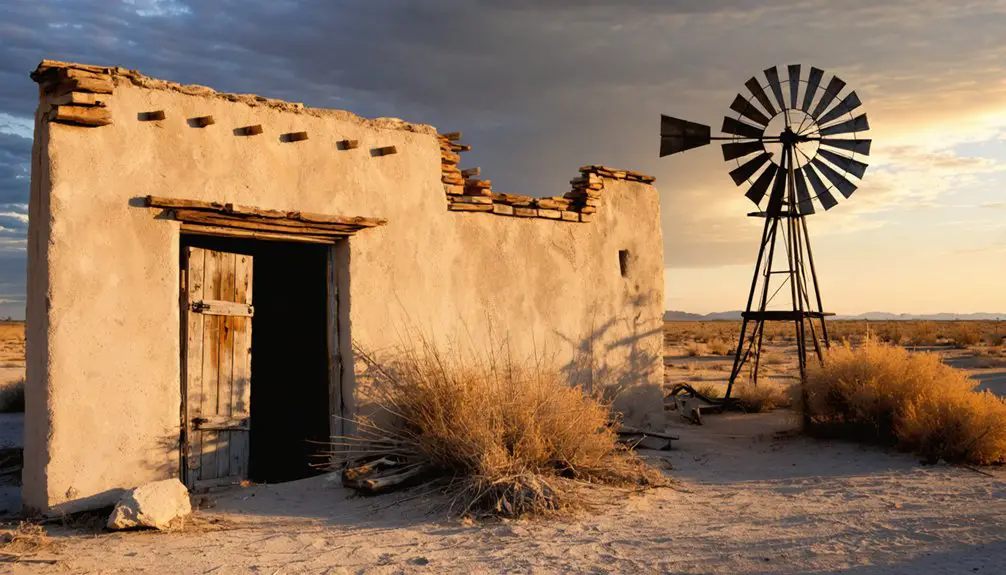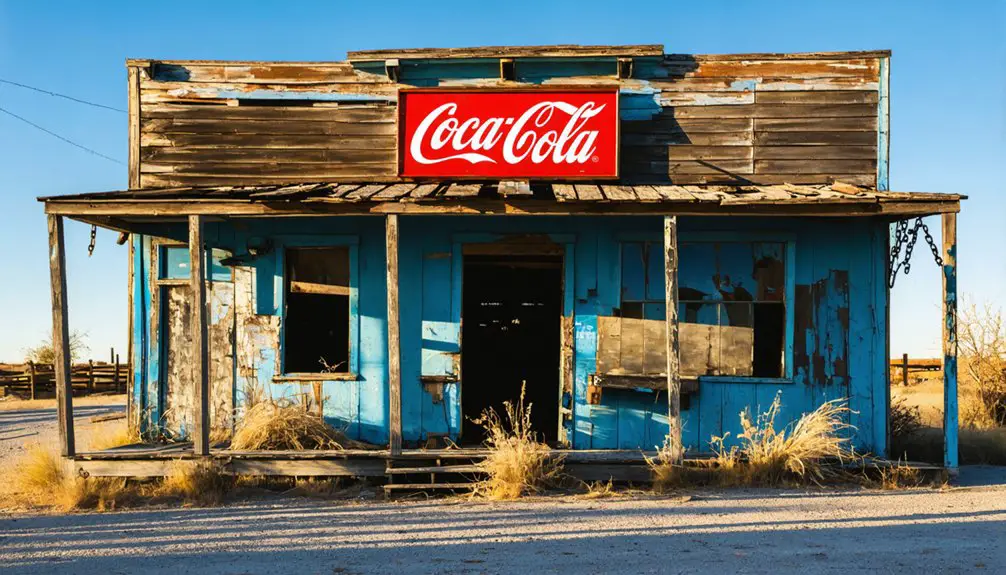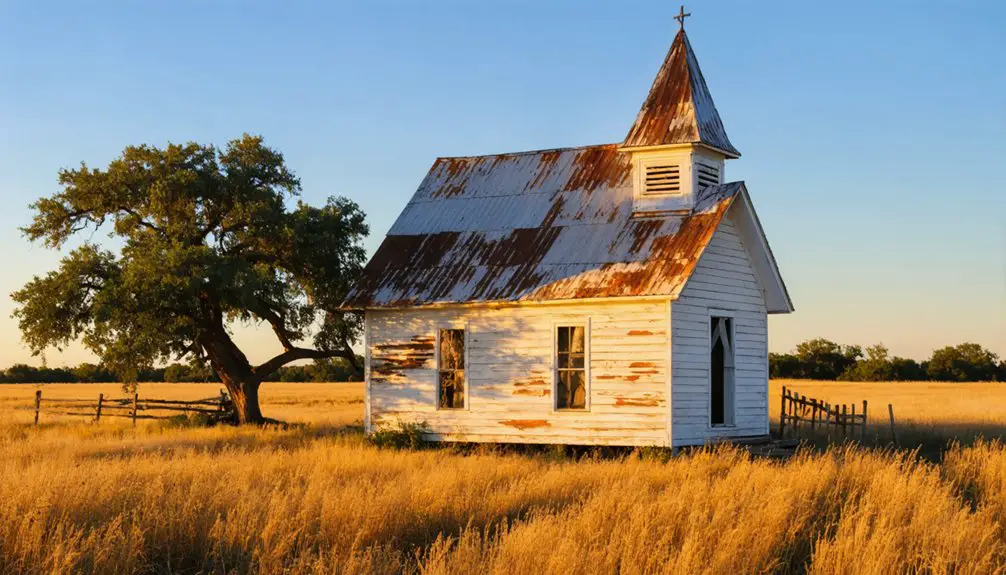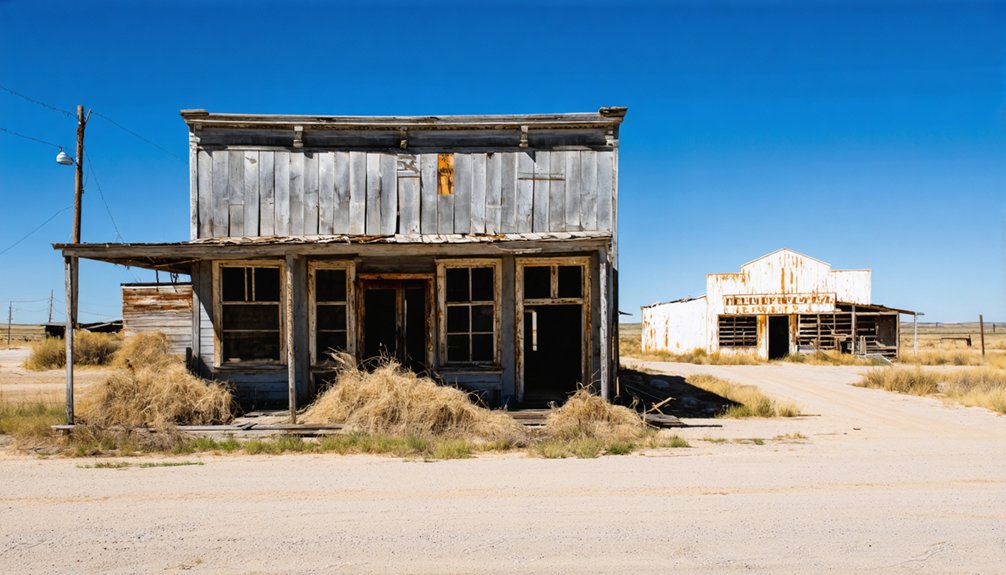
You’ll find dozens of ghost towns scattered across the Texas Panhandle, where economic forces and infrastructure decisions erased once-thriving communities. Tascosa, established in 1876 by Mexican sheepherders, became notorious for outlaw violence before fading away. Glenrio transformed from a 500-person border town to abandoned ruins after Interstate 40’s 1972 bypass. Railroad rerouting devastated settlements like Panhandle City in 1908, while oil boom-bust cycles emptied towns dependent on extractive industries. Sandstone courthouses, adobe battle sites, and Route 66-era gas stations now mark these windswept locations where preservation groups work to protect architectural remnants and heritage tourism connects visitors to frontier America’s volatile past.
Key Takeaways
- Tascosa, established in 1876, was known for outlaw activity involving Billy the Kid and Pat Garrett before becoming abandoned.
- Glenrio transformed from a 500-person border town to ruins after Interstate 40 bypassed it in 1972.
- Economic collapse from railroad rerouting, oil booms, and highway shifts created volatile boom-bust cycles across Panhandle communities.
- Architectural remnants include sandstone courthouses, Route 66-era gas stations, and adobe structures marking historical battles and settlements.
- Heritage tourism connects sites like Tascosa’s battlefield and Glenrio’s roadside attractions, offering authentic frontier history experiences.
Formation and Settlement of Panhandle Communities
Long before Anglo settlers staked their claims across the Texas Panhandle, the Antelope Creek people built thriving communities along the Canadian River valley between 1150 and 1450 AD.
These prehistoric plains villagers established pueblo-like settlements, practicing horticulture while hunting bison. Their community dynamics centered on flint quarrying operations—they dug hundreds of sites over three centuries for toolmaking.
The Antelope Creek people combined agriculture and bison hunting while operating extensive flint quarrying operations throughout the Canadian River valley.
Pottery fragments reveal extensive trade networks that connected them across vast distances.
Settlement patterns shifted dramatically when Apache groups migrated southward from Canada between 1000 and 1400 AD, followed by Comanche expansion in the late 17th century.
These migrations fundamentally altered territorial control. By 1876, you’d witness the Texas legislature carving twenty-six counties from Bexar Land District, opening the region for ranching operations like Thomas Sherman Bugbee’s Quarter Circle T.
Spanish exploration of the Panhandle began when Francisco Vázquez de Coronado crossed the region in 1541 while searching for the legendary city of Gran Quivira. His expedition found no gold in the Texas Panhandle, dashing Spanish hopes for mineral wealth in the region.
Economic Forces Behind Town Abandonment
When you examine Panhandle county records and railroad surveys from the 1930s through 1960s, you’ll find that transportation shifts devastated entire communities overnight.
Towns like Lefors and McLean thrived as railroad stops and highway service centers until Route 66 bypassed them or rail lines chose alternate paths, cutting off their commercial lifelines.
The region’s heavy dependence on extractive industries—oil, gas, and agriculture—created volatile boom-bust cycles that repeatedly emptied settlements when commodity prices collapsed or resources ran dry.
Rural areas often rely on one or two major employers, typically schools or hospitals, making communities vulnerable when these anchor institutions disappear.
In towns like Pecos, economic reliance on oil led to job scarcity and foreclosures, with foreclosure rates increasing by 40% as the energy sector contracted.
Railroad Rerouting Impact
Railroad companies’ strategic decisions to reroute or abandon unprofitable lines became the primary economic force that transformed thriving Panhandle communities into ghost towns.
When Santa Fe abandoned its original Panhandle City trackage in 1908, replacing it with a direct line to Amarillo, 125 miles of established settlements faced immediate economic isolation.
Rock Island’s 1960 abandonment of twelve miles from Dalhart to Wilco marked the beginning of systematic route pruning that severed communities from commercial lifelines.
You’ll find that railroad expansion initially created these towns, but companies prioritized efficiency over community displacement.
The automatic interlocking’s discontinuation at Etter in 1941 symbolized declining regional importance, as corporate restructuring eliminated marginal operations, leaving once-vibrant towns stranded without the transportation infrastructure essential for survival.
The Panhandle and Santa Fe Railway operated 1,879 miles of track by 1933, demonstrating the vast network that would later undergo consolidation and abandonment.
Rock Island’s bankruptcy declared in 1975 led to asset liquidation that permanently severed the remaining communities along the Amarillo-Liberal line from their historic transportation networks.
Highway Commerce Collapse
The completion of Interstate 40 in 1975 delivered a more devastating blow than any railroad abandonment, erasing Glenrio’s economic existence within months as travelers bypassed the Texas-New Mexico border town at 75 miles per hour.
Highway infrastructure decisions determined which communities survived and which became crossroads graveyards. You’ll find empty gas stations and collapsed diners throughout the Panhandle—monuments to commerce shifts that favored distant interchanges over local main streets.
Border towns like Glenrio received single exits without business loops, guaranteeing their irrelevance. The old Route 66 alignment west of town reverted to dirt, eliminating even nostalgic traffic. The First/Last Motel in Texas stands just east of the state line with falling ceilings and debris-filled rooms, its faded signage marking decades of abandonment.
Meanwhile, drug trafficking concentrates at highway junctions, accelerating the flight of legitimate businesses. Panhandle counties hemorrhage 10% of their population each census, leaving storefronts vacant since the 1920s. Corporate consolidation transformed farming from a community enterprise into an automated industry, with large corporations dominating agricultural production and eliminating the family operations that once sustained these highway towns.
Boom-Bust Resource Cycles
Buffalo hunters descended on the Panhandle with such ferocity that Mobeetie’s surrounding camps shipped over 150,000 hides to Dodge City merchants, transforming empty grasslands into a commercial engine that couldn’t last.
Within years, overhunting depleted herds and the resource extraction cycle moved on.
Your Panhandle ancestors witnessed repeating patterns of explosive growth followed by sudden collapse:
- Oil booms in Moore County (1926) rapidly swelled Dumas’s population, then refineries closed and workers vanished
- Ranching dominance sustained towns through the 1900s before shifting to agriculture
- Railroad rerouting in 1902 created overnight winners and losers among settlements
Economic resilience determined which communities survived.
Towns dependent on single resources—buffalo, cattle, petroleum—faced extinction when markets shifted or deposits ran dry.
Mobeetie’s population plummeted from 400 after Fort Elliott’s abandonment in 1890, stripping away the military market that had sustained local merchants and suppliers.
The 1930s oil boom revitalized struggling communities across Texas, though the subsequent economic shifts left many settlements with only remnants of their former prosperity.
Tascosa, Glenrio, and Other Notable Abandoned Settlements
You’ll find the Panhandle’s most storied ghost town at Tascosa, where Billy the Kid once traded stolen horses and the 1886 Big Fight at Jenkins Saloon left more dead than Tombstone’s O.K. Corral.
The town that rivaled Dodge City for lawlessness now survives as just two buildings—a frame schoolhouse and stone courthouse—standing near Boot Hill’s 26 graves.
Further east on the forgotten stretches of Route 66, Glenrio’s abandoned motels and cafes mark where Interstate 40’s 1972 bypass turned a border town of 500 into weathered ruins.
Tascosa’s Outlaw Heritage
Named after Atascosa Creek—Spanish for “boggy”—this remote settlement in northeastern Oldham County emerged in 1876 when Mexican sheepherders established Plaza Atascosa along the Canadian River.
Hundreds of miles from established frontier law, Tascosa became a haven where outlaw folklore took root alongside legitimate ranching operations.
The town’s criminal legacy centered on notorious figures who shaped its violent reputation:
- Billy the Kid and Dave Rudabaugh worked cattle rustling operations targeting LX and Frying Pan ranches
- Pat Garrett pursued outlaws through streets without formal law enforcement for five years
- Boot Hill Cemetery filled with gunfight victims, including shootouts at Hogtown saloons and the Equity Bar
Cowboys shifted between legitimate ranch work and rustling after job losses, blurring moral boundaries in this lawless territory where only gun law prevailed.
Route 66 Abandonment Stories
While Tascosa’s outlaw days ended with the arrival of organized ranching, the Mother Road’s construction and subsequent abandonment created a different pattern of ghost towns across the Texas Panhandle.
You’ll find Jericho’s story particularly telling—founded in 1902 as a railroad stop, it peaked at 100 residents before Route 66’s 1936 realignment doomed the settlement.
The infamous “Jericho Gap” stretched as the highway’s last unpaved segment, where local farmers profited from extracting stuck motorists from treacherous mud.
When property owners refused land rights for paving, engineers simply moved the road a mile north, bypassing the town entirely.
By 1955, the post office closed, marking Jericho’s official end.
Today, only the cemetery and 1911 turkey courts remain standing.
Architectural Remnants and Historical Structures
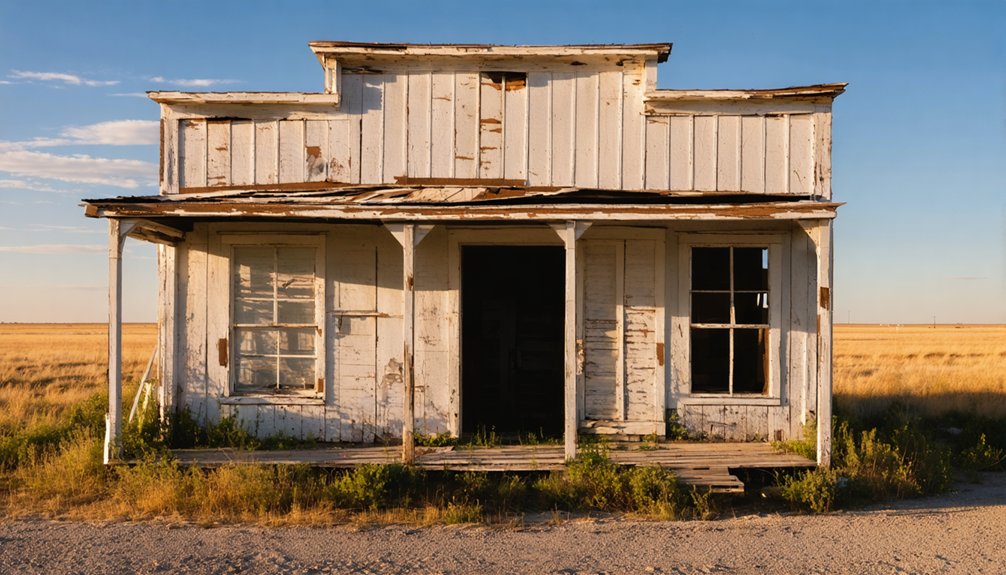
The ghost towns scattered across the Texas Panhandle preserve architectural evidence of settlement dreams that collapsed under economic pressure and environmental hardship.
You’ll discover diverse architectural styles across these abandoned settlements, from Claremont’s thick sandstone courthouse and jailhouse to Barstow’s brick schools and churches built during the 1891 railway boom.
Independence maintains remarkable preservation, with Baylor University’s original buildings and a pioneer church still open for exploration.
Each structure carries historical significance beyond mere building materials:
- Adobe Walls’ crumbling fortifications mark Kit Carson’s 1864 battle site
- Glenrio’s Route 66-era gas stations freeze automotive history in time
- Independence’s Houston family home stands among cedar trees, sheltering generations of stories
These remnants defy plains weathering, offering you tangible connections to pioneers who risked everything chasing frontier opportunities.
Preservation Efforts and Current Town Conditions
Across the Texas Panhandle, grassroots organizations and dedicated volunteers work to prevent these architectural witnesses from disappearing entirely into the prairie.
In Helena, residents formed a preservation group in 1962, tackling preservation challenges at the abandoned courthouse with push for climate control modernization. The Karnes County Historical Society Museum sustains operations through community involvement at events like Victorian Tea Party and Indian Heritage Summer Festival.
Meanwhile, Lonnie’s church remains a disintegrating husk where longhorns graze, illustrating what happens without intervention.
Preservation Texas expands Borderland advocacy, empowering communities through grants and education to protect intact neighborhoods. In Plemons, Boy Scouts uncovered sandstone markers during 1987 cemetery restoration.
Yet Barstow’s weathered structures continue surrendering to wind and sand, their fate dependent on whether remaining residents choose action over abandonment.
Heritage Tourism and Regional Historical Significance
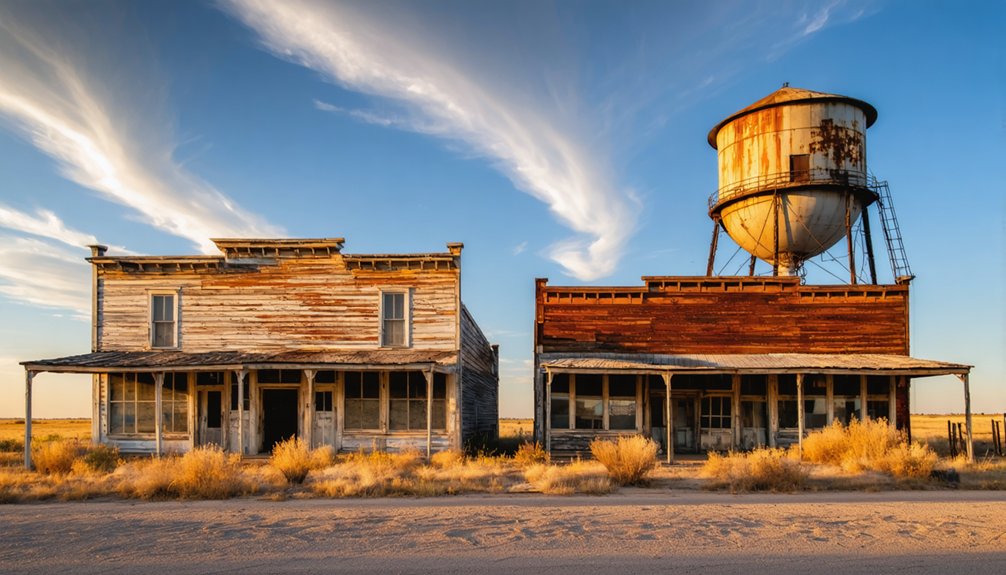
Windswept prairies hold stories that transform forgotten settlements into unexpected tourist destinations.
You’ll discover heritage trails connecting sites like Tascosa’s 1874 battlefield and Glenrio’s Route 66 remnants, where cultural revival breathes life into abandoned Main Streets.
These Panhandle ghost towns offer authentic glimpses into frontier America’s boom-bust cycles, from oil gushers to cattle switching stations.
Witness the raw cycle of prosperity and decline that shaped the American frontier through windswept streets and weathered structures.
Key attractions include:
- Tascosa’s Boys Ranch preservation – Billy Dixon’s legendary mile-long rifle shot site and adobe fort ruins
- Glenrio’s border-straddling nostalgia – Mid-century roadside culture frozen in time
- Mendota’s open range hunting grounds – Where deer roam former grain hub locations
You’re not visiting sanitized theme parks but real places where armadillos navigate church foundations and tumbleweeds drift past pioneer graveyards.
This region’s historical significance lies in its unvarnished authenticity.
Frequently Asked Questions
Are Ghost Towns in the Texas Panhandle Safe to Visit Alone?
Solitary exploration carries risks you’ll face like tumbleweed in windstorms—structural collapses, extreme crime rates exceeding Chicago’s, and isolation delaying help. You’d better take safety precautions: visit populated towns like Canyon, bring communication devices, and avoid abandoned buildings.
Can Visitors Legally Explore Buildings in Abandoned Panhandle Towns?
You can’t legally explore abandoned structures without owner permission, despite open doors or vacancy. Legal considerations require consultation before entry—trespassing violations apply even in ghost towns. Highway-accessible sites still demand authorization for interior access.
What Is the Best Time of Year to Visit Panhandle Ghost Towns?
Spring and fall offer ideal seasonal weather for exploring Panhandle ghost towns. You’ll find comfortable temperatures for photography tips like capturing historic structures during golden hour, while avoiding winter blizzards and summer’s intense heat that challenges outdoor exploration.
Are There Guided Tours Available for Texas Panhandle Ghost Towns?
You’ll find guided tours at Jericho Gap that uncover Dust Bowl-era stories like echoes from Steinbeck’s pages. These experiences reveal the historical significance of abandoned structures, offering freedom to explore authentic frontier narratives through immersive, expert-led journeys.
Do Any Ghost Towns Have Camping Facilities or Nearby Accommodations?
You’ll find camping options at Lake Meredith’s free sites near Glenrio, plus Historic Route 66 Ghost Town Farm offers generator-friendly dry camping. Borger provides nearby lodging when exploring Electric City’s oil boom remnants.
References
- https://www.county.org/county-magazine-articles/summer-2025/ghost-towns
- https://mix941kmxj.com/25-texas-and-oklahoma-ghost-towns-and-the-legends-they-left/
- https://livefromthesouthside.com/10-texas-ghost-towns-to-visit/
- https://mix931fm.com/texas-ghost-towns-history/
- https://mix941kmxj.com/shot-of-the-century-legacy-of-forgotten-panhandle-town-revisited/
- https://www.texasescapes.com/TOWNS/Texas-Ghost-Towns-5-Texas-Panhandle.htm
- https://en.wikipedia.org/wiki/Category:Ghost_towns_in_the_Texas_Panhandle
- https://kissfm969.com/urban-legends-texas-panhandle/
- https://www.texasalmanac.com/articles/early-european-exploration-and-development
- https://libguides.southtexascollege.edu/c.php?g=1039868&p=7541550