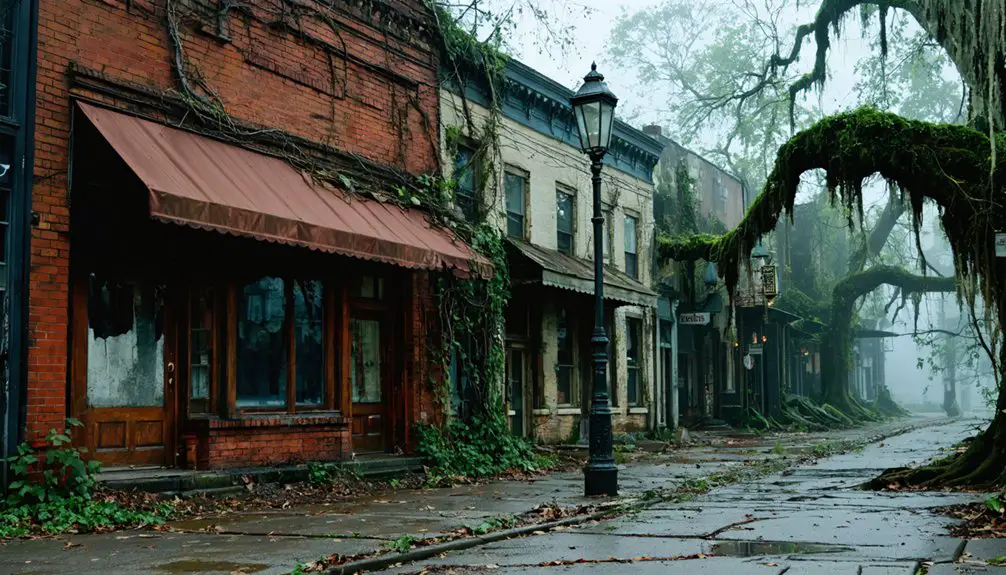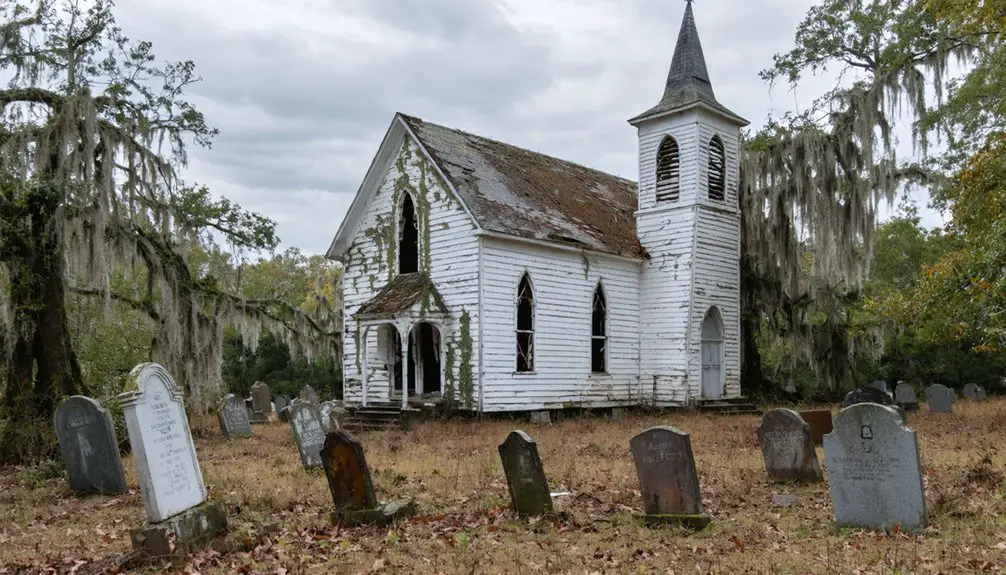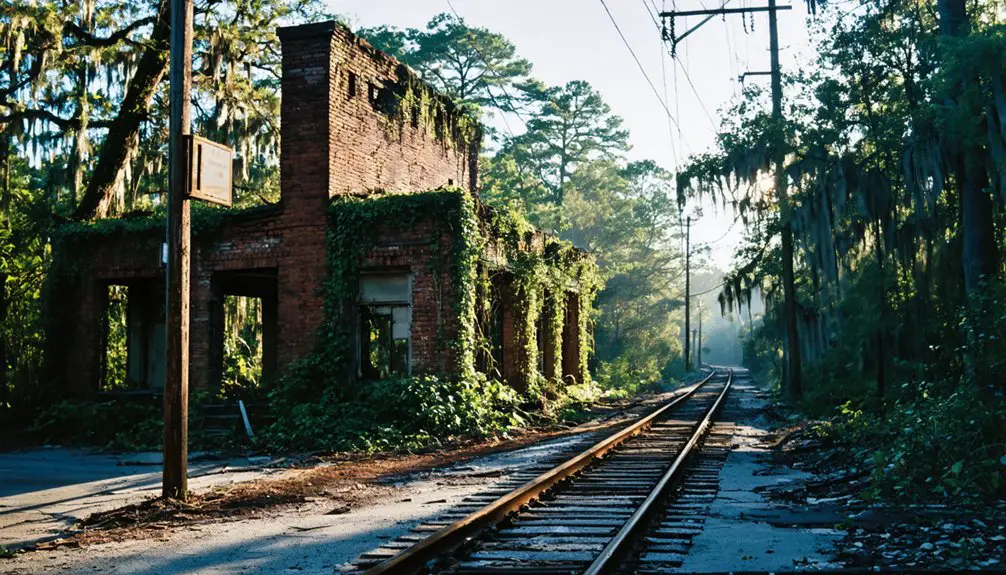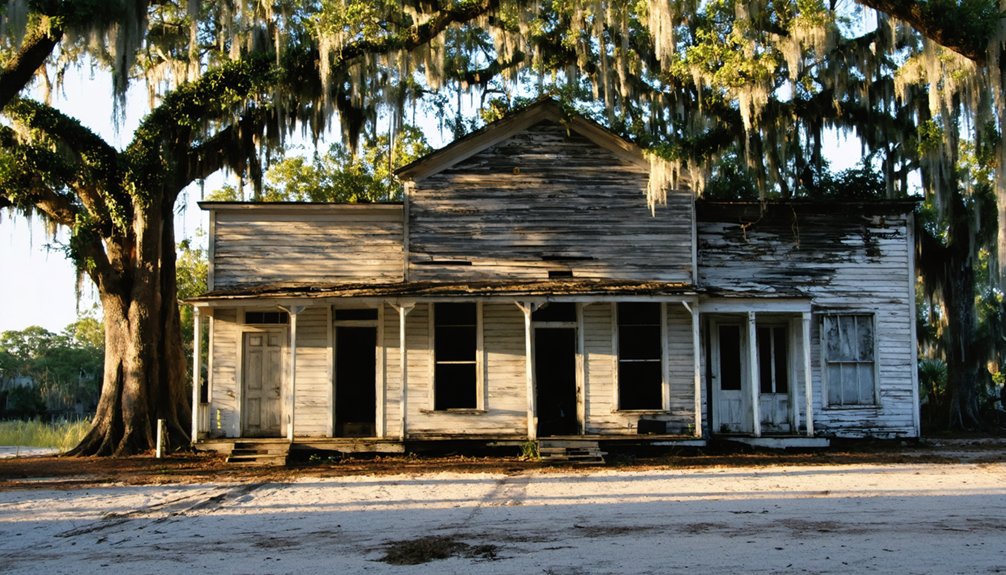
You’ll find Henry River Village’s abandoned mill houses transformed District 12 in *The Hunger Games*, while Edisto Island’s overgrown Cassina Point Plantation provided Civil War desolation for *Cold Mountain*. Chester’s minimally-developed downtown and historic farms doubled as Revolutionary War battlegrounds in *The Patriot*, and Georgetown’s weathered colonial storefronts recreated period scenes. Beaufort’s decaying antebellum mansions like Tidalholm offered authentic architecture without costly set construction. Hunting Island‘s maritime forests convincingly portrayed Vietnam jungles through natural fog and wetlands. These locations deliver period authenticity through existing decay and preservation.
Key Takeaways
- Henry River Village served as District 12 in *The Hunger Games*, featuring abandoned mill houses now offering guided tours and vacation rentals.
- Chester’s historic downtown provided Revolutionary War battle scenes for *The Patriot* with preserved 18th-century architecture and minimal modern development.
- Georgetown’s colonial waterfront and storefronts created Revolutionary War and antebellum backdrops for films including *The Notebook*.
- Beaufort’s decaying antebellum mansions like Tidalholm provided authentic weathered architecture for period films such as *The Big Chill*.
- Edisto Island’s abandoned Cassina Point Plantation offered authentic Civil War settings with overgrown landscapes for *Cold Mountain*.
Henry River Village: District 12 Comes to Life in The Hunger Games
When The Hunger Games film crew arrived at Henry River Village in 2012, they discovered a perfectly preserved time capsule nestled along a small gorge in western Catawola County, North Carolina. You’ll find this abandoned mill town featured Jennifer Lawrence’s character development as Katniss Everdeen, with House 16 serving as her home base.
The film production logistics spanned nine days, transforming the brick company store into Mellark’s Bakery and converting dirt roads to match Panem’s dystopian aesthetic.
The director’s crew didn’t hold back—they destroyed one mill house for an explosion scene. The 72-acre property’s terraced green spaces, fieldstone walls, and remaining worker houses created an authentic backdrop that resonated with viewers seeking authenticity in cinema’s portrayal of survival against oppressive systems. The village’s historical significance earned its NRHP listing in 2019, recognizing its role as an unaltered example of Burke County’s early industrial environment.
Since its fall 2017 purchase by Calvin Reyes and family, the village has transformed into a destination offering guided tours, special events, and vacation rentals in restored 1905 mill houses.
Edisto Island’s Abandoned Landscapes in Cold Mountain
You’ll find Edisto Island’s preserved 19th-century plantations and untamed Lowcountry forests provided the perfect backdrop for Cold Mountain’s Civil War sequences.
Where Inman’s grueling journey home required authentic period settings. The island’s Cassina Point Plantation and surrounding wilderness areas captured the desolation and isolation of war-torn North Carolina.
With dense maritime forests and abandoned structures framing the wounded Confederate soldier’s desperate trek. Production teams utilized the island’s coastal terrain alongside Charleston-area locations to create visually cohesive scenes that emphasized the physical and emotional distance between battlefield and home. Cypress Gardens in Moncks Corner served as a swamp setting that enhanced the film’s Southern landscape authenticity. The film also featured the College of Charleston as one of its key South Carolina filming locations.
Civil War Era Authenticity
Since Cold Mountain demanded visual authenticity for its 1860s North Carolina setting, location scouts identified Edisto Island’s Cassina Point Plantation as an ideal site.
The site featured abandoned structures and overgrown fields that required minimal alteration.
You’ll find the derelict homestead provided genuine aged architecture that digital effects couldn’t replicate—weathered wood, natural decay, and swampy overgrowth matched the script’s harsh wartime environments perfectly.
Unlike locations compromised by urban redevelopment or modern architecture, Edisto’s isolation preserved 19th-century visual fidelity without contemporary intrusions.
The island’s untouched terrain mirrored Blue Ridge inspirations, while abandoned waterways aligned with post-war desolation themes.
Production designers integrated these naturally eroded landscapes with Romanian-built sets, contributing to the film’s Oscar-winning realism.
Charleston’s College of Charleston also served filming purposes, where Inman’s scene with a blind peanut vendor showcased the Historic District’s period-appropriate architecture.
Edisto’s preserved ecology delivered credible 1865 storytelling through authentic Confederate homefront hardship rather than constructed facades.
The production utilized Berkeley and Charleston as additional South Carolina locations that reinforced the film’s depiction of war-torn landscapes.
Isolated Rural Film Settings
Production scouts targeting *Cold Mountain*’s desolate wartime sequences leveraged Edisto Island’s geographic remoteness—situated 45 miles south of Charleston across causeway-accessed marshlands—to capture genuine abandonment atmosphere without set construction.
You’ll find Cassina Point Plantation anchored the family homestead portrayal, its weathered structures and overgrown grounds eliminating digital enhancement needs.
The island’s scenery preservation through limited commercial development gave cinematographers untouched vistas mimicking 1860s depopulation.
Natural barriers—salt marshes, maritime forests, tidal creeks—isolated filming zones from contemporary intrusions during 2002 production.
Sullivan’s Island supplemented key sequences, while Botany Bay contributed windswept coastal backdrops.
The production also utilized Cypress Gardens in Berkeley County to depict historical scenes that enhanced the film’s authentic Civil War-era atmosphere.
This rural exploration approach delivered authentic period aesthetics, transforming South Carolina’s barrier islands into convincing Civil War-era territories where characters navigate landscapes stripped bare by conflict and exodus.
Wounded Soldier Journey Scenes
When Jude Law’s Inman staggers through Edisto Island’s overgrown terrain in *Cold Mountain*, the location’s naturally decaying plantations and marsh-edged pathways eliminate the need for heavy set dressing to convey Civil War devastation.
You’ll find Cassina Point Plantation’s abandoned structures provided authentic desolation as Inman encounters corrupt ministers and evades Home Guard pursuers.
The island’s wildlife preservation restrictions actually enhanced production value—untouched forests and overgrown fields created period-accurate abandonment without artificial distressing.
Seasonal weather during filming contributed atmospheric fog banks rolling across lowcountry swamps, while Berkeley County’s Cypress Gardens supplemented nearby swamp sequences.
Production teams leveraged South Carolina’s protected antebellum landscapes, transforming Edisto’s preserved rural isolation into North Carolina’s war-torn backcountry, where deserters navigated genuine wilderness rather than fabricated sets.
Director Anthony Minghella selected these South Carolina locations to authentically capture the wounded soldier’s arduous journey home following the Civil War.
Hunting Island’s Transformation Into Vietnam War Jungles
Located 15 miles east of Beaufort, Hunting Island‘s 5,000 acres of dense subtropical forest and brackish marshes provided filmmakers with a rare geographic advantage: natural terrain that authentically doubled for Southeast Asian jungles without expensive set construction.
Hunting Island’s 5,000 acres of subtropical wilderness offered filmmakers an authentic Southeast Asian jungle setting without costly artificial construction.
When *Forrest Gump*’s crew arrived in 1993, they enhanced the island’s native cypress trees with tropical plants to achieve Vietnam jungle realism.
You’ll find the swamps and tributaries feeding Beaufort River served as patrol routes where Bubba met his fate. The filming techniques prioritized authenticity—locals hired as Marines trained under retired Capt. Dale Dye, avoiding showers and sleeping outdoors.
The island’s humid, hazy atmosphere required zero special effects. The park’s maritime forest and saltwater marshes created natural backdrops that eliminated the need for artificial jungle construction.
*G.I. Jane* and *Rules of Engagement* later exploited these same semitropical conditions, cementing Hunting Island’s reputation as Hollywood’s go-to Vietnamese jungle double. The surrounding waterway marshes continue to attract filmmakers seeking authentic wetland scenery reminiscent of riverine combat zones.
Chester’s Historic Downtown as Revolutionary War Backdrop
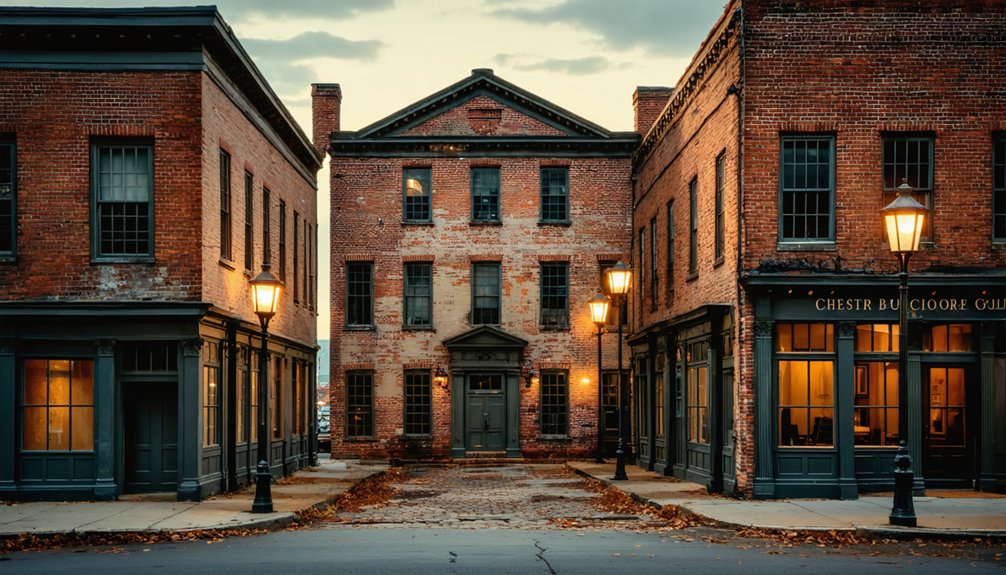
Settled by Scots-Irish immigrants as early as 1755, Chester‘s position in South Carolina’s Olde English District made it an authentic Revolutionary War filming destination that required minimal set dressing.
When you explore this town seven miles southwest of Rock Hill, you’ll discover why production crews chose Chester Farm’s rolling hills and private properties for The Patriot’s battle sequences. The county’s landscape lacks modern development that would compromise period authenticity—no power lines, contemporary structures, or intrusive infrastructure to digitally remove.
Downtown Chester’s Grecian-pillared Bolster Building (1871-1874) and Fishing Creek Presbyterian Church provided genuine 18th-century atmosphere. Though not traditional tourist attractions, these locations delivered the logistical advantages Hollywood demanded: accessible terrain, authentic architecture, and rural expanses where Revolutionary War scenes could unfold without anachronistic interruptions.
Georgetown’s Forgotten Corners in Shag
You’ll find Georgetown’s waterfront districts and colonial storefronts provided period-accurate backdrops for Revolutionary War dramas like “The Patriot.”
They also served as settings for antebellum scenes in “The Notebook,” though the town wasn’t actually featured in “Shag.”
The Strand Theater on Front Street captured 1950s small-town America in “Made in Heaven,” its marquis lights and brick façade framing Timothy Hutton’s exit from a showing of “Notorious.”
Georgetown County’s rice plantations—particularly Mansfield Plantation (1718) and Rice Hope Plantation—offered moss-draped oaks and Georgian architecture.
Filmmakers repurposed these sites for nursing homes, militia hideouts, and Charlotte Selton’s estate exteriors.
1960s Beach Town Atmosphere
Nestled between the Grand Strand’s vacation buzz and Charleston’s polished charm, Georgetown serves up a third option—a waterfront town where colonial-era houses and sprawling live oaks frame quiet streets that filmmakers prize for their authentic 1950s beach town feel.
Founded in 1526 and operating as South Carolina’s third oldest seaport since 1732, you’ll find seaside charm that hasn’t been Disneyfied.
The boats moored along the waterfront, the pre-Civil War architecture, and the unhurried pace deliver coastal ambiance directors need for period pieces.
Unlike fabricated sets, Georgetown’s genuine historic district gives you real textures—weathered clapboard, moss-draped branches, and harbor breezes.
Walk these streets yourself, and you’ll understand why cinematographers return: the town naturally captures that elusive atmosphere where past and present blur.
Historic Downtown Period Authenticity
Georgetown’s original 1729 grid—four blocks deep by eight blocks wide—gives directors something modern sets can’t replicate: streets that actually witnessed three centuries of American history.
You’ll find over 60 National Register buildings lining Front Street, their authentic architectural preservation untouched by urban renewal projects that gutted other Southern towns. The Cleland House at 405 Front Street still stands where Revolutionary generals and Vice President Aaron Burr once slept.
Film crews can shoot colonial scenes beside structures that hosted George Washington in 1791, then pivot to capture antebellum mansions where rice barons lived among 200-500 enslaved workers.
Live oak canopies shade original lot numbers from Elisha Screven’s survey. No constructed backlot matches this density of period-authentic locations within seven walkable square miles.
Coastal Setting Versus Upstate
While most South Carolina film scouts default to upstate courthouses and inland mill towns for period drama, Georgetown’s coastal waterfront delivers atmospheric contrasts that no landlocked location can match.
You’ll find urban decay interwoven with 1732 architecture—collapsed theater balconies beside functioning galleries, crumbling cemetery gates near pristine colonial facades. Modern infrastructure hasn’t erased Georgetown’s haunted corners:
- DuPre House: Fire-scarred 19th-century ruins where pre-Civil War spirits persist
- Strand Theatre: 1941 cinema shell, now performance space with paranormal acoustics
- Kaminski Building: 1842 art gallery where peg-leg footsteps echo above modern exhibits
The Sampit River’s tidal influence creates fog patterns impossible to replicate inland.
When productions need authentic coastal menace—storm warnings from Gray Man legends, harbor-side tension—Georgetown’s forgotten waterfront blocks provide period authenticity without CGI intervention.
Beaufort’s Decaying Mansions and Churches on the Silver Screen
The antebellum mansions lining Beaufort’s oak-shaded streets have drawn Hollywood scouts for decades. Their weathered columns and peeling paint offer directors an authentic backdrop of Southern decay that set designers struggle to replicate.
Tidalholm Mansion, built in 1853, anchored The Big Chill’s emotional narrative despite restoration challenges that followed its Civil War service as a Union hospital. The Castle’s turreted silhouette provided Forces of Nature’s wedding backdrop, while architectural styles ranging from Greek Revival to Victorian Gothic created visual diversity across productions.
You’ll find Forrest Gump’s white-columned childhood home thirty minutes away in Yemassee, where Bluff Plantation’s dirt road still bears witness to young Forrest’s leg-brace liberation.
Downtown’s Point Neighborhood supplied Something to Talk About with genuine antebellum interiors at 702 Craven Street, preserving period authenticity without Hollywood fabrication.
Frequently Asked Questions
Are Any of These Ghost Town Filming Locations Open to the Public?
South Carolina’s filming locations aren’t actual ghost towns—they’re active sites you can freely visit. Historic preservation maintains places like Hunting Island and Boone Hall, creating local community impact through tourism while ensuring your unrestricted access to cinematic landmarks.
What Permits Are Required to Film at Abandoned Sites in South Carolina?
You’ll navigate a permit maze! Filming permits depend on your project’s scale and location. Private abandoned sites need owner permission, while public ghost towns require land access regulations compliance, insurance certificates, and possibly neighborhood notifications before you’re free to shoot.
How Do Production Companies Ensure Safety When Filming in Ghost Towns?
You’ll deploy extensive safety equipment like hard hats and steel-toe boots while conducting structural assessments of unstable buildings. Production teams balance historical preservation requirements with hazard mitigation through air quality testing, wildlife relocation, and establishing emergency evacuation routes.
Can Visitors Stay Overnight at Henry River Village or Other Film Locations?
Step back in time—you can overnight at Henry River Village’s restored House 12 units, complete with historical preservation charm. However, private property restrictions limit most other film location stays, though nearby hotels offer convenient alternatives for exploration.
Which Ghost Town Location Generated the Most Tourism After Its Movie Released?
You’ll find Henry River Village drew significant post-*Hunger Games* attention, though exact tourism data isn’t publicly available. Historical preservation efforts and local legends surrounding District 12 transformed this North Carolina ghost town into a pilgrimage site for freedom-seeking fans.
References
- https://www.worldatlas.com/cities/4-south-carolina-towns-where-famous-movies-were-filmed.html
- https://www.romanticasheville.com/henry-river
- https://www.youtube.com/watch?v=PcI59BodZek
- https://www.eatstayplaybeaufort.com/10-movies-filmed-in-south-carolina/
- https://www.locallifesc.com/the-most-iconic-movies-that-were-filmed-in-beaufort-county/
- https://www.sciway.net/movies/all-sc-movies.html
- https://en.wikipedia.org/wiki/Henry_River_Mill_Village
- https://www.nctripping.com/henry-river-mill-village/
- https://www.visitnc.com/itinerary/go-behind-scenes-hunger-games
- https://www.discoverburkecounty.com/all-attractions/henry-river-mill-village/