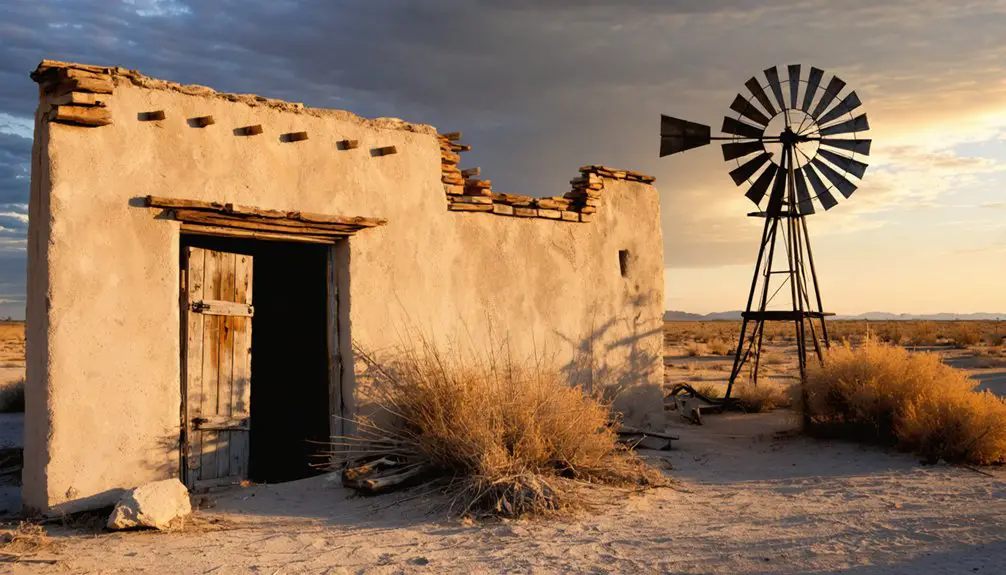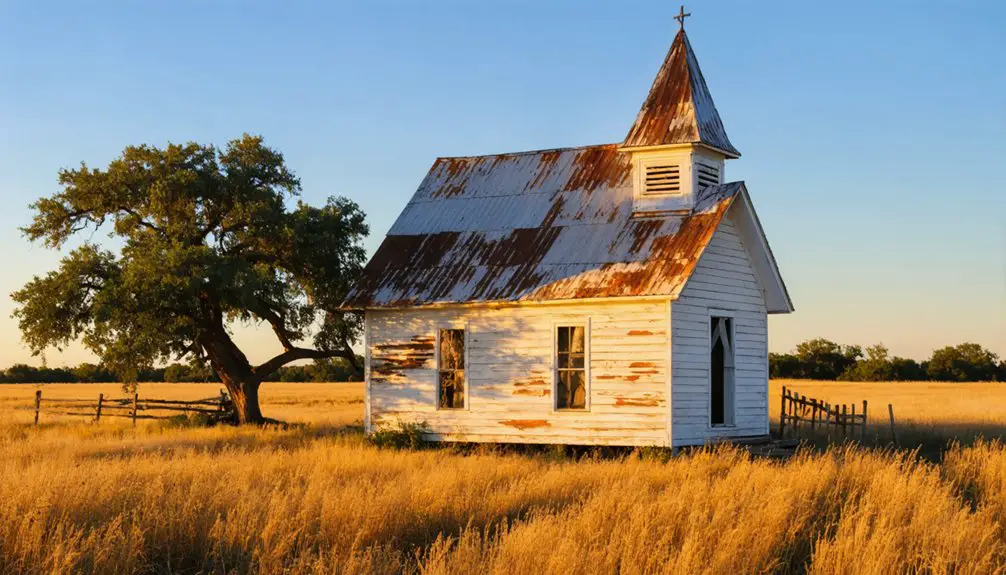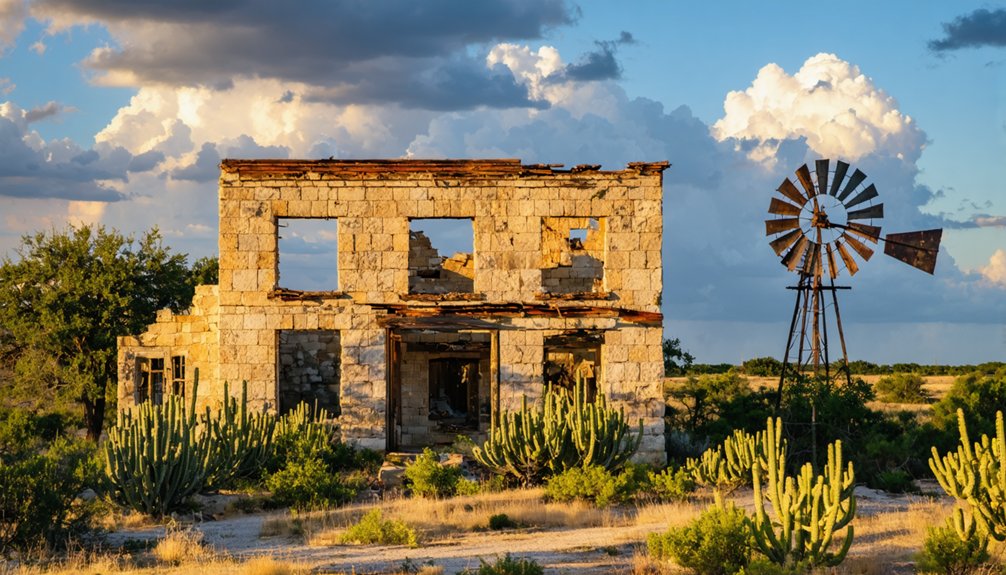
You’ll find several fascinating ghost towns within 20 miles of Fredericksburg, each telling stories of German settlers and Texas’s colorful past. Luckenbach, perhaps the most famous, dropped to just three residents by 1970 before Hondo Crouch revived it as a “free state of mind.” Grapetown, established in 1848, thrived for 91 years before fading into quiet obscurity. Cherry Spring’s historic dance hall once hosted Elvis, Hank Williams, and Patsy Cline. Bankersmith transformed from abandoned railroad town to modern event venue, while Morris Ranch’s thoroughbred empire left behind crumbling barns and a stone schoolhouse that reveal more remarkable details.
Key Takeaways
- Luckenbach, founded in 1849, dropped to three residents by 1970 and became famous through outlaw-country music in the 1970s.
- Bankersmith, established in 1913, became a ghost town after railroad closure and now operates as an event venue.
- Morris Ranch was a prestigious 23,000-acre thoroughbred breeding operation from 1856, producing globally competitive champion horses.
- Grapetown, founded in 1848, thrived for 91 years as a German trading hub but now exists as a quiet village.
- Cherry Spring Dance Hall, established in 1889, hosted Elvis Presley and country legends but now features decaying walls.
Luckenbach: The Hill Country’s Most Famous Near-Ghost Town
Though Luckenbach began as an 1849 trading post founded by German immigrants in Gillespie County—one of the Hill Country’s oldest settlements—the town you’ll encounter today bears little resemblance to its nineteenth-century origins.
By 1970, population had crashed to three, prompting a for-sale notice. Hondo Crouch bought the ghost town for $30,000 in 1971, reinventing it as a “free state of mind.” He staged Hug-Ins and chili cookoffs that transformed Luckenbach culture into playful rebellion.
Hondo Crouch rescued a three-person ghost town in 1971, reimagining Luckenbach as a freewheeling refuge for chili cookoffs and collective joy.
Jerry Jeff Walker’s 1973 live album and Waylon Jennings’ 1977 hit cemented Luckenbach music as outlaw-country legend. Among the early settlers was Texas Revolution veteran Jacob Luckenbach, whose son Albert would later give the town its name.
Today, you’ll find picker circles under live oaks, a dance hall hosting weekend shows, and maybe two dozen residents preserving authentic Hill Country freedom. The historic General Store still operates, offering souvenirs and drinks that recall the town’s frontier past.
Bankersmith: Railroad Town Turned Event Destination
Unlike Luckenbach’s organic decline into near-abandonment, Bankersmith’s ghost town status arrived swiftly when the San Antonio, Fredericksburg and Northern Railroad ceased operations in the 1940s.
Founded in 1913 as a shipping point for Hill Country ranches, this town of 50 residents vanished almost overnight once the trains stopped running.
You’ll find it just north of Texas’s only railroad tunnel, now a popular bat-watching destination that draws ghost town tourism enthusiasts.
In 2013, entrepreneur Doug Guller spotted Bankersmith on Craigslist and transformed the derelict townsite into a thriving event venue.
The town was briefly renamed Bikinis, Texas, complete with a sports bar and restaurant that attracted celebrity visitors and national media coverage before local concerns prompted its return to the original name.
Today you can visit its dance hall, saloon, and festival grounds—a 500-guest capacity destination that honors railroad history while breathing new life into abandoned Hill Country terrain along Highway 290.
The venue sits approximately 75 miles northwest of San Antonio, making it an accessible day trip for urban visitors seeking authentic Hill Country atmosphere.
Morris Ranch: Remnants of a 19th-Century Horse-Breeding Community
While Bankersmith’s ghost town transformation stemmed from railroad economics, Morris Ranch tells a different story—one of ambition, bloodlines, and the peculiar challenges of managing a sprawling Texas horse-breeding empire from a Manhattan townhouse.
Francis Morris acquired 23,000 acres in 1856 for twenty-five cents per acre. His son John transformed the property into one of America’s finest thoroughbred facilities, investing half a million dollars in infrastructure:
From twenty-five cents per acre to half a million in improvements—transforming raw Texas land into thoroughbred excellence.
- One-mile race track with seventeen horse barns
- Two-story manager’s residence doubling as headquarters
- Rock church-schoolhouse overlooking a hillside cemetery
- Hotel, general store, and drug store
- Mill and cotton gin supporting employees
This self-contained community operated through an unusual arrangement—New York-based ownership directing Texas-based management via power of attorney, with nephew Charles Morris coordinating daily horse breeding operations.
The ranch’s flour mill produced three grades of flour, each named after the family, serving both the community and broader commercial markets. Morris Ranch raised thoroughbreds that competed on the global racing circuit, with notable champions including Gallantry, winner of the English Derby, and Orbicular, who claimed the Belmont Stakes.
Grapetown: A Quiet German Settlement Fading Into History
John Hemphill’s 1848 land deed marked the beginning of Grapetown, a settlement ten miles south of Fredericksburg along the San Antonio road that would quietly endure for nearly a century before slipping into obscurity.
You’ll find Grapetown history intertwined with German heritage when Friedrich Wilhelm Doebbler established the town’s commercial foundation in 1860. His general store and inn served settlers who’d migrated from Fredericksburg seeking abundant land and wildlife.
The settlement thrived for 91 years as a trading hub, strategically positioned on the San Antonio, Fredericksburg and Northern Railroad route. Grapetown was settled in 1855 as part of the broader German colonization of the Texas Hill Country that began with the Adelsverein’s efforts in the 1840s. Like nearby communities, Grapetown attracted skilled workers and professionals who sought opportunities beyond the European famine and harsh factory conditions of their homeland.
Today, you’re looking at remnants of what once was. The railroad tracks are gone, commerce has vanished, and this German-Texan community exists as a sleepy village—a reflection of how quickly prosperity fades when transportation routes change.
Cherry Spring Dance Hall Area: Where Country Music Legends Once Played
Fifteen miles northwest of Fredericksburg along US Highway 87, Herman Lehmann—former Comanche captive and adopted son of Chief Quanah Parker—transformed his frontier experiences into an unlikely entrepreneurial venture when he established the Cherry Spring Tavern and dance hall in 1889.
This weathered landmark became a proving ground where country legends earned their spurs before nationwide fame.
The hall’s storied roster reads like a country music hall of fame:
- Hank Williams commanded the 12-foot stage during the honky-tonk era
- Patsy Cline brought her powerful vocals to Hill Country dancers
- Johnny Cash performed during the venue’s 1950s–60s heyday
- Elvis Presley played here October 9, 1955—misspelled “Clovis Presley” by local press
- Cowboys and travelers once stopped for whiskey, gambling, and live music on cattle drives north
The venue’s interior now features decaying walls, piles of old furniture, and a rusty tin roof—a stark contrast to its vibrant musical past.
Visitors exploring the structure today will notice missing glass windows throughout the abandoned building.
Today’s population of 75 residents marks Cherry Spring’s ghost-town evolution.
Frequently Asked Questions
Are There Any Other Ghost Towns Near Fredericksburg Worth Visiting?
You’ll find Morris Ranch, Grapetown, and Bankersmith each offer distinct historic sites worth exploring. Morris Ranch preserves horse-racing heritage, while Grapetown’s cemetery holds local legends from German settlers who shaped the Hill Country.
What Caused Most Hill Country Ghost Towns to Decline?
When railroads chose different routes, Hill Country towns died like forgotten outposts. You’ll find economic downturns—closed mills, exhausted mines, collapsed cotton prices—paired with population shifts toward cities that offered better opportunities and escape from failing farms.
Can You Explore Ghost Town Sites Freely or Is Access Restricted?
Access is heavily restricted—most sites sit on private land where trespassing laws apply strictly. You’ll need owner permission to explore legally. Ghost town regulations and fences protect both liability concerns and crumbling structures from further damage.
How Many Total Ghost Towns Exist in the Fredericksburg Area?
You’ll find 4–6 recognized ghost towns dot the Fredericksburg area like weathered monuments to freedom-seeking pioneers. Ghost town history reveals Grapetown, Morris Ranch, and Bankersmith anchor your Fredericksburg exploration, each site whispering tales of independent communities that vanished.
What Should I Bring When Visiting Remote Ghost Town Locations?
You’ll need sturdy boots, camera gear for documenting crumbling structures, and extensive safety supplies—water, maps, first-aid kit, emergency communication. I’ve learned offline GPS and respect for private land prove essential in remote Hill Country sites.
References
- https://thetexasiantravels.wordpress.com/2015/03/15/texas-hill-country-ghost-towns-an-abandoned-dance-hall-a-haunted-tavern/
- https://worldfootprints.com/compass/north-america/united-states/texas/ghost-towns-and-goblins-halloween-traditions-in-the-lone-star-state/
- https://tpwmagazine.com/archive/2018/jan/wanderlist_ghosttowns/
- https://www.hipcamp.com/journal/camping/texas-ghost-towns/
- https://www.texasescapes.com/TOWNS/Texas-Ghost-Towns-3-Hill-Country.htm
- https://www.lifeofalley.com/what-to-do-in-the-historic-ghost-town-bankersmith-tx/
- https://en.wikipedia.org/wiki/Morris_Ranch
- https://mix931fm.com/texas-ghost-towns-history/
- https://mix941kmxj.com/see-how-two-texas-ghost-towns-battled-for-the-county-and-lost/
- https://one-million-places.com/en/united-states/luckenbach-texas-german-ghost-town