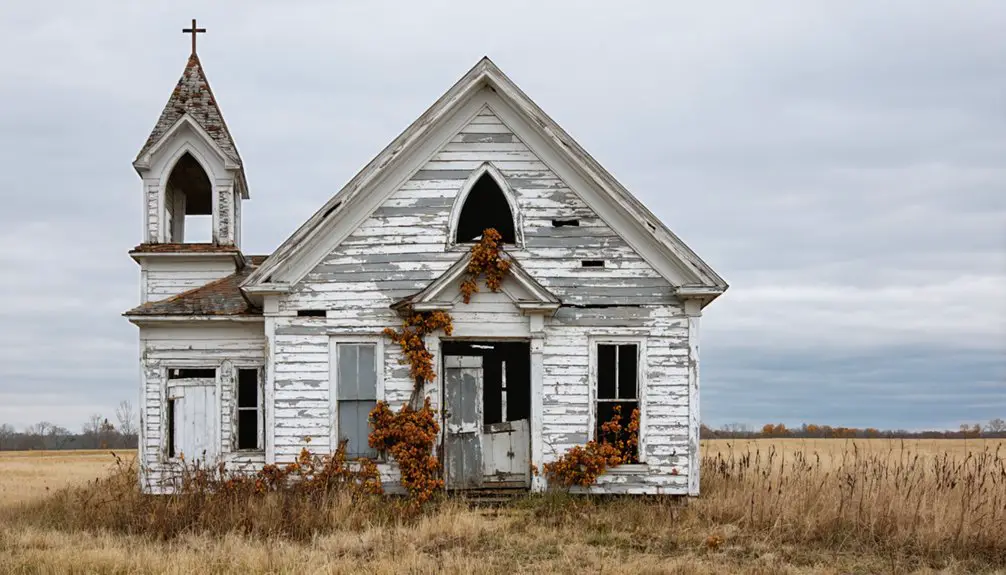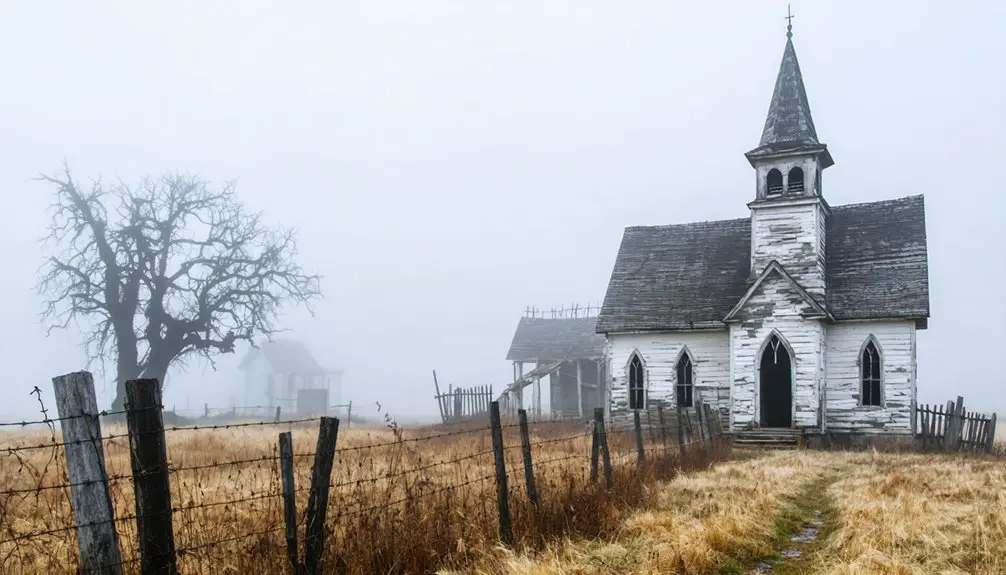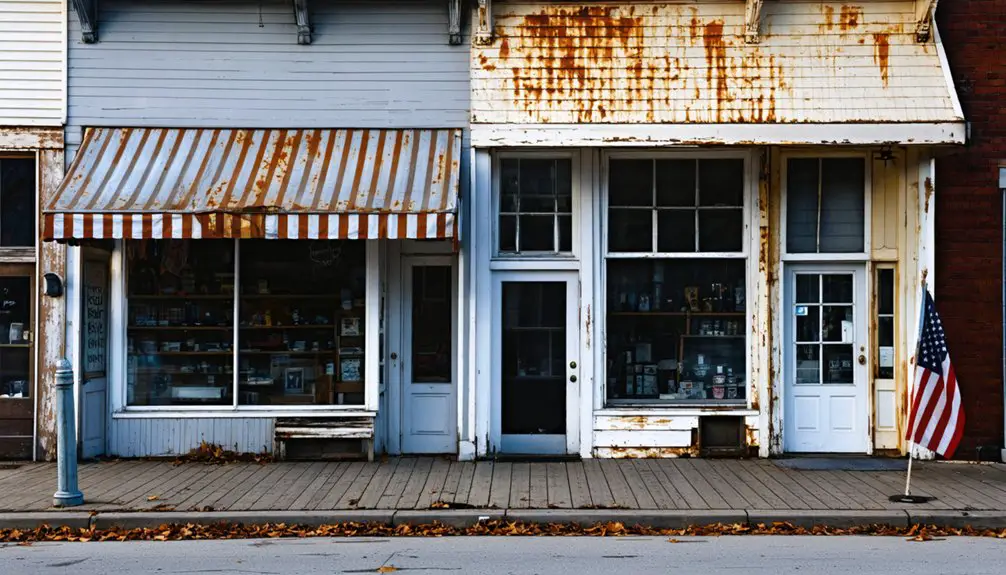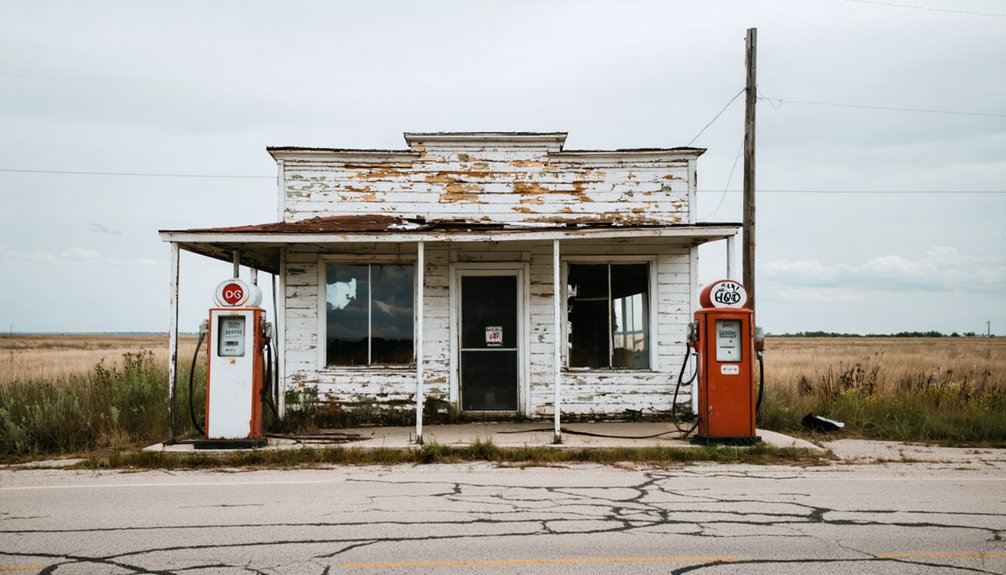
You’ll find several ghost towns scattered around Joplin, each telling a different chapter of Missouri’s past. Georgia City, fifteen miles northwest, once thrived on lead and zinc mining before rail-connected boomtowns pulled commerce away. Monark Springs attracted resort-seekers until a 1950s typhoid outbreak ended its camp-meeting glory. Along Route 66, Avilla declined after I-44’s bypass in the late 1950s, while Hannon and Barton City faded into farmland memories. The stories behind these vanished communities reveal the forces that shaped southwestern Missouri’s landscape.
Key Takeaways
- Georgia City, platted in 1868 fifteen miles northwest of Carthage, faded when commerce shifted to rail-connected mining boomtowns like Joplin.
- Monark Springs was an early 1900s resort town that declined after a typhoid outbreak in the 1950s damaged its reputation.
- Avilla thrived as a Route 66 stop until I-44’s bypass in the late 1950s and the highway’s 1978 decommissioning caused economic decline.
- Hannon and Barton City are unincorporated communities along Missouri Route 43 that lost commercial centers as transportation patterns shifted.
- Barton City Cemetery, established in 1870, serves as the primary memorial to the region’s ghost town history and settlers.
Georgia City: Echoes of a Mining Community in Jasper County
When John C. Guinn platted Georgia City in January 1868 along Spring River, you’d find a promising settlement history unfolding fifteen miles northwest of Carthage.
The town quickly attracted 200 residents by March 1869, establishing two general stores, two drugstores, a Methodist church, and a schoolhouse. Joseph Wagner ran the pioneer mercantile operation.
Within its first year, Georgia City boasted 200 settlers, four commercial enterprises, a church, and a school serving the Spring River community.
You’ll discover the community’s mining legacy tied directly to Jasper County’s lead and zinc deposits, while Spring River’s water power drove local mills and industry.
Despite these advantages, Georgia City couldn’t compete with rail-connected mining boomtowns like Joplin. The settlement faded as commerce shifted away from isolated river communities, leaving behind only traces of its brief existence in northwestern Jasper County.
Monark Springs: From Resort Retreat to Abandoned Campgrounds
In the early 1900s, Truman Elmore founded Monark Springs as a resort town in Newton County east of Neosho, naming it after the Missouri and North Arkansas Railroad that made the location accessible to regional visitors.
The resort history began with natural springs and Ozark woodlands attracting leisure travelers seeking rural escape. Hermann Jaeger’s nearby vineyards connected the area to regional viticulture.
By mid-century, religious gatherings transformed Monark Springs into a prominent Church of God camp-meeting site, drawing thousands annually for extended conventions.
Temporary dorms, tents, and dining halls supported these seasonal surges.
A devastating typhoid outbreak in the early 1950s, traced to contaminated water during a national gathering, shattered the campground’s reputation.
Over 400 attendees from states including California and Kentucky had gathered at the camp meeting when the outbreak occurred in August 1956. The site never recovered, leaving abandoned facilities as reminders of its dual identity. The Independent Order of Odd Fellows established Granby Lodge No. 113 in nearby Newton County, holding meetings from 1867 to 1873 during the region’s development era.
Dupont: The Vanished Company Town of the Dynamite Works
Between 1906 and 1909, E.I. du Pont de Nemours carved a company town from roughly 3,200 acres of former Fort Nisqually land on the southern shore of Puget Sound, creating what would become the Pacific Northwest’s first major industrial explosives center.
The plant opened in September 1909, and DuPont history reveals remarkable industrial ambition—this remote Washington outpost eventually produced over 1 billion pounds of dynamite.
From a remote Puget Sound site emerged an industrial powerhouse that manufactured over one billion pounds of dynamite.
The explosives legacy touched global projects:
- Panama Canal construction relied on Dupont dynamite
- Grand Coulee Dam excavation used plant output
- 40 million pounds annual capacity reached by 1915
You’ll find the corporate grip was absolute. DuPont controlled housing, commerce, churches, and schools—over 100 family homes by 1917.
A 17-mile narrow-gauge railroad threaded through the site, moving volatile cargo between manufacturing points and Puget Sound wharves. The railroad’s first Baldwin locomotive, a gasoline-powered 0-4-0, arrived in July 1910 to replace the unreliable horse-and-gravity system.
The workforce swelled to 350 employees during World War II to meet national defense demands.
Route 66’s Forgotten Stops: Avilla and the Mother Road’s Decline
Long before Interstate 44 drew a hard line through the Ozarks, Avilla thrived as a stagecoach crossroads in eastern Jasper County, platted in 1858 by D.S. Holman and A.L. Love.
Its Civil War Union garrison spared it from destruction, and by the 1870s you’d find a prosperous trade center.
When Route 66 followed the Ozark Trail corridor through town in 1926, Depression-era motorists kept local taverns and garages alive.
Bernie’s Bar & Grill charged locals less than out-of-towners—a tight economy riding highway patronage.
Then I-44 bypassed Avilla in the late 1950s, strangling commerce.
Route 66’s 1978 decommissioning sealed the economic downturn.
A 1971 lumberyard fire gutted buildings along the route.
The 1915 bank building still houses the post office, one of the few structures to survive Avilla’s decline.
Today, roughly 125 residents walk past brick ruins and empty storefronts.
Traffic speeds through town, often disregarding posted speed limits.
Hannon and Barton City: Cemetery Markers Along Route 43
Traveling north from Joplin along Missouri Route 43, you’ll find the corridor dotted with settlements that barely cling to memory—Hannon and Barton City chief among them.
These unincorporated communities once served surrounding farmsteads but lost their commercial centers as transportation patterns shifted.
Today, Barton City Cemetery stands as the primary memorial to ghost town history, its weathered headstones marking families who built lives here in the late 1800s.
The cemetery was established in 1870, documenting generations of settlers who shaped this corner of southwestern Missouri.
When exploring this vanishing landscape, you’ll notice three telling signs:
- Cemetery significance outlasting the townsite itself
- Scattered farmsteads replacing former business districts
- Historic markers visible only to those who venture off-highway
Similar patterns of abandoned buildings and nature reclaiming structures characterize other small farming communities throughout the region.
The cemetery sits roughly a quarter-mile from Route 43, accessible by side road, its monuments documenting an era when small settlements thrived independently before regional consolidation erased their economic purpose.
Frequently Asked Questions
Are There Any Ghost Towns Near Joplin Safe to Visit With Children?
Avilla offers family-friendly adventures along Route 66 with daytime visits to historic buildings. Follow safe exploration tips: stay together, avoid abandoned structures, and visit during daylight when local businesses operate for added security.
What Mining Towns Disappeared After the Tri-State District Collapsed?
Many smaller mining camps vanished completely, though specific names aren’t documented here. You’ll find this mining history fascinating—town decline followed the 1967 collapse when lead and zinc prices plummeted, ending over a century of prosperity.
Can You Legally Explore Abandoned Buildings in Joplin Area Ghost Towns?
No, you can’t legally explore abandoned buildings without permission—most remain privately owned despite appearing forgotten. Urban exploration in Joplin-area ghost towns requires express consent from owners to avoid trespass charges and legal considerations under Missouri law.
Which Ghost Towns Near Joplin Have the Most Remaining Structures?
Like layers of sediment preserving the past, Avilla and Spencer along Route 66 offer you the most remaining structures with historical significance and architectural features—banks, stores, and service stations frozen in time.
How Did the 2011 Joplin Tornado Affect Nearby Abandoned Communities?
You’ll find the tornado aftermath barely touched regional ghost towns physically—they lay outside the damage path. Community resilience channeled investment into rebuilding Joplin itself, leaving abandoned mining settlements in their long-standing decline.
References
- https://en.wikipedia.org/wiki/List_of_ghost_towns_in_Missouri
- https://www.vacationsmadeeasy.com/TheBLT/20ParanormalPlacesinSouthernMissouritoAddtoYourBucketList675.html
- https://www.youtube.com/watch?v=jzQWokeD4PQ
- http://www.spookthefourstates.com/REAL Haunted Places.html
- https://www.ghosttowns.com/states/mo/mo.html
- https://www.undergroundozarks.com/forum/viewtopic.php?t=445
- https://abandonedmo.com/city/southern-missouri/joplin/
- http://freepages.rootsweb.com/~judysstuff/genealogy/jasper/jashist04.htm
- https://ia801309.us.archive.org/5/items/historyofjasperc01livi/historyofjasperc01livi.pdf
- https://usgenealogyresearch.atwebpages.com/Missouri/Jasper/misc_jasper_county_in_the_civil_war.pdf