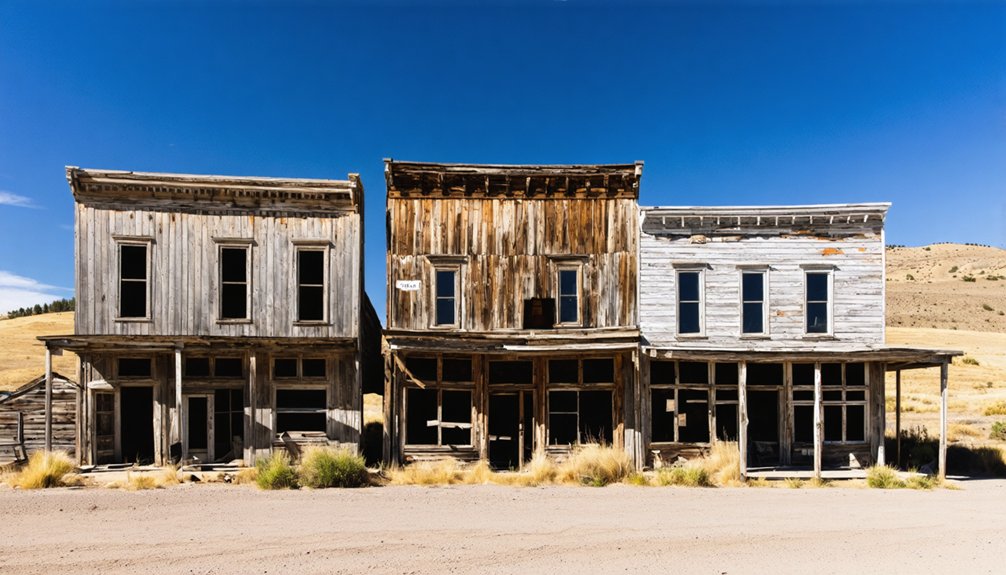
You’ll find Nevada City just 1½ miles west of Virginia City, preserved with over 90 historic buildings from the 1863 Alder Gulch gold strike. Within a 90-mile radius, Bannack State Park offers Montana’s first territorial capital with 50+ original structures, while Elkhorn State Park showcases impressive 1880s silver boom architecture. Marysville and Rimini provide additional glimpses into Montana’s mining legacy near Helena, and Granite Ghost Town State Park near Philipsburg reveals remnants of a 3,000-resident silver mining community. Each site offers distinct architectural evidence and historical context from Montana’s transformative mining era.
Key Takeaways
- Nevada City lies 1½ miles west of Virginia City with over 90 historic buildings from the 1863 gold rush.
- Bannack State Park, Montana’s first Territorial Capital, preserves over 50 original buildings visitors can explore unlocked.
- Elkhorn State Park features two major 1880s silver boom structures: Fraternity Hall and Gillian Hall from mining operations.
- Granite Ghost Town State Park above Philipsburg peaked at 3,000 residents, producing $40 million in silver by 1890.
- Marysville grew to 4,000 residents during peak mining, becoming one of the world’s leading gold-producing regions.
Nevada City: Virginia City’s Neighboring Ghost Town
Just 1½ miles west of Virginia City, Nevada City emerged from the Alder Gulch gold discovery of spring 1863 as a bustling mining camp that would help form what prospectors called the “Fourteen-mile City”—a continuous stretch of settlements strung along one of the Rocky Mountains’ richest placer strikes.
You’ll find Nevada City’s mining history etched into every restored cabin and boardwalk. At its peak, dozens of businesses served fortune-seekers: three general stores, two saloons, a brewery, and a Masonic Hall.
Nevada City once buzzed with three general stores, two saloons, a brewery, and a Masonic Hall serving eager gold-seekers.
The camp’s most significant moment came December 21, 1863, when George Ives swung from a hastily constructed gallows just 58 minutes after conviction—an execution that sparked Montana’s vigilante movement and 24 more hangings within weeks.
Today, you can explore this living museum where gold-rush justice once prevailed. Over 90 historic buildings now occupy the site, including both original structures and relocated Montana buildings collected by Charles and Sue Bovey during the 1950s. The Nevada City Music Hall now stands among the town’s major attractions, drawing visitors alongside gold panning activities and historic train rides.
Bannack State Park: Montana’s First Territorial Capital
The town’s territorial significance peaked in 1864 when Governor Sidney Edgerton designated Bannack as Montana’s first Territorial Capital—a status lost to Virginia City in 1865 as richer strikes diverted investment.
Today, Bannack State Park preserves over 50 original buildings exactly where miners abandoned them, offering you an authentic glimpse of 1860s Montana without modern interference. The site represents the “door through which the world rushed into Montana,” marking Bannack’s pivotal role in opening the territory to widespread settlement and development. Visitors can explore unlocked historic buildings including the 1877 church, the 1874 schoolhouse that doubled as a Masonic lodge, and the 1875 brick courthouse that once served Beaverhead County.
Elkhorn State Park: Silver Mining Remnants
You’ll find Elkhorn State Park preserves two major architectural survivors from the 1880s silver boom: Fraternity Hall and Gillian Hall.
These structures stand as direct evidence of the town’s peak period, when nearly 2,500 residents supported a community infrastructure unusual for Montana mining camps.
The buildings’ survival through decades of abandonment reflects their substantial construction during Elkhorn’s prosperity, before the 1893 silver crash triggered a catastrophic 75% population loss within two months.
The Elkhorn Mine’s extraordinary output included 8,902,000 ounces of silver by 1900, along with 8,500 ounces of gold and over 4 million pounds of lead.
Silver deposits were initially discovered in 1870 by Swiss immigrant Peter Wyes, who first identified the valuable mineral resources in the Elkhorn Mountains.
Historic Fraternity Hall Building
Rising above Elkhorn’s abandoned Main Street, Fraternity Hall stands as one of Montana’s most architecturally sophisticated ghost town structures—a two-story wood-frame building whose Greek Revival-influenced false front and cantilevered balcony contradicted the rough functionality typical of 1890s mining camps.
Incorporated in 1893, this joint venture housed multiple fraternal orders while serving broader community needs:
- Fraternity Functions occupied the second floor, where Masons, Knights of Pythias, Odd Fellows, and Good Templars conducted lodge business.
- Community Events filled the first floor—dances, theatrical presentations, boxing matches, and public meetings.
- Horse races, rock-drilling contests, and baseball games animated the surrounding grounds.
- The hall witnessed both celebrations and two documented funerals during the 1888–1889 diphtheria epidemic.
The building’s survival through decades of abandonment speaks to its construction quality, withstanding heavy snowfall and neglect that claimed most neighboring structures. Photographed by John N. DeHaas, Jr. for the Historic American Buildings Survey in September 1963, the structure received formal recognition when it was listed on the National Register of Historic Places in 1975. Today Montana Fish, Wildlife & Parks preserves this architectural centerpiece within Elkhorn State Park.
Gillian Hall Mining Structure
Standing shoulder-to-shoulder with Fraternity Hall along Elkhorn’s ghosted Main Street, Gillian Hall‘s two-story wood frame testifies to the commercial ambitions that flourished during the settlement’s pre-1889 silver boom—a period when seventy-five buildings crowded this mountain valley and 2,500 residents demanded the goods, spirits, and social spaces that frontier merchants rushed to provide.
You’ll find this HABS-documented structure likely operated as a store or saloon, while its upper floor hosted community gatherings that served Elkhorn’s family-oriented population of European immigrants.
Today you can walk through Gillian Hall’s interior within Montana’s smallest state park, examining preserved fixtures that reveal how merchant enterprise and social congregation formed the commercial backbone of mining-era settlements before the ore played out and prosperity vanished. The structure’s neo-classical balcony and pillars reflect the Greek Revival architectural style that mining wealth brought to this remote mountain settlement. The town’s fortunes collapsed after the Silver Crash of 1893, which triggered a 75% population decline that transformed this once-bustling commercial center into the skeletal remains you encounter today.
Marysville: 1870s Mining Settlement
Among the ghost towns scattered across Montana’s mountainous terrain, Marysville stands out for the scale and wealth of its mining operations.
Located northwest of Helena along Silver Creek, Marysville history began around 1870 when Irish immigrant Thomas Cruse discovered a rich gold-bearing quartz vein in 1876, establishing the Drumlummon Mine.
Irish immigrant Thomas Cruse struck gold in 1876, launching Marysville’s transformation from remote creek valley to Montana’s premier mining district.
By the 1880s–1890s, you’d have found one of the world’s leading gold-producing regions here, with the community swelling to 3,000–4,000 residents.
Company records reveal the operation’s industrial scope:
- Five-stamp mill processing ore from hundreds of feet of underground tunnels
- Extensive machinery requiring costly wagon freight through remote mountain passes
- Drumlummon Provident and Accident Insurance Association protecting workers from hazardous conditions
- Multiple commercial enterprises supporting diverse immigrant and domestic labor populations
Rimini: Helena’s Nearby Mining Town
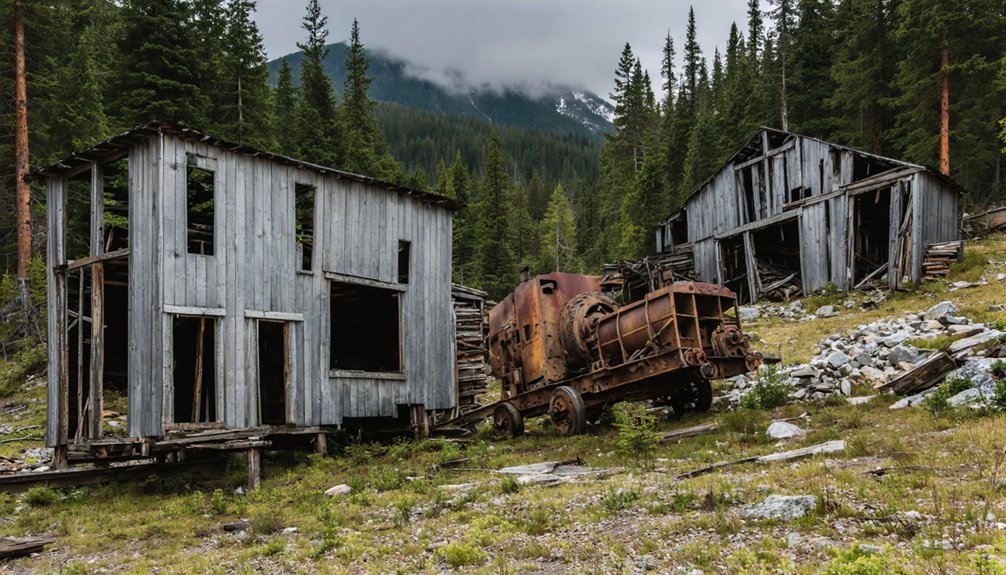
You’ll find Rimini nestled in the Tenmile Creek Valley west of Helena, where silver lode discoveries in the mid-1860s transformed the Irish mining camp of Young Ireland into a town named after Dante’s tragic heroine.
By 1890, this railroad-connected district supported 300 residents and shipped 400 tons of ore weekly, leaving behind false-front commercial buildings and an 1904 schoolhouse now on the National Register.
The maintained scenic road from Helena provides direct access to interpretive signs and surviving log-and-frame structures that document the boom-and-bust cycle of Montana’s mineral frontier.
Historic Mining Town Origins
When prospector John Caplice discovered a rich ore vein in the Tenmile Creek valley west of Helena in 1864, he set in motion the creation of what would become one of Montana’s most productive mining districts.
The settlement’s town evolution reflects the cultural makeup of early Montana:
- Young Ireland – The camp’s original name honored the primarily Irish miners who staked the first claims, including the Lee Mountain Mine in 1864.
- Rimini – By the mid-1860s, the town adopted this theatrical name from Dante’s Inferno inspired by popular Helena stage productions.
- Strategic Location – Positioned between Red Mountain and Lee Mountain, the townsite anchored Lewis and Clark County’s mining legacy.
- Diversified Production – Silver, lead, zinc, copper, and gold deposits enabled sustained extraction beyond single-commodity operations.
Preserved Buildings and Structures
The 1904 Rimini Schoolhouse stands as the town’s most recognized architectural landmark, its wood-frame construction and false-front façade exemplifying the vernacular design principles that frontier builders employed across Montana’s mining districts.
You’ll find this National Register structure anchoring a streetscape where late-19th-century commercial buildings and log cabins demonstrate evolving construction methods—hybrid designs combining log walls with frame false fronts.
The architectural significance extends beyond individual buildings to the Moose Creek Ranger Station complex, where the 1908 log station and remnants of Camp Rimini preserve federal land-management and World War II war dog training history.
Today roughly 93 residents occupy adaptively reused miners’ cabins, though private ownership complicates systematic historic preservation efforts as weathering and structural decline threaten unrestored properties.
Accessibility From Helena
From Helena’s south side, Rimini Road (Forest Road 695) climbs approximately 15 miles southwest into the Helena National Forest, ascending from the capital’s valley floor to the 5,200-foot mining district in roughly 30 to 40 minutes under favorable conditions.
Planning Your Rimini Access:
- Late June through September offers the most reliable passage on graded gravel surfaces suitable for standard vehicles in dry weather.
- Spring snowmelt and winter accumulation create muddy ruts and snow-blocked stretches requiring high-clearance 4WD.
- Fire season closures may restrict Forest Service roads from late summer through early fall—verify Helena National Forest conditions beforehand.
- Seasonal conditions dictate whether you’ll need AWD capability; washboards and potholes intensify during shoulder months.
You’ll find current road status through Helena National Forest ranger district offices before departure.
Granite Ghost Town State Park
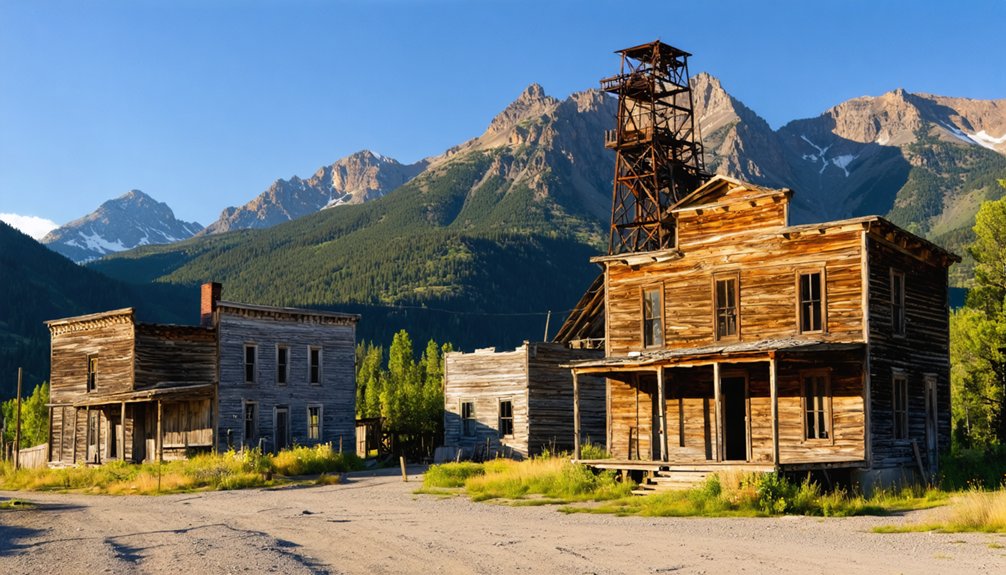
Perched in the mountains above Philipsburg, Montana, Granite Ghost Town State Park preserves the haunting remains of what was once called “Montana’s Silver Queen.”
Silver’s discovery near the future townsite in 1865 by prospector Hector Horton set the stage for development, though the truly significant Granite mine wasn’t discovered until autumn 1872 by a prospector named Holland, with the mine being relocated in 1875.
Granite history reveals a spectacular rise—by 1890, roughly 3,000 residents populated the town, with similar numbers in surrounding areas. Silver production reached extraordinary levels, yielding approximately $40,000,000 during peak years and over $250,000 monthly by 1889.
At its zenith, Granite boasted 3,000 residents and generated over $40,000,000 in silver during its remarkable boom years.
You’ll find the skeletal three-story Miners’ Union Hall, the superintendent’s house, and hospital ruins standing as evidence to this once-thriving community that collapsed almost overnight following the Silver Panic of 1893.
Planning Your Ghost Town Tour Through Southwest Montana
When planning your ghost town tour through Southwest Montana, you’ll discover that the region’s most rewarding itineraries connect multiple sites within a concentrated geographic area centered on the Alder Gulch mining district.
Essential planning considerations:
- Tour duration: Allocate a full day for Virginia City and Nevada City exploration, with half-day blocks for Bannack, Garnet, or Elkhorn when extending your trip into a multi-day loop.
- Seasonal considerations: Visit late May through September for ideal access and open attractions, while winter limits higher-elevation sites like Rimini and Elkhorn.
- Fuel strategy: Tank up in Ennis, Dillon, Helena, or Butte before venturing to remote locations on gravel roads.
- Base camp selection: Choose Ennis or Virginia City for proximity to core sites, with historic accommodations available in restored 19th-century structures.
What to Expect When Visiting Montana Ghost Towns
Montana’s ghost towns deliver experiences that range from meticulously preserved museums to weathered ruins accessible only by rough mountain roads, and understanding these distinctions before you arrive shapes realistic expectations for each site.
In addition to the allure of ghost towns surrounding Virginia City, each location has its own unique story that invites exploration. Visitors often find themselves captivated by the relics of a bygone era, where history comes alive through the remnants of old buildings and the tales they tell. As you wander through these eerie landscapes, the contrast between the once-thriving communities and their present desolation sparks curiosity and reflection on the passage of time.
Ghost town preservation varies dramatically—state parks like Bannack offer marked trails and basic facilities, while remote locations such as Granite require traversing rougher terrain with minimal services.
You’ll encounter well-maintained structures certified by the Montana Historical Society alongside stabilized buildings containing original artifacts. Visitor experiences depend heavily on accessibility: some sites provide interpretive signs and self-guided exploration, others present only weathered facades and informal paths.
Expect uneven ground, extensive walking, and seasonal weather impacts. Mixed-use communities blend inhabited properties with abandoned cabins, demanding respect for private land boundaries throughout your exploration.
Frequently Asked Questions
Are Pets Allowed at Montana Ghost Town Sites?
Yes, you’ll find pets allowed outdoors on leash at Montana ghost town sites, following standard pet policies and ghost town etiquette—but they’re excluded from historic buildings to preserve artifacts and respect shared space.
What Is the Best Season to Visit Virginia City Area Ghost Towns?
The best time to visit is Memorial Day through Labor Day, when you’ll find full access to both ghost towns, daily operations, living history programs, and complete seasonal activities across Nevada City’s museum buildings and Virginia City’s historic attractions.
Do Ghost Towns Near Virginia City Charge Admission Fees?
Admission policies vary: Virginia City’s streets are free to explore, reflecting its historical significance as a living town, while Nevada City charges $10–12 per adult for museum access. Bannack remains free to roam.
Can You Camp Overnight at These Ghost Town Locations?
You generally can’t camp overnight inside Virginia City or Nevada City due to camping regulations protecting historic resources. Check nearby public lands for dispersed options or use commercial campgrounds, though overnight permits aren’t typically required for those areas.
Are Guided Tours Available at Virginia City Ghost Towns?
Step back in time—you’ll find multiple guided experiences at Virginia City, from walking ghost tours to historic fire truck rides. Professional guides deliver historical context through documented paranormal sites and authentic Old West narratives.
References
- https://en.wikipedia.org/wiki/List_of_ghost_towns_in_Montana
- https://www.roamingnearandfar.com/montana-ghost-towns-near-helena/
- https://practicalvagabonds.com/southwest-montana-ghost-towns/
- https://www.gonomad.com/232995-ghost-towns-of-montana
- https://southwestmt.com/thegreatoutdoors/ghosttowns/
- https://www.youtube.com/watch?v=q-4LJ9Z0gWc
- https://virginiacitymt.com/Experience-The-Old-West/index
- https://destinationyellowstone.com/day-trip-ghost-towns-virginia-nevada-city-montana/
- https://visitmt.com/things-to-do/ghost-towns
- https://sherilyndecter.com/virginia-city-from-ghost-town-to-tourist-mecca/