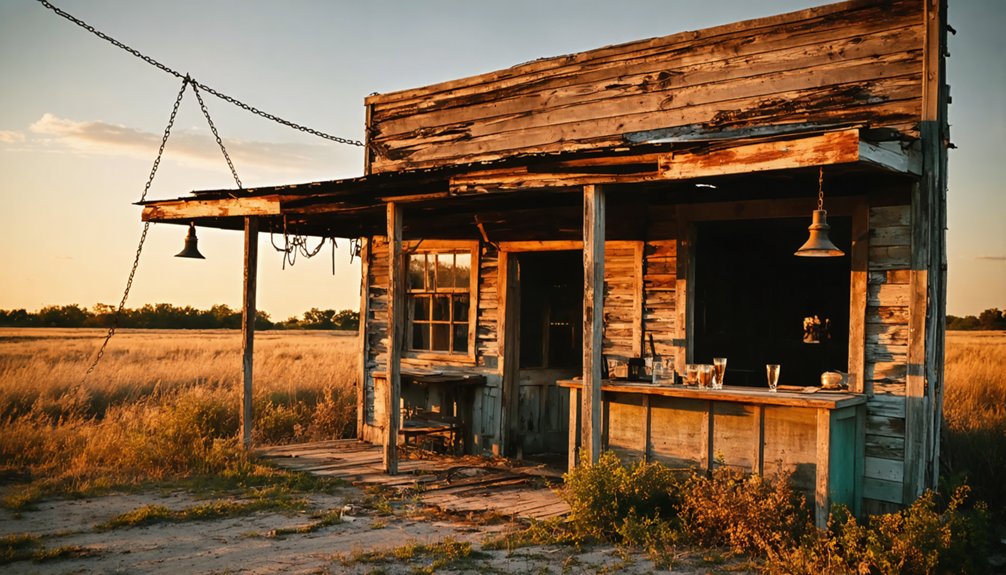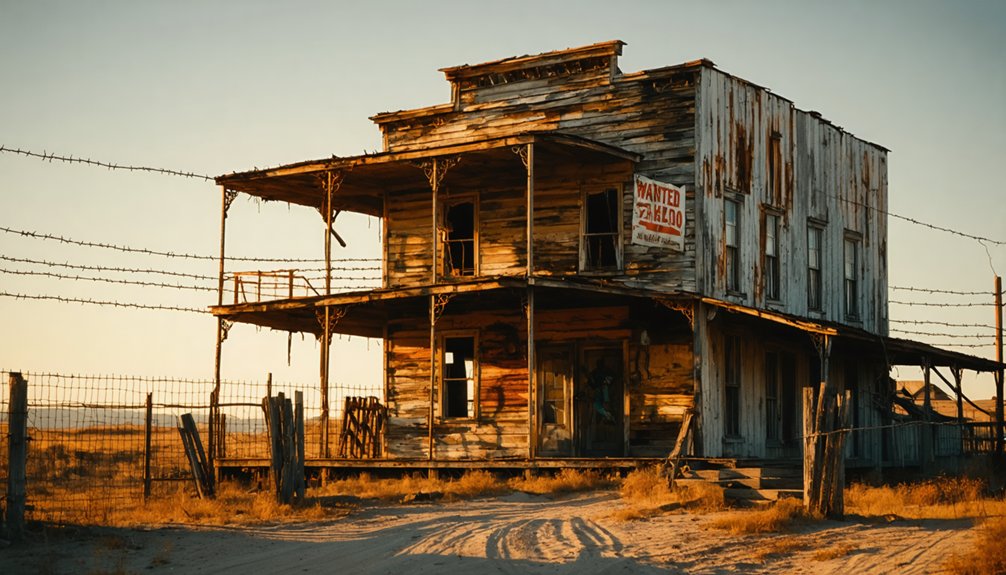
Texas ghost towns tell tales of boom-and-bust cycles that shaped the Lone Star State. You’ll find submerged Bluffton beneath Lake Buchanan, Terlingua’s mercury mining ruins in the desert, and New Birmingham’s collapsed iron dreams. These abandoned settlements showcase weathered headstones, rusted industrial remnants, and occasionally revived cultural celebrations. Pack your vehicle carefully for remote explorations—gas stations are scarce and roads rough. The whispers of these forgotten communities await your arrival.
Key Takeaways
- Texas ghost towns like Terlingua, Bluffton, and New Birmingham represent abandoned communities with rich industrial and cultural histories.
- Economic shifts, natural disasters, and changing transportation routes were primary factors in the decline of these once-thriving settlements.
- Many ghost towns maintain cultural heritage through seasonal celebrations, preserved cemeteries, and historical landmarks.
- Exploration routes like Ross Maxwell Scenic Drive and River Road provide access to these historical sites with stunning landscapes.
- Visitors can experience authentic stays in historic accommodations while exploring remnants of Texas’s boom-and-bust economic cycles.
The Rise and Fall of Terlingua: Mercury Mining Boom to Artistic Haven
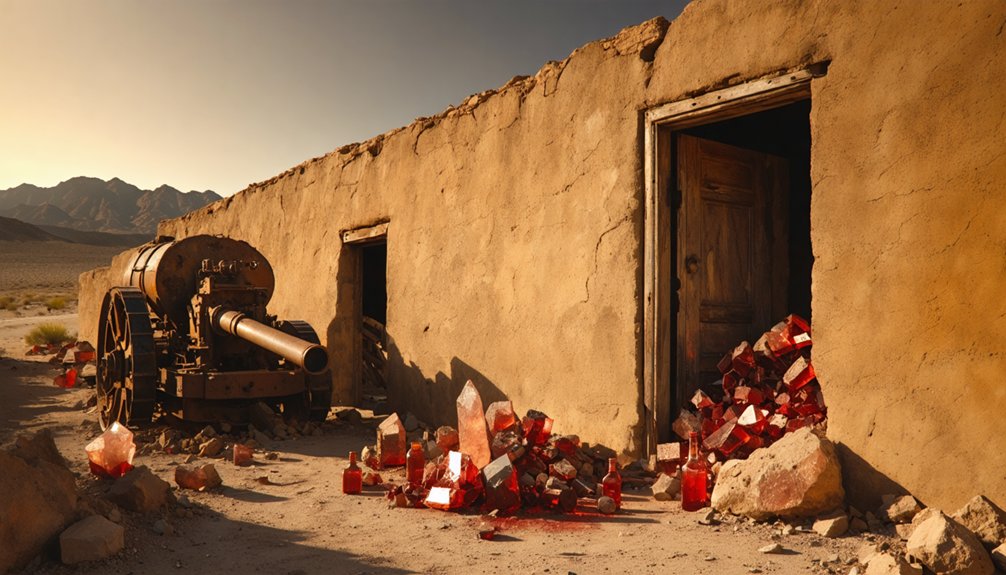
Nestled along Terlingua Creek near the Rio Grande, the humble Mexican settlement of Terlingua Abaja transformed almost overnight when cinnabar deposits were discovered in the mid-1880s.
You’d hardly recognize the sleepy village as it exploded into a bustling mining district with over 1,000 souls by 1913.
The town’s mining heritage was built on quicksilver extraction, essential for munitions during the Great War. By 1922, Terlingua was producing 40% of America’s quicksilver.
Mercury rose from these dusty mines to fuel the bullets and bombs that would decide the fate of nations.
Howard Perry’s mansion stood proudly while Mexican families lived east of the company store, Anglos to the west—a stark divide in the desert community.
When the mines dried up after WWII, Terlingua withered into a ghost town.
But you can’t keep a good place down. By the ’60s, an artistic resurgence began, sparked by the famous Chili Cook-off in ’67, breathing new life into abandoned ruins. The World’s Chili Cook-off was actually created as a publicity stunt to promote land sales in the sparsely populated area.
Underwater Secrets: The Story of Bluffton’s Submersion
While Terlingua found resurrection after its mining collapse, another Texas town met a more permanent fate beneath the waters of progress. Bluffton, founded by Billy Davis in the mid-1800s, thrived as a riverside community until 1937 when the Buchanan Dam project sealed its destiny.
You’d hardly know that thirty feet below Lake Buchanan’s surface lies the ghostly remains of a once-vibrant settlement. When severe droughts hit in 1984 and 2009, the waters receded to reveal foundations, a hotel storm cellar, and the haunting remnants of the town’s past.
Underwater archaeology expeditions uncovered tools, medicine bottles, and artifacts from freed slaves. In its heyday, Bluffton supported numerous businesses including pecan orchards that contributed significantly to the town’s prosperity. The construction of the dam was part of New Deal projects designed to control flooding and provide electricity to the region. Historical preservation laws protect this submerged heritage, making it illegal to remove items from what many consider a sacred underwater graveyard—a sobering reminder of what Texans sacrificed for modern development.
Lost Iron Dreams: New Birmingham’s Industrial Collapse
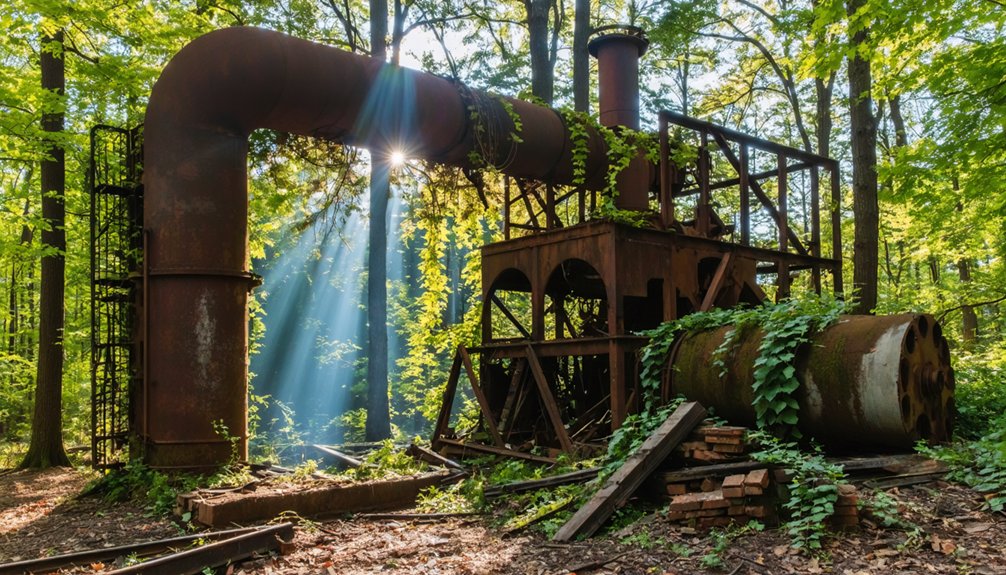
You’ll scarcely believe that New Birmingham, once proudly called the “Iron Queen of the Southwest,” blossomed in 1888 with grand dreams of rivaling Alabama’s iron industry before vanishing into Texas scrubland less than a decade later.
The town’s two blast furnaces, including the Tassie Belle, stood as monuments to ambitious Eastern investors who poured fortunes into Cherokee County’s iron-rich hills before the Panic of 1893 and Governor Hogg’s Alien Land Act crushed their vision. The town initially flourished with impressive infrastructure including brick-built structures that signaled the founders’ intention for permanence. Anderson B. Blevins, the town’s ambitious founder, was a sewing-machine salesman from Alabama who envisioned transforming the area into an industrial powerhouse.
What few locals remember is how quickly this 2,000-person boomtown collapsed after General Hammon’s murder and his widow’s legendary curse that “no stick or stone” would remain—a prophecy fulfilled when salvagers carried away the last physical remnants of Texas’s failed industrial jewel.
Rise and Fall
Founded with grand industrial visions in 1888, New Birmingham rose from the East Texas landscape as a would-be rival to its Alabama namesake. You’d hardly believe how quickly this iron boomtown sprouted—growing to 2,000 souls with blast furnaces, electric lights, and the grand Southern Hotel by 1891.
But y’all can’t build industrial ambition on shaky foundations. The Panic of ’93 dried up money faster than August rain, while Governor Hogg’s Alien Land Act scared off foreign investors. The town’s promise was further hampered when the Tassie Belle furnace shut down in 1903, triggering mass unemployment.
When blast furnaces exploded and fires consumed the charcoal beds, economic failure was inevitable.
Mrs. Hammon’s curse following her husband’s violent death in 1890 became the town’s enduring legend. By the time they hauled away the last machinery for World War I scrap, New Birmingham was just a ghost in the piney woods.
Blast Furnace Legacy
The heart and soul of New Birmingham’s ambitious dream stood tall in the form of two massive 50-ton blast furnaces, constructed by the Cherokee Land and Iron Company back in the fall of 1887.
Y’all would’ve marveled at these iron giants—the Tassie Belle, named for Blevins’s wife, and the Star and Crescent—each promisin’ 50 tons of cast iron daily.
When the furnaces first roared to life in November 1891, hope billowed like smoke from their stacks.
But liberty’s flame burns quick when money runs dry. The 1893 financial panic crushed iron prices, and a catastrophic explosion at Tassie Belle scattered 300 workers to the winds.
The industrial legacy of these silent sentinels remains—rusted monuments to ambition, where freedom-seekers once gambled everything on East Texas ore. Just like Sir Vere Hunt in the early 1800s, their attempts to establish manufacturing centers ultimately failed despite ambitious planning.
Forgotten Industrial Promise
Dozens of ambitious Texas dreams have vanished into the piney woods, but none burned as bright or collapsed as suddenly as New Birmingham’s iron empire.
You’d hardly believe it now, but back in ’91, this boomtown boasted electric lights when most Texans still used oil lamps. Its industrial aspirations weren’t just talk—two iron furnaces roared day and night while the J.D. Baker Company turned out 25,000 bricks daily. The town’s iron furnaces, Tassie Belle and Star and Crescent, produced pig iron at the remarkably efficient rate of $11 per ton.
Saloon bars dented with gold pieces thrown by well-paid workers tell the tale of fleeting prosperity. The town’s impressive Southern Hotel stood as the crown jewel of New Birmingham’s brief glory days.
Then came the perfect storm: the Panic of ’93, a devastating furnace explosion, and plummeting pig iron prices. Governor Hogg’s Alien Land Act delivered the final blow.
Economic decline swept through like wildfire, emptying streets overnight. By 1906, nothing remained but memories of the “Iron Queen of the Southwest.”
Route 66 Memories: Exploring Glenrio’s Mid-Century Ruins
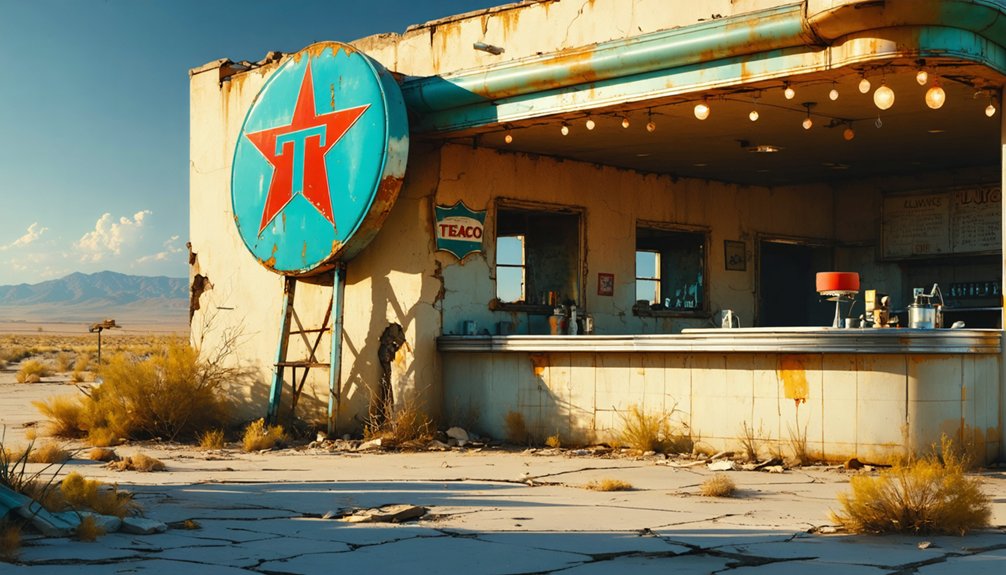
Standing astride the Texas-New Mexico border like a sentinel of mid-century Americana, Glenrio beckons to those seeking authentic remnants of Route 66‘s golden era. This peculiar town—named for a valley and river that ain’t even there—thrived during the heyday of the Mother Road, offering weary travelers their first (or last) taste of Texas.
Y’all can still explore:
- The abandoned 1950 Texaco station with its original pumps, where cars once lined up bumper-to-bumper
- The art moderne-style diner from ’52, its “Last Stop in Texas” sign a silent testimony to border-town ingenuity
- The crumbling Texas Longhorn Motel, where Route 66 nomads once rested before continuing their westward journey
Interstate 40’s arrival in ’73 sealed Glenrio’s fate, transforming bustling Glenrio nostalgia into haunting Route 66 remnants.
Belle Plain College and the Ghost of Education Past
If you’re fixin’ to visit Callahan County, y’all can still spy the weathered stone ruins of Belle Plain College standin’ like ghostly sentinels amid the mesquite.
Founded in 1881 with Methodist ambitions and a dozen grand pianos, this three-story educational beacon once drew 300 students from across the frontier to its classical courses and renowned music program.
Ruins Amid Callahan County
Among the scattered remnants of West Texas’s frontier dreams, the weathered stone walls of Belle Plain College rise from the prairie like silent sentinels of a bygone era. Founded in 1881 by Methodists, this educational bastion once bustled with 300 students just six miles southeast of Baird.
Y’all can still witness the historical preservation of these rectangular stone ruins – now the last whisper of a town established on state school land in 1876.
Three reasons to appreciate Belle Plain College’s educational legacy:
- It represents the church’s pioneering effort to bring learnin’ to frontier folks
- The dense stonework showcases 19th-century buildin’ techniques
- The site remains an essential research resource for historians studyin’ Texas ghost towns
Founded With Grand Dreams
The ambitious dreams of Methodist educators took physical form in 1881 when Belle Plain College opened its doors to just 22 enthusiastic students, a modest beginnin’ that belied the grand vision for this frontier institution.
You’d scarcely believe how quickly those educational aspirations blossomed—within a few years, nearly 300 scholars from across West Texas filled its halls.
The college wasn’t just buildin’s and books; it became the beatin’ heart of community pride, with its renowned music department boastin’ multiple grand pianos that’d impress even city folk.
While townsfolk gathered at the general store, Belle Plain’s intellectual life flourished through classical studies—philosophy, astronomy, and physics—bringin’ high culture to cattle country.
For a brief, shinin’ moment, frontier education reached toward the stars.
Silent Classrooms Revisited
Standing today as silent sentinels of frontier ambition, those weathered stone walls of Belle Plain College tell a powerful story you can’t hear in textbooks.
The silent echoes of its 1881 Methodist founding reverberate through these ruins where once 300 students pursued knowledge beneath a grand cupola.
Three forgotten legacies you’ll discover at Belle Plain:
- The music department’s dozen grand pianos that once filled these halls with melodies
- Students in blue and gray uniforms who marched where you’re standing
- The cultural heartbeat that sustained this frontier town before drought and railroad politics sealed its fate
Y’all can still touch the same stones that witnessed Belle Plain’s rise and fall—a stark reminder that even our grandest educational visions remain vulnerable to fortune’s whims.
How Texas Ghost Towns Were Born: Economic Shifts and Natural Disasters
Tucked within the sprawling Lone Star landscape, Texas ghost towns didn’t simply disappear overnight—they faded slowly as economic tides shifted beneath their foundations.
You’d have seen it yourself if you’d walked Terlingua during its quicksilver heyday—bustling with life until the mines ran dry after WWI.
When the railroads changed course or highways like Route 66 gave way to Interstate 40, towns withered.
Belle Plain’s fate was sealed when the iron horse moved on, drought finished what economics began.
Belle Plain withered as locomotives chose new paths, its parched fields unable to sustain what prosperity had abandoned.
Oil boomtowns flourished then collapsed when black gold stopped flowing.
Without economic resilience or community reinvention, they couldn’t weather the storm.
Sometimes nature delivered the final blow—hurricanes swallowed St. Mary’s of Aransas, while Hagerman now sleeps beneath Denison Dam’s waters.
Cemetery Stories: Whispers From Abandoned Texas Communities
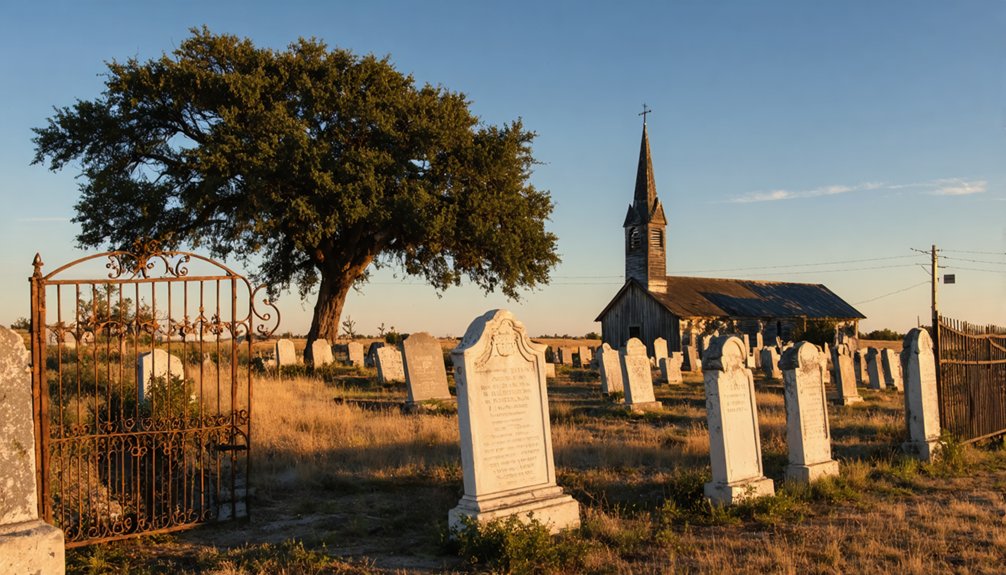
Beneath sunbaked Texas soil, silent chronicles of vanished communities speak through weathered headstones and forgotten plots where you’ll find stories no history book captured.
These sacred grounds—like Terlingua with its folk cemetery art or Springfield’s isolated plots—remain when all other traces have disappeared.
- Wander Camptown Cemetery where runaway slaves once found refuge, now marked with historical markers documenting freedmen’s struggles.
- Discover Terlingua’s unique grave decorations—from metal dinosaurs to personal mementos—tellin’ stories of mercury-poisoned miners.
- Stand at Springfield Cemetery, the lone sentinel of a vanished county seat, where courthouse fires and railroad decisions erased everything but these final resting places.
Y’all are witnessin’ the last chapters of communities that thrived, struggled, and eventually surrendered to time.
Architectural Remnants: What Survives When Towns Disappear
The ghosts of Texas boom towns don’t just whisper through cemetery plots—they speak loudly through weatherbeaten walls and crumblin’ foundations that refuse to surrender completely to time.
You’ll find Fort Leaton’s massive adobe walls standin’ tall as one of the Southwest’s best-preserved fortified structures, while Terlingua’s mercury mining ruins paint a stark picture of boom-and-bust economics.
In Aldridge, nature’s reclaimed the concrete sawmill structures—vines crawlin’ up walls like slow-motion invaders in an endless battle of architectural preservation versus decay.
The four columns at Independence’s original Baylor University site reach skyward like defiant fingers, while Toyah’s high school sits frozen in time, furnishings intact, reportedly haunted by children’s spirits.
Urban decay creates its own beauty in these places—the Wood Mansion and Thurber’s brick remnants remind you that Texans built to last, even when their dreams didn’t.
Seasonal Celebrations: Modern Life in Historic Ghost Settlements
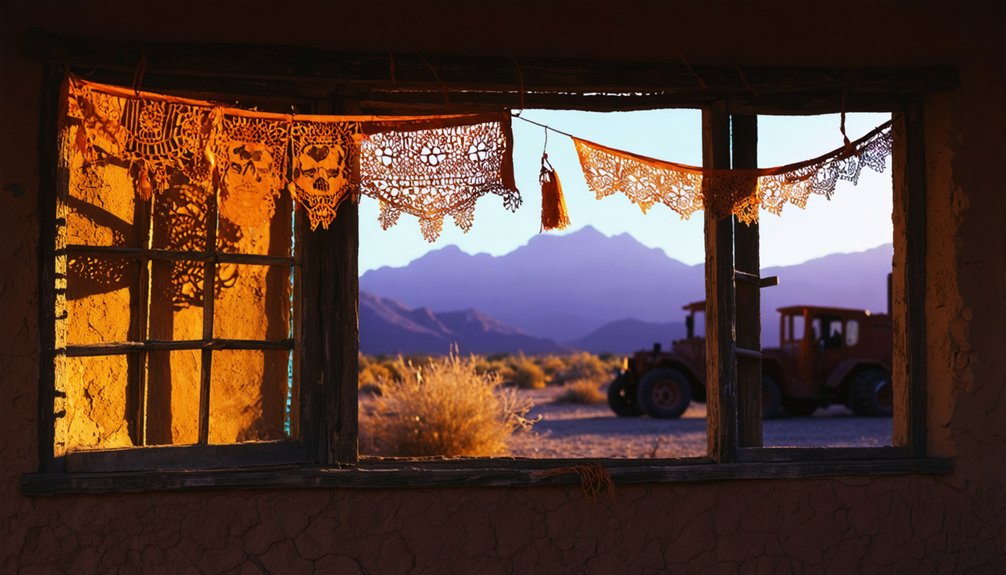
While many ghost towns across Texas have succumbed entirely to time and the elements, several historic settlements stubbornly refuse to become mere footnotes in history books.
These resilient communities maintain their cultural heritage through vibrant seasonal festivities that breathe life into weathered structures.
- Terlingua transforms each November when thousands descend upon this former mining settlement for dueling chili cookoffs, with the Starlight Theatre serving up hearty plates and live music.
- Luckenbach’s dance hall remains one of Texas’s most celebrated venues, where you’ll find guitars playing well past midnight beneath ancient live oaks.
- Medicine Mound preserves its Comanche ceremonial heritage while visitors explore abandoned storefronts with original fixtures still intact, offering glimpses into the town’s vibrant past.
Road Trip Guide: Planning Your Texas Ghost Town Adventure
Planning a ghost town expedition across the vast Texan landscape requires both careful preparation and a willingness to embrace the unexpected turns that any worthwhile adventure demands.
Exploring abandoned towns across Texas can reveal rich histories and stories of resilience. From crumbling storefronts to rusted-out vehicles, each site offers a glimpse into the lives once lived there. Travelers may even encounter relics of the past that ignite the imagination and spark a desire to learn more about the people who called these places home.
Y’all best ready your vehicle for them long stretches ‘tween Terlingua and Glenrio, where gas stations are ’bout as common as rain in August.
For proper ghost town exploration, chart your course along the Ross Maxwell Scenic Drive or the River Road, pathways that’ll lead you through the remnants of Texas’s bygone boom towns.
Consider bunking down in Terlingua’s tipis or historic cabins—authentic stays that honor historical preservation while offering respite from the desert heat.
Come autumn, when the air cools and Día de los Muertos celebrations commence, these abandoned settlements breathe with renewed spirit.
Frequently Asked Questions
Are Texas Ghost Towns Legally Protected as Historical Sites?
Y’all’s ghost towns ain’t fully protected unless they’re on public land. Your private property ghost towns only get legal protections if they’ve got historical significance that triggers federal involvement through Section 106.
Do Paranormal Investigators Frequently Explore These Abandoned Towns?
Ever wonder what lurks in those shadowy corners? Y’all bet they do! Paranormal investigators regularly descend on Texas ghost towns, conductin’ ghost hunting expeditions to document paranormal activity with their fancy equipment and determination.
As they explore the history of abandoned Texas towns, enthusiasts often uncover stories of those who once called these places home. Each decaying building and deserted street whispers tales of a bygone era, inviting speculation about the lives that were lived and the mysteries that remain. With every investigation, they hope to connect with the spirits of the past and shed light on the eerie silence of these forgotten communities.
Explorers often find themselves captivated by the stories behind eerie ruins as they visit the ghost towns of Texas. Each location offers a glimpse into the lives of former residents and raises questions about their untimely departures. As night falls, the atmosphere thickens with a sense of anticipation, urging visitors to uncover secrets long kept hidden in the shadows.
Can Visitors Legally Take Artifacts From Ghost Towns?
No, y’all can’t legally take artifacts. They’re protected by federal and state laws with serious legal repercussions. Best preserve history where it lies, or you’ll find yourself in a heap o’ trouble.
Which Ghost Towns Are Accessible for Mobility-Impaired Tourists?
Y’all won’t find many accessible features in Texas ghost towns. Terlingua and Helena offer some basic mobility options, but they’re still mighty rough. Best to view Glenrio from your wagon instead.
How Have Climate Change Impacts Affected Preservation of Ghost Towns?
You’ll be shocked—billions of gallons lost annually due to aging infrastructure. Climate impacts have accelerated deterioration of Texas ghost towns, creating preservation challenges from hurricanes, floods, and droughts that ravage these fragile historic remnants.
References
- https://www.youtube.com/watch?v=Zd8-gKw-5Hc
- https://texashighways.com/travel-news/four-texas-ghost-towns/
- https://www.hipcamp.com/journal/camping/texas-ghost-towns/
- https://www.frrandp.com/p/ghost-towns-map.html
- https://tpwmagazine.com/archive/2018/jan/wanderlist_ghosttowns/
- https://www.county.org/county-magazine-articles/summer-2025/ghost-towns
- https://www.texasescapes.com/TOWNS/Texas_ghost_towns.htm
- https://www.tripadvisor.com/Attractions-g28964-Activities-c47-t14-Texas.html
- https://mix931fm.com/texas-ghost-towns-history/
- https://www.tshaonline.org/handbook/entries/terlingua-tx