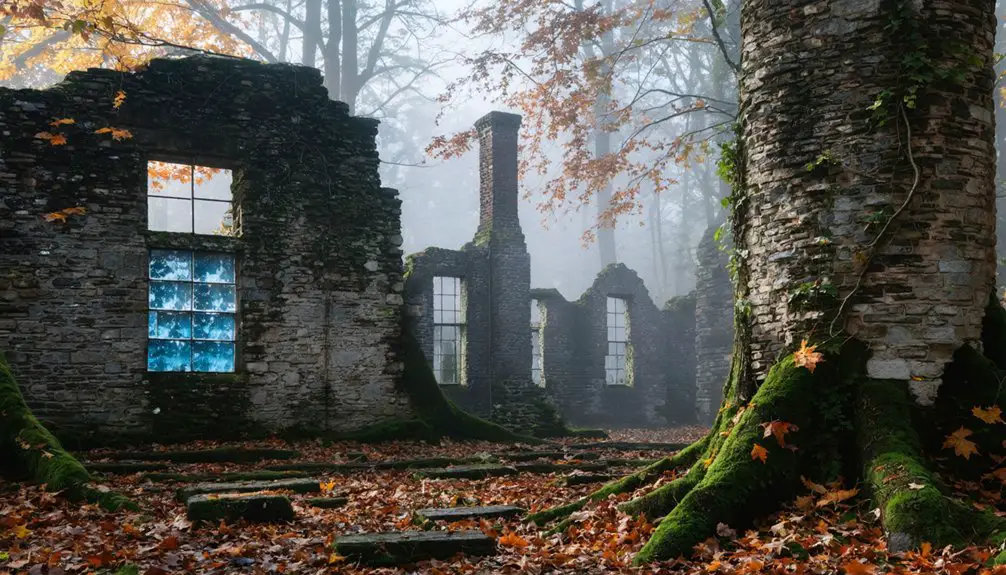
You’ll find at least seven abandoned settlements across Massachusetts where nature has reclaimed communities dating from 1641 through the 1930s. Dogtown on Cape Ann features 75 former homesteads marked by stone foundations and Depression-era boulder inscriptions, while Dana’s Common stands as the sole visible remnant of four towns submerged beneath Quabbin Reservoir’s 412 billion gallons. Two centuries of ecological succession have transformed these sites into hiking trails where cellar holes mark where families once lived, and preserved memorials document what systematic demolition couldn’t erase.
Key Takeaways
- Dogtown, abandoned by 1830, shows nearly two centuries of ecological succession transforming former settlements into wilderness with stone foundations remaining.
- Dana’s buildings vanished beneath greenery within a decade after 1938 disincorporation, now preserved as a historic site above Quabbin Reservoir.
- Stone cellar holes endure as durable archaeological artifacts marking homesites throughout abandoned Massachusetts communities reclaimed by forest growth.
- Hiking trails provide access to ghost towns including Dogtown, Dana Commons, Freetown-Fall River State Forest, and Norton Memorial Forest’s restored landscape.
- Babson Boulders at Dogtown feature 24 Depression-era inspirational slogans carved into glacial erratics along trails connecting former homesteads.
Dogtown: Cape Ann’s 17th-Century Abandoned Settlement
Around 1641, English settlers established the Common Settlement across 5 square miles of Cape Ann’s interior, choosing this inland location for strategic advantages that coastal sites couldn’t provide.
You’ll find this settlement history reveals protection from pirates and harsh weather, though the ecological impact began immediately—settlers harvested pine forests and grazed livestock on land Indigenous peoples had utilized for over 12,000 years.
By the mid-1700s, 75 homes housed more than 100 families who extracted timber, granite, and water resources. The community thrived until wars, resource depletion, and coastal industry growth triggered abandonment. Following the War of 1812, remaining residents were primarily widows and single women, sparking rumors of witchcraft that added to the settlement’s mysterious reputation.
The settlement reached its peak in the 1750s with around 80 affluent families, marking the height of Dogtown’s prosperity before its eventual decline. Today, Roger Babson’s 1930 donation of 1,000 acres ensures the area remains a public park, where remnants of colonial infrastructure like cellar holes and the old mill dam stand as reminders of this once-thriving community.
The Babson Boulders: Depression-Era Messages Carved in Stone
During the Great Depression, you’ll find evidence of Roger Babson’s unemployment relief project throughout Dogtown’s 3,600 forested acres—24 inspirational slogans carved into massive glacial erratics by 35 Finnish stonecutters from Gloucester.
The 1930s inscriptions range from imperative phrases like “Get a Job” and “Keep Out of Debt” to single-word virtues such as “Courage” and “Integrity,” all selected from Babson’s personal “Good Cheer Library.”
These carved messages remain legible today, marking a Works Progress Administration effort that provided wages during economic hardship while creating a permanent trail system connecting numbered cellar holes of former homesteads.
Babson, who founded Babson College and documented Dogtown’s history, envisioned the boulder inscriptions as a way to create a book in stone that would uplift spirits during the depression. Despite family opposition and claims of defacement, he persisted with the project, finding personal satisfaction in the work.
Babson’s Unemployment Relief Initiative
When unemployment in Massachusetts surged from 1.6 million to 12.8 million nationally between 1929 and 1933, Roger Babson—founder of Babson Institute and prominent economic forecaster—commissioned a distinctive relief project in Gloucester’s abandoned Dogtown settlement.
Babson’s philanthropy targeted unemployed stonecutters devastated by the quarrying industry’s collapse, offering skilled work carving inspirational messages into massive boulders scattered throughout the reclaimed wilderness.
This private initiative preceded federal programs like the CCC, embodying economic resilience through productive labor rather than direct cash relief. You’ll find these carved stones enduring as artifacts of 1930s relief creativity, where Babson’s statistical approach to business merged with humanitarian action.
The project preserved traditional stone-carving skills while supporting Gloucester’s workforce, exemplifying local responses before New Deal expansion transformed unemployment relief into a federal responsibility. Unlike public welfare programs of 1929 that provided an average of just $62.50 per recipient annually, Babson’s approach offered skilled employment wages that maintained workers’ dignity and craftsmanship.
While radical political movements advocated for comprehensive unemployment insurance legislation during this period, Babson’s project represented a capitalist alternative that emphasized self-reliance through work opportunities.
Inspirational Messages Still Legible
Deep within Dogtown’s 3,600 acres of reclaimed forest, approximately three dozen granite boulders bear Roger Babson’s Depression-era philosophy carved into their weather-resistant surfaces.
You’ll encounter twenty-four distinct slogans—ranging from single-word commands like “Courage,” “Loyalty,” and “Truth” to complete directives such as “If Work Stops, Values Decay” and “Prosperity Follows Service.” These inspirational legacies remain remarkably legible nearly a century later, their incised letters resisting New England’s harsh weathering cycles.
The boulders’ cultural significance transcends Babson’s original unemployment relief intent.
They’ve transformed Dogtown’s maze of footpaths into something resembling an outdoor philosophical gallery, where hikers bushwhack through dense scrub to discover stone-carved wisdom emerging from overgrown clearings. Babson consulted his “Good Cheer Library” to select the motivational phrases that would be permanently etched into the granite. The project served as part of the Works Progress Administration, providing employment to stonecutters during the economic crisis.
What Babson’s family condemned as defacement now stands as Massachusetts’ most unusual Depression-era monument—permanent testimony to one eccentric millionaire’s conviction.
Dana: The Town That Survives Above the Quabbin Reservoir
When the Massachusetts Water Department disincorporated Dana in 1938 to create the Quabbin Reservoir, you’ll find it differed from the other three sacrificed Swift River Valley towns in one essential way: Dana Common remained above the waterline.
The reservoir displaced over 2,000 residents across four municipalities between 1922 and 1938, systematically demolishing homes and relocating graves before filling began on August 14, 1939.
You can still access this preserved archaeological landscape today, where 19th-century land use patterns survive as tangible evidence of the community that once served as Worcester County’s institutional center in the Swift River Valley. Originally incorporated in 1801 from parts of Greenwich, Hardwick, and Petersham, Dana thrived as an agricultural community with soapstone quarrying operations that contributed to its economic foundation.
The town’s population peaked at 876 in 1860, when commercial activity flourished around the Common at the intersection of five roads.
Disincorporation for Reservoir Creation
As Boston’s water demands intensified following the Wachusett Reservoir’s completion in 1905—which had already displaced 1,700 residents—engineers turned their attention westward to the Swift River Valley.
You’ll find the disincorporation impacts began with the 1927 Swift River Act, which appropriated funds and sealed four towns’ fate. Dana, Enfield, Greenwich, and Prescott ceased to exist in April 1938. Dana’s last town meeting occurred that March; its final resident departed by year’s end.
The reservoir implications were staggering: over 2,000 people displaced, 6,600 graves relocated to Quabbin Cemetery, and entire communities erased.
Above-Water Remnants Remain
Unlike its three companion towns, Dana’s institutional center survived the reservoir’s creation through fortunate geography.
You’ll find Dana Common positioned above the reservoir’s flow line on the East Branch of Swift River—elevation that spared it from the flooding that claimed Enfield, Greenwich, and Prescott.
This preserved landscape tells Dana history through archaeological remnants of 19th-century town organization.
What you can witness at Dana Common:
- The most accessible pre-Quabbin village site, where freedom to explore connects you directly to displaced communities
- Best-preserved institutional remnants among Swift River Valley’s lost towns
- Quabbin ecology reclaiming former streets and foundations through seven decades of forest succession
- Protected shoreline trails threading through 120,000 watershed acres—your portal into Massachusetts’ submerged past
Accessing Dana Commons Today
Seven decades of forest succession have transformed Dana Common from institutional center to ecological archive, yet the site remains the most accessible window into Swift River Valley’s pre-reservoir settlement patterns.
You’ll find this archaeological landscape positioned above Quabbin Reservoir‘s flow line—the geographic detail that prevented its inundation when filling began August 14, 1939. Access requires traversing numbered gates along Quabbin’s perimeter, though gates 17-21 remain off-limits.
The preservation isn’t intentional monument-building; it’s accidental geography meeting bureaucratic neglect. What you’re walking through when you visit Dana Commons isn’t reconstruction—it’s original townscape frozen at 1938’s disincorporation.
Stone foundations, cellar holes, and road traces persist beneath second-growth forest, offering unmediated encounter with settlement patterns that Metropolitan District Commission’s eminent domain erased elsewhere.
Four Towns Sacrificed: The Creation of Quabbin Reservoir

When metropolitan Boston’s population surged beyond what Wachusett Reservoir could supply in the 1930s, state planners identified the Swift River Valley as the solution—a decision that would erase four towns from the map.
The Swift River Act of 1927 appropriated funds and granted eminent domain authority, sealing the fate of Dana, Enfield, Greenwich, and Prescott.
With a single legislative act, four communities received their death sentence—erased by law before water ever rose.
What was destroyed for Quabbin history and water supply:
- 2,500 residents forcibly displaced from ancestral homes
- All structures razed—churches, schools, homes turned to ash
- 6,600 graves excavated and relocated to Quabbin Cemetery
- Entire forests clearcut before 412 billion gallons flooded the valley
Construction spanned 1936-1946, creating what became the world’s largest man-made reservoir, now serving three million people through gravity-operated infrastructure.
Greenwich, Enfield, and Prescott: Communities Now Underwater
Of the four towns condemned for Quabbin Reservoir, Greenwich, Enfield, and Prescott now rest beneath 412 billion gallons of water, their streets and structures completely submerged.
You’ll find only Dana Common remains above the waterline, managed as a historic site where you can walk old roads leading to the reservoir’s edge.
These underwater communities vanished systematically—buildings demolished, vegetation stripped to bare earth, creating what witnesses described as “a moonscape” before flooding began in 1939.
The reservoir took seven years to fill, completing its erasure by 1946.
While gravestones were relocated to preserve historical memory, the towns themselves became Massachusetts’ most extensive sacrifice to infrastructure.
From Enfield Lookout, you’ll see only water where entire neighborhoods once thrived.
How Nature Reclaims Abandoned Settlements in Three Decades
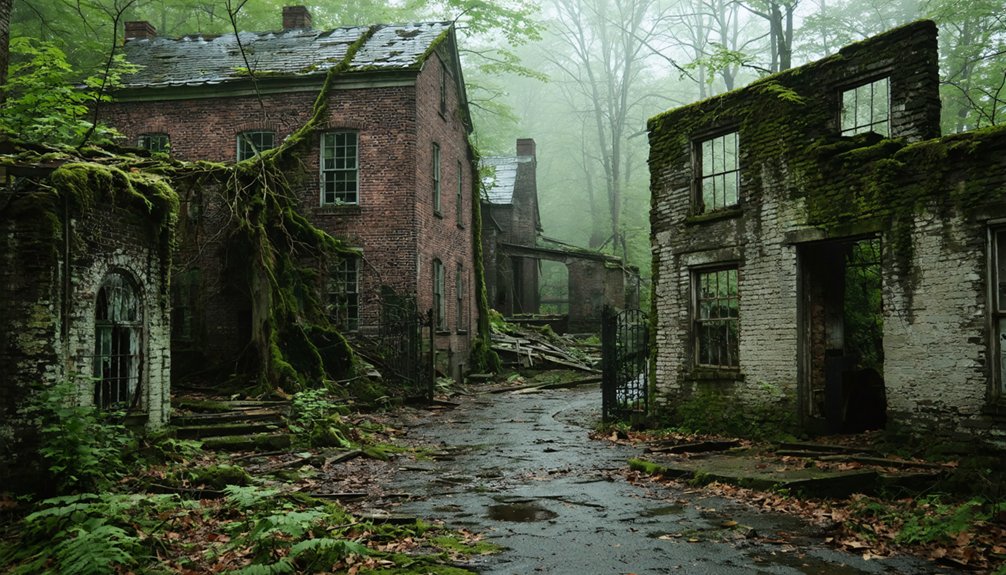
Nature’s reclamation of abandoned Massachusetts settlements follows predictable ecological succession, though human intervention can accelerate or redirect the process dramatically.
Vegetation recovery timelines across Massachusetts ghost towns:
- Dogtown’s gradual transformation: Nearly two centuries of natural succession since 1830 abandonment created thriving woods and trails you’ll explore today.
- Dana’s rapid concealment: Razed buildings in 1939-1940 disappeared beneath greenery within a decade, roads vanishing into overgrowth.
- Catamount’s mid-century shift: Early 20th-century abandonment became state forest by 1967, roads deteriorating as forest growth consumed infrastructure.
- Norton Memorial Forest’s accelerated ecological restoration: Thousands of planted trees and ferns boosted biodiversity beyond natural succession rates.
When settlements lose human maintenance, pioneering plants colonize within months.
Without interference, hardwood forests reclaim cleared land, wetlands expand, and wildlife returns—transforming former communities into accessible wilderness preserves.
Stone Foundations and Cellar Holes: What Remains Behind
Throughout Massachusetts ghost towns, stone cellar holes persist as archaeology’s most durable artifacts—outlasting wooden structures, metal implements, and human memory itself.
Your cellar exploration reveals distinct construction signatures: Dana’s stream-smoothed stones, West Rutland’s cement-block porch supports with four-stud configurations, and Dogtown’s numbered foundations mapped during the Great Depression.
Foundation history tells migration patterns—dense clusters abandoned during 1840s westward movements left moss-covered walls enclosing tight farming plots.
You’ll find fireplace remnants with nine-plus cement blocks, filled wells, and secret rock rooms hidden within structures.
Davis Mining Village’s 150 cellar holes from 1911’s collapse demonstrate industrial abandonment, while Monson Center preserves original Gould and Wallingford family foundations.
Stone-retaining walls resist razing efforts, creating permanent records of communities erased by reservoirs, economic collapse, and voluntary exodus.
Hiking Trails Through Massachusetts’ Ghost Town Landscapes

These stone remnants now serve as waypoints along established trail systems that transform archaeological sites into accessible wilderness corridors.
You’ll navigate terrain where nature’s reclaim has erased civilization, creating landscapes perfect for those seeking ghostly encounters beyond institutional boundaries.
Four trails offering temporal freedom through Massachusetts’ abandoned settlements:
- Dogtown Trails – 3,600 acres threading through 100-family settlement ruins, where Depression-era boulders carved with “Courage” mark Cornelius Finson’s 1830 removal to poorhouse.
- Dana Commons – Broken 1930s asphalt leading to submerged Quabbin towns with street signs pointing toward reservoir-drowned edges.
- Freetown-Fall River State Forest – “Most Haunted Forest in America” with supernatural legends amid dense canopy.
- Becket Quarry – 200-year-old mining ruins where forest reclaims industrial history.
Public Access to Abandoned Historical Sites
You’ll find that Massachusetts’ abandoned historical sites exist within a complex framework of access restrictions determined by ownership status, structural integrity assessments, and preservation designations.
Former settlements accessible through state park systems like Rutland Prison Camp contrast sharply with closed psychiatric facilities where building entry constitutes trespassing despite permissible exterior grounds exploration.
These access gradations—from fully open hiking destinations with interpretive markers to completely restricted properties requiring special permits—reflect evolving legal standards governing public interaction with decaying infrastructure across two centuries of New England’s settlement patterns.
Trails Through Former Settlements
- Dana Common reveals an entire submerged town center through 1.8 miles of walking-only road.
- Prescott’s 6-mile loop exposes displaced community remnants beneath reclaimed hardwood forest.
- Monson Center’s colonial home sites span three miles of original settlement roads.
- Chester Hudson Quarry demonstrates industrial abandonment overtaken by 200 years of forest regrowth.
These paths require no permits—just respect watershed restrictions and leave historical artifacts undisturbed.
Preservation Markers and Memorials
Massachusetts preserves its abandoned settlements through physical markers that transform inaccessible histories into tangible waypoints. The 1930 Tercentenary Commission installed 275 markers commemorating colonial moments, though many have vanished—Essex County lost 43 of its 83 originals by 2011.
You’ll find marker significance extends beyond commemoration; they’re contested narratives requiring active preservation. Arlington restored corroded markers in 2019, while Gloucester revived four sites through 2025.
At Dana’s ghost town, memorials mark foundations along pedestrian-only Old Dana Road. Dogtown’s numbered cellar holes and Babson’s inscribed boulders guide you through vanished neighborhoods.
These markers don’t offer thorough historical narratives—they present colonial perspectives that obscure indigenous and alternative viewpoints. Restoration efforts acknowledge both preservation needs and interpretive limitations in documenting disappeared communities.
Restricted Versus Open Access
When abandoned settlements cross legal boundaries between public and private domains, access becomes a patchwork of statutory permissions and physical barriers.
You’ll find restricted pathways marked by stone walls and “No Trespassing” signs where easements dissolved through decades of non-use. Meanwhile, open routes persist through statutory private ways that retain public access rights without full municipal maintenance.
Your navigation depends on:
- Whether discontinuance proceedings preserved cemetery access under MGL c. 114, § 17
- If alternative routes replaced original pathways since 1914
- When towns abandoned easements through silent acquiescence to property alterations
- Whether permanent markers at road termini still guide your passage
These ghost settlements exist in legal twilight—neither fully public nor entirely forbidden—where historical preservation confronts property sovereignty.
Preservation Efforts and Memorial Markers in Reclaimed Towns
As ghost towns across Massachusetts returned to nature, deliberate preservation efforts transformed abandoned settlements into documented public spaces.
You’ll find Roger Babson’s 1927 preservation strategies at Dogtown, where he numbered 1,150 acres of cellar holes and commissioned Depression-era stonecutters to inscribe boulders with enduring wisdom. These markers remain legible today, guiding you through vanished neighborhoods.
At Dana Common, memorials identify foundations of the schoolhouse, town hall, and hotel—structures razed by 1940 for Quabbin Reservoir. The memorial significance extends beyond nostalgia; stone walls built from local stream stones persist despite demolition efforts.
Former NASA physicist contributions created Norton Memorial Forest, while Dr. Robert Lehman’s Questing farmstead became protected reservation land.
You’re granted pedestrian access through maintained trails, experiencing documented history reclaimed by hardwood forests and wetlands.
Frequently Asked Questions
Are There Any Other Ghost Towns in Massachusetts Besides These?
Yes, Massachusetts contains over 20 documented forgotten settlements beyond these four counties. You’ll discover historical landmarks scattered across Hampshire, Worcester, and Plymouth counties, where abandoned communities vanished between 1750-1950 due to economic shifts and environmental pressures.
Can You Visit the Submerged Towns When Water Levels Are Low?
You can’t access fully submerged towns like Enfield or Greenwich during low water, but Dana’s higher elevation permits year-round submerged exploration of foundations and cellar holes, preserving their historical significance through visible remnants above the waterline.
Were Residents Compensated When Forced to Leave Their Homes?
Compensation policies varied dramatically across ghost towns. You’ll find Quabbin residents received minimal eminent domain payments—reportedly pennies per dollar—while Dogtown’s displaced outcasts experienced forced removal without compensation, dying in poorhouses or relocating independently.
What Happened to the Cemeteries in the Abandoned Towns?
Out of sight, out of mind—most cemeteries were relocated before flooding, though you’ll find some graves weren’t moved. Cemetery preservation balanced historical significance against progress, leaving abandoned burial grounds nature now reclaims in these forsaken Massachusetts settlements.
Is It Legal to Remove Artifacts From These Ghost Towns?
You can’t legally remove artifacts without permits due to artifact preservation laws protecting state-owned properties. These ghost towns hold historical significance—you’ll need BUAR authorization or must qualify under Isolated Finds exceptions to retain any recovered items.
References
- https://travelnoire.com/abandoned-town-in-northern-massachusetts
- https://historyofmassachusetts.org/ghost-towns-massachusetts/
- https://www.youtube.com/watch?v=NrBWmYUnqPM
- https://www.outoftheoffice4good.com/post/hiking-to-the-abandoned-town-of-dana-massachusetts
- https://www.atlasobscura.com/things-to-do/massachusetts/abandoned
- https://www.bbcearth.com/news/abandoned-places-reclaimed-by-nature
- https://www.geotab.com/ghost-towns/
- https://www.tripadvisor.com/Attractions-g28942-Activities-c47-t14-Massachusetts.html
- https://www.bostonhiddengems.com/blog/dogtown-ma
- https://babsonassoc.org/indegeneous-presence-dogtown/