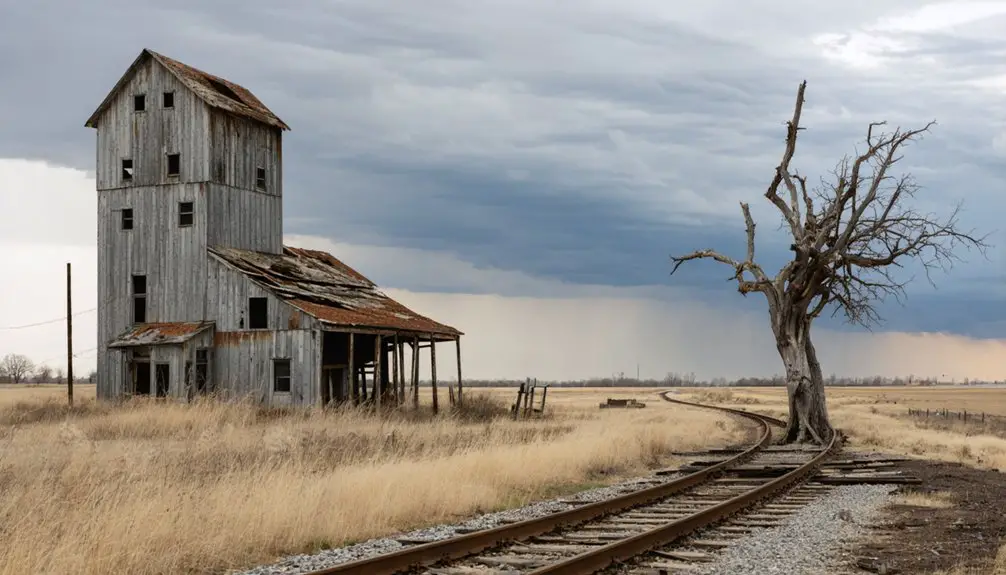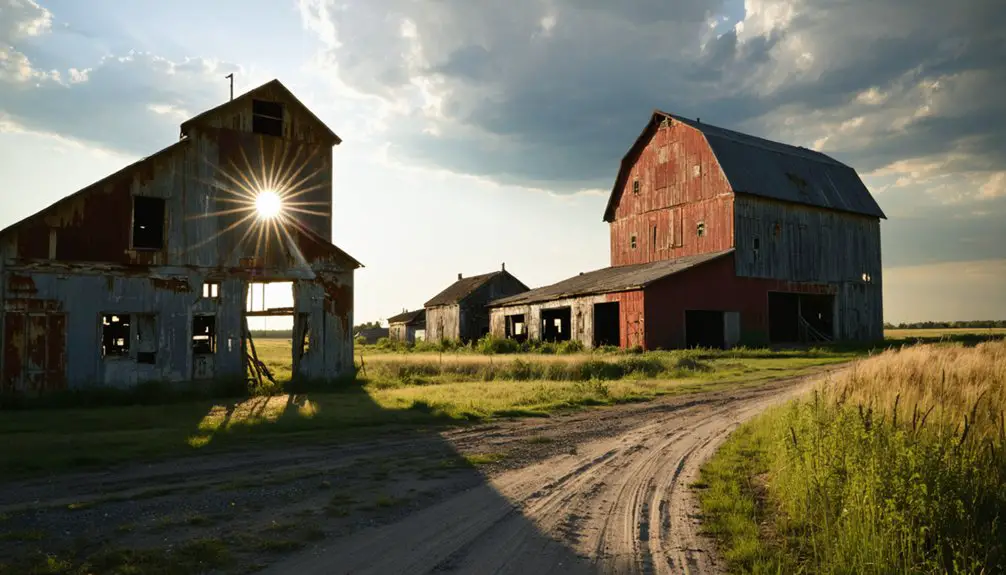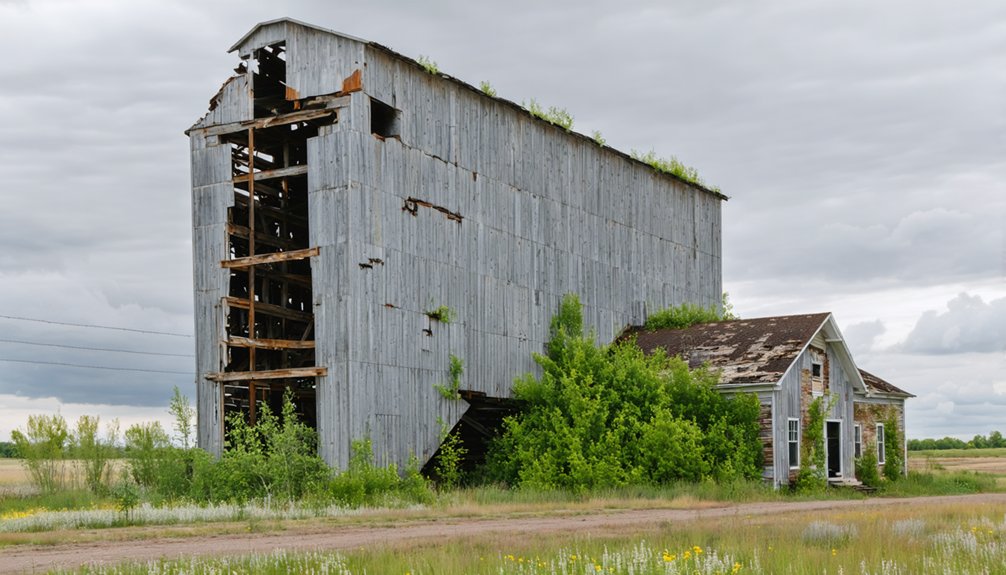
Minnesota’s abandoned settlements reveal how quickly nature erases human presence. You’ll find Forest Center, a 1949 logging town near Lake Isabella that extracted 100,000 cords annually before the 2011 Pagami Creek Fire destroyed its last foundations. Banning State Park’s quarry town thrived with 300 residents by 1896 before vanishing by 1912, now reclaimed along the 1.8-mile Quarry Loop Trail. Taconite Harbor’s 1957 prefab community declined in the 1980s, leaving rusted streetlights among encroaching wilderness. These sites demonstrate nature’s persistent reclamation of what we’ve built and abandoned.
Key Takeaways
- Banning State Park’s 1.8-mile Quarry Loop Trail showcases nature reclaiming the former quarry town abandoned in 1912.
- Forest Center’s remaining foundations were destroyed by the 2011 Pagami Creek Fire, accelerating nature’s reclamation along Lake Isabella.
- Mineral Center’s foundations now blend seamlessly with natural forest growth after the Grand Portage Tribe reclaimed the land.
- San Francisco at Carver Rapids site transformed into farmland and parkland after residents abandoned it due to repeated flooding.
- Taconite Harbor features rusted streetlights and crumbling infrastructure being overtaken by nature following 1980s industry collapse.
Banning State Park: From Bustling Quarry to Forest Wilderness
When the St. Paul and Duluth Railroad laid tracks to this remote outcrop in 1892, they sparked a quarry history that would birth and destroy a town within two decades.
You’ll find Banning’s ghost town legacy etched into abandoned sandstone walls, where 500 workers once chiseled pink stone for distant cities. The settlement peaked at 300 residents by 1896, supporting bars and boarding houses until depleted reserves and steel’s rise killed operations by 1905.
The asphalt company’s 1912 closure erased the town entirely.
Today, you’re free to explore nature’s reclamation along the 1.8-mile Quarry Loop Trail, where lush forests consume drill holes and rock crushers—reminders that wilderness ultimately reclaims what humanity temporarily borrows. The park’s terrain sits atop a natural geological fault that extends 10,000 feet thick beneath the surface. The Pine County Historical Society championed the preservation of this ghost town site, successfully advocating for state park status in 1959.
Forest Center: Erased by Time and Fire
Deep in Lake County’s wilderness, the Tomahawk Timber Company carved Forest Center from virgin forest in 1949, establishing a self-contained logging community along Lake Isabella’s southern shore.
From untouched wilderness emerged Forest Center in 1949, a self-contained logging town born of industry and isolation along Lake Isabella’s remote shores.
You’ll find scant trace of the 250 souls who once inhabited this remote settlement, accessible only via unmarked roads 40 miles from Ely. For fifteen years, workers extracted over 100,000 cords annually, building homes with white picket fences and weekend baseball games—a logging legacy that shaped these woods.
When timber ran out in 1964, nature reclaimed what humans had borrowed. The community once boasted a school, general store, post office, and two churches serving its isolated population. Like other vanished settlements, workers received payment in store credit, binding them to the company in cycles of debt. The 2011 Pagami Creek Fire obliterated remaining foundations, erasing even community memories.
Today, only BWCA entry signs hint that families once thrived here, their footprints vanished beneath regenerated forest.
Mineral Center: Tourism Hub Lost to the Wild
While Forest Center yielded to timber economics, Mineral Center‘s fate took a different turn—one driven by sovereignty rather than scarcity.
You’ll find this Cook County settlement’s homestead stories begin with the Linnell family’s 1909 arrival, verifying mineral deposits fifteen miles inland from Hovland. By 1930, 350 residents sustained three schools, a church, and thriving commerce built on mineral memories and fish-rich rivers.
The 1913 wildfires tested their resolve, but governmental action sealed their destiny. In 1940, federal authorities purchased these homesteads, returning the land to the Grand Portage Tribe—reversing the Nelson Act’s 1889 dispossession.
Unlike resource-depleted towns, Mineral Center didn’t fade gradually. It vanished through policy, its tourism hub status erased as wilderness reclaimed what sovereignty restored. Buildings and homes were relocated or dismantled, their materials scattered as the settlement returned to forest. Today, natural reclamation creates a blend of architecture and nature where forest growth intertwines with the few remaining foundations.
San Francisco at Carver Rapids: Swallowed by Floods and Forgotten
Unlike Mineral Center’s policy-driven erasure, San Francisco met its end through elemental forces that wouldn’t negotiate.
William Foster’s 1854 settlement below the Minnesota River rapids seemed promising—it claimed county seat status by 1855, established schools, and built commercial infrastructure.
But you can’t bargain with geography. The historical significance of being Carver County’s first administrative center vanished when officials relocated to Chaska in 1856, recognizing what locals already knew: the rapids created impossible conditions.
Spring flood impacts devastated the town repeatedly throughout the 1860s, with the 1863 deluge washing away Foster’s warehouse and multiple structures.
After a decade of fighting rising waters, residents surrendered.
Today, farmland and parkland occupy where Minnesota’s brief San Francisco once stood, its ambitions drowned beneath seasonal currents.
Taconite Harbor: Vanished Community on Lake Superior’s Shore
When Erie Mining Company trucks delivered twenty-two prefabricated homes along Highway 61’s shoreline in 1957, the construction crews assembled each structure in roughly two hours—an industrial efficiency that perfectly matched the company’s ambitions for its new taconite shipping facility.
The harbor thrived for three decades, shipping 10 to 11 million tons annually to Detroit and eastern steel mills. Families enjoyed affordable housing at $400 down and $100 per month, creating a vibrant neighborhood that peaked with 74 children. Life in the company town came with industrial side effects, including taconite dust that turned laundry hanging outside a distinctive red color. This taconite history abruptly ended when 1980s industry collapse triggered community decline.
Three decades of prosperity vanished when steel industry collapse transformed a bustling taconite harbor into an abandoned relic.
By 1986, Erie Mining issued eviction notices to the final 21 families, offering homes for one dollar if relocated.
Today you’ll find only rusted streetlights, crumbling basketball courts, and vegetation consuming the settlement. Nature’s reclamation accelerates as Lake Superior’s forest systematically erases what corporate efficiency once built.
Frequently Asked Questions
Are There Any Safety Concerns When Visiting These Abandoned Ghost Town Sites?
Yes, you’ll face significant dangers from structural collapse, environmental contamination, and unstable ground. Follow safety precautions and visitor guidelines carefully—archival sources document centuries of nature reclaiming these sites through decay and overgrowth.
Can Artifacts or Relics Be Legally Collected From These Reclaimed Ghost Towns?
No, you can’t legally collect anything—ironic for freedom-seekers. Minnesota’s artifact preservation laws and relic legality regulations protect ghost town remnants on state, federal, and private lands, ensuring future generations witness humanity’s footprints gradually returning to nature.
What Wildlife Species Now Inhabit These Former Minnesota Ghost Town Locations?
You’ll find diverse wildlife observations across these sites—white-tailed deer, black bears, bald eagles, bats, and river otters thrive here. These species adaptations demonstrate nature’s remarkable resilience, transforming human settlements into unrestricted wilderness where wildlife now roams freely.
Are Guided Tours Available for Exploring Minnesota’s Nature-Reclaimed Ghost Towns?
You’ll find guided explorations through Cook County Historical Society’s resources, though most sites lack formal tours. These ghost towns whisper through forest shadows—you’re free to discover historical insights independently using archival maps and educational materials they’ve preserved.
How Do Minnesota Ghost Towns Compare to Abandoned Sites in Other States?
Minnesota’s ghost town history shows slower, gentler nature reclamation compared to rapid Western abandonment. You’ll find preserved parks and ongoing human-nature interaction here, unlike completely vanished sites elsewhere—offering you authentic exploration without restrictions or barriers.
References
- https://www.cbsnews.com/minnesota/news/how-a-ghost-town-was-turned-into-a-minnesota-state-park/
- https://exploringnorthshore.com/north-shore-ghost-towns/
- https://www.fws.gov/story/ghost-town-carver-rapids
- https://thievesriver.com/blogs/articles/ghost-towns-in-minnesota
- https://www.cascadevacationrentals.com/6953/taconite-harbor-a-ghost-town/
- https://quickcountry.com/minnesota-ghost-towns/
- https://www.youtube.com/watch?v=SK_qpflb_ao
- https://kroc.com/9-strange-ghost-towns-within-100-miles-of-rochester-minnesota/
- https://www.carvercountyhistoricalsociety.org/ghost_towns.php
- https://en.wikipedia.org/wiki/Banning_State_Park