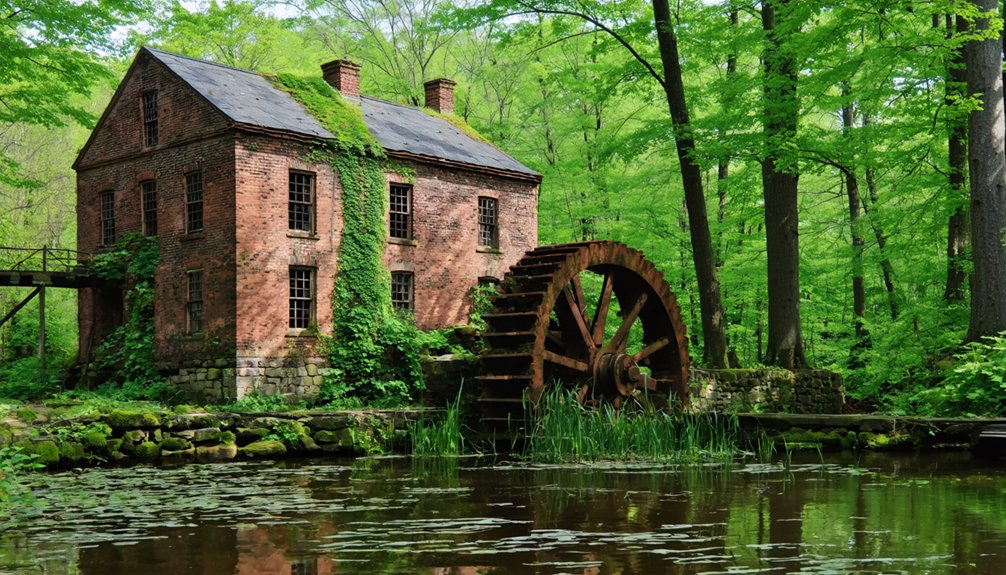
You’ll find Rhode Island’s ghost towns quietly disappearing beneath forest canopies, where nature’s reclaimed what humans abandoned. Fort Wetherill‘s military fortifications, decommissioned in 1946, now crumble under coastal erosion and creeping vegetation across 61.5 acres. Meanwhile, Hanton City—a colonial settlement that vanished between 1800-1850—hides stone foundations, cellar holes, and quarry scars beneath dense woodland in Smithfield. Nearly two centuries of ecological succession have transformed these sites, leaving only stone remnants as wooden structures rotted away. The stories behind their abandonment reveal fascinating patterns of disappearance.
Key Takeaways
- Hanton City, a colonial settlement in Smithfield, was abandoned between 1800-1850 and is now hidden beneath dense woodland.
- Fort Wetherill State Park, decommissioned in 1946, shows coastal erosion and vegetation growth reclaiming military fortifications since 1972.
- Stone foundations, cellar holes, and quarry scars remain visible at Hanton City after wooden structures rotted away.
- Nearly two centuries of ecological succession transformed Hanton City from a thriving settlement into overgrown wilderness with crumbling remnants.
- Former military routes at Fort Wetherill became hiking trails as nature reclaimed the 61.5-acre decommissioned military site.
Fort Wetherill State Park: A Military Outpost Surrendered to the Wild
Where Narragansett Bay’s East Passage narrows between Conanicut Island and Newport, Fort Wetherill‘s concrete gun emplacements still grip the 100-foot granite cliffs they’ve occupied since 1899.
You’ll find 61.5 acres where military history surrendered to nature after the fort’s 1946 decommission. The massive Endicott-period fortifications—once camouflaged observation towers, ammunition bunkers, and communication networks—now stand exposed to coastal erosion and reclamation.
Graffiti-covered tunnels wind through structures that trained artillery spotters and housed German POWs during two World Wars. Since Rhode Island acquired this abandoned outpost in 1972, vegetation’s consumed what concrete can’t resist.
Where military precision once reigned, nature and graffiti artists now collaborate in reclaiming concrete corridors from their regimented past.
The trails you’ll hike follow old military routes where surveillance once dominated these strategic heights. Scuba diving clubs from across the Northeast now explore the underwater terrain below these former defense positions. Tram tracks still visible in the mine storehouse area once transported naval mines to Narragansett Bay during both World Wars. It’s freedom reclaimed from regimentation, wildness restored to engineered control.
Discovering Hanton City: Rhode Island’s Hidden Colonial Settlement
Deep in Smithfield’s oak and maple forests, stone foundations mark coordinates where thirty families built lives between 1730 and 1900—a settlement that vanished so completely locals rechristened it “Haunted City.”
Hanton City’s erasure from Rhode Island’s landscape happened gradually, documented only through cemetery records at Alfred Smith’s burial ground and the Paine, Hanton, and Shippee family names in colonial land grants.
You’ll find tanners’ workshops reclaimed by undergrowth along Hanton City Trail, their colonial heritage preserved in crumbling walls rather than museum displays.
The settlement’s historical significance extends beyond verified records—theories suggest it sheltered Loyalists, escaped slaves, or disease-afflicted outcasts.
Whether these narratives hold truth matters less than what remains: proof that established communities can dissolve entirely, leaving only stones and speculation.
Residents survived through bartering goods and services, trading handcrafted boots and tanned leather in Providence’s markets when cash remained scarce.
By the late 1800s, overgrowth and swampy conditions rendered the area uninhabitable, forcing the final residents to abandon their homes to the encroaching wilderness.
The Mystery Behind Hanton City’s Disappearance
While Providence Journal reporters chronicled Hanton City‘s existence through three distinct articles spanning 1889 to 1937, they couldn’t pin down why thirty families abandoned functional homesteads between 1800 and 1850.
Hanton history reveals competing abandonment theories that range from documented economic collapse to sensational folklore. You’ll find the most credible explanation centers on poverty—residents simply sold their properties and died off as trade routes shifted toward newer highways connecting Providence and Woonsocket.
Yet wilderness breeds speculation. Stories persist about mysterious plagues decimating the population and mass alien abductions erasing entire bloodlines overnight.
The timeline itself debunks later myths linking the site to Civil War trauma or asylum scandals, which occurred decades after empty foundations already dotted these woods beneath gathering canopies. The settlement’s prosperity had once relied on stone quarries and handmade shoe production before factory mechanization displaced the remaining workers. The town was founded by three families—the Paines, Hantons, and Shippees—who established the community around 1776.
Stone Foundations and Forgotten Structures Beneath the Canopy
The theories matter less than what survives.
When you walk Hanton City’s trails today, you’ll find stone structures speaking directly across centuries—foundations marking where families built lives, cellar holes preserving domestic architecture, and quarry scars recording labor.
These aren’t decorative remnants; they’re functional infrastructure: wells still standing open, steps descending into earth, corn cribs scattered among trees.
Stone walls divide properties that exist only in memory now. The forest hasn’t erased this settlement—it’s suspended it.
You’ll trace kitchen cellars, burial sites, even a defunct dam, all testifying to organized colonial enterprise. Similar preservation efforts exist throughout New England, including the Blackstone River Valley National Heritage Corridor, where cultural and historical heritage receives institutional protection.
Historical preservation here isn’t institutional; it’s geological. The stones outlasted everything else, creating an archive you navigate physically rather than read. Access to these sites often requires hiking or walking, as many of Rhode Island’s ghost towns are embedded in rural areas where nature continues its gradual reclamation.
Nature’s Patient Conquest of Rhode Island’s Abandoned Places
Since Hanton City’s desertion in the early 1800s, nearly two centuries of ecological succession have systematically dismantled what human hands built.
You’ll witness nature’s methodical reclamation process where wooden structures rotted completely, leaving only stone foundations as skeletal remains. Trees sprouted only after buildings collapsed, transforming settled land into dense Smithfield woodland.
This isn’t typical urban decay—it’s ecological restoration erasing human presence entirely.
The forest’s patient conquest created a landscape where you’ll navigate overgrown paths to discover crumbling cellars, deteriorating dams, and uncovered wells.
Stone walls and quarry markings persist as defiant monuments against nature’s advance. The water table has shifted dramatically over the years, as human development altered natural drainage patterns and runoff throughout the abandoned settlement.
At Fort Wetherill’s 61.5 acres, you’ll observe similar patterns: unmaintained trails threading through abandoned structures, demonstrating how Rhode Island’s wilderness steadily reclaims territory once controlled by colonial settlement. 100-foot cliffs now overlook Narragansett Bay where military fortifications once stood guard.
Frequently Asked Questions
Are There Other Ghost Towns in Rhode Island Besides Hanton City?
You’ll discover Rocky Point Amusement Park, Fort Wetherill, and Napatree Point among Rhode Island’s abandoned settlements beyond Hanton City. Each site reveals historical significance through crumbling foundations, where nature reclaims human ambition, transforming structured civilization into wilderness.
Is It Legal to Explore Fort Wetherill and Hanton City Ruins?
Fort Wetherill’s legally accessible as public parkland, though you’ll navigate hazards at your own risk. Hanton City lacks documented exploration laws governing urban exploration—verify current regulations through state authorities before venturing into these reclaimed wilderness zones.
What Safety Precautions Should Visitors Take When Exploring These Sites?
You’ll need proper safety gear including sturdy boots, flashlights, and first aid supplies. Practice wildlife awareness in overgrown areas, maintain clear exit paths through unstable structures, and respect the temporal boundaries where nature’s reclaiming human history.
Can You Camp Overnight at Fort Wetherill State Park?
No, you can’t camp overnight at Fort Wetherill—it’s a day-use park. Ironically, while nature reclaims abandoned spaces, camping regulations restrict your freedom here. Explore nearby park amenities at Fishermen’s Memorial or Burlingame campgrounds instead.
Are Guided Tours Available for Hanton City’s Colonial Ruins?
No formal guided exploration exists for Hanton City’s colonial ruins. You’ll navigate independently through wooded terrain to discover the historical significance of these 1600s-era foundations, experiencing unmediated encounters with archaeology that rewards your self-reliant spirit.
References
- https://www.onlyinyourstate.com/experiences/rhode-island/abandoned-and-reclaimed-by-nature-ri
- https://www.youtube.com/watch?v=kpy7zlXYrAU
- https://en.wikipedia.org/wiki/Hanton_City
- https://weird-island.simplecast.com/episodes/57-ghost-town-hanton-city-ky53imy0
- https://smithapplebyhouse.org/arethereghosts/
- https://www.youtube.com/watch?v=qKrO3QlnbY4
- https://riparks.ri.gov/parks/fort-wetherill-state-park
- https://en.wikipedia.org/wiki/Fort_Wetherill
- https://artinruins.com/property/fort-wetherill/
- https://www.tclf.org/landscapes/fort-wetherill-state-park