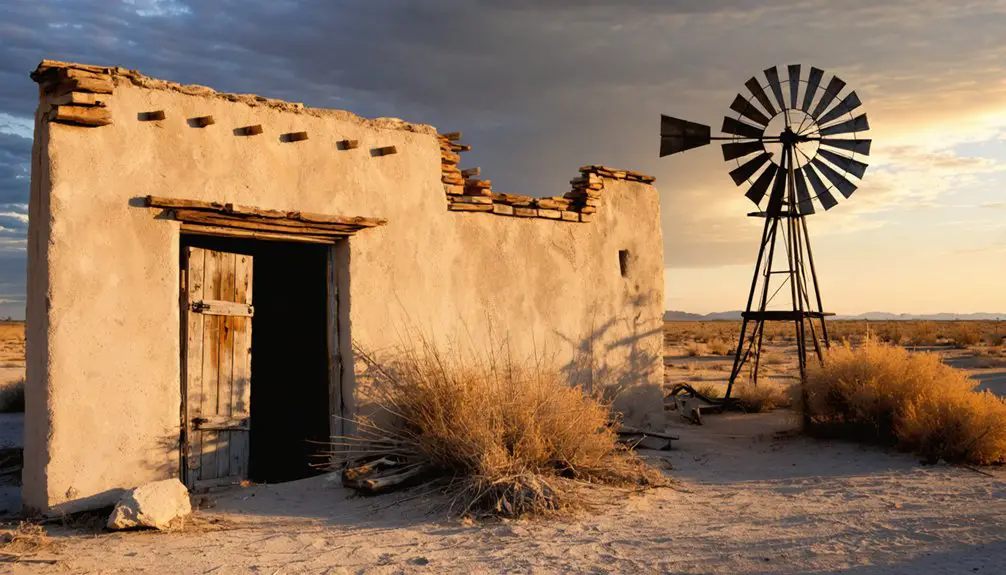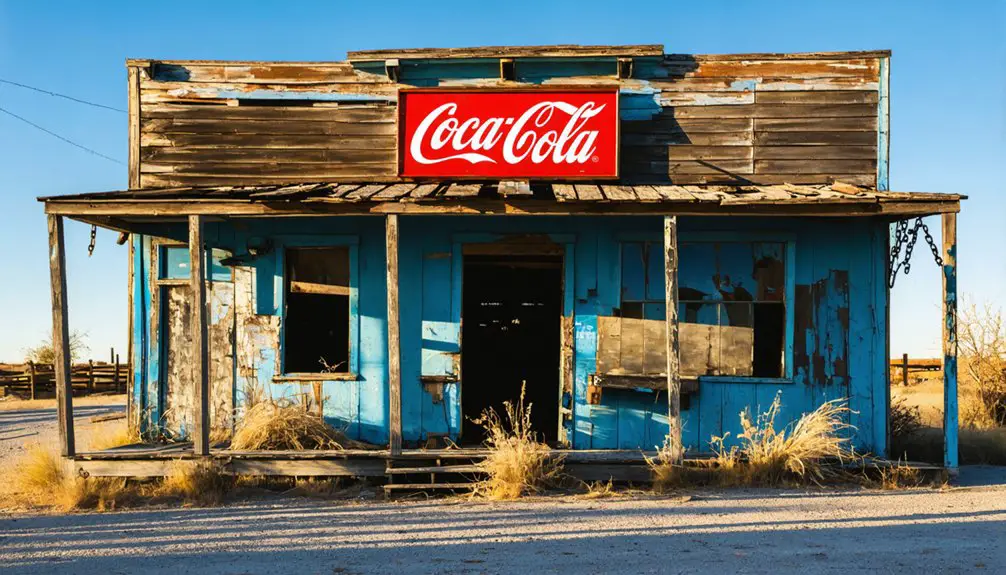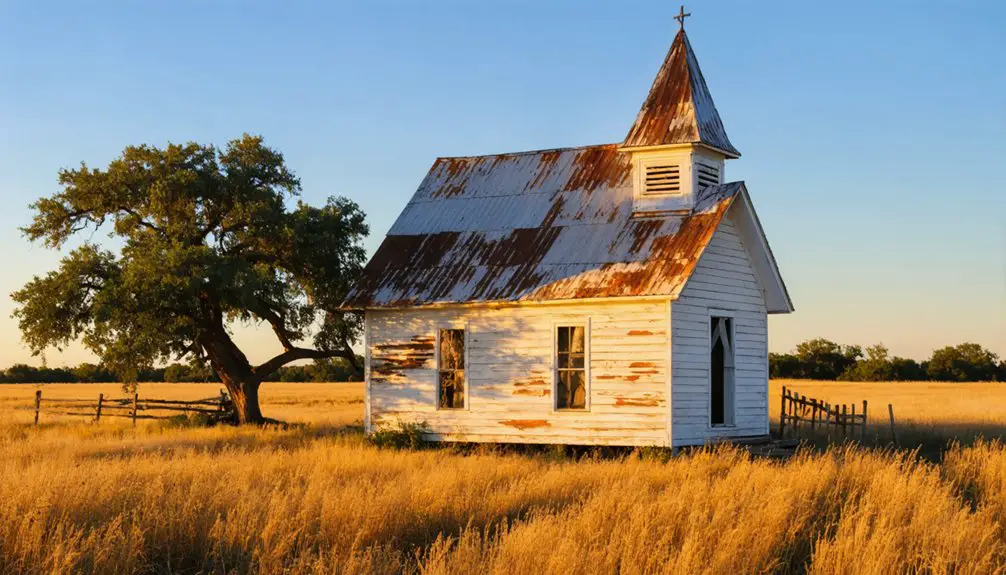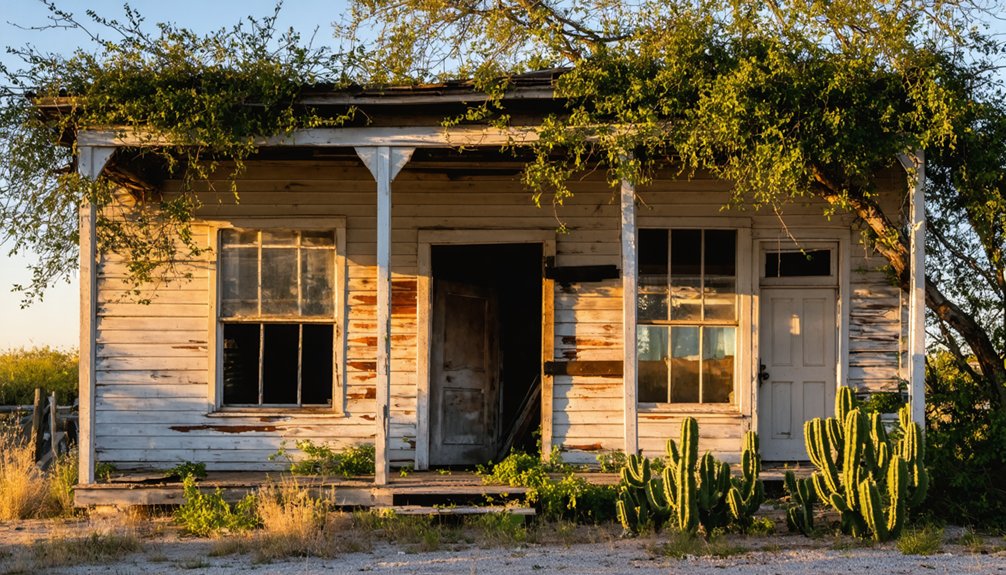
You’ll discover Texas’s ghost towns vanishing beneath nature’s relentless advance—Indianola’s once-grand port now submerged under Gulf waters after catastrophic 1875 and 1886 hurricanes, while Terlingua’s mercury mines surrender to Chihuahuan Desert vegetation. Aldridge’s sawmill ruins disappear into regenerated pine forests, and Barstow’s irrigation networks crumble among mesquite thickets following devastating floods. Each site preserves archaeological evidence of communities destroyed by environmental forces between the 1880s and 1940s. The mechanisms driving their abandonment and the challenges facing their preservation reveal patterns connecting Texas’s economic history with its unforgiving landscapes.
Key Takeaways
- Spring Creek and Sherwood show nature overtaking 1870s ranch foundations and commercial districts with vegetation.
- Indianola’s original town sites now lie submerged beneath rising waters after devastating 1875 and 1886 hurricanes.
- Extreme weather, including flash flooding and temperature swings, accelerates structural decay across Texas ghost towns.
- Lake Belton’s historic low water levels exposed pre-1972 settlement foundations previously hidden underwater.
- Railroad bypass patterns left communities abandoned, allowing natural reclamation to transform former thriving settlements.
Indianola: Where the Gulf Swallowed a Thriving Port
When Prince Karl zu Solms-Braunfels surveyed the Texas coast in 1844, he identified a promising landing site along Matagorda Bay that would soon transform into one of the state’s most essential ports.
By 1875, Indianola’s population exceeded 5,000, ranking as Texas’s second-largest port and primary gateway for European immigrants traveling westward. You’ll find Angelina Belle Eberly, the Archives War heroine, among those who recognized the town’s potential, operating hotels until her death in 1860.
Nature had different plans. A Category 3 hurricane devastated the settlement in 1875, killing 300 residents. The storm destroyed 75 buildings, leaving the once-thriving port in ruins.
The rebuilt community couldn’t survive the 1886 Category 4 storm. During its peak years, Indianola had even surpassed Galveston in port activity during 1869 and 1870. Today, Indianola’s Legacy lives only in historical records—the Gulf’s Reclamation is complete, with original town sites submerged beneath rising waters.
Terlingua: Mercury Boom Gone Silent in the Desert
Deep in the Chihuahuan Desert, where summer temperatures scorch the landscape and the nearest water source required careful rationing, prospectors in the late 1880s discovered something far more valuable than gold—cinnabar ore rich with mercury.
Howard E. Perry’s 1903 Chisos Mining Company transformed Terlingua history into America’s mercury capital, housing 2,000 residents by the 1920s.
World War I’s explosive demand generated $12 million in revenue, with daily profits hitting $2,000.
Yet this mining legacy came at tremendous cost—mercury poisoning killed workers within five years, their graves filling the western cemetery.
When ore bodies depleted and markets crashed, the 1942 bankruptcy left only limestone ruins.
By the late 1940s, the population dwindled to about 350 residents, reducing Terlingua to ghost town status as surface installations were sold for salvage.
Groundwater influx flooding the mines in 1946 sealed the site’s fate alongside a depressed mercury market.
Today’s ghost town stands as a reminder of both industrial ambition and nature’s reclamation of human excess.
Aldridge: A Sawmill Settlement Consumed by Forest
Among the towering longleaf pines of Angelina County’s Piney Woods, Rockland lumberman Hal Aldridge envisioned an industrial empire that would transform virgin timber into the nation’s building material.
By 1905, his sawmill roared to life near the Neches River bend, churning out 125,000 board feet daily and employing 500 workers who built a thriving town of 1,500 residents. This sawmill history showcases the “Bonanza” era’s relentless appetite for yellow pine.
Yet Aldridge’s prosperity proved fleeting. Devastating fires in 1911, 1914, and 1919 gutted operations while exhausted timber stands signaled the end. In 1933, the U.S. Forest Service purchased the depleted lands from lumber companies to begin conservation efforts that would eventually restore the forest. Despite its ghost town narrative, Aldridge remains an incorporated town with a post office serving the scattered residents who call this once-bustling settlement home.
Barstow: When the Springs Ran Dry
Where the Pecos River carved through West Texas’s arid expanse, George E. Barstow envisioned an agricultural paradise. His 1892 enterprise transformed desert into productive farmland through ambitious canal systems.
You’d have witnessed Barstow’s irrigation network sustaining vineyards that won silver medals at the 1904 St. Louis World’s Fair, feeding a population exceeding 1,000 residents. The town thrived as Ward County’s seat, boasting banks, churches, and hotels. The first bank in Ward County, constructed in 1901, still stands as a testament to those prosperous years.
Then nature reclaimed what human ambition had temporarily conquered. Barstow’s decline began when the Pecos River dam shattered in 1904, releasing catastrophic floods.
Another dam failure in 1910, combined with relentless droughts, devastated agricultural operations. New Mexico dams upstream further strangled the town’s lifeline by reducing water flow and increasing salinity in the Pecos River. By 1918, farming became impossible.
You’ll find only 265 residents today—down from 1,219—living among oil fields and the crumbling Masonic Lodge ruins.
Shafter: Silver Dreams Fading Near the Border
While rancher John W. Spencer discovered silver ore in September 1880, he couldn’t have imagined the boom-and-bust cycle that would define Shafter history.
Named after Colonel William R. Shafter, this mining legacy transformed West Texas’s first major silver town into a border outpost where 4,000 residents once thrived.
Colonel William R. Shafter’s namesake town rose from silver dreams to become West Texas’s first major mining community with 4,000 souls.
You’ll find Shafter’s rise and fall marked by dramatic shifts:
- Silver veins at 700 feet yielded $500 per ton
- Mexican Revolution refugees flooded in during 1910
- Military posts stationed here protected against border raids
- Final closure came in 1942 when prices collapsed
From peak operations employing 500 miners to today’s 11-30 residents, Shafter represents freedom’s double edge—the liberty to chase fortune and the harsh reality when dreams fade.
The Presidio Mining Company’s arrival in June 1882 kickstarted development of silver deposits valued at $45 a ton, attracting miners from diverse ethnic backgrounds including Mexicans and African Americans who built a thriving community complete with saloons, dance halls, and the Sacred Heart of Jesus Catholic Church.
Located eighteen miles north of Presidio, Texas, the town struggled with severe water shortages that would ultimately hinder sustainable mining operations even during attempted revivals.
Sherwood: The County Seat Lost to Time
You’ll find Sherwood’s limestone courthouse standing sentinel over a community that never recovered from being bypassed by the railroad in the early twentieth century.
While Mertzon’s position along the tracks secured its future as county seat in 1936, Sherwood’s foundations crumbled beneath creeping mesquite and prickly pear.
The two-story edifice, built in 1901 when the town thrived on ranching and farming, now presides over empty lots where county business once drew residents from across Irion County.
Railway Brought Brief Prosperity
- The 1903 land rush released 76 sections at bargain prices
- Oil discovery in 1928 sparked temporary excitement
- Prosperity remained tied to the pre-railway era
- Sherwood’s abandonment preceded the 1936 county seat transfer
- Kansas City, Mexico and Orient Railroad chose Mertzon instead
- State highways followed, draining commerce two miles away
- Courthouse became obsolete after voters relocated government in 1936
- Picturesque ruins now mark where authority once resided
- Desert conditions in Southwest Texas rapidly reclaim abandoned structures, turning Terlingua’s mercury mining ruins into wind-scoured monuments.
- Extreme heat pushes temperatures beyond 110ºF in Ghost Town, warping wood and crumbling concrete.
- Flash flooding demolishes what drought exposes, claiming over 30 lives while erasing Central Texas communities.
- Temperature swings from semi-desert Panhandle to humid Dallas-Fort Worth accelerate material deterioration across diverse ecosystems.
- https://everafterinthewoods.com/texas-ghost-towns-that-became-ruins-that-locals-turned-into-quirky-getaways/
- https://www.expressnews.com/san-antonio-weather/article/ghost-towns-texas-extreme-weather-storms-drought-19877053.php
- https://www.texasstandard.org/stories/texas-population-boom-ghost-towns-rural-urban-suburban-shift/
- https://texashighways.com/travel-news/four-texas-ghost-towns/
- https://mix931fm.com/texas-ghost-towns-history/
- https://www.youtube.com/watch?v=_ndTmBBAC1I
- https://takingthekids.com/eerie-texas-ghost-towns-where-time-seems-to-stand-still/
- https://www.lovemoney.com/gallerylist/86648/americas-empty-ghost-towns-and-why-theyre-abandoned-today
- https://www.youtube.com/watch?v=v2JfTPg4z6k
- https://calhouncountymuseum.org/exhibits/indianola/
This death-by-railroad pattern repeated across Texas, leaving communities reclaimed by nature’s persistent grasp.
Desert Vegetation Overtakes Foundations
Along the banks of Spring Creek, nature has steadily reclaimed what 1870s ranchers carved from rugged West Texas terrain.
You’ll find foundation decay marking where buildings once housed a thriving county seat, now surrendered to advancing vegetation. The picturesque setting tells a story of nature reclamation—trees line the creek banks where Sherwood’s commercial district stood before voters relocated the county seat to Mertzon in 1936.
While the magnificent 1901 courthouse remains privately occupied, surrounding ruins blend into their environment.
This ghost town’s transformation accelerated after the 1911 railroad bypass stripped away its economic purpose.
Today, you can access these atmospheric grounds via standard roads, witnessing how quickly the natural world erases human ambition when populations abandon their settlements to pursue opportunity elsewhere.
Remote Ranching Community Fades
When ranchers established their settlement along Spring Creek in the 1870s, they couldn’t have predicted their community would become Irion County’s governmental heart—then fade into Texas legend.
Sherwood’s ranching history transformed dramatically when it became county seat in 1889, symbolized by an 1901 courthouse whose tower clock remained frozen at Lincoln’s death hour.
The 1911 railroad bypass devastated everything:
This community decline exemplifies how infrastructure decisions determine settlement survival.
You’ll find Sherwood’s privately owned courthouse standing among occupied buildings—a monument to governmental ambitions overtaken by economic reality.
Preservation Challenges in Remote Locations
When you venture into Texas’s remote ghost towns, you’ll find preservation efforts constantly battling extreme heat, flash flooding, and relentless wind that accelerates structural decay far from urban conservation resources.
These sites’ isolation means accessing them requires hours of travel over unpaved roads, while securing funding proves nearly impossible when stakeholders can’t easily witness the historical value firsthand.
You’re looking at structures where traditional infrastructure—electricity, internet, climate control—doesn’t exist, forcing preservationists to develop off-grid monitoring systems that won’t compromise the sites’ architectural integrity.
Harsh Environmental Conditions
Texas’s ghost towns face relentless assault from environmental extremes that both reveal and destroy their remnants. You’ll witness how drought resilience proves futile against forces that simultaneously expose and erase history.
When Lake Belton drops to historic lows, you can walk among foundations from pre-1972 settlements, yet these same conditions accelerate decay in structures lacking environmental adaptation.
The state’s climate variability creates paradoxical preservation challenges:
Limited Access and Funding
Preserving Texas’s ghost towns demands resources that rarely reach the state’s most isolated settlements.
You’ll find funding barriers particularly restrictive—grants typically flow to nonprofit organizations and public agencies, excluding private owners who’ve acquired these abandoned properties. When available, awards range modestly from $2,500 to $30,000, competing against hundreds of applicants statewide.
Access limitations compound these challenges. Ghost towns like Gomez lost their economic viability when railroads bypassed them, leaving structures without water, electricity, or sewage systems. Restoration costs skyrocket in these conditions.
You’re also confronting unclear property titles from generational transfers, multiple landowners requiring simultaneous negotiations, and banks viewing these ventures as high-risk investments.
Remote locations that killed these towns now prevent their resurrection, creating a cycle of continued abandonment despite historical significance.
Frequently Asked Questions
Are These Ghost Towns Safe to Visit Without a Guide?
Like traversing unmarked wilderness, you’ll find ghost town safety varies dramatically. Terlingua and Helena welcome independent exploration, but visitor precautions remain essential—crumbling structures, remote locations, and environmental hazards make informed preparation crucial for your freedom-seeking adventure.
Can You Legally Take Artifacts From Abandoned Texas Ghost Towns?
You can’t legally take artifacts without understanding artifact ownership rights. On public lands, you’ll face legal repercussions for removal without permits. Private property artifacts belong to landowners—you’d need their permission. Federal and state-designated sites require archaeological permits regardless.
What Wildlife Hazards Should Visitors Expect in These Locations?
You’ll face wildlife encounters from venomous rattlesnakes in Terlingua’s ruins to scorpions in adobe structures. Take safety precautions: watch for copperheads in East Texas forests, black widows in rubble, and mountain lions prowling Big Bend sites.
Do Any Former Residents or Descendants Still Visit These Sites?
You’ll find former residents and their descendants regularly visiting these sites, particularly at The Grove’s cemetery where descendant gatherings honor German settler families, and at Terlingua during the annual chili cook-off when old-timers share stories.
Which Ghost Town Is Closest to Major Texas Cities?
Wilson County’s ghost towns sit closest to major cities, offering you unparalleled urban exploration opportunities. You’ll find 25 historic landmarks within 25 miles of New Braunfels and San Antonio—freedom to discover Texas’s abandoned past awaits your journey.