You’ll find Alaska’s ghost towns hosting remarkable annual events that blend history with cultural celebration. Kennicott features summer heritage festivals and mine tours through June and August, while Treadwell commemorates its Gold Rush Days each June near Juneau. Dyea offers ranger-led Klondike Gold Rush programs within the national park, and Portage holds earthquake remembrance gatherings every March 27th. Remote Ukivok welcomes descendants for late-spring cultural workshops, and Whittier showcases military history tours year-round. Each location offers unique perspectives on Alaska’s resilient past worth exploring further.
Key Takeaways
- Kennicott hosts Summer Arts and Lectures Series in June and a storytelling festival in August within historic mining structures.
- Treadwell Ruins commemorates Gold Rush Days each June, celebrating its gold mining history with augmented reality tours and events.
- Dyea offers ranger-led programs and annual presentations on Buffalo Soldiers and Women of the Gold Rush year-round.
- Portage holds annual earthquake remembrance gatherings every March 27th with survivor testimonials and seismic education workshops.
- Ukivok organizes community-led spring expeditions featuring traditional knowledge workshops, storytelling, and craft skills like drum making.
Kennicott’s Summer Heritage Festivals and Mine Tours
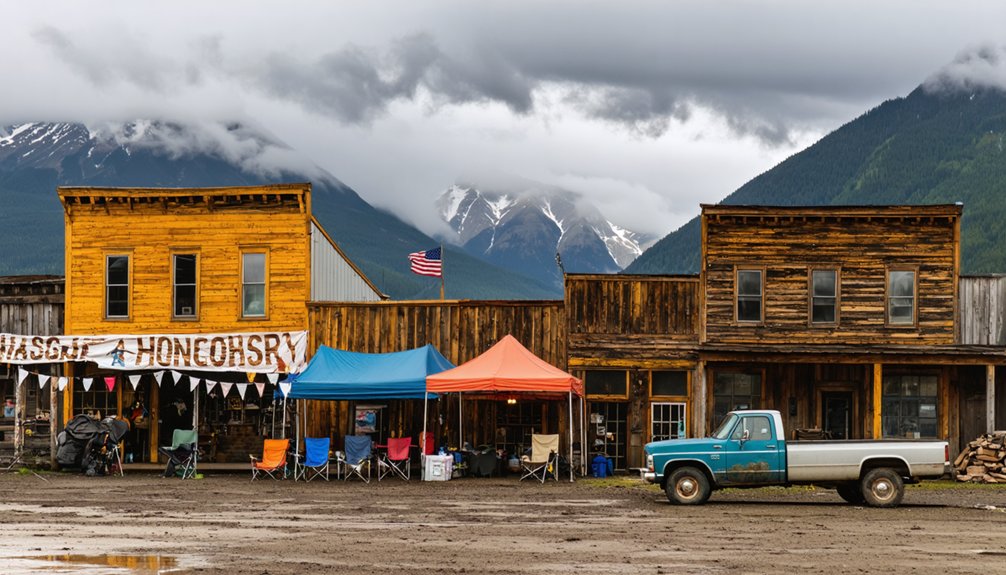
Deep in Wrangell-St. Elias National Park, Kennicott’s preserved copper mining structures host summer events that blend historic preservation with wilderness adventure. You’ll access this remote ghost town via an off-road route from McCarthy, crossing a striking footbridge into the mountains.
Access this copper mining ghost town through McCarthy’s rugged terrain, where preserved industrial history meets Alaska’s dramatic mountain wilderness.
The Summer Arts and Lectures Series brings outdoor performances to the historic Recreation Hall, featuring concerts by wilderness-connected musicians and geology talks starting each June. August’s storytelling festival draws explorers seeking cultural immersion.
St. Elias Alpine Guides offers mine tours revealing early 20th-century operations, often combined with Root Glacier hikes. Festival visitors should carry waterproof hiking boots to manage the shifting trail conditions including mud puddles and loose rocks along the route. Flight-seeing tours provide spectacular aerial perspectives of the expansive valleys and glaciers surrounding the historic mining site.
The McCarthy Summer Music Festival transforms the mining town into an adventure-art destination, with evening events requiring headlamps as you explore preserved structures that detail miners’ lives against towering peaks.
Treadwell Ruins’ Annual Gold Mining History Celebrations
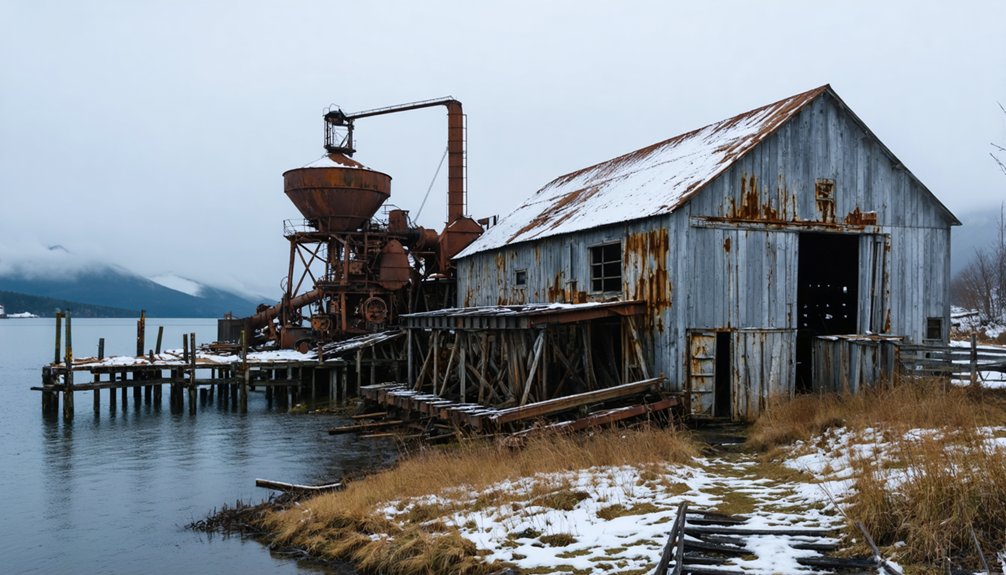
Across Gastineau Channel from downtown Juneau, the Treadwell Ruins stand as haunting acknowledgments to Alaska’s most ambitious gold mining operation—once the world’s largest hard rock gold mine before seawater consumed its tunnels in 1917.
You’ll find this treadwell ghost town transforms each June during Gold Rush Days, when mid-month celebrations spotlight the complex’s 34-year legacy of extracting $70 million in gold.
The Treadwell Historic Preservation & Restoration Society maintains trails threading through moss-covered foundations, towering structures, and collapsed shafts where 1,000 workers once labored beneath the seabed.
The operation’s 300-stamp mill, installed under one roof in 1899, was the largest facility of its kind worldwide at the time.
Augmented reality walking tours let you witness Alaska mining history from the 1880 discovery through the catastrophic April 1917 cave-in, when 3 million tons of seawater flooded the tunnels in just 3.5 hours, ending an era.
The 100-year anniversary commemoration in 2017 featured Douglas Days celebrations from April through July 4, including a miners’ ball at the Baranof Hotel, walking tours at Treadwell Mine Historic Park, and a theatrical production based on the mine’s history.
Dyea’s Klondike Gold Rush Commemoration Events
Where stampeders once hauled ton-loads of supplies toward Yukon gold fields, Dyea’s skeletal remains now host annual commemorations that transport you back to the frenzied 1897-1898 rush.
Part of Klondike Gold Rush National Historical Park since 1976, this abandoned townsite stages ranger-led programs celebrating the era when thousands flooded through on their way to fortune.
You’ll find exhibits highlighting Tlingit trading traditions—the Dayéi people who controlled pack routes over Chilkoot Pass long before prospectors arrived.
Annual programming includes gold rush-themed events featuring Buffalo Soldiers and Women of the Gold Rush presentations at Skagway’s Trail Center, open May through September.
The park’s historic buildings, including the Moore House restored to its 1904 appearance, showcase pioneer life with original family possessions.
Self-guiding tours let you explore building foundations and wharf ruins independently, while the historic Chilkoot Trail still beckons adventurers willing to trace that legendary 33-mile path to Bennett Lake. The valley’s agricultural suitability allowed farmers to grow vegetables for Skagway markets as early as 1900, demonstrating how some residents adapted after the gold rush ended.
Portage Memorial Gatherings and Earthquake Remembrance Days
When you visit Portage each March 27th, you’ll join annual earthquake memorial services marking the 1964 Good Friday disaster that dropped this railroad town six feet below high tide and forced its complete abandonment.
The commemorations bring together survivor testimonials and photographic exhibits amid the eerie ghost forest—dead trees still standing as sentinels where saltwater flooded after the ground collapsed.
You can also participate in seismic education workshops that explain how Alaska’s most powerful earthquake reshaped this landscape, transforming a bustling transportation hub into one of the state’s most haunting reminders of natural forces. The Alaska Railroad, completed in 1923 when President Harding visited to mark the occasion, once provided crucial transportation through Portage before the earthquake’s devastation.
While Portage holds its somber commemorations, Anchorage celebrates winter with its Fur Rendezvous festival, which has attracted visitors from Outside since resuming in 1946 after wartime cancellation.
Annual Earthquake Memorial Services
Each March 27th, survivors and visitors gather at Portage’s haunting ruins to honor those lost in the 1964 Good Friday Earthquake—the second-largest temblor in recorded history.
You’ll witness skeletal structures standing amid barren forest, tangible reminders of the 9.2 magnitude quake that claimed 139 lives and triggered devastating tsunamis across Prince William Sound.
These memorial services double as practical tsunami preparedness drills, testing response coordination that mirrors Operation Helping Hand‘s massive relief effort.
You’re exploring more than history—seismic hazard assessment shaped Alaska’s modern building codes here.
The Pioneers of Alaska lead commemorations connecting Portage’s abandonment to Valdez’s relocation and Girdwood’s survival.
The earthquake’s 4 minutes and 38 seconds of violent shaking fundamentally altered the landscape, causing terrain elevation changes of up to 30 feet that made the original townsite uninhabitable.
Valdez itself relocated approximately four miles to a safer site after the earthquake rendered the entire original community unsafe for habitation.
It’s raw education about plate tectonics’ power, delivered where aftershocks once rattled a doomed mining community into permanent silence.
Survivor Testimonials and Exhibits
Standing among Portage’s ghost forest, you’ll hear survivors describe the ground transforming into “frozen blocks” that shattered beneath their feet while muddy geysers erupted 50 feet high from splitting earth. Unlike fictional ghost stories, these testimonials document the five-minute terror when the 9.2-magnitude quake dropped the town 6-10 feet below high tide on Good Friday 1964.
You’ll find exhibits along Seward Highway where saltwater-killed trees rise from marshland like skeletal monuments. Urban exploration reveals abandoned stables and cabin ruins marking what once thrived as a mining junction.
Memorial signs throughout the ghost forest educate you on subsidence effects while Alaska Wildlife Conservation Center maintains access to structural remains, preserving authentic accounts of nature’s devastating power.
Seismic Education Workshop Programs
How do you transform a ghost town into a living classroom where fifth-graders crack Oreo cookies to understand the tectonic forces that swallowed Portage? You partner with Chugach National Forest and bring earthquake science directly to the valley floor where the 1964 quake reshaped everything.
At Begich, Boggs Visitor Center, Alaska Outdoor School runs spring and fall programs where students explore seismic hazard through hands-on lessons above Portage Lake. Three-day overnight experiences blend campfire storytelling with earthquake preparedness curriculum aligned to state standards.
You’ll watch kids layer cookie “plates” to grasp the rupture mechanics that created this haunted landscape.
These field studies don’t just teach seismology—they build resilience. When you connect students to earthquake-scarred terrain, you’re cultivating stewards who understand Alaska’s volatile ground beneath their boots.
Ukivok’s Cultural Heritage Programs and Arctic Expeditions
You’ll find Ukivok’s heritage programs offer rare access to one of Alaska’s most remote ghost villages, where National Science Foundation-funded expeditions have reconnected Ukivokmiut descendants with their ancestral home since 2005.
Local researchers now coordinate late spring boat trips that bring original residents and cultural practitioners back to the stilted village perched on King Island’s dramatic cliffs.
These visits blend traditional knowledge workshops with archaeological exploration, preserving Inupiat subsistence practices and the Aseuluk people’s deep connection to this windswept Arctic outpost.
Inupiat Traditional Knowledge Workshops
While most ghost towns fade into obscurity, Ukivok maintains its cultural pulse through monthly Iñupiat Traditional Knowledge Workshops that draw artists and students to Alaska’s remote Arctic coastline.
You’ll find skilled artisans teaching drum making and ivory carving in week-long sessions, with twelve students rotating through each program.
These workshops go beyond craft—they’re vessels for Iñupiat storytelling and traditional dances that carry ancestral wisdom forward.
The programs integrate core Ilitqusiat values like respect for elders, knowledge of language, and responsibility to tribe.
You’ll learn subsistence skills essential for Arctic survival while connecting to whaling traditions through hands-on tool construction.
Supported by North Slope Borough and Alaska Native Heritage Center partnerships, these workshops offer you authentic immersion in Indigenous knowledge systems that’ve sustained communities for millennia.
Guided Cliffside Archaeological Tours
Beyond the workshop spaces where traditional knowledge passes between generations, Ukivok’s dramatic cliffside architecture tells its own story—though access remains tightly controlled by the King Island Native Community.
Currently, no commercial archaeological tours operate on these steep slopes where 19th-century stilt houses cling to rock faces.
You’ll find circumnavigation cruises offering distant views, but foot exploration requires community permits that prioritize cultural preservation over tourism.
The marine geology surrounding this isolated outcrop—86 miles northwest of Nome—creates unique cliffside preservation challenges:
- Coastal erosion constantly threatens structures anchored with braided walrus hide
- Precambrian basement rocks support biotite-hornblende formations
- Seasonal ice movement accelerates rock shifting
- Seabird colonies complicate access routes
Researchers occasionally facilitate visits for original Aseuluk descendants, finding buildings remarkably intact since mid-20th-century abandonment.
Annual Arctic Photography Expeditions
Since King Island’s dramatic coastline disappeared from regular tourism circuits in the 1960s, photography expeditions to this remote outpost have remained largely theoretical rather than operational. You won’t find scheduled tours here—access requires charter flights and serious planning.
The island’s abandoned village offers haunting compositions against Bering Sea ice formations, though weather windows are unpredictable and brief.
Independent photographers occasionally coordinate informal expeditions during summer months, timing visits to capture polar wildlife migrations along the cliffs.
You’ll need cold-weather gear, backup equipment, and flexibility when conditions turn.
The cultural sensitivity required here goes beyond standard protocol—you’re documenting a homeland, not just ruins. Most shooters partner with King Island descendants who can provide context and permission for their work.
Whittier’s Military History Tours and Buckner Building Explorations
- Movie theater and bowling alley
- Complete sleeping quarters
- Full dining facilities
- 14-story Begich Towers nearby
- https://www.historicanchoragehotel.com/local-events-and-conventions-anchorage.htm
- https://elsewhereboundtravel.com/alaskan-events/
- https://thealaskafrontier.com/ghost-towns-in-alaska/
- https://www.atlasobscura.com/things-to-do/alaska/ghost-towns
- https://www.alaska.org/things-to-do/festivals
- https://www.youtube.com/watch?v=88sdmoSEoTA
- https://www.sitkamusicfestival.org
- https://explorealaska.us/the-most-epic-annual-events-in-alaska-top-10-must-experience-festivals-currently-open/
- https://www.blm.gov/announcement/blms-annual-garnet-day-brings-ghost-town-life-fun-and-games
- https://www.youtube.com/watch?v=3D1nA7GGj_Y
Cap your exploration at Prince William Sound Museum in Anchor Inn, where $5 gets you access to rare WWII artifacts, original photographs, and uniforms.
Ted Spencer’s nonprofit collection reveals why Alaska Magazine called it “Must-See.”
Frequently Asked Questions
What Accommodations Are Available Near Alaska’s Ghost Town Event Locations?
You’ll find limited historical lodging near Alaska’s ghost town events. Seward’s Military Resort offers rustic accommodations with winter packages during Halloweek. Most festival locations don’t provide detailed lodging info, so you’ll need to research independently for your adventure.
Are Alaska Ghost Town Events Suitable for Young Children?
Alaska’s ghost town events aren’t specifically designed for young children. You’ll find historical reenactments and vintage exhibitions fascinating, but remote locations, limited facilities, and adult-focused programming make them better suited for older kids and independent explorers.
What Should Visitors Pack for Ghost Town Events in Alaska?
Layer up like a seasoned prospector: pack thermal gear, waterproof boots, and windproof jackets for unpredictable conditions. Bring historical attire for themed celebrations, plus headlamps and bear spray. Follow photography tips—capture Alaska’s rugged spirit while staying warm and prepared.
Do Ghost Town Events Operate During Alaska’s Winter Months?
No, Alaska’s historic ruins don’t host winter festivities. You’ll find ghost towns like Kennicott and Dyea shut down during harsh winter months, while populated areas like Anchorage and Talkeetna run lively festivals where you’re free to explore.
Are Pets Allowed at Alaska’s Ghost Town Annual Events?
Your adventure dog will have to sit this one out—pet policies remain frustratingly vague across Alaska’s ghost town events. Animal restrictions aren’t documented for Kennicott, Treadwell, or Dyea, so you’ll need to contact organizers directly before heading out.