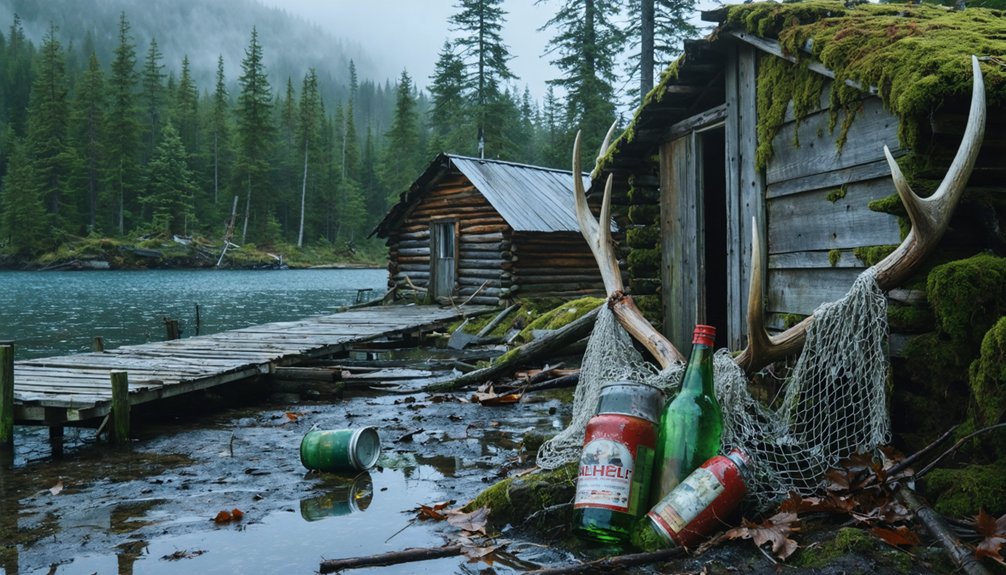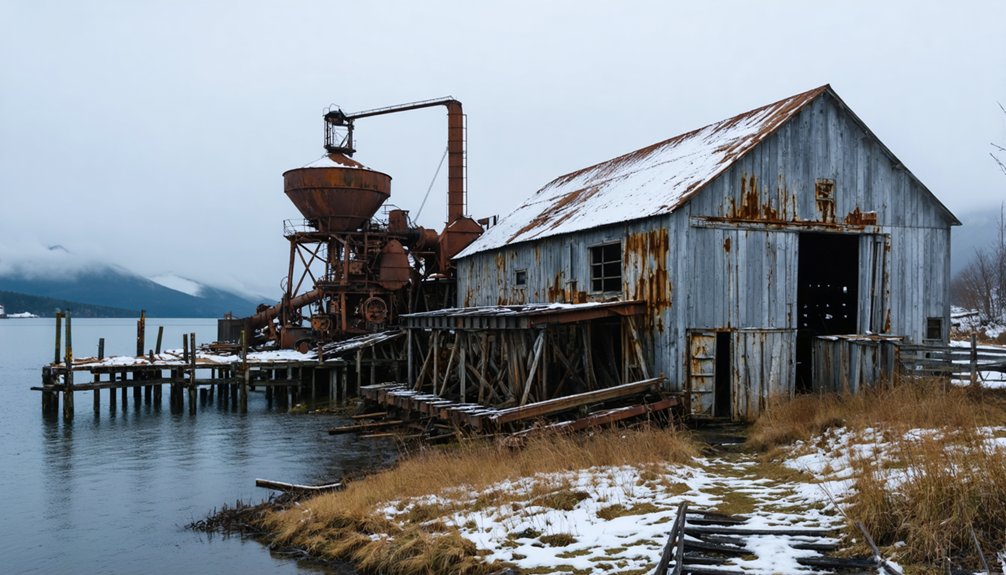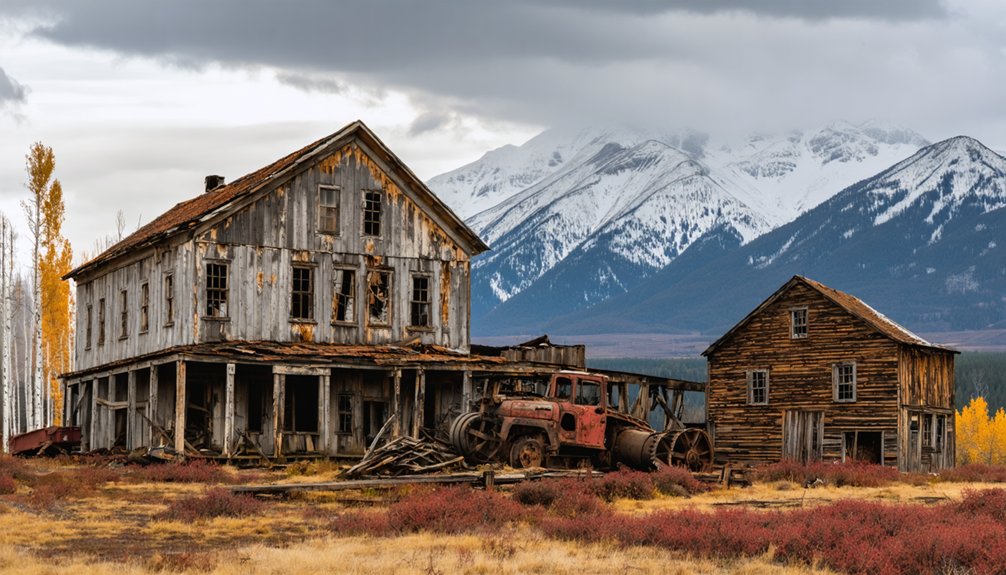
You’ll find Alaska’s most haunting ghost towns transformed by fall’s dramatic palette—Kennicott’s copper-stained buildings gleaming against golden aspens, Treadwell’s moss-covered ruins framed by Juneau’s fiery foliage, and Dyea’s scattered remnants where caribou migrate through Klondike history. Early September offers the sweet spot: 40-degree days, vibrant tundra, and enough daylight to safely explore these weather-beaten settlements. The shifting light and retreating wildlife create an atmosphere that’s both melancholic and magical, while proper layering and satellite communication devices become your lifelines in these remote locations where civilization simply walked away.
Key Takeaways
- Early September offers optimal conditions with golden foliage, moderate temperatures in the 40s-60s°F, and 11-14 hours of daylight for exploration.
- Caribou migrations and bird movements intersect with abandoned settlements, creating unique wildlife viewing opportunities amid historic sites.
- Pack layered clothing, satellite communication devices, bear spray, and GPS equipment to safely navigate remote ghost town locations.
- Use long exposures and natural framing to photograph weathered structures against vibrant fall landscapes and dramatic atmospheric conditions.
- Practice minimum impact principles by documenting sites through photography only, leaving structures and artifacts undisturbed for preservation.
Kennicott Ghost Town: Copper Riches Frozen in Time
When prospectors stumbled upon veins of vibrant green malachite and azure blue copper ore in 1900, they’d uncovered what would become the largest concentration of high-grade copper ever found in North America.
You’ll find Kennicott’s 14-story mill still looming against Alaska’s wilderness, frozen exactly as workers left it in 1938 when the company abruptly shuttered operations.
The industrial heritage here tells a raw story—600,000 tons of copper extracted, fortunes made, then abandoned overnight when ore depleted.
Today’s preservation efforts within Wrangell-St. Elias National Park let you explore this massive operation independently.
Walk through the ammonia leaching plant, peer into manager residences, and stand where 500 workers once transformed wilderness into $200 million worth of copper before vanishing into history. Inside abandoned buildings, you’ll still find salt shakers and half-eaten bread left behind when the last train departed with barely any warning. While Kennicott maintained strict company town rules, nearby McCarthy village emerged to provide miners with alcohol and entertainment the corporation banned.
Treadwell Ruins: Juneau’s Sunken Gold Mining Legacy
What compels a mining operation to tunnel so greedily deep that it devours itself? At Treadwell, you’ll find your answer beneath Douglas Island’s peaceful forest. Once the world’s largest hard rock mine, it produced $67 million in gold before April 21, 1917, when 3 million tons of seawater swallowed three shafts in 3.5 hours.
The miners had tunneled too close to the seabed—2,700 feet deep—chasing veins that couldn’t sustain their ambition.
Today, you’ll discover towering ruins, rusted gears, and foundations reclaimed by spruce and hemlock. The Glory Hole still gapes, while mining technology relics rust along forgotten streets. Among the remnants, the saltwater pump stands as a direct reminder of the catastrophic breach that ended an era. The Treadwell Mine Historic Trail now guides visitors through this landscape, offering both scenic beauty and educational value as it winds past the industrial remnants.
Historical preservation efforts maintain trails through this industrial graveyard, where augmented reality resurrects ghosts of 35 years’ labor—a cautionary tale carved in saltwater and stone.
Dyea: Gateway to the Klondike Gold Rush
Long before the thunder of 40,000 boots shook its planked streets, Dyea existed as a quiet Tlingit village where 138 souls lived in rhythm with the tides.
Before gold fever transformed it into chaos, Dyea thrived as a peaceful Tlingit settlement where lives followed the ancient rhythm of coastal waters.
Then 1897 arrived like wildfire—prospectors flooding through this saltwater port, 600 miles from Klondike’s glittering promise.
You’ll find five blocks wide, eight blocks deep of dreams that once stretched toward the Chilkoot Trail, where stampeders hauled year-long provisions over mountain passes.
Mountains of outfits and supplies lined Dyea’s muddy streets, each miner’s lifeline carefully assembled before the brutal trek north.
The Palm Sunday Avalanche of 1898 buried those dreams under snow and silence.
By 1903, Skagway’s railroad won, and Dyea emptied like spent mine shafts.
Today, you’ll walk through Klondike Gold Rush National Historical Park’s historical preservation efforts, where cemetery stones mark avalanche victims and cultural significance lives in whispered Tlingit stories beneath autumn’s golden canopy. History and ghost town enthusiasts continue to seek out this remote site, drawn by its haunting remnants of the Gold Rush era.
Portage Ghost Town: Nature’s Earthquake Memorial
At 5:36 p.m. on Good Friday 1964, the earth beneath Portage didn’t just shake—it swallowed an entire town whole. The 9.2 magnitude quake dropped the ground ten feet, plunging everything below high tide. Saltwater flooded in, killing the forest and erasing a community forever. The 4 minutes and 38 seconds of violent shaking registered effects as far away as Florida and Texas.
Today, you’ll find a haunting landscape where wildlife habitats have reclaimed what humanity lost.
Historical preservation here means leaving ruins untouched—nature’s own memorial.
What makes fall visits unforgettable:
- Ghost forests of ashen tree trunks rising from golden wetlands
- Skeletal building remains visible from Seward Highway, 47 miles south of Anchorage
- Alaska Wildlife Conservation Center nearby, where protected animals roam the earthquake-transformed terrain
Before the disaster, travelers stopped at this popular highway rest stop for gas, lunch, and drinks famously served with 1,000-year-old glacier ice. The tides and time continue their slow work, erasing evidence while creating something wildly beautiful.
Ukivok (King Island): Cliffside Village Above the Bering Sea
Sixty-four kilometers from Alaska’s western coast, wooden houses on stilts cling to 45-degree cliffs above the Bering Sea—defying gravity and common sense.
Wooden homes on impossible stilts—clinging to sheer cliffsides where logic says nothing should stand, yet stood for centuries.
The Iñupiat called themselves Aseuluk—people of the sea—and they built this impossible village on driftwood legs where no flat land exists.
For two thousand years, they hunted walrus from these slopes until 1959, when a falling boulder forced the school’s closure.
Families scattered to Nome. By 1967, Ukivok became Alaska’s most dramatic ghost town.
You can’t easily visit this remote island. Winter pack ice still surrounds it, and supply runs challenge even experienced mariners.
But from the water, you’ll see sod-roofed structures perched impossibly high, some intact, others reduced to skeletal stilts—monuments to humans who chose freedom on vertical rock.
The small island measures approximately one mile wide and one mile long, making it one of Alaska’s most compact settlements.
Captain James Cook first surveyed these cliffs in 1778, giving the island its English name.
Pilgrim Hot Springs: Geothermal Retreat on the Seward Peninsula
Your journey along Kougarok Road reveals layers of historic significance:
- Gold-rush saloon and spa that burned in 1908
- Mission buildings and cemetery standing silent since 1942
- Thermal pools reaching 178°F bubbling through permafrost
Pack everything—there’s no cell service or amenities. Request your no-fee permit and explore fifteen weathered structures nestled between Hen and Chickens Hill.
This sub-Arctic oasis belongs to Bering Strait Native Corporations, who’ve preserved its wildness for adventurers seeking untamed Alaska.
Best Times to Explore Alaska’s Ghost Towns in Fall
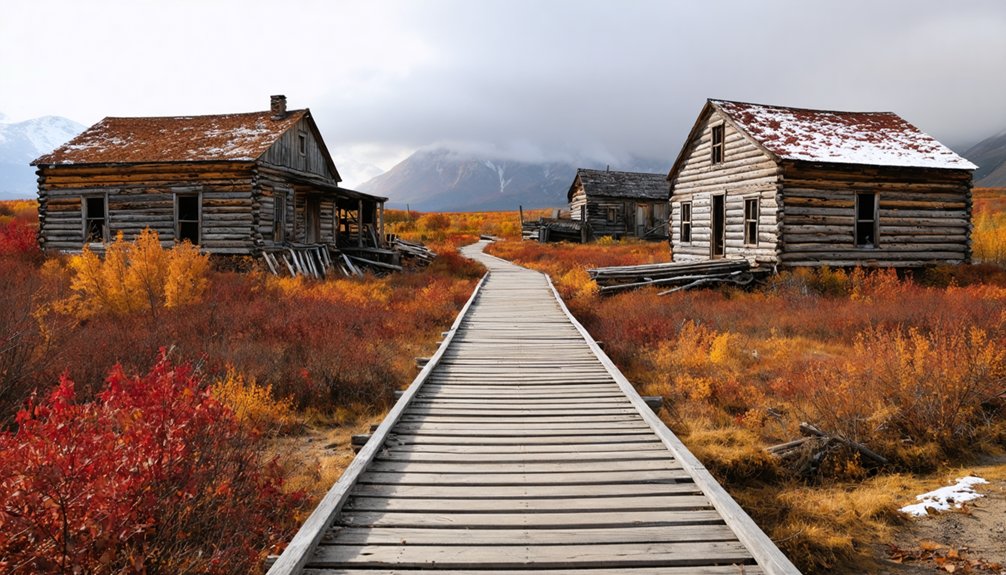
You’ll find September’s first two weeks offer the sweet spot for ghost town exploration, when aspens blaze gold against weathered timber frames. The temperatures hover in the comfortable 40s.
The shortening daylight—still stretching 11 to 14 hours in early fall—gives you ample time to photograph crumbling structures before shadows swallow the valleys.
Early Fall Weather Conditions
When autumn arrives in Alaska, the landscape transforms into a photographer’s dream, but the weather becomes as unpredictable as a gold prospector’s fortune. Early September greets you with temperatures reaching 60°F in Southcentral regions, perfect for exploring abandoned settlements beneath brilliant fall foliage.
You’ll discover autumn festivals celebrating this golden window before winter’s grip tightens.
Pack strategically for three distinct conditions:
- Sunny exploration days with highs in the high 50s-70°F range
- Rain-soaked adventures during September’s 14 average precipitation days
- Frigid nights requiring down jackets and winter accessories
Wildlife and Migration Patterns
As caribou herds thunder southward from the Arctic tundra with the season’s first snowfalls, Alaska’s ghost towns become staging grounds for one of nature’s most spectacular performances. You’ll witness hundreds of miles of migration corridors intersecting abandoned settlements where gold seekers once chased their fortunes.
Bird flight paths crisscross overhead in August and September—snow geese and trumpeter swans departing the Mat-Su Valley in thousand-strong flocks at sunset.
Along coastal ghost towns, marine mammal migration unfolds as gray whales begin their 7,000-mile journey to Baja California, while orcas follow retreating ice southward.
These convergences transform desolate townscapes into wildlife highways.
You’re free to explore when nature’s wanderers reclaim what humans left behind, creating unforgettable encounters among weathered structures and wild migrations.
Daylight Hours and Accessibility
The amber light of September stretches across Alaska’s abandoned settlements like spilled honey, offering explorers twelve to fourteen hours of workable daylight before darkness swallows the northern horizon. You’ll need to time your ghost town expeditions carefully as solar angles shift dramatically through October, stealing precious minutes each day.
Critical planning factors:
- Early September provides maximum daylight—ideal for photographing weathered structures without headlamps.
- Moon phases become navigation allies by mid-October when civil twilight shrinks to six hours.
- Late November triggers polar night in northern sites like Utqiagvik, ending practical exploration for 65 days.
The Arctic Circle’s proximity transforms casual adventure into calculated missions. Beyond mid-November, you’re racing against astronomical realities that won’t accommodate spontaneity. Pack accordingly—freedom here demands respect for celestial mechanics.
What to Pack for Fall Ghost Town Adventures
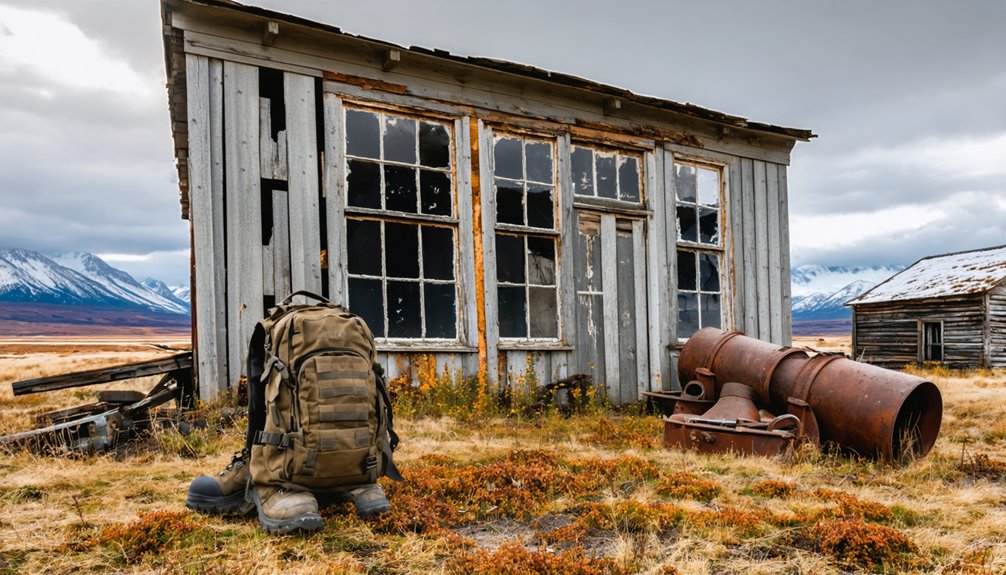
You’ll need to layer every piece of clothing you own when temperatures plunge and fog rolls in thick enough to hide the ground at your feet. The damp air penetrates even the best gear.
While fresh snow on distant peaks warns that winter’s coming faster than you expect. Pack for both the mild 59°F afternoons and the bone-chilling winds that can sweep down from the Gulf of Alaska without warning.
Essential Clothing and Layers
When icy winds howl through abandoned mining camps and temperatures plummet without warning, your clothing becomes your lifeline in Alaska’s remote ghost towns. Fall’s unpredictable shift brings icy rain and freezing nights by mid-October, demanding strategic layering for successful urban exploration.
Exploring the abandoned towns in southcentral Alaska reveals remnants of a bustling past, where hope once thrived among the rugged terrain. Navigating these eerie landscapes requires not only preparation but also a profound respect for the stories that linger in the air. Each derelict structure stands as a testament to the resilience of those who once called this stark land home.
Your essential system includes:
- Base layers in moisture-wicking merino wool that keeps you dry while photographing historical attire remnants in decaying saloons.
- Insulating mid-layers of fleece or down that trap warmth as you navigate Kennecott’s copper-stained corridors.
- Weatherproof outer shells with sealed seams to shield against wind-driven precipitation at exposed sites like Forty Mile.
Pack convertible pieces that adapt quickly—you’ll shed layers during strenuous hikes through wilderness, then bundle up immediately when standing still among frost-covered ruins where Alaska’s elements show no mercy.
Safety Gear and Supplies
Beyond proper clothing, survival in Alaska’s ghost towns hinges on what you carry in your pack. You’ll need bear spray and bells—these aren’t tourist props but essential defense where wilderness reclaims historical preservation sites. A bear-resistant container protects your food from curious grizzlies drawn to local legends’ crumbling structures.
Navigation demands redundancy: GPS, compass, and headlamp with spare batteries guide you through fog-shrouded streets where signposts rotted decades ago. Your first aid kit becomes vital on debris-laden paths—moleskin prevents blisters, space blankets counter hypothermia in abandoned buildings.
Pack insect repellent and sunscreen; fall mosquitoes still swarm near stagnant water, while UV rays reflect mercilessly off early snow. Waterproof everything—Alaska’s weather respects neither schedules nor explorers seeking freedom in forgotten places.
Photography Tips for Capturing Autumn in Abandoned Sites
The golden light of Alaska’s abbreviated autumn days transforms abandoned structures into haunting galleries where decay meets natural splendor.
Alaska’s fleeting autumn transforms forgotten buildings into ethereal exhibitions where natural beauty collides with architectural decay.
You’ll want to shoot low angles looking upward, emphasizing the vastness while honoring these sites’ historical preservation and cultural significance.
Master these techniques for compelling shots:
- Control your exposure: Set 30-second shutter speeds at f/8, using your flashlight to selectively illuminate weathered chairs or crumbling walls while windows catch ambient twilight.
- Embrace autumn’s reclamation: Frame fiery birch leaves threading through collapsed rooflines, creating powerful juxtaposition between nature’s persistence and human abandonment.
- Seek disorienting perspectives: Crouch, climb, or tilt your camera to convey the unsettling beauty of these spaces where time stopped.
Long exposures reveal ghostly textures on weathered surfaces, capturing the spirit that draws freedom-seeking explorers northward.
Staying Safe While Visiting Remote Ghost Towns
The autumn wind cuts through abandoned buildings with a sharpness that reminds you how quickly Alaska’s weather can turn deadly.
You’ll need more than your camera and curiosity—pack waterproof matches, emergency shelter, and a satellite communicator that works beyond cell range.
Before you step into those decaying structures where miners once sought fortune, make certain your survival kit rides at your hip and someone back in civilization knows exactly where you’ve gone.
Essential Gear and Supplies
Cold wind slices through inadequate layers as you step from your vehicle onto the weathered boardwalk of an abandoned mining town. That’s when most visitors realize their Seattle rain jacket won’t cut it here.
Alaska’s fall demands gear that matches its unforgiving character.
Your survival kit should include:
- Layered cold-weather clothing – moisture-wicking base layers, insulating fleece, and weatherproof shells that block icy rain driven by high winds
- Emergency communication devices – satellite messengers for areas where cell towers vanish into wilderness, giving you freedom without isolation
- Bear deterrents and wildlife precautions – spray, noise-makers, and awareness tools that respect both your safety and the landscape
Pack preservation tips in mind too: document these ghost towns through photographs, not souvenirs. Take only memories, leave only footprints.
Your backpack holds every item you need to survive Alaska’s backcountry—except the one thing that matters most when everything goes wrong. Communication equipment transforms isolation into calculated risk.
Personal Locator Beacons deliver your exact coordinates to rescue helicopters—no voice capability needed, just one deliberate button press broadcasting on dual frequencies.
Satellite safety devices like SHOUT Nano transmit GPS locations where cellular towers don’t exist, automatically alerting rescue centers during emergencies.
Satellite phones provide voice contact across mountainous terrain that blocks traditional radios, requiring only clear sky views.
Monitor Alaska’s emergency broadcast frequencies as your primary lifeline.
These tools aren’t paranoia—they’re liberation.
You’ll explore forgotten settlements knowing rescue coordinates travel instantly through space, transforming ghost town adventures from dangerous gambles into informed expeditions.
Frequently Asked Questions
Are Guided Tours Available for Alaska’s Remote Ghost Towns?
Yes, you’ll find exclusive guided tours at Kennecott, where you’re granted rare access inside historic buildings. You’ll discover exceptional photography opportunities while exploring authentic artifacts, ensuring proper history preservation of this remarkable copper mining landmark.
Can I Camp Overnight Near These Ghost Town Sites?
You can sleep beneath starlit ruins, though Alaska’s historical preservation guidelines and camping regulations require you’ll respect these fragile sites. Disperse your camp responsibly—at least 200 feet from structures—honoring both wilderness and history’s whispers.
Do I Need Special Permits to Visit These Locations?
You won’t need permits or restrictions for most ghost town explorations—just respect private property considerations. Wander freely through Kennecott’s open areas, but book permitted air taxis for remote sites like Bremner, where wilderness beckons beyond civilization’s reach.
Are the Ghost Towns Accessible for People With Mobility Limitations?
Wondering if adventure awaits you? Most Alaska ghost towns lack accessible pathways and mobility assistance, sitting on rugged, uneven terrain. You’ll find independence-crushing barriers—no paved routes, steep grades, and crumbling structures that challenge even the most determined explorers seeking frontier freedom.
Among these obstacles lie the abandoned mining towns in Alaska, remnants of a once-thriving rush for gold and resources. As you traverse the remnants of these settlements, each decayed building tells a story of ambition and hardship etched into the landscape. Exploring these haunting locations can evoke a sense of connection to the past, where dreams of fortune faded into the chill of isolation.
What Wildlife Might I Encounter While Exploring These Sites?
You’ll encounter remarkable wildlife diversity across seasonal habitats—moose wandering through abandoned structures, bald eagles soaring overhead, and salmon spawning in nearby streams. Brown bears, wolves, and beluga whales inhabit these wild spaces you’re free to explore.
References
- https://thealaskafrontier.com/ghost-towns-in-alaska/
- http://freepages.rootsweb.com/~gtusa/history/usa/ak.htm
- https://www.atlasobscura.com/things-to-do/alaska/ghost-towns
- https://www.youtube.com/watch?v=TC_KPrhDByY
- https://getlostinamerica.com/alaska-ghost-towns/
- https://www.geotab.com/ghost-towns/
- https://www.gi.alaska.edu/alaska-science-forum/ghost-towns-scattered-across-alaska-map
- https://www.atlasobscura.com/places/kennicott-ghost-town
- https://www.ultimathulelodge.com/blog/169452
- https://www.jasonchapmanphoto.com/kennecott