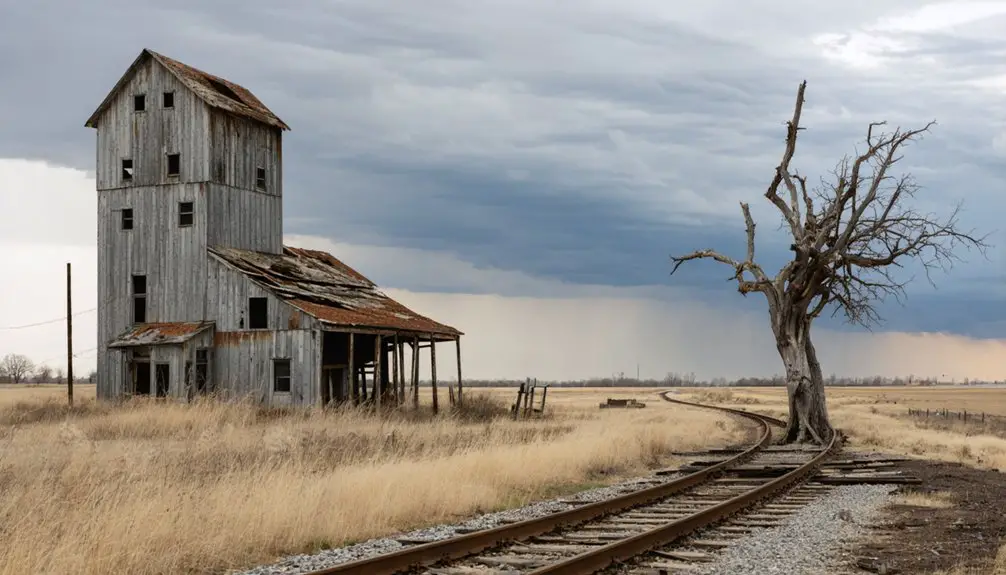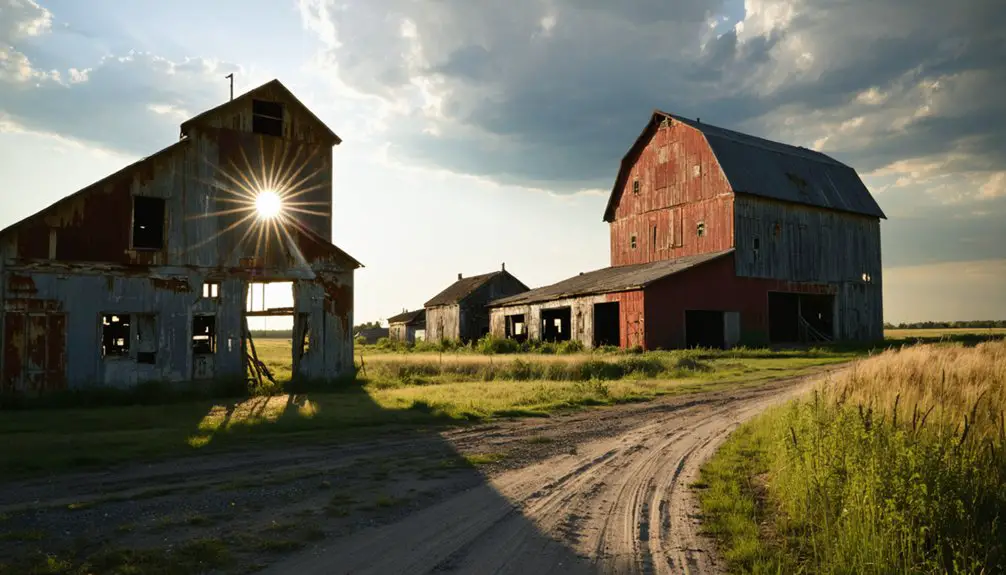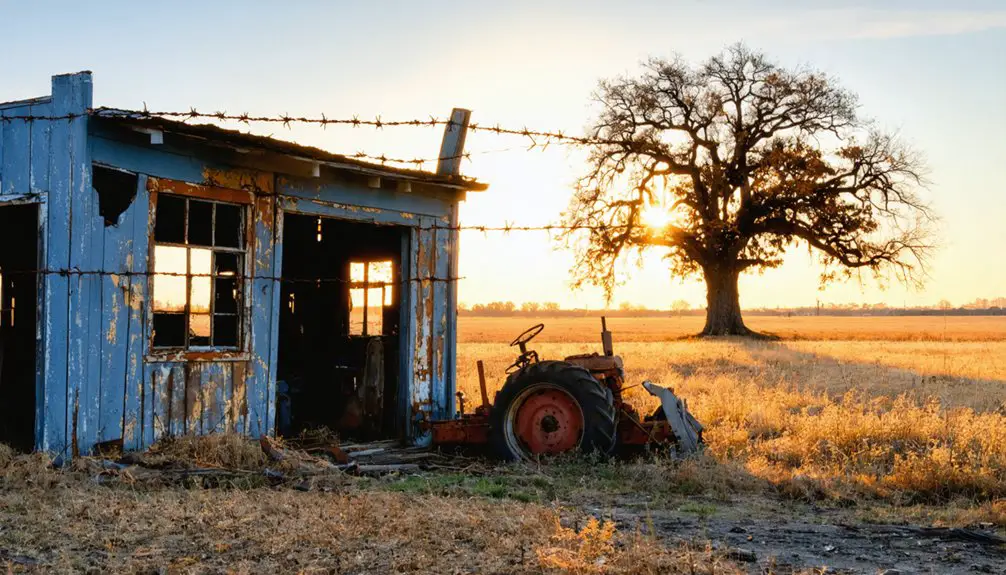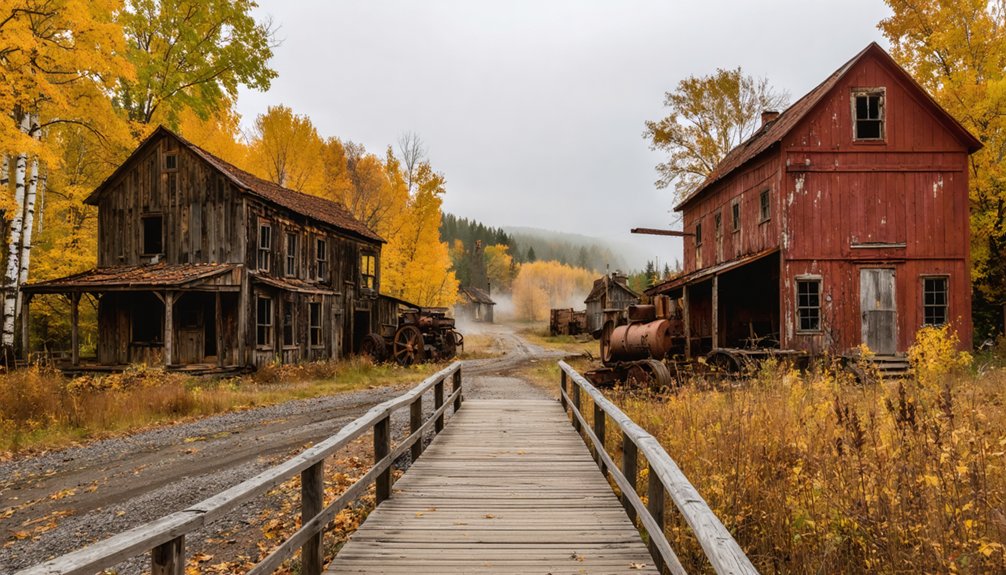
You’ll find Minnesota’s most atmospheric ghost towns brilliant with fall color from late September through mid-October. Forestville’s preserved 1890s storefronts glow against turning maples, while Elcor’s mining ruins emerge from crimson undergrowth near Gilbert. Don’t miss Whalan’s quirky Stand Still Parade or Leaf River’s blend of abandoned cellars and working establishments. Pack sturdy boots for overgrown paths around Perkinsville’s brick fields, and bring layers—temperatures hover between 40-60°F. The guide below reveals hidden routes, preservation efforts you can document, and strategic base towns for exploring multiple abandoned settlements.
Key Takeaways
- Forestville offers preserved 1800s storefronts with period interpreters, open Memorial Day through October, surrounded by vibrant fall foliage in southeast Minnesota.
- Whalan hosts the unique Stand Still Parade and features railroad heritage, with population of 63, ideal for autumn trail biking.
- Leaf River blends historic schoolhouse and cellar holes with fall scenery, transforming into amber and crimson landscapes peak mid-October.
- Elcor near Gilbert showcases mining remnants including crumbling foundations and slag piles, best visited early before seasonal weather deterioration.
- Bohemian Flats in Minneapolis offers interpretive signage about immigrant history along the Mississippi, now scenic parkland with excellent fall river views.
Forestville: A Preserved 19th-Century Settlement
When you visit Forestville in fall, you’ll step into a town frozen in the 1890s, where original storefronts still line the dirt road and period-dressed interpreters demonstrate blacksmithing and farming techniques their ancestors used over a century ago.
This southeastern Minnesota settlement peaked at 150 residents before remote transportation—specifically the 1868 railroad bypass—triggered its abandonment. You’ll explore authentic pioneer architecture, including the Meighen general store that closed in 1910, marking the town’s final chapter as a company town.
The Minnesota Historical Society operates tours from Memorial Day through October’s end, letting you wander through preserved cabins and workshops. Robert Foster and Felix Meighen founded the settlement in 1853, establishing a general store with goods transported by steamboat and oxcart from Galena, Illinois. The town officially became a ghost town around 1910 after the last businesses shut down. Located within Forestville/Mystery Cave State Park, it’s roughly an hour south of Rochester, offering genuine escape from modern constraints.
Whalan and Its Stand Still Parade Tradition
Tucked into a limestone valley along the Root River Trail, Whalan built its reputation not on what it lost to history, but on what it created from scratch—a parade that refused to move. For 25 years, this parade community flipped convention: floats stayed put while you walked the route, circling stationary marching bands and antique cars at your own pace.
The tradition celebration drew CBS cameras and crowds who devoured lefse from the Lutheran church between stops at the petting zoo. Though pandemic paused this quirky festival, Whalan’s spirit endures.
You’ll find freedom here among 63 residents who turned their smallest-town status into charm—biking the trail, grabbing pie at Aroma Pie Shoppe, exploring Ernie’s 1917 filling station where parade magic began. Inside the station, vintage gas pumps and oil signs from decades past line the walls alongside the town’s first telephone booth, preserving automotive history in what began as a simple collection space. The Whalan Museum, established in 2002 in a renovated 1898 building, opens its doors on weekends from May through October, offering a deeper dive into the town’s railroad heritage and early industries.
Elcor: Remnants of Minnesota’s Iron Mining Legacy
Unlike Whalan’s playful defiance of abandonment, Elcor surrendered entirely to the Mesabi Range’s economic gravity. You’ll find this ghost town between Gilbert and McKinley, where mining history wrote its final chapter in 1956.
Once home to nearly 1,000 souls serving the iron industry, Elcor’s abandoned structures now hide beneath reclaimed forest—foundations crumbling, slag piles rusting into earth. The town featured a company store, school, and housing that once supported 800 residents during its operational years. Croatian, Slovenian, Finnish, and Italian immigrants formed the backbone of this diverse mining community.
You can still spot eerie relics: a fire hydrant standing sentinel, a porcelain toilet bowl marking where bathrooms once stood.
Since 1993, mining companies have dumped overburden here, literally burying the past.
Budget an hour for exploration; the moderate trek rewards you with authentic industrial decay. Iron ore still lines old roads—the Range’s parting gift to a town that fed America’s steel furnaces.
Dale: A Railroad Town Lost to Time
While Elcor’s ghost persists in rusting slag and buried foundations, Dale’s disappearance tells a quieter story—one where the trains never stopped running.
You’ll find Dale in Fish Lake Township, where Amtrak’s Empire Builder still thunders past what’s left.
Andrew L. Jelsing founded this railroad village by moving a saloon from Winnipeg Junction—a beginning that captures the era’s opportunistic spirit.
At its peak, Dale sustained a grain elevator, creamery, town hall, and jail.
Then the trains quit stopping.
Without passengers or freight, Dale’s railroad history became just history.
Like many settlements across the region, Dale’s decline was fueled by transportation shifts that redirected commerce away from once-thriving stops.
Today, you’ll discover Dale Free Church standing on property dating to 1873, a solitary witness to community nostalgia.
The church now occupies the site where Dale once had a general store and schoolhouse.
The rails remain, but the town that depended on them vanished—a reminder that freedom requires movement, not just infrastructure.
Leaf River: A Living Ghost Town Experience
You’ll find Leaf River straddling the line between past and present, with around 50 residents keeping this Wadena County settlement alive amid its ghost town designation.
The old schoolhouse stands as your portal to history, while a working restaurant and golf course let you experience fall colors between glimpses of cellar holes marking where over 100 pioneers once lived.
Pack your camera for the Leaf River valley in October—you can photograph golden aspens framing 18th-century fur trading post sites, then warm up with a hot meal where loggers and farmers once gathered. The settlement shares its name with multiple Leaf Rivers across North America, making it important to verify you’re heading to the Wadena County location before your trip. Like many Minnesota settlements, the town includes remnants of structures that may now resemble fields where buildings have fallen apart over time.
Small But Active Community
Tucked away in section 22 of Leaf River Township, this community of roughly 50 residents defies easy categorization. You’ll find a living contradiction—a ghost town where life persists through community preservation efforts that keep essential services running.
The local restaurant serves hearty meals, while golfers swing clubs on maintained fairways where loggers once felled timber.
The old schoolhouse stands as proof of local traditions, a tangible link to when 150 residents called this place home.
You’re free to explore without tourist traps or crowds—just authentic remnants of Minnesota’s frontier past mixed with present-day resilience.
Stop by the restaurant, chat with locals who’ve chosen to stay, and witness what happens when a community refuses to completely fade away.
Historic Sites and Amenities
Before Leaf River became the quiet community you’ll encounter today, it bustled with loggers, farmers, and traders who capitalized on the region’s rich timber and agricultural bounty.
Now you’ll find preserved remnants that tell this frontier story—the old schoolhouse stands as a monument to education on Minnesota’s wild edge, while the original town hall watches over approximately 50 remaining residents.
Preservation efforts have maintained these structures without commercializing the experience. You’re free to explore at your own pace, grab a meal at the working restaurant, or play a round at the golf course that weaves through historic grounds.
Urban legends whisper about fur traders who wintered along the nearby Crow Wing River in the 1700s, adding mystery to your autumn wanderings through this living ghost town.
Fall Activities and Scenery
When October transforms Leaf River’s landscape into a patchwork of amber and crimson, you’re witnessing one of central Minnesota’s most understated fall spectacles. Launch your kayak along the Leaf River as floating leaves drift past—it’s foliage photography at its finest.
The township’s trails wind through gold-drenched woods where 40-60°F temperatures make hiking comfortable without crowds.
The old Great Northern Railway station adds haunted legends atmosphere to your exploration, especially during twilight walks when fewer than 50 residents remain scattered about.
Golf amid the colorful surroundings, then grab warm meals at the local restaurant after your adventures.
Drive the rural roads for unobstructed views of turning maples and harvest fields. With minimal precipitation typical through mid-October, you’ll capture this living relic’s seasonal transformation on your own terms.
Bohemian Flats: Minneapolis’s Forgotten Riverside Community
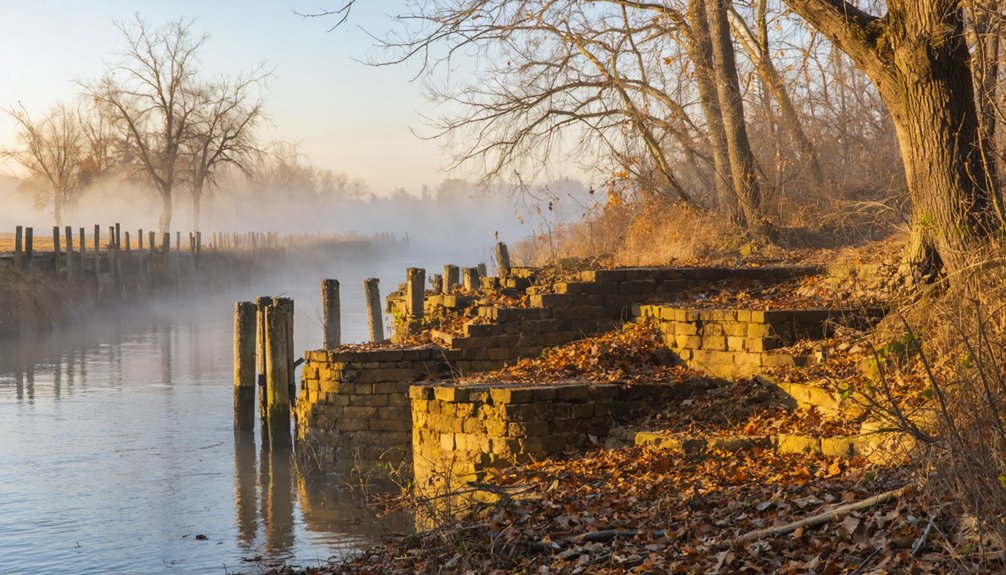
You’ll discover a vanished world when you stand beneath the Washington Avenue Bridge, where Slovak and Czech immigrants once hauled lumber from the Mississippi and climbed 79 wooden stairs to their riverside shanties.
The community’s forced removal between 1915 and 1931—complete with women wielding brooms against eviction officers—tells a stark story of urban progress erasing working-class neighborhoods.
Today, you can walk the Mississippi Gorge Regional Park trails where over 300 homes once stood, though you’ll find no physical trace of the thousand souls who called Bohemian Flats home.
Immigrant Settlement’s Cultural Heritage
Descending 79 wooden stairs from the Washington Avenue Bridge bluff in the 1860s, you’d have discovered a hidden world along the Mississippi River’s west bank—a settlement that defied Minneapolis’s orderly grid above.
Bohemian Flats thrived as a self-determined enclave where 1,200 Eastern European immigrants preserved their autonomy. Czech, Slovak, and Finnish families transformed shanties into homes adorned with pianos and Brussels carpets, speaking native tongues while maintaining traditional costumes.
Cultural preservation meant resisting conformity—women blocked evictions in 1923 with brooms, defending their squatter rights. Today’s riverside park reveals only urban decay’s erasure of this working-class refuge, cleared between 1915-1963 for industrial terminals.
The settlement’s defiant spirit lives through Ole Rolvaag’s novel and historical records documenting Minnesota’s largest river flats community.
Urban Redevelopment and Displacement
As industrial ambitions seized Minneapolis’s waterfront, the city wielded eminent domain like a wrecking ball against Bohemian Flats. You’ll find no historical preservation here—over 1,000 Eastern European immigrants watched their community vanish between 1915 and 1931.
What emerged from this calculated urban decay tells a familiar American story:
- 1915: Barge terminal construction triggered first evictions.
- 1923: Police met broomstick-wielding residents defending doorways.
- 1929: Condemnation proceedings targeted remaining 300 houses for coal terminals.
- 1963: Final structure demolished, erasing all physical memory.
The city transformed thriving riverbanks into freight yards, replacing immigrant traditions with industrial progress. Today’s I-35W bridge debris storage occupies land where families once endured annual floods and sewage-heavy waters.
Their sacrifice built Minneapolis’s navigation infrastructure—a ghost town born from government force, not abandonment.
Modern Riverside Attractions Today
Where flood-prone shanties and coal dust once defined riverside squalor, today’s Bohemian Flats offers sandy launch points for kayakers and shaded picnic tables overlooking the Mississippi River Gorge. You’ll descend the bluff via paths replacing those infamous 79 wooden stairs, reaching parkland where 300 immigrant homes once clustered.
While historical preservation here means interpretive signage rather than structures—every building vanished after 1963—the transformation freed this prime riverfront for your exploration. Launch your canoe into waters Bohemian families knew, or spread your picnic where urban gardening once sustained Eastern European households.
Fall visits reward you with blazing bluff colors framing the gorge. The northern brick terminal and southern grain facility remind you: industry consumed this community, but public access reclaimed what developers nearly buried forever.
Best Time to Visit Minnesota Ghost Towns in Autumn
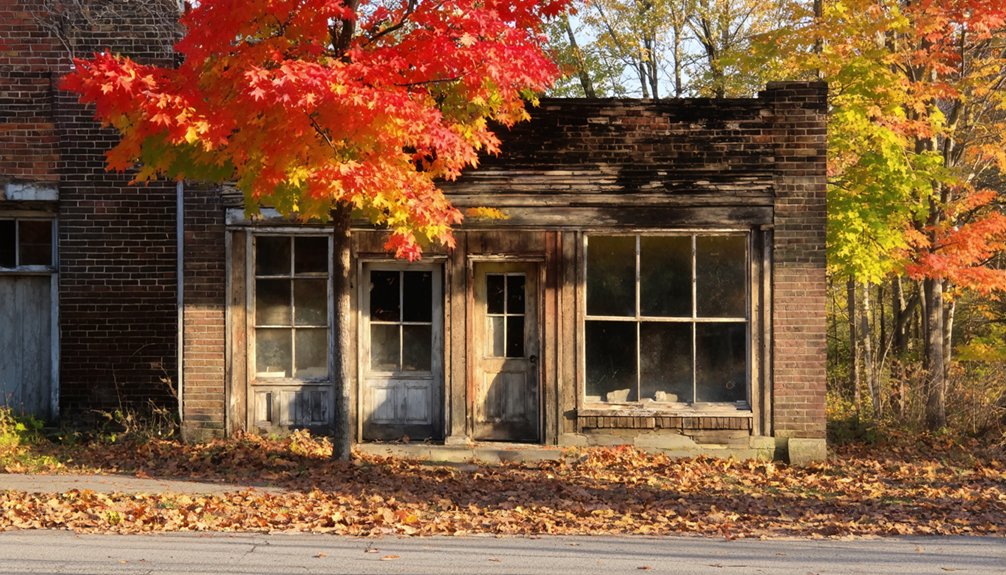
Timing your ghost town adventure perfectly transforms a simple historical visit into an unforgettable autumn spectacle.
You’ll capture the most dramatic autumn photography between September 20th and mid-October, when Minnesota’s abandoned settlements glow with russet and gold hues.
Southern sites like Forestville peak mid-to-late September, while northern locations hit their stride by early October.
For ideal exploration conditions, consider:
- Mid-September visits offer comfortable 50-60°F temperatures and accessible trails before crowds arrive.
- Early October weekdays let you photograph haunted legends at sites like Mineral Center without tourist congestion.
- Late September in southeast regions delivers vibrant colors along the Root River Trail near Whalan.
- Mid-October northern expeditions reward you with peak foliage at Voyageurs National Park’s lakeside ghost town remnants.
Low precipitation and 11-12 hour daylight windows make fall Minnesota’s prime ghost-hunting season.
What to Bring on Your Ghost Town Adventure
You’ll need to pack strategically for Minnesota’s unpredictable fall weather—I learned this the hard way when an unexpected snowstorm hit during my visit to the Forest Center site, and my inadequate jacket nearly cut the trip short.
Layer thermal clothing beneath a waterproof shell, bring sturdy waterproof boots with ankle support, and don’t forget gloves that allow you to operate your camera.
Beyond weather protection, pack navigation essentials like printed maps and a GPS device, since cell service vanishes in these remote locations.
Additionally, carry a camera and notepad to document the crumbling structures and historical details you’ll discover.
Essential Gear and Clothing
Minnesota’s abandoned settlements demand respect for both their historical significance and the unpredictable autumn weather that sweeps across the state.
You’ll need strategic layering as temperatures swing forty degrees between morning frost and afternoon sun. Pack these essentials:
- Safety gear including a headlamp, first-aid kit, and sturdy boots with ankle support for traversing crumbling foundations
- Weather protection with moisture-wicking base layers, an insulated mid-layer, and a waterproof shell
- Documentation tools like cameras and notebooks to capture details while honoring historical preservation
- Navigation equipment including GPS devices, paper maps, and a compass—cell service disappears quickly
Don’t forget leather work gloves for exploring debris safely and a daypack with extra water.
These ghost towns won’t coddle you, but proper preparation lets you explore freely without unnecessary risk.
Before you venture down crumbling Co Rd 89 toward Mineral Center or navigate the overgrown paths around Perkinsville’s brick-strewn fields, your navigation setup can mean the difference between discovery and disorientation. Pack a GPS device—cell signals fade fast in remote areas like Grand Portage Reservation. Digital mapping apps won’t help when you’re six miles deep on Old Highway 61’s rough terrain near Hovland, where four-wheel-drive becomes essential.
Your camera serves dual purposes: capturing Dorothy’s eerie abandoned structures and contributing to preservation efforts through documentation. The Cook County Historical Society relies on visitor photos to track sites like Mineral Center’s deterioration.
Study route details beforehand, respect private property boundaries at Grey Cloud Island, and remember—these crumbling remnants won’t wait forever. That scattered brick field you photograph today might vanish beneath next season’s tilling.
Combining Ghost Town Visits With Fall Foliage Tours
When autumn transforms Minnesota’s landscape into a tapestry of amber, crimson, and gold, ghost town exploration becomes doubly rewarding. You’ll discover historical preservation sites nestled within spectacular autumn landscapes, creating unforgettable adventures.
fall colors in Minnesota ghost towns provide a striking backdrop for photography enthusiasts and history buffs alike. The remnants of once-thriving communities are beautifully framed by vibrant foliage, inviting visitors to wander through time. Each turn reveals a new perspective, combining the stark beauty of decay with the warmth of autumn hues.
Northwest Minnesota offers premier combinations:
Northwest Minnesota delivers the perfect pairing of historical ghost towns and breathtaking fall foliage for adventurous explorers.
- Itasca State Park showcases sugar maples in brilliant red and aspens radiating gold near multiple ghost town sites.
- Buena Vista State Forest hosts the Fall Color Festival with food and live music among northern hardwoods.
- Goodhue County features 60-plus ghost towns marked by roadside signs alongside autumn woodland clusters.
- Lake Bemidji’s Bog Walk provides immersive foliage viewing near abandoned settlements.
Peak season arrives when crisp air carries rustling leaves underfoot. Forestville’s restored 1890s buildings gain atmospheric depth against seasonal colors.
Meanwhile, Whalan’s Stand Still Parade celebrates harvest time along the Root River State Trail’s vibrant corridors.
Nearby Attractions and Accommodations
Since ghost towns rarely offer modern conveniences, you’ll need to plan accommodations in nearby communities that combine comfort with strategic access to multiple sites. Rochester serves as your southern Minnesota basecamp, positioning you within an hour of nine ghost towns where historical preservation efforts have transformed abandoned settlements into compelling destinations.
Exploring historic sites in Minnesota can provide a unique glimpse into the state’s rich past and cultural heritage. From the remnants of former mining towns to beautifully restored buildings that tell stories of early settlers, there is much to discover. Make sure to allocate time for each visit, as these sites often offer guided tours and informative exhibits to enhance your experience.
Up north, Grand Marais provides lodging near Chippewa City, while Ely accommodates explorers heading to Mineral Center’s wilderness ruins.
Minneapolis hotels work perfectly for touring Bohemian Flats and Falls City along the Mississippi River, where cultural heritage markers document immigrant communities. Preston and Wykoff offer proximity to Forestville‘s restored 1890s buildings.
Each hub delivers restaurants, supplies, and local expertise—essential support for your freedom-seeking adventures into Minnesota’s forgotten corners where autumn colors frame these haunting reminders of pioneering ambition.
Frequently Asked Questions
Are These Ghost Towns Safe to Explore With Children?
Several ghost towns are child-safe due to preservation efforts and historical significance. You’ll find Forestville, Bohemian Flats, and Taylors Falls offer maintained trails and guided tours. However, you should avoid decayed sites like Elcor where unstable structures pose real dangers to curious kids.
Do Any Ghost Towns Charge Admission Fees?
You’ll be thrilled—most Minnesota ghost towns are absolutely free to explore! Historical preservation efforts keep sites like Forestville open without admission fees. However, organized ghost tours featuring haunted legends typically charge $15-$54, depending on your chosen experience.
Can I Bring My Dog to Minnesota Ghost Towns?
You can bring leashed dogs to most Minnesota ghost towns like Chippewa City and Leaf River. However, Forestville requires guided tours through historic buildings where pets aren’t allowed. Always respect local myths about wildlife and check current regulations beforehand.
Are the Ghost Towns Wheelchair Accessible?
Sadly, Minnesota’s ghost towns are wheelchair accessibility nightmares—overgrown ruins lack ramps or paved paths. Historical preservation hasn’t prioritized access. You’ll find better photography opportunities at nearby accessible attractions like Bohemian Flats’ urban trails or Glensheen Estate’s adapted tours instead.
What Cell Phone Coverage Can I Expect at These Locations?
You’ll find excellent cell reception in Minneapolis locations like Bohemian Flats and Reyataotonwe with full 5G coverage. However, rural Forestville and Leaf River have spotty coverage areas—download maps beforehand and embrace the digital detox adventure!
References
- https://www.minnesotahauntedhouses.com/fall-attractions/
- https://www.exploreharmony.com/follow-the-call-of-fall-exploring-harmony-mn/
- https://thievesriver.com/blogs/articles/ghost-towns-in-minnesota
- https://screamtown.com
- https://quickcountry.com/minnesota-ghost-towns/
- https://www.littlefallsmn.com/fall-in-love-with-little-falls-mn/
- https://www.youtube.com/watch?v=10pR1My6V7g
- https://www.exploreminnesota.com/seasons/fall/spookiest-places-minnesota
- https://www.mngoodage.com/voices/mn-history/2019/07/a-ghost-town-turned-history-site/
- https://kdhlradio.com/forestville-named-the-creepiest-and-coolest-ghost-town-in-minnesota/