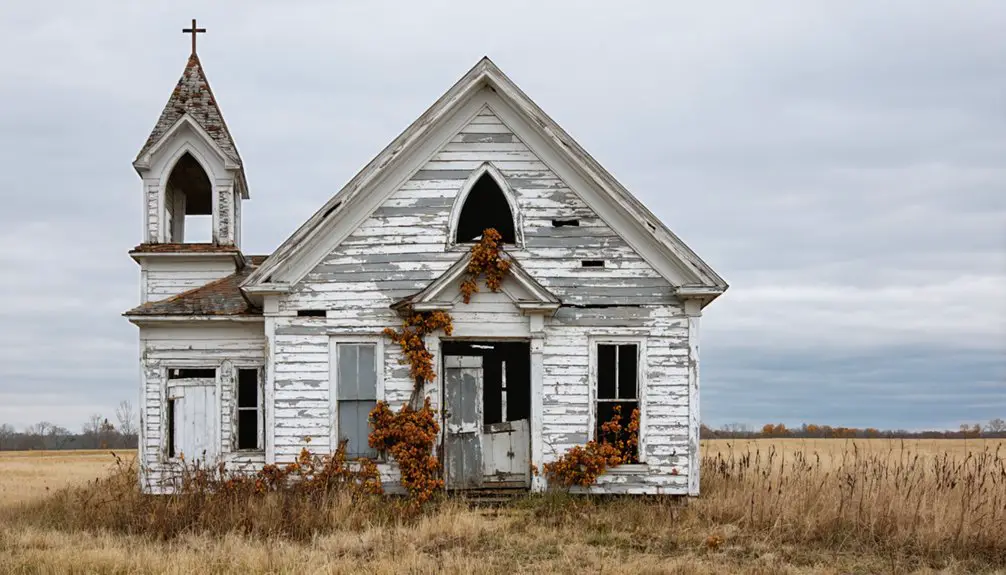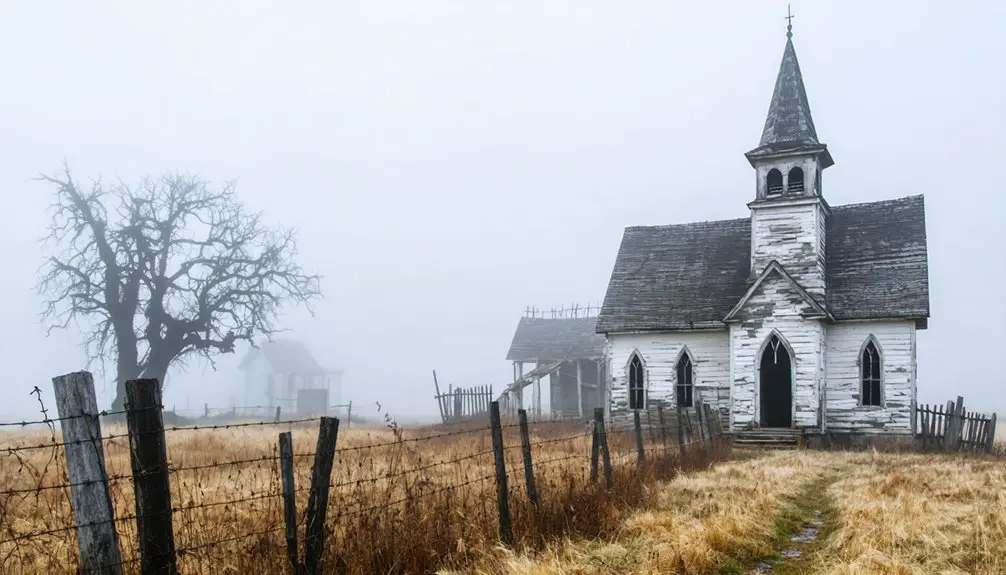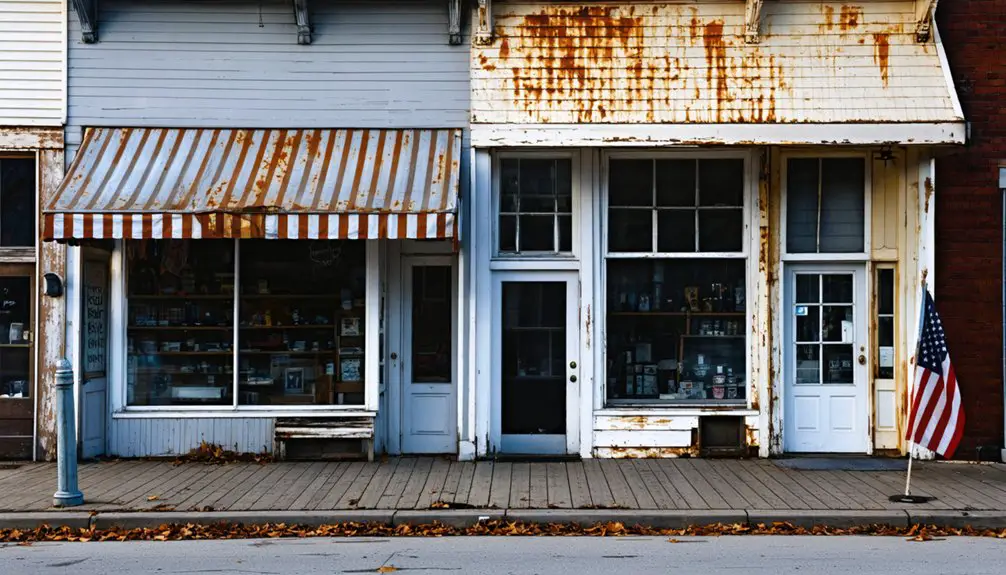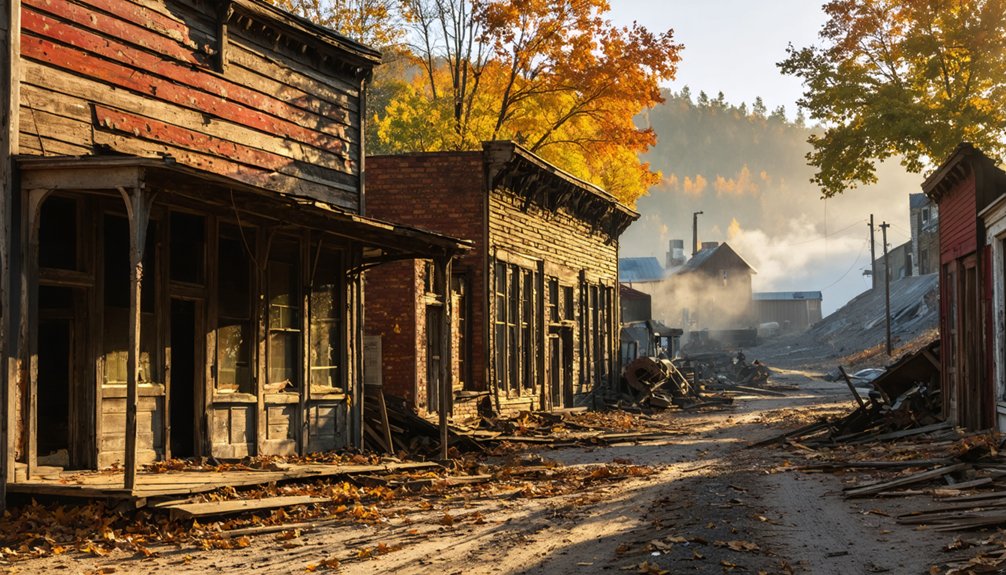
You’ll find Missouri’s most haunting ghost towns come alive during fall when amber leaves soften abandoned structures. Windyville’s crumbling 1920s cannery echoes with unexplained screams, while Black Forest near Cape Girardeau offers genuine paranormal experiences among its Wild West ruins. The Missouri State Penitentiary—nicknamed the “bloodiest 47 acres in America”—provides chilling tours through gas chambers and cellblocks. Mid-October through early November offers peak foliage, fewer crowds, and perfect temperatures for exploring these weathered sites where history lingers in every shadowed corner.
Key Takeaways
- Windyville Ghost Town features a crumbling 1920s cannery, haunted cemetery with children’s laughter, and locals call it “spookyville.”
- Black Forest Haunted Ghost Town in Cape Girardeau offers four nightmare attractions rooted in Wild West dark history legends.
- Ha Ha Tonka State Park showcases castle ruins with 60-room mansion foundations best explored during fall’s seasonal colors.
- Missouri Workhouse provides historic prison atmosphere softened by autumn foliage, ideal for fall visits amid urban decay.
- Cementland presents 54 acres of abandoned cement machinery transformed into industrial art along the Mississippi River.
Black Forest Haunted Ghost Town: Missouri’s Longest Running Haunt Enters Final Season
The fog rolls thick across the dusty paths of Black Forest Haunted Ghost Town, clinging to weathered wooden structures like spirits that refuse to leave. You’re stepping into Missouri’s longest-running haunt for its final season—a bittersweet farewell to haunted legends that have terrified visitors for decades at 2728 Co Rd 638 in Cape Girardeau.
Every weekend starting October 4, you’ll navigate four distinct nightmares: Nightmare Mansion’s creaking halls, Cain’s Asylum’s twisted corridors, The Tool Shed’s blood-stained implements, and Freak Show Farms’ grotesque inhabitants.
These ghostly legends emerge from Wild West darkness, surrounding you with sinister figures lurking in shadows. The area’s supernatural reputation extends beyond the haunt itself—nearby Bloomfield Road has sparked reports of strange radio transmissions and floating lights for decades. FrightFind’s location guides help you discover this and other paranormal experiences across the state. Whether you’re chasing thrills or exploring Cape Girardeau’s spooky heritage, this immersive ghost town delivers genuine scares before it vanishes forever.
Windyville Ghost Town: Where Screams Echo From the Old Cannery
You’ll hear the screams before you see the crumbling cannery—bloodcurdling wails that slice through Windyville’s autumn silence from a building that hasn’t processed food in decades.
As darkness falls over the cemeteries, children’s laughter drifts between weathered headstones marking graves from the 1800s. Their giggles are somehow both innocent and unsettling. A horseback rider is rumored to guard the cemetery, appearing as a spectral sentinel among the graves.
The general store still stands with its 1920s character intact, but step inside any of Windyville’s remaining structures and you’re walking into a building with its own ghost story. After purchasing your 15-cent bologna sandwich, you can explore the rooms for rent upstairs, each with its own bathroom and a breakfast waiting in the morning.
Eerie Cannery Screams Persist
Adjacent to Windyville’s weathered general store stands a crumbling structure that locals won’t approach after dark—the old 1920s cannery where unexplained screams pierce the silence.
For years, paranormal investigations have documented these bone-chilling cries echoing through the dilapidated walls, drawing ghost hunters from across the state.
You’ll hear accounts from longtime residents who’ve experienced the phenomena firsthand—disembodied wails that seem to emanate from nowhere and everywhere at once.
The current owner’s purchased these 30 acres for historical preservation, planning to transform the haunted ruins into an event venue while maintaining its eerie character.
Whether you’re a skeptic or believer, there’s something unsettling about standing near those crumbling walls at dusk, waiting to hear what generations of visitors have reported experiencing. The factory once processed 96,000 cans of tomatoes in 1925, marking a record year for Windyville’s agricultural operations. The vintage-style shop now sells root beer, float treats, candies, and the famous 15-cent bologna sandwich, connecting visitors to the town’s past.
Cemetery Laughter After Dark
When darkness settles over Windyville’s historic cemetery, visitors report something that sends chills down even the most seasoned ghost hunter’s spine—the unmistakable sound of children’s laughter drifting between weathered headstones.
Historical folklore traces these eerie giggles to multiple child deaths during the 1800s, and the phenomena persist today according to documented accounts.
You’ll hear voices echoing through the burial grounds long after sunset, where spirits of deceased children allegedly manifest as playful laughter.
The 2005 Reflex newspaper compiled eyewitness reports of these unexplained sounds.
Children’s stories passed through generations claim these restless young souls continue their games eternally among the graves.
Near Native American burial grounds and Civil War-scarred earth, the cemetery remains Windyville’s most haunting landmark—where innocence and tragedy intertwine in spectral form.
Despite Windyville’s reputation as a ghost town, a few remaining residents still inhabit the area, adding to the mystery of who—or what—witnesses these paranormal occurrences.
Abandoned Buildings Hold Secrets
The old cannery looms beside Windyville’s general store like a specter from the 1920s, its deteriorating walls concealing something far more disturbing than rusted equipment and rotting timbers. You’ll hear the screams before you see the building—visitors consistently report terrifying sounds erupting from within this haunted architecture.
Walk through on one of the available tours, and you’ll understand why this ranks among Missouri’s most actively haunted locations. Heavy footsteps echo through empty corridors where no one stands.
The secret hauntings extend beyond the cannery itself—abandoned houses and a rundown mill scattered throughout town pulse with unexplained phenomena. Locals have dubbed this unincorporated community “spookyville” due to the persistent reports of paranormal activity dating back generations.
Red eyes watch from darkness near the bridge. You’re free to explore these ruins, but some mysteries demand a price for discovery.
Missouri State Penitentiary: The Bloodiest 47 Acres in America
You’ll stand where 40 condemned men drew their final breaths in the gas chamber, a green-painted room that still holds the chemical tang of death decades later. The limestone walls of this 168-year-old fortress witnessed such brutality that Time Magazine couldn’t find gentler words than “bloodiest 47 acres in America” to describe it.
Today’s tours let you walk through cellblocks and execution chambers where James Earl Ray and “Pretty Boy” Floyd once counted their days, transforming Missouri’s most notorious maximum-security prison into one of the state’s darkest historical attractions. Operating continuously from 1836 until 2004, this penal institution holds the distinction of being the first state prison built west of the Mississippi River. The inmate-constructed buildings contributed significantly to Jefferson City’s development, including the governor’s mansion, with many of these early structures still standing today.
Historic Prison Tours Available
Standing before the weathered limestone walls of Missouri State Penitentiary, you’ll feel the weight of 168 years of history pressing down on this 47-acre compound in Jefferson City.
The state-owned facility now opens its cells to curious visitors seeking authentic experiences beyond sanitized tourist attractions.
Your guided tour navigates through authentic prison architecture where 5,300 souls once lived behind bars.
- Walk through housing units where Pretty Boy Floyd and James Earl Ray plotted their escapes.
- Stand inside the gas chamber where Missouri executed its condemned.
- Explore the riot-scarred buildings from 1954’s deadly uprising.
- Hear inmate stories from guards who witnessed boxing champion Sonny Liston transform himself.
Tours run March through November through Jefferson City’s Convention & Visitors Bureau, offering daylight history walks and evening paranormal investigations for those craving unfiltered historical truth.
Gas Chamber Execution History
Beyond the prison’s crumbling cellblocks and guard towers lies its most chilling artifact: a small, sealed room where 40 condemned souls breathed their last between 1938 and 1989.
You’ll stand where cyanide gas once swirled, ending lives within six minutes of exposure. The chamber replaced public hangings when Governor Stark centralized executions here, though historical ethics questions still haunt these walls—more than half the executed were Black men.
You can peer through the viewing window where families watched, including Bonnie Heady’s relatives who funded their own observation room in 1953.
Preservation efforts maintain this controversial space intact, forcing you to confront America’s capital punishment legacy.
It’s authentic history, uncomfortable and uncensored—exactly what independent-minded travelers seek.
Ha Ha Tonka State Park: Exploring Castle Ruins Above Lake of the Ozarks
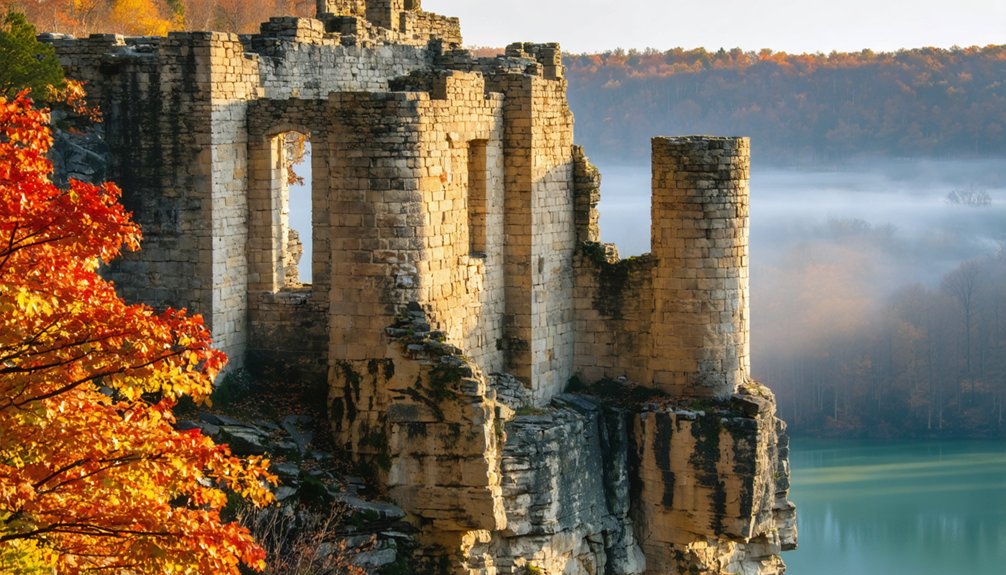
When you round the final bend of the trail and the castle ruins materialize through the oak canopy, you’ll understand why Robert Snyder spent a fortune recreating European grandeur on this Missouri bluff.
The crumbling sandstone walls stand as monuments to ambition cut short—Snyder died in 1906, his sons completed construction by 1922, and fire consumed everything in 1942.
Castle preservation efforts let you wander freely through:
- 60-room mansion foundations overlooking Lake of the Ozarks
- Stone stable remnants where European masons once worked
- 80-foot water tower with five-story living quarters
- Scenic overlooks above the spring-fed waters
Ruins exploration here means touching history without velvet ropes.
Seventeen miles of trails wind through sinkholes and natural bridges, offering unrestrained access to architectural ghosts.
Cementland: An Artist’s Unfinished Castle Vision in Jefferson City
How does an artist turn sixty tons of abandoned cement machinery into a castle? Bob Cassilly proved it’s possible at Cementland, transforming a defunct Portland cement plant into climbing pyramids and concrete giants along the Mississippi. You’ll find this 54-acre playground of urban decay in Riverview, where rust meets artistry and obsolete industry becomes adventure.
The sculptor behind City Museum envisioned waterways threading through cement sculpture gardens, bridges spanning forgotten depressions, and a castle rising from factory bones. His 2011 death left the vision incomplete, yet the skeletal structures remain hauntingly beautiful.
Purchased in 2022 for $785,000, much has been cleared, but you can still glimpse what freedom looks like when an artist refuses to accept abandonment as an ending.
Kansas City Workhouse: Prison Turned Urban Art Gallery
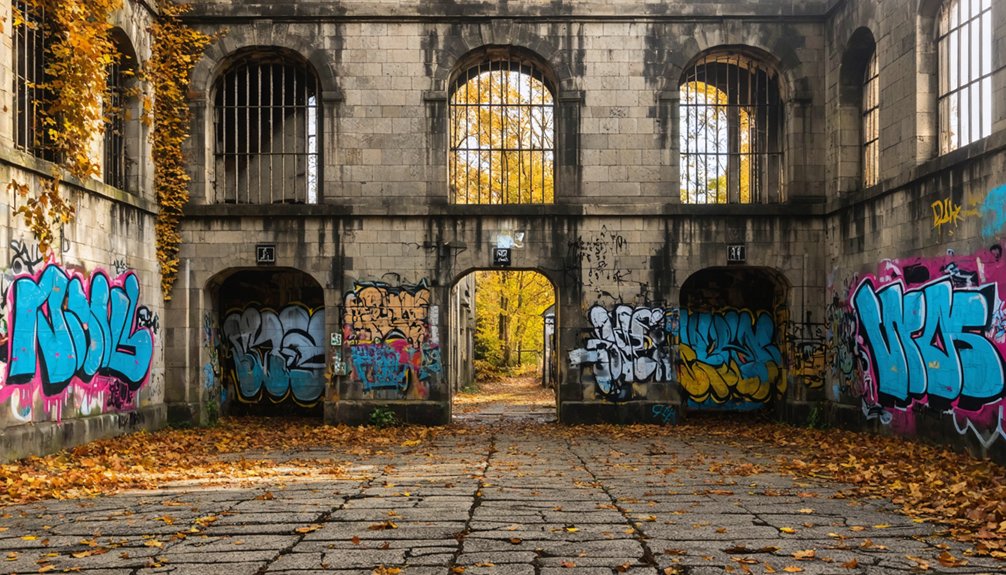
The workhouse’s evolution tells a distinctly American story:
- Women sewed uniforms while men labored on public works.
- Corruption investigations closed it by 1924.
- Over a dozen repurposing attempts failed.
- Community restoration plans were blocked by municipal politics.
Walk these grounds during fall, when seasonal colors soften the stone’s harsh history.
Planning Your Ghost Town Adventure: What to Bring and Expect
Before your boots hit the crumbling threshold of your first Missouri ghost town, you’ll want your backpack loaded with essentials that match the terrain’s demands. Pack sturdy shoes with ankle support, layered clothing for unpredictable fall weather, and a reliable headlamp for shadowy interiors where sunlight hasn’t penetrated in decades.
Preparation separates curious wanderers from reckless explorers—your gear determines whether abandoned corridors reveal their secrets or their dangers.
Your camera becomes vital here—photography tips include shooting during golden hour when rust-colored walls glow amber, and capturing wide angles that showcase historical preservation efforts alongside nature’s reclamation.
Expect overgrown paths, weathered foundations, and structures that groan with age. Some sites offer guided experiences with visitor centers, while others present only skeletal remains demanding careful navigation.
Update your tetanus shot beforehand, respect trespassing laws, and embrace the possibility that Missouri’s 300+ abandoned locations hold stories you’ll uncover through careful exploration.
Best Times to Visit Missouri’s Haunted Locations This Fall
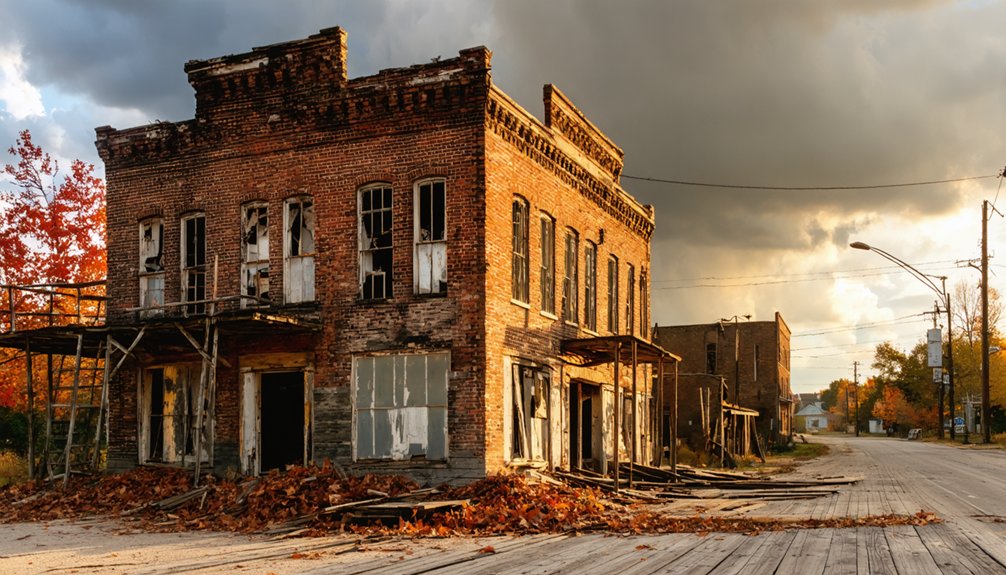
Timing transforms your Missouri ghost town expedition from ordinary to otherworldly. You’ll catch peak foliage between mid-October and early November while exploring abandoned settlements along Route 66.
The Ozark Mountains blaze with autumn colors as you wander through forgotten streets. Fall’s cooler temperatures make outdoor exploration comfortable after summer’s heat.
Prime visiting windows for maximum thrills:
- Arrive at haunted house attractions by 6:30pm on Fridays for shorter lines
- Book neighborhood ghost tours Friday or Saturday evenings at 5pm
- Explore daylight ghost towns during first warm fall weekends
- Schedule Missouri State Penitentiary tours for 2-hour evening investigations
You’ll find fewer crowds at museums and historic sites during fall’s off-season, giving you freedom to roam at your own pace through America’s most haunted locations without summer’s tourist rush.
Combining Ghost Town Visits With Other Ozarks Autumn Activities
While abandoned streets whisper their forgotten stories, Missouri’s Ozarks burst alive with October’s carnival atmosphere—and you’ll discover these contrasts create unforgettable autumn adventures.
Where October’s ghostly silence meets carnival chaos, the Ozarks transform ordinary autumn into spine-tingling adventure.
Design haunted road trips linking Myers Forest of Fears‘ greenhouse pathways with Spook Light viewing near Oklahoma’s border (best 10 p.m.-midnight). You’ll traverse Bennett Spring State Park‘s crimson foliage before sunset, then chase Windyville’s cannery screams after dark.
Autumn ghost tours gain dimension when paired with Tombstone’s haunted hayride at Creepyworld or Waynesville’s half-mile river float featuring zombie ambushes. Between scares, grab gourds and corn stalks at patches offering bounce pillows and tri-cycle tracks.
Cap adventures at Missouri State Penitentiary in Jefferson City, where 39 gas chamber executions haunt limestone corridors. Freedom means crafting your own paranormal itinerary without tourist-trap constraints.
Frequently Asked Questions
Are Missouri Ghost Towns Safe to Visit With Children?
Many Missouri ghost towns offer safe family adventures with historical preservation efforts ensuring accessible paths and facilities. You’ll encounter wildlife while exploring maintained trails, though you should research each site’s specific conditions and contamination history beforehand.
As you embark on these adventures, consider visiting some of the lesser-known ghost towns in Missouri to explore the remnants of a rich past. Each town tells its own story through abandoned buildings and historic landmarks that can spark the imagination. Don’t forget to take plenty of photos to capture the eerie beauty of these hidden gems.
As you explore historical sites in Missouri’s landscapes, you’ll discover a variety of unique stories that showcase the state’s vibrant history. Each location presents an opportunity to delve into the past while enjoying the natural beauty surrounding these sites. Engaging with local guides can also provide deeper insights into the significance of each historical landmark you encounter.
Do I Need Permission to Explore Abandoned Locations in Missouri?
Yes, you’ll need permission to explore most abandoned locations in Missouri. Despite their allure, private property rights and legal restrictions protect these crumbling spaces. Seeking owner consent lets you roam freely without risking arrest or fines.
Are Ghost Tours Wheelchair Accessible at These Locations?
Don’t let barriers clip your wings—accessibility options vary dramatically. Hannibal’s ghost tours aren’t wheelchair-friendly, but Dead Factory Haunted House welcomes everyone with full wheelchair amenities. You’ll find dusty gravel paths challenging at Missouri Town, limiting your exploration freedom.
Can I Bring My Dog to Missouri Ghost Towns?
You’ll find pet friendly spots at Missouri’s state park ghost towns like Ha Ha Tonka, where dog friendly trails welcome leashed companions through autumn leaves and crumbling ruins. Just keep Fido outside castle structures for everyone’s safety.
Are There Hotels Near These Missouri Ghost Town Attractions?
You’ll find hotels within 1-15 miles of each attraction, making historic preservation exploration easy. Downtown Jefferson City’s Truman Hotel sits just miles from the penitentiary, offering prime photographic opportunities while you chase spine-tingling adventures independently.
References
- https://www.missourihauntedhouses.com/fall-attractions/
- https://www.blackforesthaunted.com
- https://visitcape.com/spooky-fun-in-cape-girardeau/
- https://www.hauntworld.com/find-top-best-pumpkin-patches-attractions-in-missouri-near-me
- https://www.417mag.com/issues/october-2018/halloween-springfield-missouri/
- https://mostateparks.com/park/ha-ha-tonka-state-park
- https://www.youtube.com/watch?v=-CQMZGaRPtM
- https://www.atlasobscura.com/things-to-do/missouri/abandoned
- https://www.youtube.com/watch?v=PwxitjsqExM
- https://frightfind.com/black-forest-haunted-ghost-town/