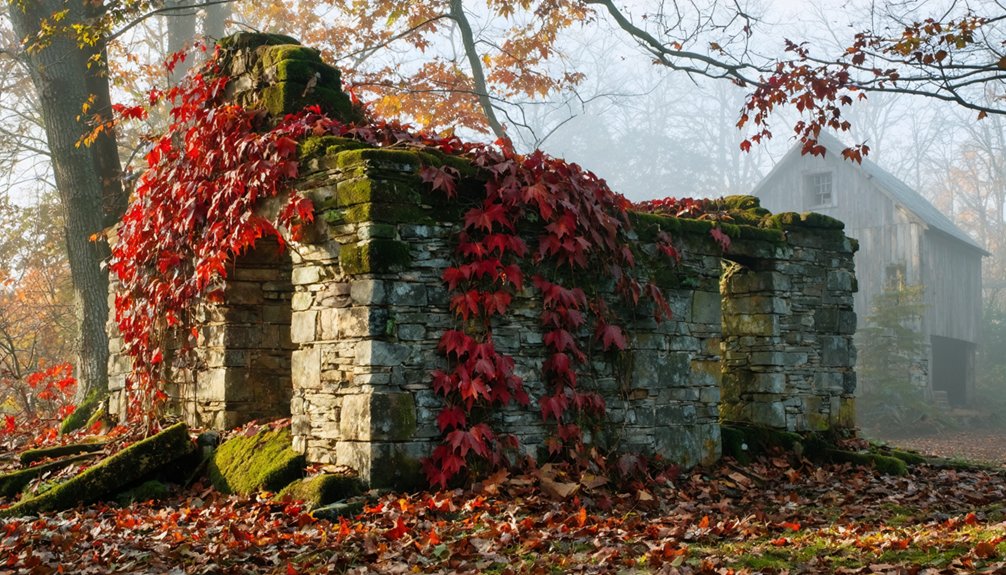
You’ll find Rhode Island’s most atmospheric ghost towns at their peak in mid-October, when crimson foliage frames Hanton City’s stone foundations in Smithfield’s woods and Napatree Point’s coastal ruins in Westerly. Foster’s Ram Tail Factory and the 1736 Arnold Estate offer haunting colonial glimpses, while the abandoned Ladd School grounds echo institutional history. Visit on weekday mornings between October 10-20 for ideal lighting and solitude—bring sturdy boots, offline maps, and your camera. The stories behind these crumbling settlements reveal fascinating chapters of Rhode Island’s hidden past.
Key Takeaways
- Hanton City in Smithfield features stone foundations and cellar holes deep in woods, with peak foliage in early October enhancing exploration.
- Napatree Point in Westerly offers coastal fort ruins and hurricane-swept cottage foundations, now a conservation area with ongoing natural reshaping.
- Ram Tail Factory in Foster displays abandoned mill ruins with stone foundations, accessible via trails off Route 6 near a historic cemetery.
- Arnold Estate in Burrillville, built in 1736, combines colonial architecture with haunted legends amid protected woodland ideal for fall visits.
- Mid-October provides optimal conditions with vibrant foliage and 50–60°F temperatures; weekday mornings offer solitude for photography and exploration.
Hanton City: Explore the Forgotten Settlement in Smithfield
Deep in Smithfield’s woods, stone foundations emerge from the forest floor like forgotten memories, marking where Hanton City once thrived as a self-sufficient settlement. You’ll discover crumbling cellar holes and stone walls where yeoman families—the Paines, Hantons, and Shippees—built their lives after King Philip’s War.
Archaeological discoveries reveal their trades: tanning leather, quarrying stone, and crafting boots they’d barter in Providence. Metal detectors have uncovered vintage bottles and cans, some still sealed, scattered among the ruins alongside old ceramic pieces and artifacts from the settlement’s daily life.
Historical myths cloud this “Lost City’s” past. Some claim it housed British Loyalists or runaway slaves, while others whisper about disease victims. Truth’s simpler: when mills offered better wages in the 1800s, residents abandoned their hand-crafted economy. The settlement reached its peak by the 1730s, coinciding with Smithfield’s incorporation as families established their foothold in this remote woodland community.
You’ll find Alfred Smith Cemetery‘s weathered headstones and an irrigation dam hidden among the trees—silent witnesses to lives lived beyond society’s reach.
Napatree Point: A Coastal Military Ghost Town in Westerly
- Military heritage: Fort Mansfield’s 1898 coastal defenses, abandoned by 1917.
- Lost neighborhood: 39 summer cottages blown into Little Narragansett Bay during the 1938 hurricane.
- Natural reclamation: Storm-driven ecosystem where forests never returned after 1815’s Great September Gale.
Walk the 1.5-mile peninsula freely—preservation efforts since 1945 protect this 86-acre conservation area from development.
You’ll find no crowds, no restrictions, just sand, sky, and crumbling fortifications.
The name Napatree itself comes from the “Nap of Trees” that once covered this point when Dutch explorer Adriaen Block charted these waters in 1614.
A major design flaw discovered in 1907 revealed enemy ships could sail beneath the fort’s shell trajectory, sealing its military fate.
The breachways cut by that catastrophic hurricane still separate Sandy Point, now drifting northward as longshore drift continues reshaping this haunted coastline.
Ram Tail and Mill Factory: Foster’s Abandoned Industrial Village
While Napatree Point’s ghosts haunt open beaches where hurricanes swallowed entire neighborhoods, Rhode Island’s most officially recognized haunted site hides deep in Foster’s forests.
Ram Tail Factory’s stone foundations mark where mill owner Peleg Walker met his violent end in 1822—throat slit on his final night of ownership. The 1885 state census actually listed this place as haunted.
You’ll find the ruins off a dirt road, where abandoned machinery once spun itself without power and workers fled believing in curses. The factory ceased operation around 1873 when it was deliberately set on fire, completing its transformation from industrial hub to ghost town. Haunted legends claim Walker’s lantern still glows through the trees at dawn.
Take Route 6 west, turn onto Ram Tail Road past the cemetery, and follow the trail beyond Central Pike. The foundation walls sit peacefully beside the stream, reclaimed by wilderness—no apparitions required. A short walk down Danielson Pike reveals a haunted bridge where quicksand once claimed swimmers in a now-vanished swimming hole.
Arnold Estate: Step Back to 1736 Colonial Rhode Island
You’ll find yourself transported to 1736 when you explore the Arnold Estate’s weathered colonial farmhouse, where centuries-old architecture stands frozen in time amid the fall foliage of Burrillville.
The property’s mysterious past—documented in local legends and the infamous “Black Book of Burrillville”—adds an eerie dimension as you wander through rooms that have witnessed nearly three centuries of New England history. The estate gained widespread attention as the inspiration for the 2013 horror film “The Conjuring,” based on the Perron family’s experiences during the 1970s.
Plan your autumn visit for late afternoon when the golden October light casts long shadows across the original colonial structure, and bring a camera to capture the rustic timber frames and period details that transport you straight back to pre-Revolutionary Rhode Island. Note that the house is currently inaccessible to visitors, so you’ll need to check ahead for any future openings or viewing opportunities.
Colonial Architecture and Ruins
Standing at 1677 Round Top Road in Harrisville village, you’ll find yourself before a rare architectural treasure that predates the American Revolution by forty years. This 1736 farmhouse, spanning over 1,000 acres originally, stands as proof of colonial independence and self-sufficiency.
The estate’s authentic colonial features transport you back to pre-Revolutionary times:
- Great Chamber – housed 12 Arnold family members above the Great Room
- Public house operations – travelers rented cots in the small guest room off the Great Room
- Strategic location – positioned on Great Road connecting to Providence
Unlike a Medieval castle or Revolutionary battleground, this farmhouse reveals intimate colonial daily life. The property sits within protected woodland, making it an ideal spot for a picnic while exploring the historic Great Road corridor. The estate changed ownership multiple times throughout its history before becoming the private residence known today.
You’ll discover how early Americans carved out freedom through practical architecture designed for both family living and entrepreneurial hospitality.
Mysterious Historical Past
Before the ink dried on the Declaration of Independence, the Arnold Estate had already weathered four decades of New England winters and the brutal raids of King Philip’s War.
You’ll discover a structure that’s witnessed America’s fight for independence firsthand—built in 1736, it survived conflicts that reshaped a nation.
The cultural significance runs deeper than aged timber and colonial craftsmanship. Mrs. John Arnold’s 1797 suicide at 93, Bathsheba Sherman‘s alleged witchcraft, and the Perron family’s documented terrors have cemented this location’s haunted legends.
Ed and Lorraine Warren’s dramatic 1970s investigation—complete with séances and possessions—transformed 1677 Round Top Road into paranormal folklore.
You’re standing where freedom was forged and where darkness allegedly dwells. The line between history and horror blurs here.
Autumn Exploration Tips
Planning your autumn visit to 1677 Round Top Road requires steering 26.2 miles northwest from Providence into Burrillville’s countryside, where State Route 96 delivers you to Harrisville village—just a quarter-mile from the Massachusetts border. The fall foliage transforms this haunted history site into something extraordinary.
Essential preparation for your Colonial encounter:
- Book ghost tours or paranormal investigations ahead—availability fills quickly during October’s peak season.
- Arrive during golden hour—late afternoon light illuminates the 1736 farmhouse against crimson maples.
- Check Airbnb listings—overnight stays let you experience the property’s authentic atmosphere beyond daylight hours.
Current owner Jacqueline Nuñez maintains the location for visitors seeking genuine Colonial engagement.
You’ll find cars parked along the property as groups explore where Roger Williams’ followers once carved civilization from wilderness, and where the Perron family confronted unexplained phenomena decades later.
Ladd School: A Haunting Reminder of the Past
Tucked away in the woods of Exeter, Rhode Island, the crumbling remains of Ladd School stand as one of New England’s most haunting abandoned sites. Founded in 1908, this former institution housed over 4,500 people before closing in 1994 amid abuse scandals and legal action.
You’ll find decaying cottages scattered across 331 acres, though most buildings were razed by 2016. Haunted legends swirl around the property—visitors report unexplained sounds and shadowy figures among the ruins. Preservation efforts focus on documenting nearly 1,000 photographs and oral histories through independent documentaries like “Best Judgment.”
While exploring, respect posted boundaries and remember the thousands who suffered here. This isn’t just abandoned architecture—it’s a sobering reminder of institutional failures and society’s evolution toward community-based care.
The Conjuring House: Where History Meets the Paranormal
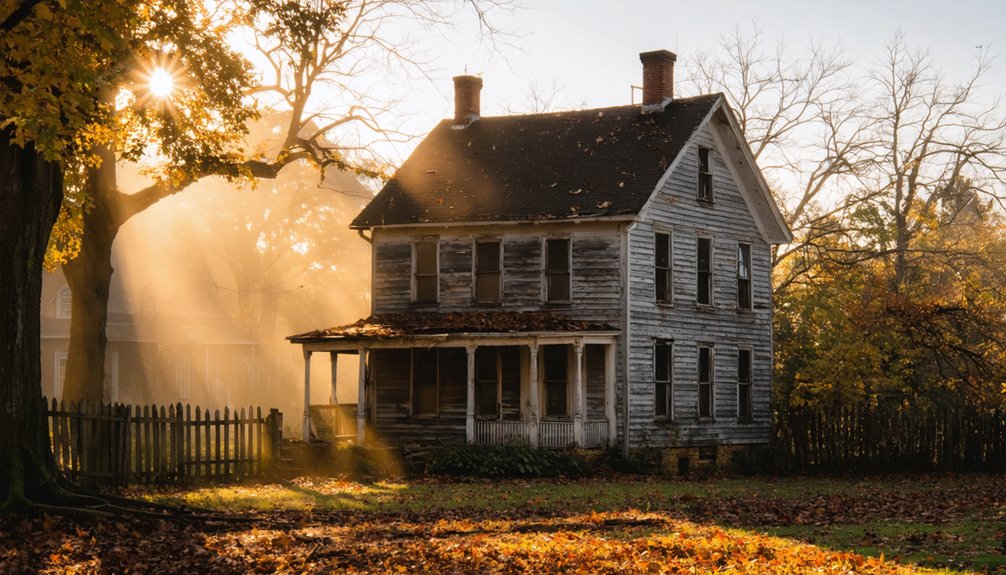
Standing since 1736, the weathered colonial farmhouse in Burrillville’s Harrisville village has witnessed nearly three centuries of American history—and allegedly, something far more unsettling.
The Perron family’s decade-long residency sparked haunted legends that captured Ed and Lorraine Warren’s attention in 1973. Their paranormal investigations claimed malevolent spirits roamed the 14-room structure, inspiring 2013’s blockbuster “The Conjuring.”
You’ll discover the property’s complex legacy includes:
- Authentic colonial architecture predating American independence by 40 years
- Warren case files documenting unexplained phenomena like synchronized clock stoppages at 3:07 AM
- Recent controversy surrounding tourist operations that permanently closed in 2025
While the business has shuttered amid scandal, the farmhouse itself remains a testament to New England’s intertwined relationship with history and the unexplained.
Best Times to Visit Rhode Island’s Ghost Towns This Fall
You’ll find mid-October offers the sweet spot for ghost town exploration, when sugar maples frame crumbling foundations in crimson and gold.
Plan your visits for weekday mornings at Hanton City or Ram Tail Factory—you’ll navigate the ruins without competing for parking or photo angles.
Temperatures hover around 55°F, making for comfortable hiking.
Weekend crowds surge near Halloween, particularly October 25-31.
Early October Peak Foliage
When the calendar flips to early October, Rhode Island’s ghost towns transform into something extraordinary—crumbling stone foundations peek through carpets of scarlet and gold, and abandoned wells reflect brilliant amber canopies overhead.
Providence and inland areas hit peak foliage first, making this your prime window for exploring Hanton City’s 1730s ruins in Smithfield. The folklore legends surrounding these abandoned cellar holes feel more tangible when surrounded by vivid autumn color.
Photography tips for early October ghost town visits:
- Shoot during golden hour when low-angle sunlight illuminates both foliage and weathered stone
- Frame colonial-era foundations against the northwest’s brightest woodland colors
- Capture reflections in historic wells before leaves blanket the ground
The Scituate Loop circles the reservoir, connecting multiple abandoned settlements while mirrored water views double your foliage impact.
Weekday Versus Weekend Crowds
Weekday mornings offer unrestricted access to these forgotten places. You’ll have cellar holes and cemetery stones to yourself, capturing that authentic sense of discovery without dodging selfie-takers.
Tour timing becomes essential during October’s peak foliage—arrive at sunrise on Tuesdays or Wednesdays for maximum solitude. The crunch of leaves underfoot becomes your soundtrack, not distant conversations.
Freedom means choosing your own pace through history’s remnants.
Weather and Safety Considerations
Rhode Island’s fall weather creates a narrow window of perfect conditions—typically mid-September through late October—when temperatures hover in the comfortable 50s to low 60s. You’ll find vibrant foliage enhancing your exploration of ruins while avoiding summer’s oppressive heat.
This season perfectly aligns with ghost stories and haunted legends that make these sites legendary.
Essential Safety Gear for Ghost Town Exploration:
- Sturdy footwear for steering cellar holes and rocky terrain at Hanton City
- Flashlight for dark ruins and wooded paths where cell service fails
- First aid kit for unexpected trips on unstable foundations
Download offline maps before venturing out—remote locations won’t save you. Watch for crumbling structures, hidden wells, and swampy ground. Verify property access beforehand; trespassing charges aren’t worth it.
Early fall maximizes daylight hours before winter’s early sunsets eliminate safe exploration.
What to Bring on Your Ghost Town Adventure
As fall temperatures dip and coastal winds whip across abandoned settlements, packing the right gear transforms a ghost town visit from uncomfortable stumble to thrilling adventure. You’ll need layered clothing and waterproof jackets for Napatree Point‘s unpredictable coastal rain, while sturdy boots navigate Hanton City‘s brush-choked trails.
Don’t skimp on illumination—headlamps and high-lumen flashlights reveal crumbling foundations at dusk, with extra batteries ensuring you’re not stranded in darkness at Ram Tail. Offline GPS maps prove essential in remote Foster locations where cell service vanishes.
Pack your first aid kit, bug spray, and emergency whistle for those solitary explorations where historical preservation meets raw wilderness. Bring camera gear with night mode to document your discoveries, supporting community involvement in keeping Rhode Island’s forgotten settlements alive through shared stories.
Frequently Asked Questions
Are Pets Allowed When Exploring Rhode Island’s Ghost Towns and Abandoned Sites?
Pet policies vary dramatically—while 68% of Rhode Island’s public ghost town trails welcome leashed dogs, you’ll find animal safety concerns and structural hazards make most abandoned buildings off-limits. Always verify access rules before exploring with your four-legged adventurer.
Do I Need Special Permits to Visit These Abandoned Locations?
You won’t need permits for most sites like Hanton City or Napatree Point, but Rocky Point requires landowner permission. Always respect historical preservation guidelines and check local photography permissions before capturing your adventure shots.
Are Guided Tours Available for Rhode Island Ghost Town Explorations?
Like treasure hunters without maps, you’ll find no guided tours at these ghost towns—they’re strictly self-exploration adventures. You’ll navigate historical preservation sites independently, though photography restrictions may apply. Pack your sense of discovery and explore freely on your own terms.
Which Ghost Towns Are Wheelchair Accessible or Suitable for Mobility Devices?
The Olde Town Ghost Walk offers accessible pathways throughout Newport’s historic district. You’ll find mobility-friendly trails connecting all tour stops, from the Marriott to Trinity Church. Wheelchairs and strollers roll smoothly over these well-maintained surfaces nightly.
Can I Camp Overnight Near Any Rhode Island Ghost Town Locations?
You can’t camp directly at Rhode Island’s ghost town sites due to historical preservation rules, but nearby campgrounds offer excellent bases. Burlingame’s 700+ sites near Arcadia’s ruins provide perfect photography opportunities while respecting these fragile locations.
Exploring the abandoned sites across Rhode Island allows visitors to connect with the state’s rich history. Many of these locations are marked with informative plaques that enhance the experience, providing insights into their past. Photographers particularly find inspiration in the haunting beauty of these neglected areas, capturing moments that tell forgotten stories.
References
- https://whatsupnewp.com/2025/10/from-harvest-festivals-to-haunted-mansions-newports-fall-calendar-is-packed-with-events/
- https://www.visitrhodeisland.com/things-to-do/haunted-rhode-island/
- https://www.rimonthly.com/haunted-places-rhode-island/
- https://www.rihauntedhouses.com/fall-attractions/
- https://www.youtube.com/watch?v=3bFcmv7IH40
- https://smithapplebyhouse.org/arethereghosts/
- https://www.youtube.com/watch?v=kpy7zlXYrAU
- https://www.chowdaheadz.com/blogs/news/new-england-myths-legends-the-ruins-of-hanton-city-rhode-island
- https://weird-island.simplecast.com/episodes/57-ghost-town-hanton-city-ky53imy0
- https://vitabrevis.americanancestors.org/2017/01/no-notorious-scandals