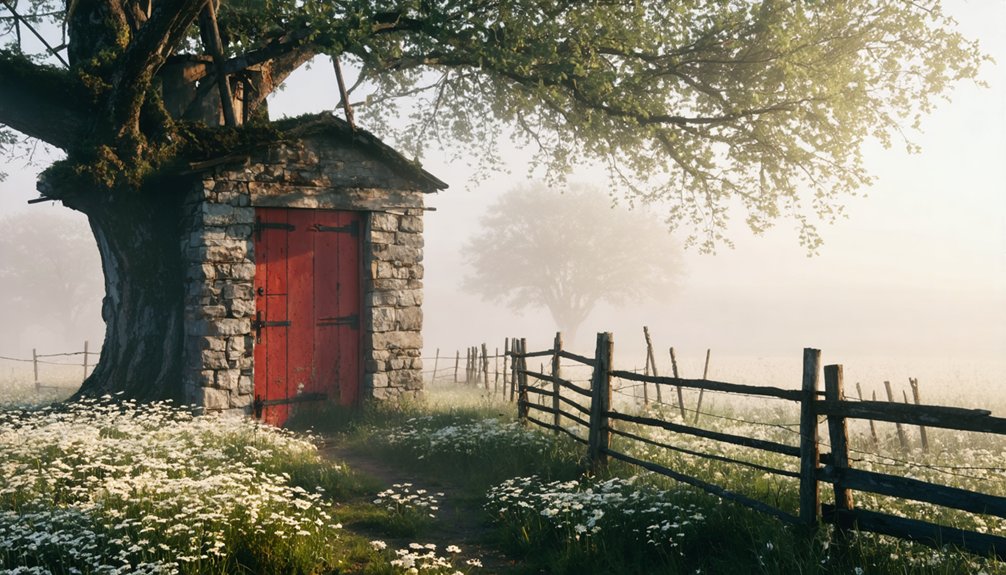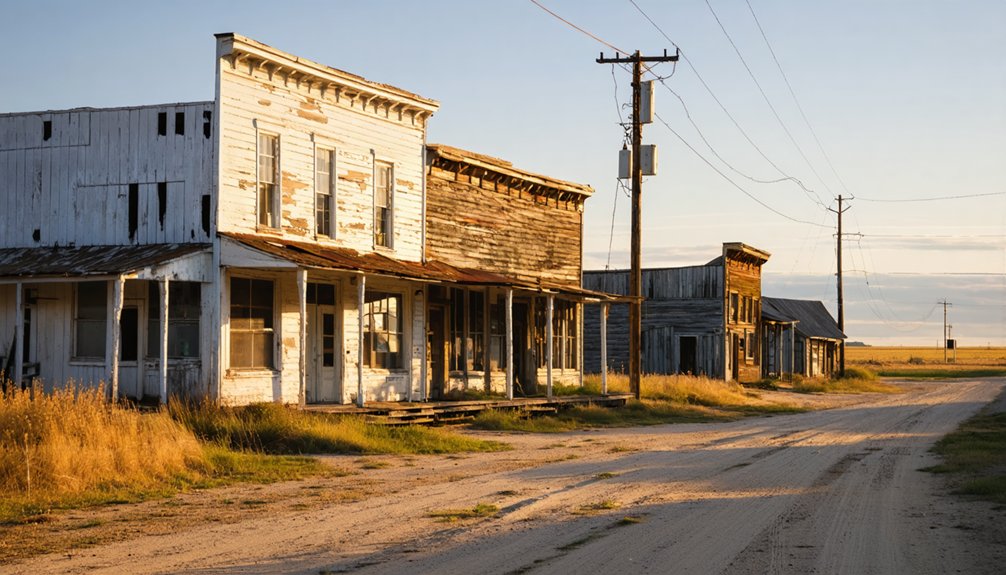
You’ll find Iowa’s most accessible ghost towns scattered across the state’s rural counties, each telling a different story of frontier collapse. Rockville offers mill ruins and a 200-grave cemetery dating to the Civil War era, while Buckhorn’s deteriorating creamery and preserved church sit just 1/3 mile from Maquoketa Municipal Airport. Carrollton’s abandoned schoolhouse marks where a county seat died after railroad bypass, and Elkport’s empty streets remember the 2004 flood that submerged everything. The Carroll County Historical Society offers guided tours revealing how transportation routes determined which communities survived and which disappeared beneath farmland.
Key Takeaways
- Rockville offers ruins of an 1845 grist mill and a cemetery with 200 graves, including Civil War-era headstones along Rockville Road.
- Buckhorn features a deteriorating creamery, preserved church, and guided cemetery tours with graves from the 1840s near Maquoketa Municipal Airport.
- Carrollton provides historical tours through Carroll County Historical Society for $20, showcasing an abandoned schoolhouse and former county seat history.
- Elkport was completely relocated after a 2004 flood and disincorporated by 2005, offering a unique modern ghost town experience.
- Sunbury displays decaying structures from its 1895 dance hall and 1901 bank, marking its transition from prosperity to abandonment.
Rockville: A Mill Town Frozen in Time
Nestled along the North Fork Maquoketa River in Delaware County, Rockville stands as one of Iowa’s most atmospheric ghost towns.
Founded in 1845, this former mill town thrived as a stagecoach stop and trading hub before the railroad bypassed it for Dyersville in the late 1920s.
You’ll find the historic architecture of the old grist mill ruins along Rockville Road, silent witnesses to the town’s bustling past when three hotels, stores, and a blacksmith shop served the community.
The Rockville Cemetery tells compelling community stories through roughly 200 burial sites, including Civil War-era headstones. Among the weathered tombstones, you’ll discover graves of young children who died in the early 1900s, alongside markers dating from the 1860s through as recently as 1951.
By 1915, Rockville’s population had dwindled so drastically that the last resident departed, leaving behind only crumbling foundations and headstones.
Elkport: Where the River Once Ruled Commerce
While Rockville succumbed to economic forces when the railroad passed it by, Elkport met a far more dramatic fate at the hands of nature itself. Founded in 1855 along Elk Creek’s banks, this community of 88 thrived for 150 years until May 23, 2004, when catastrophic flooding breached levees and submerged everything in eight to ten feet of water.
In a single devastating day, 150 years of community vanished beneath floodwaters that no levee could contain.
You’ll find this ghost town transformed into agricultural fields now, with only scattered foundations marking where homes once stood:
- River ecology patterns permanently altered by upstream convergence of Turkey and Volga Rivers
- Federal buyout program relocated all residents after flood mitigation efforts proved futile
- Complete disincorporation by 2005, with demolition finished September 2006
Before the disaster, the town’s median household income stood at $24,375, reflecting a modest but stable community. The 2020 census recorded just 29 residents within the original city boundaries, a stark contrast to its former population. Today’s landscape offers sobering evidence of nature’s power over human settlement.
Buckhorn: The Creamery Community That Faded Away
You’ll find Buckhorn’s most striking remnants scattered along the rural roadside: a deteriorating creamery building with a partially collapsed roof covered in graffiti, and a surprisingly well-preserved whitewashed church that stands shuttered but intact.
The active Buckhorn Cemetery holds weathered headstones dating back to the Civil War era, where Shadrach Burleson—the New York settler who founded this community in 1836—rests among the farmers who once supplied milk to the cooperative that defined this town. The town’s name itself comes from antlers mounted at Burleson’s original tavern, a rustic landmark that welcomed travelers in the settlement’s earliest days.
I’ve walked these grounds on overcast afternoons when the silence feels heavy, broken only by wind rustling through overgrown grass around crumbling bricks and fragments of the community’s prosperous past. The ghost town sits just a third of a mile from Maquoketa Municipal Airport, where the hum of small aircraft occasionally drifts over the abandoned structures.
Creamery and Church Ruins
Off Iowa Highway 64 in Jackson County, the skeletal remains of the Farmer’s Union Cooperative Creamery stand as Buckhorn’s most prominent ghost town feature. You’ll find this abandoned infrastructure slowly surrendering to nature, its roof partially collapsed and interior walls covered in graffiti.
Once producing 34 million pounds of butter, the building now holds only scattered furniture and debris.
When exploring the ruins, you’ll encounter:
- Dangerous second-floor conditions with unstable flooring and structural collapse zones
- Scattered bricks and wooden beams creating obstacle courses through former production rooms
- An abandoned church on the corner, offering better structural integrity for viewing
Heritage preservation efforts remain minimal here. Across from the creamery sits an old cemetery, a quiet witness to the community that once thrived in this remote farming area. The site offers a glimpse into past rural community life through its remaining structures. The creamery and church together capture Buckhorn’s dual identity—commerce and community—frozen in decay, accessible to those seeking authentic ghost town exploration.
Active Cemetery Historical Graves
The cemetery across from Buckhorn’s crumbling creamery holds graves dating back to the 1840s, their weathered headstones marking the final resting places of Iowa’s pioneer farmers. You’ll find Civil War-era burials among the historic gravestones, some over 150 years old, standing as silent witnesses to the community’s rise and fall.
Unlike the abandoned buildings surrounding it, this cemetery remains active—a haunting contrast between past and present.
You can explore the site during guided tours led by property owner Jacob Reuter, who’s currently overseeing cemetery restoration work.
The wooded setting feels genuinely eerie, especially during October when ghost town enthusiasts make the pilgrimage.
It’s an easy 45-minute drive from the Quad Cities, offering you unfiltered access to authentic Iowa history without bureaucratic barriers. The old creamery building still stands on the property alongside the long-abandoned church, creating an atmospheric backdrop to this historic settlement.
Carrollton: The County Seat the Railroad Left Behind
When the Northwestern Railroad laid its tracks through Carroll County in 1867, it drew a line around Carrollton rather than through it—and that single decision erased a thriving county seat from Iowa’s map.
You’ll find it hard to imagine today, standing among the ruins of an old schoolhouse with its warped metal door, that this forgotten patch of farmland once bustled with courthouse business and pioneer commerce.
The railroad didn’t just bypass Carrollton; it pulled the town’s entire future onto a different set of tracks, leaving behind only crumbling concrete and the question of what might’ve been. Each October, the Carroll County Historical Society leads tours through Carrollton and other vanished communities, offering glimpses into the lives of people and businesses that once called these ghost towns home.
Railroad Bypass Sealed Fate
As railroad tracks pushed westward across Iowa in 1867, they carved destinies for entire communities with the simple choice of where to lay rails. The Cedar Rapids and Missouri River Railroad’s route through central Carroll County bypassed Carrollton entirely, placing new Carroll City at the transportation crossroads instead.
This railroad development triggered inevitable county seat relocation in 1869, despite fierce protests from Carrollton residents who’d established Iowa’s government hub thirteen years earlier.
The bypass‘s impact was devastating:
- No direct rail access meant farmers hauled goods miles to reach markets
- Business exodus followed the tracks to Carroll City’s booming warehouses
- Southern route in 1881 served neighboring towns, further isolating Carrollton
Without rails connecting it to commerce, Carrollton couldn’t compete—freedom of movement determined survival.
From Courthouse to Farmland
After losing its county seat status in 1869, Carrollton’s courthouse—once the beating heart of Carroll County‘s legal and administrative life—faced a slow erasure from Iowa’s landscape.
Today, you’ll find cornfields where judges once presided and crops growing through what were bustling streets. This agricultural transformation consumed the entire town footprint, leaving almost nothing of the original settlement.
The sole survivor of this urban decay is an abandoned schoolhouse, standing defiant among the rows.
When you visit, you’ll encounter peeling paint, rusting doors, and concrete floors crumbled by decades of water damage.
Despite the hazards, explorers still wander through, touching history that agriculture couldn’t quite erase.
The Carroll County Historical Society includes this site on their October ghost town tours—$20 tickets connect you with Carrollton’s vanished world.
Sunbury: Dancing Through History Until the Music Stopped
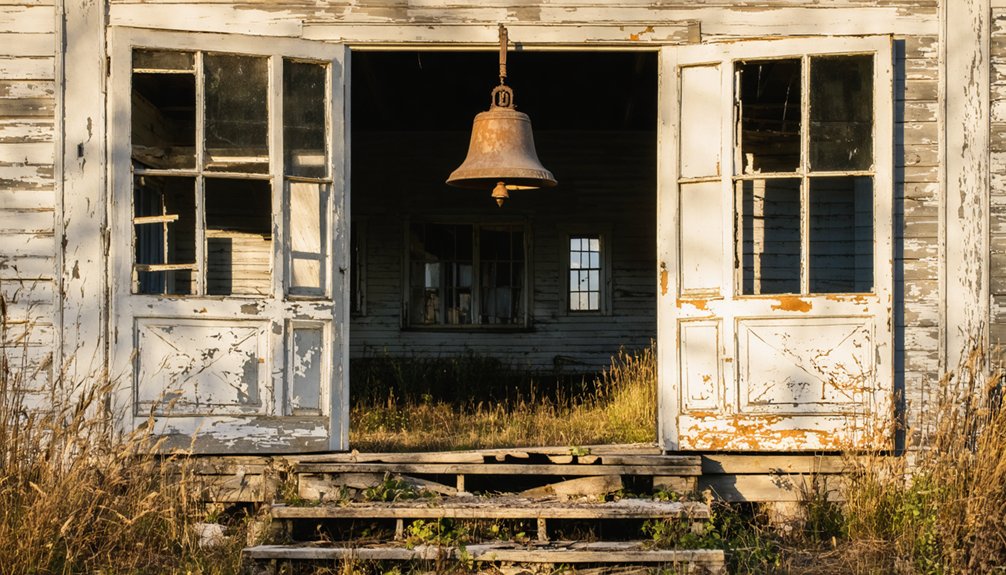
Located thirty miles west of Davenport in Cedar County, Sunbury sprang to life when the railroad arrived, transforming fertile farmland into a bustling hub for the surrounding agricultural community.
Rails carved prosperity from prairie soil, birthing Sunbury where iron horses transformed quiet farmland into commerce and community.
The town’s legendary dance hall, established in 1895, became the heartbeat of this settlement of fifty souls, where music preservation and dance hall architecture created memories for nearly seven decades.
What remains of Sunbury’s golden era:
- The dance hall operated until 1964, hosting generations of farmers and railroad workers.
- Sunbury Bank’s brick building stood from 1901 until its demolition around 2014.
- Decaying structures scatter across the landscape, marking where community once thrived.
The Great Depression crushed the bank, and when the dance hall’s music stopped in 1964, Sunbury’s spirit faded into Iowa’s haunting collection of ghost towns.
Stiles: the Thriving Settlement That Vanished From Maps
Deep in south central Grove Township of Davis County, the crossroads settlement of Stiles once buzzed with the energy of a hundred residents who’d built something substantial from Iowa prairie. Named after Stiles S. Carpenter in 1840, this community boasted three stores, two doctors, mills, and farmers who’d gather Saturdays to trade corn and wheat while debating around pot-bellied stoves.
You’ll find historical architecture still standing—the old school building near Peach Avenue and 233rd Street, plus the post office that served 91 years before closing in 1943. Community legends echo through Stiles Methodist Church’s disbanded congregation and the Lister family property, whose predecessors claimed 960 acres in 1852.
The cemetery holds original settlers’ stories, waiting for you to discover them.
Preserving Iowa’s Forgotten Communities for Future Generations
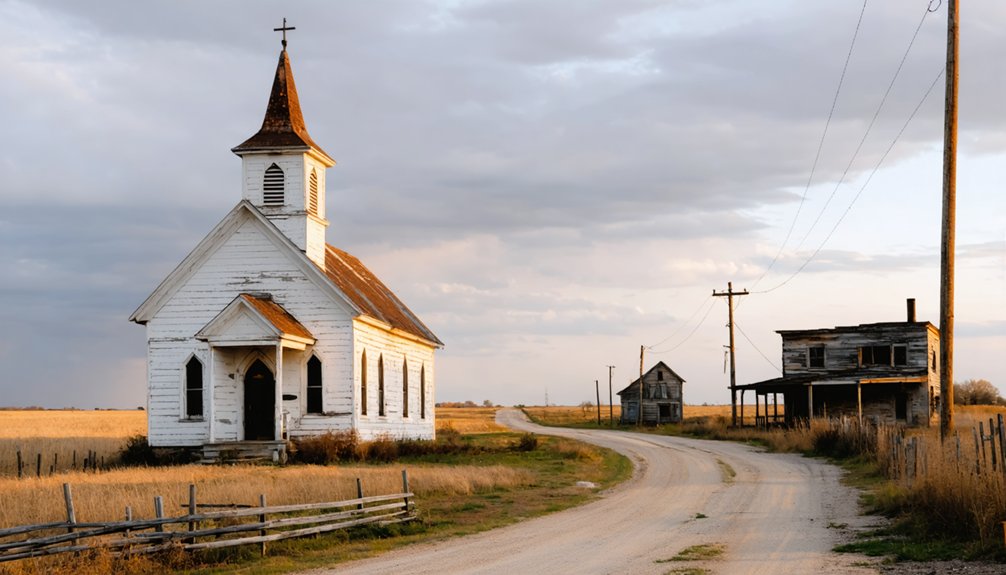
While development pressure threatens to erase Iowa’s ghost towns forever, dedicated preservationists are racing to protect what remains of these vanished communities. Historical preservation efforts focus on tangible landmarks you can still explore today.
At Buckhorn, you’ll discover the creamery structure alongside an abandoned church and cemetery.
Dalmanutha’s Monteith Town Park and Cemetery stand as attestations to community memory, while Morrisburg Church remains accessible for your visits.
Key preservation achievements include:
- The University of Iowa’s all-encompassing index documenting 362 abandoned towns, ensuring their stories survive
- Guthrie County’s meticulous records tracking post offices like Glendon (1881-1919) and Wichita (1884-1917)
- Active cemetery maintenance at sites like Bear Grove, where weathered tombstones reveal settlers’ names and dates
These efforts grant you freedom to explore authentic history without corporate interpretation.
Frequently Asked Questions
Are Iowa’s Ghost Towns Legally Accessible to Visitors Year-Round?
Ironically, “abandoned” doesn’t mean “free for all.” Legal access depends on property rights—most Iowa ghost towns remain privately owned despite appearing deserted. You’ll need owner permission or stick to public roads. Trespassing charges don’t care about your wanderlust.
What Safety Precautions Should Visitors Take When Exploring Abandoned Structures?
You’ll need sturdy boots, flashlights, and first-aid supplies when exploring. Always respect legal restrictions and trespassing concerns—some sites require permission. Test floors before stepping, wear protective masks against mold, and never explore alone for safety.
Can I Metal Detect or Collect Artifacts From Ghost Town Sites?
You’ll face a mountain of legal restrictions on ghost town detecting. Artifact laws prohibit digging or collecting items over 100 years old on public lands without permits. Private property’s different—just get written landowner permission first.
Which Iowa Ghost Towns Offer the Best Photography Opportunities?
You’ll find Buckhorn’s vintage architecture offers incredible decay shots with graffiti-covered walls, while Elkport’s haunting landscapes provide eerie, wide-angle opportunities. Sunbury’s abandoned bank and railroad relics deliver atmospheric textures. Each location rewards adventurous photographers seeking authentic, unrestricted exploration.
Are Guided Tours Available for Any of Iowa’s Ghost Towns?
You’ll find guided tours at several haunted locations, though not traditional ghost towns. Jordan House and Farrar Schoolhouse offer reservation-based experiences blending historical preservation with local legends. These sites provide authentic paranormal encounters while honoring Iowa’s pioneer heritage.
For those seeking a more immersive experience, consider exploring hauntingly beautiful Iowa ghost towns that tell stories of a bygone era. These towns, often enveloped in mist and echoing with whispers of the past, are perfect for adventurous travelers looking to uncover hidden histories. Each visit offers not only a glimpse into the lives once lived there but also a chance to connect with the lingering spirits of Iowa’s rich cultural landscape.
References
- https://www.onlyinyourstate.com/experiences/iowa/ia-ghost-town
- https://pubs.lib.uiowa.edu/annals-of-iowa/article/id/13466/download/pdf/
- https://www.discoverguthriecounty.org/ghosttowns
- https://www.geotab.com/ghost-towns/
- https://khak.com/exploring-iowa-ghost-towns/
- https://www.youtube.com/watch?v=L883pwCPOwE
- https://iagenweb.org/ringgold/misc/ghostowns.html
- https://www.youtube.com/watch?v=IJXffTEZN_g
- https://www.youtube.com/watch?v=1J0Qx64ZrwI
- https://www.findagrave.com/cemetery/2374194/rockville-cemetery