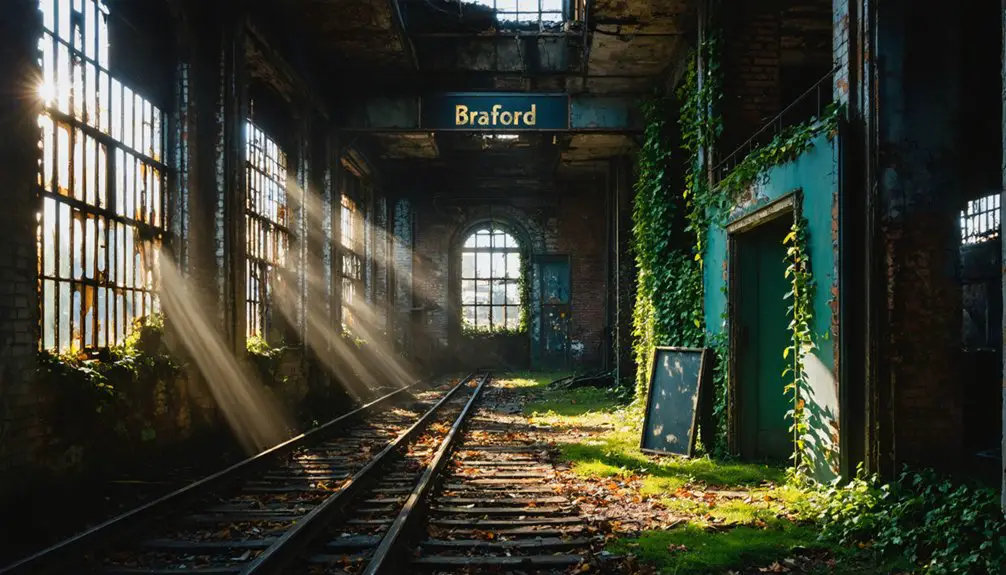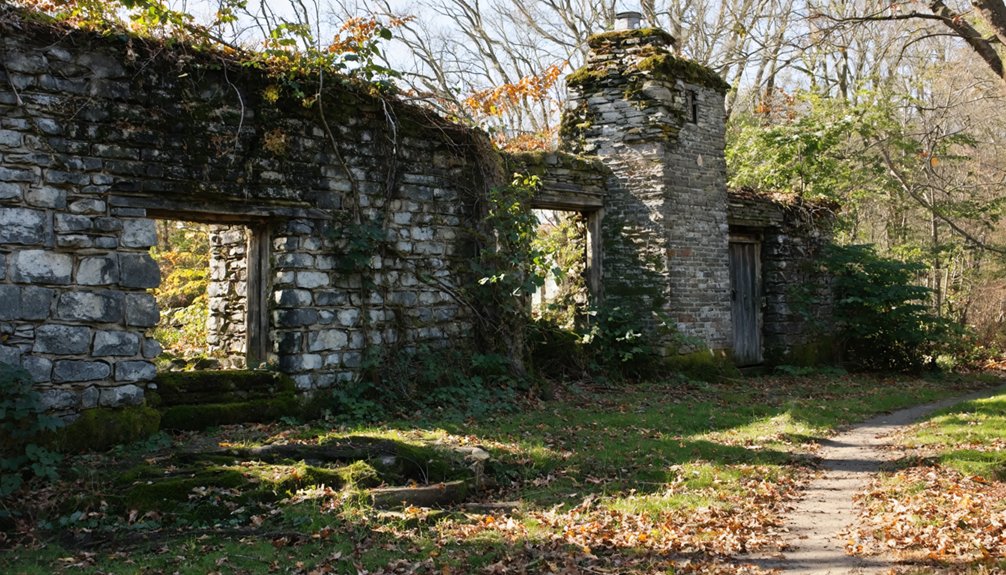
You’ll find Rhode Island’s ghost towns hiding in plain sight—from Hanton City’s stone foundations along Smithfield’s forest trails, where three families built a settlement after King Philip’s War, to Napatree Point’s hurricane-swept coast where 39 cottages vanished in 1938’s devastating storm. Fort Wetherill’s WWII bunkers still cling to Conanicut Island’s cliffs, while the Enchanted Forest’s fairy-tale ruins slowly surrender to Hope Valley’s woods. Rocky Point’s abandoned gondola cables trace memories of 150 years of seaside entertainment, and each crumbling foundation reveals stories that Rhode Island’s official records have long forgotten.
Key Takeaways
- Hanton City in Smithfield Woods features stone foundations and cellar holes from a village founded after 1676 that declined by the 1850s.
- Napatree Point’s summer colony with 39 cottages was destroyed by the 1938 hurricane, leaving concrete military ruins and protected sanctuary land.
- Enchanted Forest in Hope Valley operated from 1972 to 2005; now gated with overgrown attractions, though exploration is currently illegal.
- Rocky Point Amusement Park closed in 1995, with the accessible Skyliner Gondola Ride remaining among limited structures after fires and demolition.
- Fort Wetherill offers underground tunnels, bunkers, and gun emplacements from Revolutionary War through WWII, listed on the National Register since 1972.
Hanton City: The Lost Village Hidden in Smithfield Woods
Deep in Smithfield’s woods lies a settlement that vanished before the Civil War even began. You’ll find Hanton City’s stone foundations and cellar holes scattered along a trail off West Reservoir Road, remnants of three English families who carved out lives here after King Philip’s War in 1676.
Settlement decline came swiftly when industrialization drew residents to better-paying mill work along nearby rivers. By the 1850s, maps omitted the village entirely. Thomas Hanton, interviewed in 1889, recalled how impoverished neighbors “sold properties indiscriminately and died off.” The community had reached its peak by the 1730s, when residents engaged in farming and quarrying to serve Providence’s growing markets.
Despite historic legends branding it “Haunted City,” locals dismissed such tales with contempt. The truth’s simpler: economic forces erased this community, leaving only weathered gravestones and crumbling walls for you to discover.
Napatree Point: Hurricane-Ravaged Coastal Settlement
Before the 1938 hurricane erased it from existence, Napatree Point bustled with summer colonists who’d built thirty-nine cottages along a narrow barrier spit that Dutch trader Adriaen Block once described as a “nap of trees.” You won’t find those trees anymore—the Great September Gale of 1815 had already stripped the peninsula bare over a century earlier.
Fort Mansfield’s crumbling batteries tell another layer of this ghost town’s story:
- Constructed in 1901 with three cannon emplacements and barracks for 228 soldiers
- Decommissioned by 1907 when design flaws rendered it strategically useless
- Converted to civilian cottages before nature reclaimed everything in 1938
The hurricane’s deadly toll claimed fifteen residents who couldn’t escape the barrier beach in time. Today, coastal erosion continues reshaping what the hurricane started. The area now serves as a protected bird sanctuary during nesting season, transforming the abandoned military installation into a haven for wildlife. Historic preservation efforts maintain this vanished settlement as accessible public land—a windswept monument to impermanence where you’ll walk among concrete ruins and imagine lives the Atlantic swallowed whole.
Enchanted Forest Amusement Park: Fairytale Ruins in Nature
While hurricanes claimed Napatree Point overnight, economic forces took decades to erase another Rhode Island landmark. You’ll find Enchanted Forest’s remnants hidden in Hope Valley’s woods, where Marcus Jones and Philip Herlle’s 1972 fairytale vision once welcomed southern New England families.
Built by vocational students across 31 wooded acres, this wasn’t your typical tourist trap—designers preserved native mountain laurels around attractions like the Old Woman’s Shoe and wooden pirate ship. The park centered on a pond with waterfalls that enhanced the fairy tale scenery. Humpty Dumpty on his brick wall greeted visitors as the park’s beloved mascot.
Unlike profit-driven theme parks, Enchanted Forest’s vocational builders wove attractions through existing woodland, preserving Hope Valley’s natural character.
Fairytale nostalgia lingers among overgrown mini-golf courses and crumbling bumper car tracks, though you can’t legally explore these amusement park ruins.
Harold Fera shuttered operations in 2005, auctioning rides to Edaville while nature reclaimed what remained.
The property’s now gated and patrolled, its parking lot sign vanished—another casualty of New England’s challenging seasonal economy.
Rocky Point Amusement Park: Decaying Entertainment Landmark
Along Warwick’s coastline, Captain William Winslow transformed a Narragansett summer gathering place into what would become Rhode Island’s most beloved amusement park.
From its 1847 origins serving seafood under trees, Rocky Point evolved into an entertainment powerhouse showcasing vintage rides and industrial history spanning 148 years.
You’ll discover remnants of an empire that once drew presidential visits and hosted Babe Ruth.
The park’s golden era featured:
- Shore Dinner Hall seating 4,000 hungry visitors
- The Wildcat and Cyclone roller coasters thrilling daredevils
- Palladium Ballroom where big bands commanded dance floors
After 1995’s closure, fires and demolition erased most structures.
Today’s passive-use park offers walking paths where midways once buzzed.
You’re free to explore 124 acres of shoreline, imagining screams of joy that once echoed here.
The Skyliner Gondola Ride remains largely intact, with its cables, support towers, and station accessible via trail, offering views across the former park grounds.
Before amusement rides arrived, Rocky Point served as the site of Warwick Neck Fort, a Revolutionary War fortification built between 1776 and the 1780s to prevent British troops from landing and advancing toward Providence.
Fort Wetherill: Abandoned Military Fortifications
Perched on 100-foot granite cliffs at Conanicut Island‘s southeastern edge, Fort Wetherill has guarded Jamestown’s shores since the Revolution. You’ll discover military architecture spanning centuries—from 1798’s Fort Louis through WWII coastal batteries.
Centuries of American military history rise from Conanicut Island’s granite cliffs, where Revolutionary-era fortifications meet World War II coastal defenses.
The Endicott Defense system brought massive 12-inch disappearing rifles and concrete emplacements designed by Olmsted Brothers. During WWII, soldiers scanned horizons from camouflaged towers for German submarines before the site became a POW reeducation camp. Barracks constructed in 1940 could house 1,200 men, who trained in artillery spotting and coastal observation.
Today, you’re free to explore 61.5 acres of crumbling bunkers, shadowy tunnels, and gun embankments without restriction. The fort’s concrete and stone construction ensures these military structures resist decay far better than other abandoned buildings. Historical preservation efforts earned Fort Dumpling its 1972 National Register listing, yet nature reclaims these fortifications.
Scuba divers, cliff hikers, and history seekers roam independently through this coastal defense relic overlooking Narragansett Bay’s open waters.
Frequently Asked Questions
Are Guided Tours Available for Visiting Rhode Island’s Ghost Towns?
You won’t find guided tours for Rhode Island’s ghost towns like Hanton City or Ram Tail. These abandoned sites require independent exploration, though nearby hartford history tours exist. Preservation efforts remain minimal, letting you discover these forgotten places through your own adventurous spirit.
Exploring the ghost towns of Rhode Island can lead to unexpected encounters with remnants of the past. As nature reclaims these spaces, you might stumble upon old structures and artifacts that tell stories of a once-thriving community. Each visit offers a chance to connect with history in a way that guided tours simply can’t replicate.
With ghostly attractions in Rhode Island, the allure deepens as you wander through what remains of these eerie landscapes. Some visitors claim to have felt a presence as they explore the remnants, igniting tales of haunted history and the spirits that linger. Whether it’s the echoes of laughter from long-gone residents or the whispering winds among the abandoned structures, each location offers a chilling glimpse into the past.
What Safety Precautions Should Visitors Take When Exploring Abandoned Sites?
Watch for uncovered wells and unstable foundations with keen hazard awareness while exploring these cherished ruins. You’ll want to practice preservation ethics—leave artifacts untouched so future wanderers can discover Rhode Island’s vanished communities just as you have.
Is Permission Required to Access Private Ghost Town Properties?
Yes, you’ll need permission before exploring private ghost town properties. Property ownership matters—respecting boundaries protects both historical preservation efforts and your freedom to enjoy Rhode Island’s forgotten places. Always check access rules before venturing out.
What Is the Best Time of Year to Visit These Locations?
Visit during fall for ideal exploration—crisp temperatures reveal foundation stones through fallen leaves while seasonal weather stays mild. You’ll capture stunning photography with bare branches framing historic cellar holes, and crowds won’t restrict your wandering.
Can Artifacts Be Legally Collected From These Ghost Town Sites?
No, you can’t legally collect artifacts from Rhode Island’s ghost towns. Artifact legality strictly prohibits removal from public lands, and collection restrictions apply even to surface finds. State permits go only to licensed archaeologists, protecting these nostalgic remnants.
While exploring abandoned towns in Rhode Island, visitors may be captivated by the haunting beauty and history that lies within the decaying structures. Each location tells a story of a bygone era, evoking curiosity about the lives once lived there. However, it’s essential to respect these sites and their preservation, ensuring that the legacy of these forgotten places remains intact for future generations.
In addition to the visual allure, exploring abandoned sites in Rhode Island offers a rare glimpse into the past that many overlook. The crumbling facades and overgrown pathways invite contemplation about the stories behind the structures. Engaging with these forgotten places fosters a deeper appreciation for the history that has shaped the region.
References
- https://podcasts.apple.com/us/podcast/57-ghost-town-hanton-city/id1554896421?i=1000563483124
- https://carte-urbex.com/en/blogs/infos/top-10-abandoned-places-in-rhode-island
- https://newenglandwithlove.com/ghost-towns-in-rhode-island/
- https://www.youtube.com/watch?v=kpy7zlXYrAU
- https://www.rhodeislandredfoodtours.com/2024/10/28/haunted-sites-of-rhode-island/
- https://www.rimonthly.com/haunted-places-rhode-island/
- https://smithapplebyhouse.org/arethereghosts/
- https://www.youtube.com/watch?v=3bFcmv7IH40
- https://weird-island.simplecast.com/episodes/57-ghost-town-hanton-city-ky53imy0
- https://vitabrevis.americanancestors.org/2017/01/no-notorious-scandals