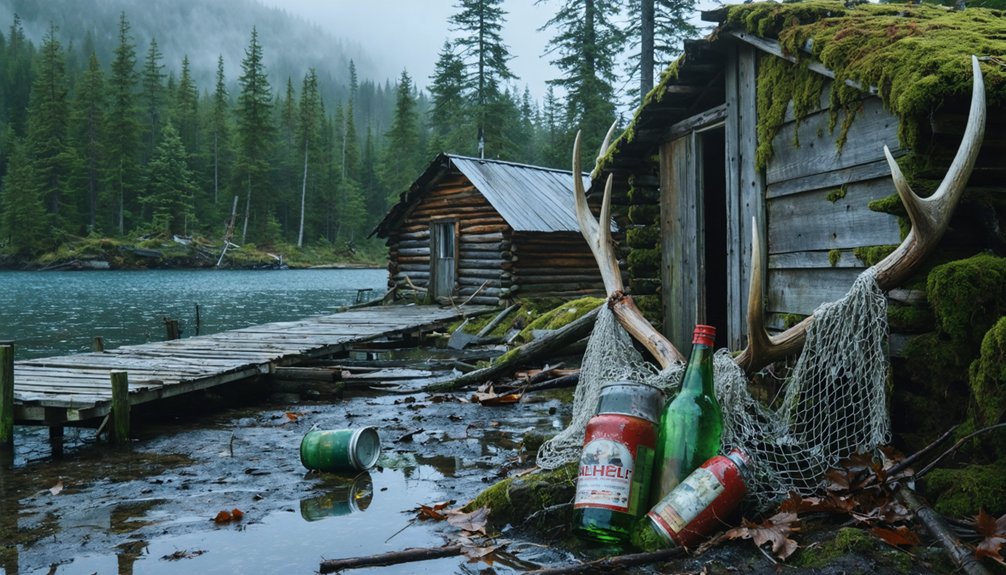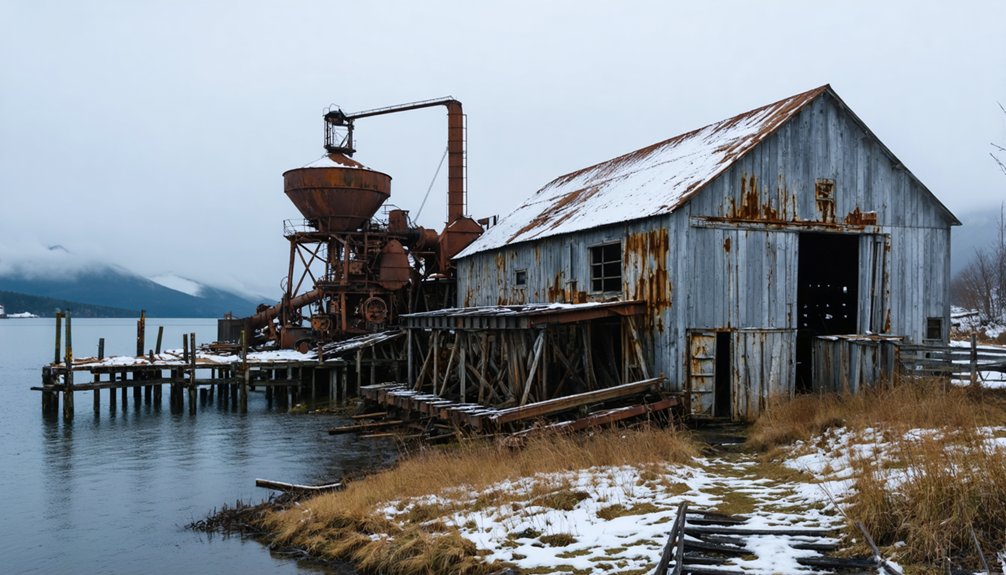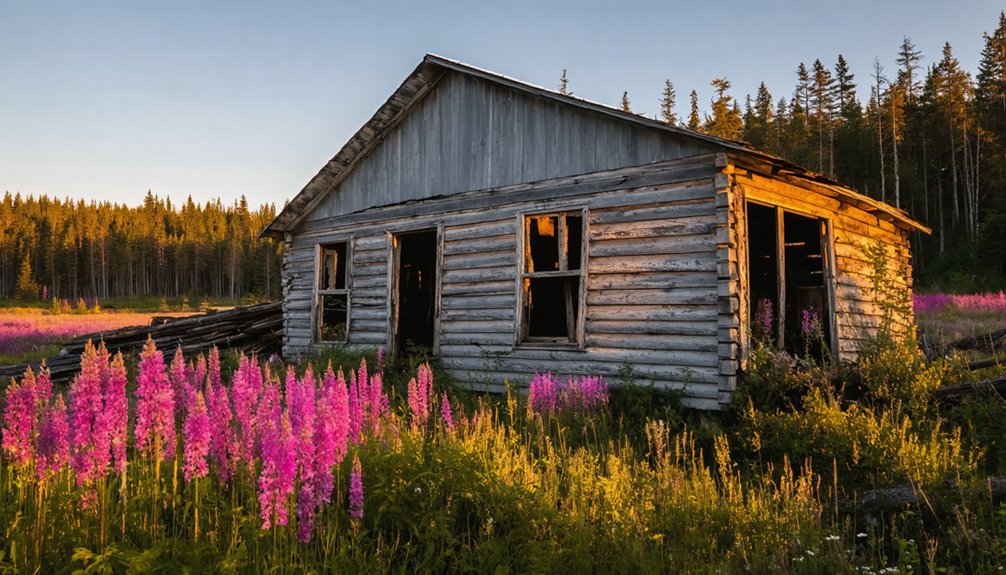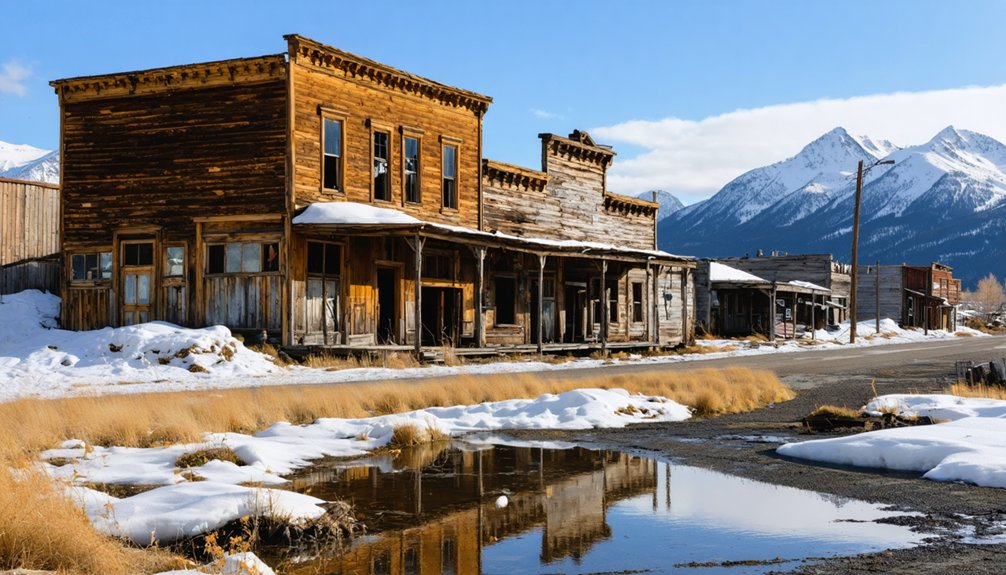
You’ll find Alaska’s ghost towns awakening each spring as snowmelt reveals their secrets. Explore Treadwell’s flooded mine shafts on Douglas Island, or trek to remote Chisana’s 450 cabin sites in the Wrangells. Kennecott’s preserved mill buildings showcase pioneering copper technology, while Dyea’s wilderness-reclaimed ruins mark Klondike dreams. For something different, soak in Pilgrim Hot Springs’ 90°C geothermal pools surrounded by mission remnants. Each site offers unique access—from roadside views of Curry’s chimneys aboard the Hurricane Turn to bush plane adventures reaching high-alpine Bremner, where the stories deepen considerably.
Key Takeaways
- Treadwell Ruins on Douglas Island offer 2-3 mile trails through foundations and shafts, best explored in spring.
- Dyea ghost town near Skagway features wilderness-reclaimed relics and the historic Chilkoot Trail accessible for spring hiking.
- Curry’s remains, including two chimneys and rusted equipment, are viewable from Hurricane Turn trains running Thursday-Sunday in summer.
- Pilgrim Hot Springs, 60 miles north of Nome, combines 90°C geothermal pools with historic Catholic mission ruins accessible in spring.
- Kennecott Mines in Wrangell-St. Elias National Park preserves mill buildings, company town infrastructure, and original mining equipment from 1915.
Treadwell Ruins: Alaska’s First Swimming Pool and Mining Marvel
The ruins of Treadwell sprawl across Douglas Island like the skeleton of a giant, where rusted machinery pokes through moss and spruce trees reclaim what was once North America’s largest gold mining operation. You’ll walk through mining history that produced $4 billion in today’s dollars before a catastrophic 1917 collapse swallowed three mines whole.
The abandoned ruins reveal Alaska’s first swimming pool—the Natatorium—which cracked and drained hours before 3 million tons of seawater flooded 45 miles of tunnels. The mines once operated around the clock, shutting down only on Christmas and the Fourth of July, with miners working relentlessly to extract gold-bearing ore from the earth.
Spring’s your best bet for exploring: snowmelt hasn’t turned trails to mud yet, and you’ll navigate roots and rocks more easily. John Treadwell founded the operation in 1882 with the goal of discovering gold deposits that would transform the region.
The Treadwell Historic Trail offers 2-3 miles of freedom to roam through foundations and shafts without crowds blocking your discoveries.
Dyea: Gateway to Klondike Gold Rush Dreams and Tragedy
While Treadwell’s mining empire crumbled beneath the earth, another Alaska boomtown met its fate through the frozen mountains above.
Where one gold town fell to cave-ins below, another perished under avalanche snow—Alaska’s twin tragedies of ambition.
You’ll find Dyea’s haunting remains where 8,000 dreamers once scrambled toward Klondike riches in 1897-98. The Tlingit village-turned-boomtown served as your gateway to gold, where stampeders packed supplies for the treacherous Chilkoot Pass. Located 600 miles south of the Klondike gold fields, Dyea became one of the closest salt water ports for arriving fortune seekers.
Walk through the ghost town’s five-by-eight-block footprint, now reclaimed by wilderness. The mining legacy lives through scattered relics and the Chilkoot Trail itself. At its peak, the town boasted over 150 businesses serving the stampede of prospectors.
But here’s what grounds you: visit the cemetery where April 3, 1898’s Palm Sunday Avalanche victims rest—70 souls buried mostly on that single day. This tragedy remembrance site marks the deadliest Klondike disaster, ultimately sealing Dyea’s doom as prospectors chose safer routes to freedom’s promise.
Pilgrim Hot Springs: Geothermal Wonder on the Seward Peninsula
You’ll find Pilgrim Hot Springs nestled sixty miles north of Nome, where a historic Catholic mission once thrived alongside naturally heated pools that still steam at 90°C today.
The journey requires careful planning—there’s no road access in winter, and spring conditions mean traversing muddy trails or chartering a bush plane to reach this geothermal wonder.
Once you arrive, you can soak in the same therapeutic waters that drew missionaries in the early 1900s.
Though the crumbling mission buildings now stand as silent witnesses to Alaska’s frontier past, the site’s geothermal legacy continues through modern greenhouse operations that take advantage of the warm ground for extended growing seasons. The hot springs are part of a complex geothermal system where deep fluids migrate through fault structures to reach the surface, creating the naturally thawed ground that surrounds the springs.
Historic Catholic Mission Establishment
Nestled 60 miles northeast of Nome, Pilgrim Hot Springs traces its Catholic mission roots to an October day in 1917 when Judge George D. Schofield gifted the property to the Catholic Diocese.
Father Bellarmine LaFortune transformed this former roadhouse site into Our Lady of Lourdes Mission by 1918.
You’ll discover remnants of impressive monastic architecture—fourteen structures once housed 100 children and twenty staff members.
The 1918 influenza pandemic shifted the mission’s purpose to orphanage care, and these halls echoed with young voices for over two decades.
By the late 1930s, most orphans had grown and departed, and the mission ended with the last resident priest’s death around 1941.
Today’s mission preservation efforts protect the deteriorating two-story church and surrounding ruins.
The site’s geothermal springs provided self-sufficiency through indoor plumbing and heating—remarkable frontier innovation you can still witness in spring’s mild weather.
The location sits between Hen and Chickens Hill and the Kigluaik Mountain range, creating a lush tree oasis in the remote sub-Arctic environment.
Natural Geothermal Hot Springs
The same geothermal forces that once heated the mission’s buildings still bubble up through the Seward Peninsula’s frozen ground, creating an otherworldly landscape where steam rises against snow-covered hills. You’ll find hot springs reaching 81°C arranged in distinctive north-south alignments, fed by a shallow aquifer just 15-35 meters beneath your feet.
The hot spring geology tells a fascinating story—faults from the Imuruk Basin graben channel heated waters from depths exceeding 150°C, creating thawed pockets amid 100-meter-thick permafrost. The area sits atop a geothermal reservoir with a mean temperature of 140°C, representing significant untapped thermal energy beneath the peninsula’s surface.
Walk carefully around the main curved stream where geothermal energy produces 3.8 megawatts of heat output. You’ll notice stunted sub-arctic vegetation thriving in these warm zones, and if you’re visiting during freeze-up, watch for open water persisting in the nearby Pilgrim River—nature’s proof of this geological marvel’s power.
Accessing the Remote Site
Getting to Pilgrim Hot Springs demands commitment—this isn’t a roadside attraction with gift shops and paved parking lots. You’ll drive 53 miles northeast from Nome on the Kougarok Road, watching for wildflower blooms and birdwatching opportunities along the way.
Spot the old yellow dozer marking your turn onto a rough 7-mile gravel spur—take it slow, as flooding sometimes makes passage impossible.
Before leaving Nome, grab your no-fee permit at the Visitors Center or Aurora Inn.
You’ll park at the designated gate area, then hike 10-15 minutes to the springs.
Pack everything in a backpack: water, food, mosquito repellent. The site operates as managed private property, so respect boundaries and follow posted guidance throughout your visit.
Cell service vanishes beyond town limits.
Spring visitors operate at their own risk, but that’s precisely the appeal—unfiltered wilderness access without bureaucratic interference.
Kennecott Mines: Copper Country’s Preserved Legacy
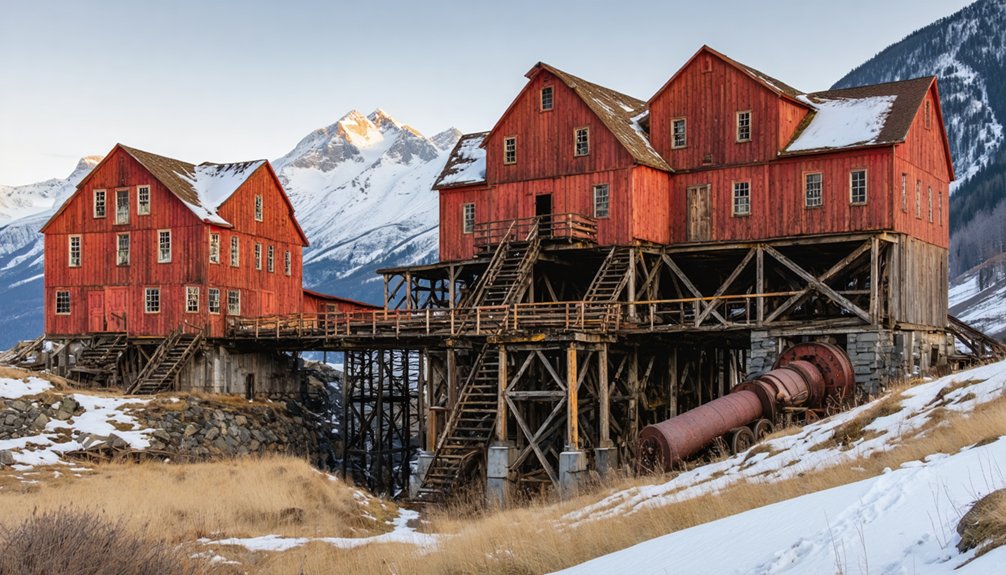
Deep within Wrangell-St. Elias National Park, you’ll discover Kennecott’s remarkably preserved copper mining camp—a $730 million investment frozen in time since 1938.
This National Historic Landmark showcases authentic Kennecott history spanning 1911-1938, when 300-500 workers extracted millions of pounds of copper monthly.
You’ll explore:
- Mill buildings featuring pioneering ammonia-leaching mining technology from 1915
- Company town infrastructure including hospital, general store, and recreation hall
- 196-mile railway corridor connecting remote operations to coastal ports
- Original equipment processing 400 tons daily at peak capacity
- Structures unchanged since the last workers departed
Spring’s melting snow reveals weathered red buildings against dramatic mountain backdrops.
You’re walking through America’s copper empire legacy—where the Alaska Syndicate’s political influence once shaped territorial destiny.
It’s freedom to witness industrial ambition reclaimed by wilderness.
Curry: Lost Luxury Along the Alaska Railroad
You’ll find Curry’s story at mile 248.5 of the Alaska Railroad, where stone chimneys and rusted machinery mark what was once a swanky wilderness resort with tennis courts and a golf course carved into the backcountry.
The 1957 fire that killed three guests and razed the 75-room hotel left behind a haunting skeleton that the railroad later demolished, though generators and old rail cars still dot the abandoned site.
Since there’s no road access, you can only glimpse this remote ghost town from passing trains or hop off at the flagstop during the Hurricane Turn’s summer Thursday-Sunday runs.
Luxury Stop’s Golden Era
When the Alaska Railroad envisioned a luxury oasis along its remote northern route in 1921, Curry emerged as an audacious answer to wilderness travel’s greatest challenge: comfort.
You’d have discovered genuine luxury travel meeting the untamed frontier at this railroad heritage landmark. The 90-room Curry Hotel delivered experiences that’d make modern resorts envious:
- Hot running water and hydroelectric power in 1920s Alaska wilderness
- Indoor swimming pool, tennis courts, and manicured golf course
- Fine dining in crystal-chandeliered ballrooms overlooking mountain peaks
- Blue-and-gold Aurora streamliner arrivals carrying distinguished guests
- Guided dog sled demonstrations and wilderness fishing expeditions
Between 1923 and 1957, you’d have joined dignitaries and adventurers seeking freedom beyond civilization’s reach. The 1947 peak season brought thousands escaping convention, embracing Alaska’s magnificent isolation wrapped in unexpected opulence.
The Devastating 1957 Fire
That golden era of champagne toasts and crystal chandeliers ended in horror on Tuesday morning, April 9, 1957. You’ll find urban legends still swirl around what sparked the flames discovered at 6:21 a.m.
The entire 75-room wooden palace was engulfed within three minutes—a nightmare that claimed three lives, including two small children. Firefighters battled desperately with inadequate equipment and pathetic water pressure from Dead Horse Creek.
Within an hour, over $500,000 worth of Alaska’s finest lodging lay in smoldering ashes.
When you visit today, only two tall chimneys pierce the wilderness—silent sentinels of that tragedy. The Alaska Railroad cited preservation challenges and safety concerns, razing what remained. They never rebuilt, sealing Curry’s transformation into the haunting ghost town you’ll explore.
Viewing From the Rails
Today’s Alaska Railroad trains slow deliberately as they glide past mile 248.5, giving passengers precious minutes to photograph what little remains of Curry’s grandeur.
You’ll spot railway archaeology scattered across the wilderness—rusty generators, abandoned rail cars, and interpretive signs marking where the “wilderness palace” once stood. This abandoned hospitality site offers a haunting glimpse into Alaska’s luxurious past.
From your window, you’ll see:
- Remnants of the 75-room hotel foundation
- Deteriorating suspension bridge over Susitna River
- Railroad equipment rusting among wildflowers
- Mount Denali looming in the distance
- Interpretive markers explaining the resort’s history
Ride the Hurricane Turn train Thursday through Sunday for the best viewing experience. There’s no road access—you’re witnessing pure, isolated wilderness reclaiming civilization.
Chisana: Remote Mining Camp in the Wrangells
Deep in the valley between the Nutzotin and Wrangell Mountains lies Chisana, once dubbed “the largest log cabin town in the world.” In 1913, gold fever gripped this remote corner of Alaska, and within months over 1,000 stampeders had carved two communities—Chisana City and Bonanza City—from the wilderness.
Today, you’ll find only twenty-five seasonal residents and weathered mining remnants scattered across wildlife habitats that have reclaimed the landscape. Roughly 450 cabin sites remain, some maintained by the Park Service, others surrendering to time.
You’ll reach this ghost town only by bush plane, snowmobile, or on foot—the latter requiring three grueling days from Nabesna with treacherous river crossings.
Walk among hydraulic operations and hand-dug channels where dreams once flourished. Just remember: leave every artifact untouched.
Bremner: Wilderness Ghost Town Accessible Only by Air
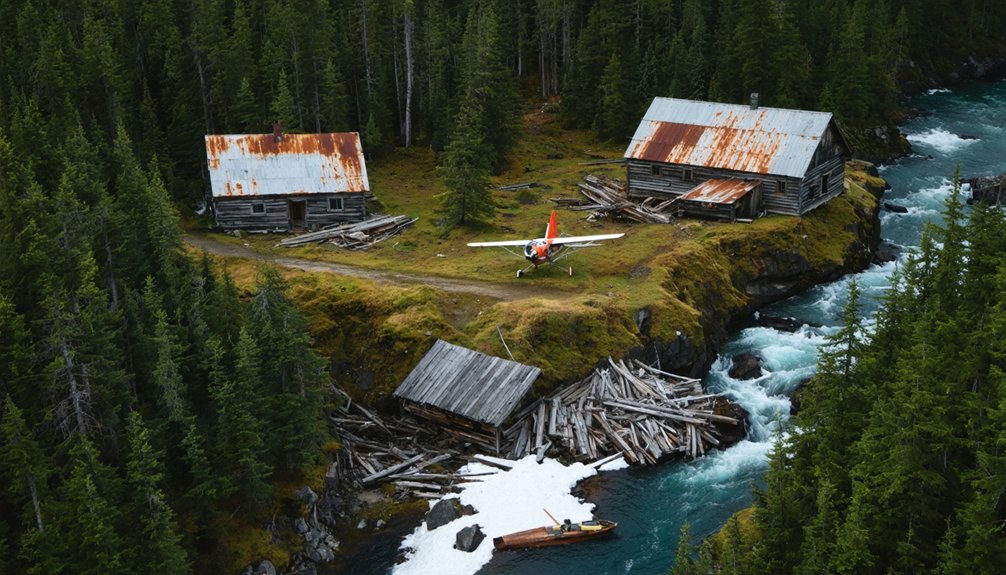
While Chisana tests your endurance with three-day treks, Bremner demands you surrender completely to bush aviation. You’ll charter into this 4,449-foot-high alpine valley, landing on 1930s-era airstrips where mining remnants tell stories of fortune-seekers who carved civilization from wilderness.
Bush planes become your only lifeline here—no trails reach this 4,449-foot fortress where fortune-seekers once carved airstrips from alpine wilderness.
The wildlife habitat surrounding these abandoned operations remains pristine, virtually untouched since operations ceased in 1942.
What awaits your exploration:
- Lucky Girl mill with intact machinery, battered by avalanches yet standing
- Hand-stacked cobble piles stretching across Golconda Creek
- Four discrete lode mines with deteriorating structures
- Elaborate ditch systems from forty years of placer operations
- Two ghost towns with visible tent camps
Spring brings accessible conditions before summer’s dense vegetation reclaims trails. You’re stepping into Wrangell-St. Elias National Park‘s backcountry—pack essentials, respect the solitude, embrace total wilderness immersion.
Frequently Asked Questions
What Permits or Fees Are Required to Visit Alaska Ghost Towns?
Like wandering through unbarred doors, you’ll find most Alaska ghost towns require no access permits or fees. However, check specific park regulations—Fairbanks charges $2 nightly for backcountry camping, while recreation.gov handles Iditarod Trail reservations.
Are Ghost Town Visits Safe for Children and Elderly Travelers?
Safety varies dramatically—you’ll find senior-friendly tours near Fairbanks with historical preservation and community engagement, but remote sites like Portlock demand serious preparation. Avoid extreme terrain with kids; choose accessible locations where you’re comfortable exploring independently.
What Wildlife Precautions Should Visitors Take at Remote Ghost Town Sites?
You’ll need wildlife safety essentials at abandoned sites: carry bear spray, make noise while exploring crumbling structures, and maintain 300 yards from bears. Remote encounters happen unexpectedly—store snacks in your vehicle and stay alert for fresh tracks around decaying buildings.
Can Visitors Camp Overnight at Alaska Ghost Town Locations?
Like forgotten sentinels awaiting discovery, historical landmarks and archaeological sites beckon your tent. You’re free to camp at most Alaska ghost towns on public lands, but you’ll need permits for State Trust areas and must avoid EPA Superfund sites.
Exploring abandoned towns in Alaska offers a fascinating glimpse into the past, where remnants of once-thriving communities tell stories of resilience and adventure. Each ghost town is a unique snapshot of history, inviting intrepid explorers to venture into the wild and uncover the secrets hidden among the decaying buildings and nature’s reclamation. Be sure to pack your camera, as the striking landscapes and intriguing relics provide endless opportunities for memorable photographs.
What Photography Equipment Works Best in Alaska’s Spring Weather Conditions?
You’ll need weather-sealed camera bodies and versatile camera lenses like a 24-105mm for Alaska’s unpredictable spring conditions. Pack weatherproof gear including cold-weather batteries, polarizing filters, and a sturdy tripod for those stunning long-exposure shots in subzero temperatures.
References
- https://thealaskafrontier.com/ghost-towns-in-alaska/
- https://getlostinamerica.com/alaska-ghost-towns/
- https://live.laborstats.alaska.gov/sites/default/files/trends/may24art2_0.pdf
- https://www.youtube.com/watch?v=TC_KPrhDByY
- https://www.nps.gov/thingstodo/ghost-towns.htm
- https://www.thealaskalife.com/blogs/news/alaska-ghost-towns-youve-probably-never-heard-of
- https://en.wikipedia.org/wiki/List_of_ghost_towns_in_Alaska
- https://www.gi.alaska.edu/alaska-science-forum/ghost-towns-scattered-across-alaska-map
- https://www.juneauempire.com/news/how-the-treadwell-mine-collapsed-100-years-ago/
- https://www.alaskaunplugged.com/treadwell-mine-trail-a-walk-through-history/