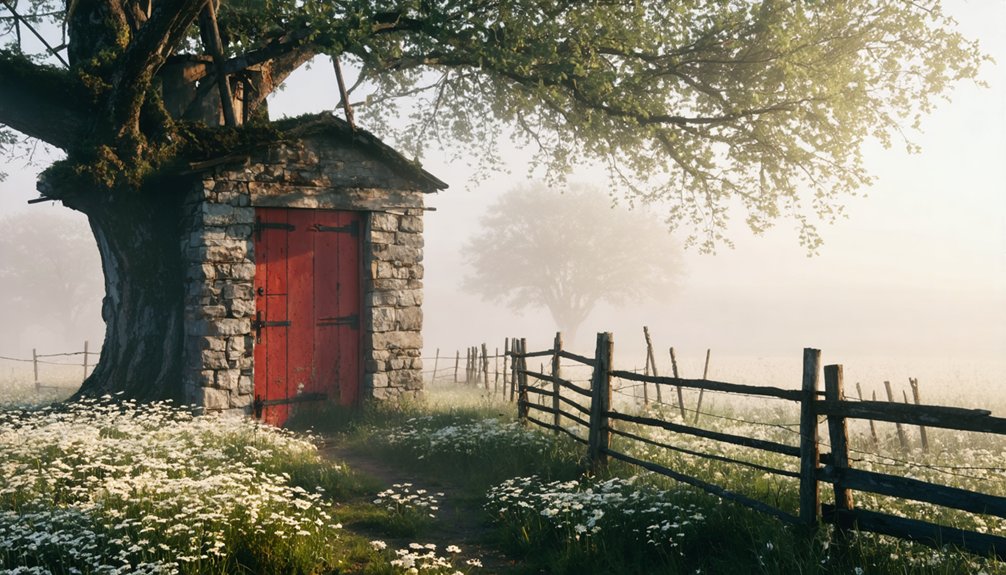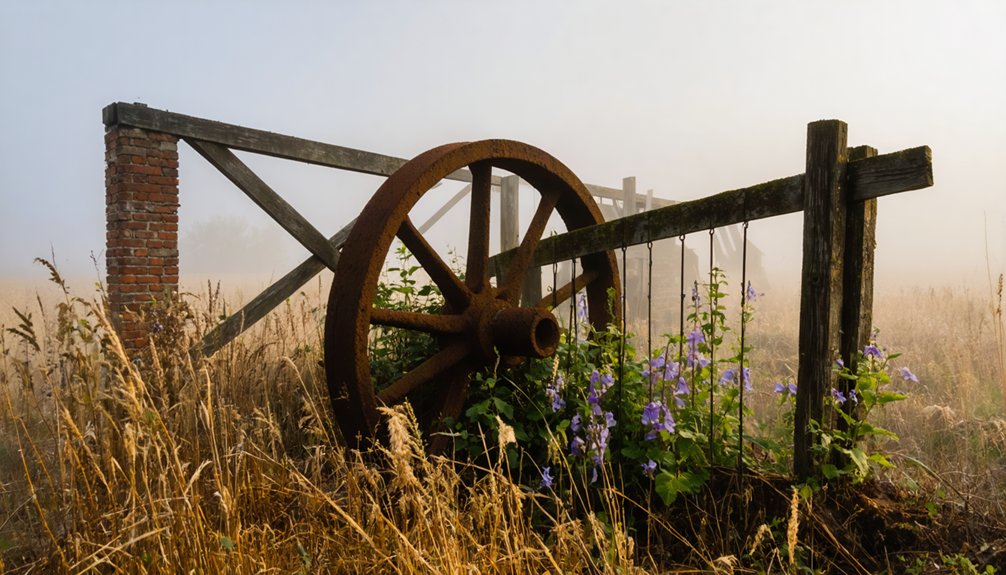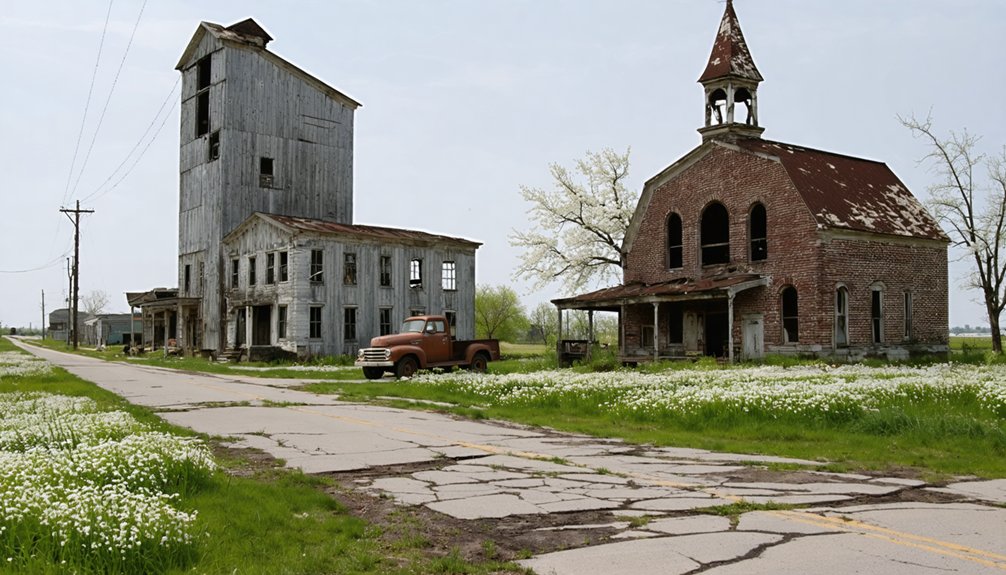
You’ll find Iowa’s most rewarding ghost town visits in spring when wildflowers blanket Mount Pisgah’s pioneer cemetery and green shoots emerge through Buckhorn’s crumbling creamery foundations. Head to Elkport where flooding left eerie streets submerged, or explore Sunbury’s legendary dance hall ruins near Cedar County’s blooming countryside. Big Spring offers authentic frontier history without crowds, while nature reclaims these forgotten settlements in the season’s perfect light. Each location reveals different chapters of Iowa’s vanished communities worth discovering further.
Key Takeaways
- Mount Pisgah offers spring wildflowers across its Mormon Trail memorial site, open year-round with National Park Service recognition since 2024.
- Elkport’s ghost streets and nature-reclaimed foundations provide dramatic flood history exploration near Turkey and Volga Rivers confluence.
- Buckhorn features a graffiti-covered creamery, historic church, and Civil War cemetery, viewable from outside due to structural instability.
- Sunbury’s dance hall ruins and Savings Bank remnants are accessible at County Roads F44 and Y26 intersection.
- Big Spring near Lineville preserves authentic frontier life through genealogical records without modern tourist amenities or significant physical structures.
Big Spring: A Hidden Gem in Wayne County
Tucked away in the rolling farmland of Jefferson Township, Big Spring once thrived as an essential post office hub from 1875 to 1901, connecting Wayne County’s agricultural communities to the broader commercial world. The settlement was named after a well-known statesman, following the common practice of honoring political figures in Iowa’s territorial development.
Today, you’ll find little physical evidence of this vanished settlement near Lineville, but its settlement history whispers through genealogical records and historical archives. Unlike commercialized historic sites, Big Spring offers you authentic exploration—no tourist traps or admission fees. The ghost town preservation here exists primarily through documentation rather than restored buildings.
This gives you freedom to imagine frontier life as you traverse section 17’s landscape. You’re walking where railroad-era farmers once gathered, experiencing Iowa’s abandoned places on your own terms, unmediated by guided tours or interpretive centers.
Elkport: Clayton County’s Eerie Railroad Remnant
Unlike most Iowa ghost towns that faded gradually through economic decline, Elkport met its end in a single catastrophic day. On May 23, 2004, river flooding from the Turkey and Volga Rivers breached the town’s levee, submerging everything under eight feet of water.
What you’ll find today represents pure urban decay—a complete community frozen in abandonment.
When you visit this Clayton County site, you’ll encounter:
- Ghostly streets where 88 residents once lived their daily lives
- Foundations of homes, schools, and banks barely recognizable after demolition
- Nature aggressively reclaiming what civilization surrendered
- Silent testimony to infrastructure destroyed beyond practical reconstruction
- Haunting beauty in the quiet persistence of abandoned landscapes
The town’s roots trace back to 1855 on Elk Creek, where it was originally established near the Turkey River before disaster struck nearly 150 years later.
Spring’s growth makes Elkport’s reclamation particularly striking—freedom seekers will appreciate this unfiltered glimpse of nature’s power. The town’s situation in a floodplain with previous flood history ultimately sealed its fate when residents voted to relocate in 2006.
Buckhorn: Jackson County’s Haunting Historical Site
Deep in Jackson County’s rural heartland, where Highway 64 cuts west of Maquoketa, Buckhorn stands as one of Iowa’s most atmospherically preserved ghost towns. Shadrach Burleson founded this settlement in 1836, naming it after the deer antlers he mounted around his tavern doors.
The town thrived when its Farmer’s Union Cooperative Creamery processed 34 million pounds of butter between 1899 and 1952, drawing thousands to annual picnics. At its peak, the creamery operated with 700 patrons and 11 milk haulers serving the thriving dairy community. The Creamery served as a community hub that distributed milk and butter throughout the Midwest.
Today, you’ll find crumbling structures that fuel haunted legends—a graffiti-covered creamery with collapsed sections, a shuttered whitewashed church, and Buckhorn Cemetery’s Civil War-era headstones.
While you’re free to explore the grounds of these historic ghost towns, stay outside the buildings. They’re private property and dangerously unstable, with fallen bricks and caved roofs creating genuine hazards.
Sunbury: Cedar County’s Dance Hall Legacy
Just forty miles east of Buckhorn, Cedar County’s Sunbury tells a different story of Iowa’s vanished communities—one written in dance steps rather than butter churns.
This southeastern Cedar County settlement thrived from the 1890s through the 1960s, peaking at 107 residents in 1925.
You’ll find Sunbury’s cultural significance in these remnants:
- The legendary Dance Hall (circa 1895-1964) that drew crowds for nearly seventy years
- Sunbury Savings Bank ruins, photographically documented before their 2014 demolition
- County Roads F44 and Y26 intersection, marking the community’s original heart
- Local history connections to Durant’s preserved taverns like the 1873 Schell Tavern
- Railroad heritage that sparked the town’s initial establishment
The name Sunbury appears in multiple geographical locations across different regions, making Cedar County’s vanished community part of a broader pattern of shared place names throughout North America.
Like nearby Durant’s Knights of Pythias Hall built in 1905, Sunbury’s dance hall represented the fraternal and social gathering spaces that anchored rural Iowa communities.
Today’s coordinates (41°40′12″N 90°55′52″W) lead you to Iowa’s dance hall ghost town, where spring exploration reveals foundations of forgotten freedom.
Mount Pisgah: Union County’s Mormon Trail Monument
Where Sunbury’s story ended in dance hall revelry, Mount Pisgah’s began in desperate faith—a twelve-mile journey east of modern Creston leads you to Union County’s most haunting monument.
Between 1846 and 1852, three thousand Mormons carved shelters into hillsides here, fleeing Nauvoo’s violence. They girdled trees across 3,000 acres, broke impossible prairie sod, and buried over 160 souls within six months.
You’ll find their religious heritage preserved in Mount Pisgah Cemetery State Preserve, where an 1888 limestone obelisk marks up to 800 graves. Most wooden markers vanished decades ago. The site sits west of Highway 169, positioned near the modern town of Afton.
The National Park Service recognized this pioneer memorial in 2024, though the grounds have welcomed visitors since 1971. The name “Mount Pisgah” itself appears at various locations across the United States, making this Iowa site part of a broader pattern of biblical place naming.
Spring wildflowers now blanket the hillside where desperate pioneers once sought refuge before continuing westward.
Frequently Asked Questions
What Photography Equipment Works Best for Documenting Iowa Ghost Towns in Spring?
You’ll want a mirrorless camera like the Nikon Z6 for historical photography excellence, plus Kodak Tri-X film for timeless aesthetics. Among gear recommendations, add a DJI Spark drone for stunning aerial perspectives and a sturdy tripod for low-light interior shots.
Are Overnight Camping Facilities Available Near These Ghost Town Locations?
You’ll find tent sites near Buckhorn at Maquoketa Caves State Park, requiring camping permits. Gitchie Manitou offers primitive camping amid its haunted landscape. Both locations let you explore freely while experiencing Iowa’s eerie abandoned settlements under spring stars.
Do Any Ghost Towns Offer Guided Tours During Spring Months?
You’ll need to contact Webster City’s Chamber at 515-832-2564 for guided ghost town tours. Historical preservation efforts depend on community involvement, so availability varies. Most haunted sites require advance reservations, giving you flexible spring exploration options.
What Safety Precautions Should Visitors Take When Exploring Abandoned Structures?
You’ll find real adventure requires real caution—master hazard identification by testing floors first, maintaining clear exits, and wearing respirators. Always bring a buddy who knows rescue procedures, because true freedom means surviving to explore another day.
Are There Entrance Fees Required to Visit Iowa’s Ghost Towns?
You won’t pay entrance fees at Iowa’s ghost towns like Buckhorn, where you’re free to explore exterior structures. However, you’ll need to respect visitor guidelines and private property boundaries that support historical preservation efforts.
As you visit abandoned places in Iowa, be sure to capture the unique architecture and eerie atmosphere of these forgotten sites. Each location tells a story of the past, often reflecting the community’s history and struggles. Don’t forget your camera, as the haunting beauty of these derelict structures can create stunning photographs.
References
- https://kids.kiddle.co/List_of_ghost_towns_in_Iowa
- https://www.onlyinyourstate.com/experiences/iowa/ia-ghost-town
- https://freepages.history.rootsweb.com/~gtusa/usa/ia.htm
- http://www.iowapbs.org/article/8600/local-legends-around-iowas-haunted-locations
- https://www.discoverguthriecounty.org/ghosttowns
- https://pubs.lib.uiowa.edu/annals-of-iowa/article/id/6960/download/pdf/
- https://www.youtube.com/watch?v=L883pwCPOwE
- http://genealogytrails.com/iowa/abandoned_towns.htm
- http://files.usgwarchives.net/ia/wayne/history/wayne.txt
- https://waynecounty.iowa.gov/history/