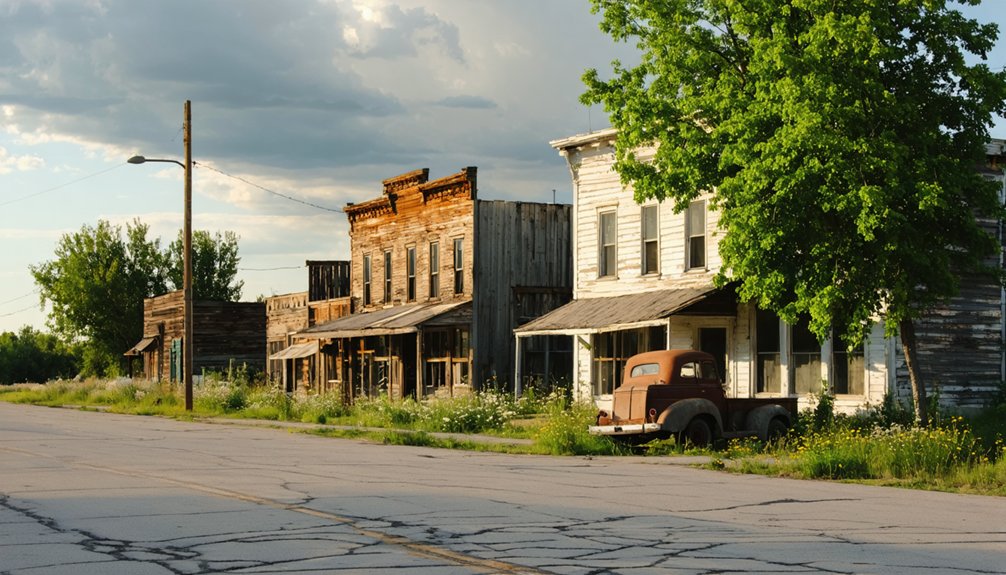
You’ll find Minnesota’s most compelling ghost towns accessible in late spring when muddy trails dry out and wildflowers frame abandoned structures. Forestville offers restored buildings from the 1860s, while Elcor’s fire hydrants and foundations tell stories of 800 iron range residents who left in 1956. Wasioja’s 1858 Gothic seminary stands hauntingly intact, and Nininger’s riverside site marks where homes literally floated away during the 1857 panic. Pack waterproof boots and your camera—the weathered textures and spring fog create atmospheric conditions that reveal how these settlements rose and fell with remarkable speed.
Key Takeaways
- Forestville (founded 1853) features a general store, sawmill, and blacksmith shop, open Memorial Day through October for visitor exploration.
- Elcor (established 1897, evacuated 1956) showcases remnants including fire hydrants, foundations, slag piles, and overgrown rail lines from mining operations.
- Wasioja preserves Minnesota’s oldest schoolhouse, an 1858 Gothic seminary, and historic Civil War recruiting station structures for exploration.
- Nininger, platted in 1856 near St. Paul, offers historical markers at the Mississippi site and Donnelly’s home commemorating the settlement.
- Late May provides optimal spring conditions with extended daylight, blooming wildflowers, and accessible roads for ghost town visits statewide.
Forestville: A Preserved River Valley Settlement
Spring’s the perfect season to visit. From Memorial Day through October, you can wander through the general store that Thomas Meighen shuttered in 1910, explore the sawmill, and touch the tools that sustained 150 residents during the 1860s boom.
The railroad passed them by in 1868. They scattered. You get to witness what remained.
Robert Foster and Felix Meighen founded the settlement in 1853, hauling $700 worth of goods by steamboat and oxcart from Galena, Illinois. By 1880, only a handful of businesses continued operating, including a convenience store, blacksmith shop, and saw and feed mill before all eventually closed by 1910.
Elcor: Iron Range Mining Community Remnants
You’ll find Elcor’s story etched in rusted fire hydrants and crumbling foundations where 1,000 iron miners once lived before Pickands Mather evacuated the town in 1956.
The boreal forest now swallows what the Minorca Mine’s overburden piles haven’t buried, making spring’s bare branches your best window to spot remnants before summer’s thick canopy obscures them.
Wear sturdy boots that can handle mud-slicked slag piles and give yourself an hour to trace the old rail line that once carried Mesabi Range ore to America’s steel mills. The town once supported its mining families with a company store and school, serving the 800 residents during its peak in the 1920s. The diverse community included Croatian, Slovenian, and Finnish immigrants who built their lives around the mining operations.
Mining Company Town History
Deep in Minnesota’s Iron Range, the story of Elcor began in 1897 when the Minnesota Iron Company opened the Elba mine and set about creating a community from scratch.
Company president Don H. Bacon planned this settlement between McKinley and Gilbert, eventually combining it with the Corsica mine to create “Elcor.”
You’ll find echoes of pioneer stories in this classic company town structure—workers owned their houses but rented the land beneath them.
Nearly 1,000 Croatian, Slovenian, Finnish, Italian, and German immigrants called it home during the 1920s boom.
The company provided everything: two churches, a store serving 800 customers, schools, and even law enforcement.
Wooden board houses lined the dirt roads, each surrounded by four-board-high fences and boardwalks that connected the mining community.
Today, urban legends swirl around the foundations and slag piles that remain after Pickands Mather cleared everyone out in 1956.
Safe Spring Exploration Tips
Visiting Elcor’s scattered remains requires more preparation than curiosity alone. Spring’s thaw transforms iron ore dumps into slippery obstacles, while melting snow reveals hidden depressions around boarded mine shafts. You’ll want proper gear before chasing urban legends among these Mesabi Range ruins.
Essential preparations include:
- Sturdy waterproof boots with aggressive tread for traversing wet ore heaps
- Flashlight or headlamp for examining boarded shafts safely from outside
- Travel companions who know your planned route and return time
- Weather check for recent flooding or mudslide conditions
- Contact information for St. Louis County authorities
Locals share ghost stories about unexplained sounds echoing from sealed shafts, but the real dangers are physical—unstable ground, standing water, and wildlife emerging from winter dens. The ore beneath glacial till presented extraction challenges that shaped mining techniques throughout the region’s history. Before exploring, verify which remnants still exist by checking recent Wikipedia updates, as documentation of these scattered sites helps visitors locate specific features among overgrown foundations.
Stick to visible paths through overgrown streets, and you’ll explore safely while respecting this abandoned community’s history.
Radium: Agricultural Hub of Northwestern Minnesota
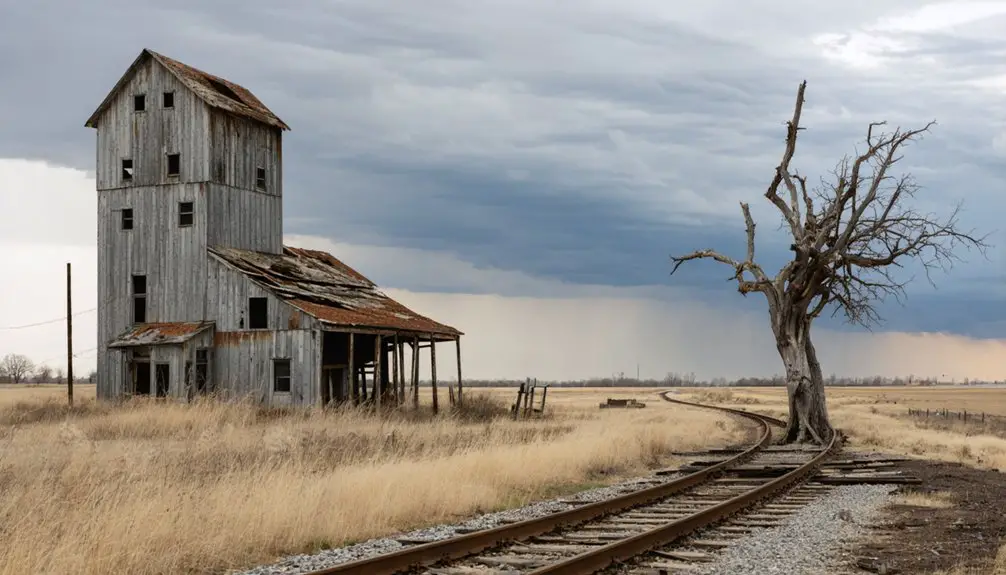
As spring winds sweep across the Red River Valley‘s black soil, the abandoned grain elevator at Radium still marks where Scottish and Metis farmers first proved this land could sustain agriculture in the 1830s. You’ll find remnants of bonanza farms that once stretched thousands of acres here, funded by eastern money and worked by hundreds of hands harvesting nothing but wheat.
The Homestead Act of 1862 drew 75,000 settlers within three years, transforming Minnesota’s prairies into a patchwork of 160-acre homesteads. The Soo Line’s 1905 arrival sparked Radium’s birth—transportation infrastructure connecting prairie to Minneapolis mills. That industrial expansion brought prosperity until wheat surplus killed profits. The town’s name echoes the era when radium-containing products appeared in advertisements across America, though no connection to the element itself existed here.
Stand beside the weathered elevator today, and you’re witnessing Minnesota’s agricultural transformation: from virgin prairie to wheat empire to ghost town. The railroad that built this place still runs through, indifferent to what remains.
Wasioja: Civil War Era Seminary Town
Before Minnesota even became a state, Free Will Baptists carved an educational empire from Dodge County limestone, raising a Gothic-spired seminary that would educate over 300 students and send dozens to their deaths at Chickamauga.
From Dodge County limestone rose a Gothic seminary that transformed Minnesota students into Civil War casualties at Chickamauga.
You’ll discover Historic architecture and Civil War history converging in remarkable ways:
- Walk through Minnesota’s oldest schoolhouse (1858), operated continuously until 1959.
- Explore the last surviving recruiting station west of the Mississippi, where Lt. Col. James George swore in men he’d later lead into battle.
- Stand before the seminary’s fire-gutted limestone shell, its Gothic cupola long vanished.
- Trace the 1861 march route from classroom to Fort Snelling.
- Touch local limestone walls that witnessed 59 young men departing—only one returned.
The Free Will Baptist church still stands, anchoring this community that never recovered from war’s devastation. The Baptist church, constructed in 1858 through barter during the economic panic of 1857, remains the only pre-Civil War wood-frame building in town.
Nininger: Failed Vision Near the Twin Cities
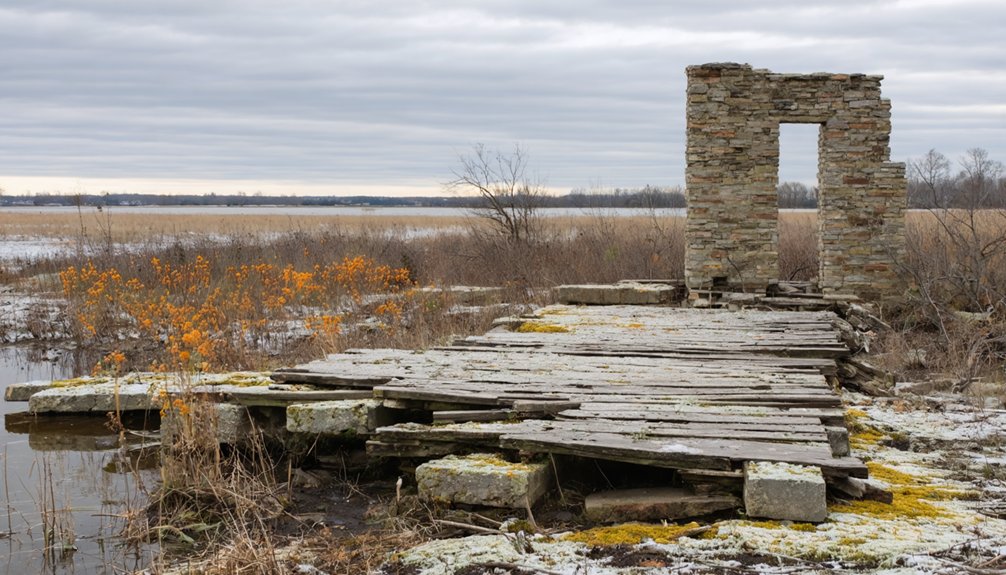
You’ll find Nininger’s story particularly haunting—a town platted with 3,800 lots in 1856 that collapsed so completely within three years that residents literally dismantled their homes and floated them downstream to Hastings.
I’ve stood on these high banks above the Mississippi, seventeen miles south of St. Paul, where cornfields now blanket what once held six saloons, multiple hotels, and a thousand hopeful residents.
The spring thaw makes this Dakota County site especially poignant to visit, since it was ice-clogged rivers and failed railroad connections that strangled Ignatius Donnelly’s grand vision before it could take root.
Grand Ambitions, Swift Decline
When Ignatius Donnelly and John Nininger purchased 474 acres of bluffland seventeen miles south of St. Paul in 1856, they envisioned nothing less than Minnesota’s future capital. Their marketing blitz worked spectacularly—at first.
Within six months, you’d have found 500 residents and 70 buildings rising from prairie soil.
The boom attracted deep-pocketed investors through political connections, transforming raw land into 3,800 lots with ambitious infrastructure plans:
- Sawmill operations and six bustling saloons
- Railroad connections via land grant
- River ferry for Mississippi access
- Hotels serving constant newcomer arrivals
- Newspaper promoting endless possibilities
Then 1857’s financial panic shattered everything. The railroad bypassed them. Steamboats ignored their landing. By 1863, preservation challenges erased what urban legends now barely remember—a ghost town reduced to farmland and historical markers.
Accessible Spring Exploration Today
The historical marker stands alone in working farmland today, a lonely sentinel where Donnelly’s grand boulevards were supposed to stretch toward the Mississippi. You’ll find two plaques marking the Good Templars Hall and Donnelly’s home—that’s it. Tractor sounds replace saloon noise; corn stalks grow where hotels once stood.
Spring’s your ideal window for exploring this ghost town. Drive seventeen miles south from St. Paul, park roadside, and walk freely across the open terrain. The elevated site offers Mississippi River views without flood concerns, especially after winter’s thaw.
Conservation challenges mean little physical evidence survived—buildings were dismantled by 1863, carted off to Hastings. This landscape warns against unchecked urban development dreams. You’re witnessing what happens when speculation outpaces reality.
Old Crow Wing: Trail Through Trading Post History
Long before Minnesota’s north woods echoed with the screech of sawmills, a British fur trader huddled through winter at the mouth of the Crow Wing River in 1771, unknowingly establishing what would become one of the territory’s most essential trading outposts.
One frozen winter in 1771 planted the seed for Minnesota’s most vital northern trading hub.
By 1839, William Aitkin’s trading post transformed this confluence into a thriving hub where French-Canadian voyageurs exchanged manufactured goods for pelts.
You’ll discover Old Crow Wing’s remarkable trajectory through interpretive trails at the state park:
- Population surged past 200 by 1860—largest settlement north of St. Paul
- Oxcart caravans thundered through on the East Woods Trail from Pembina
- Logging operations launched in 1847, floating timber to St. Anthony Falls
- International community of whites, half-breeds, and Chippewas coexisted
- Railroad bypassed the town in 1871, sealing its fate
Only Beaulieu House remains standing today.
Planning Your Spring Ghost Town Adventures
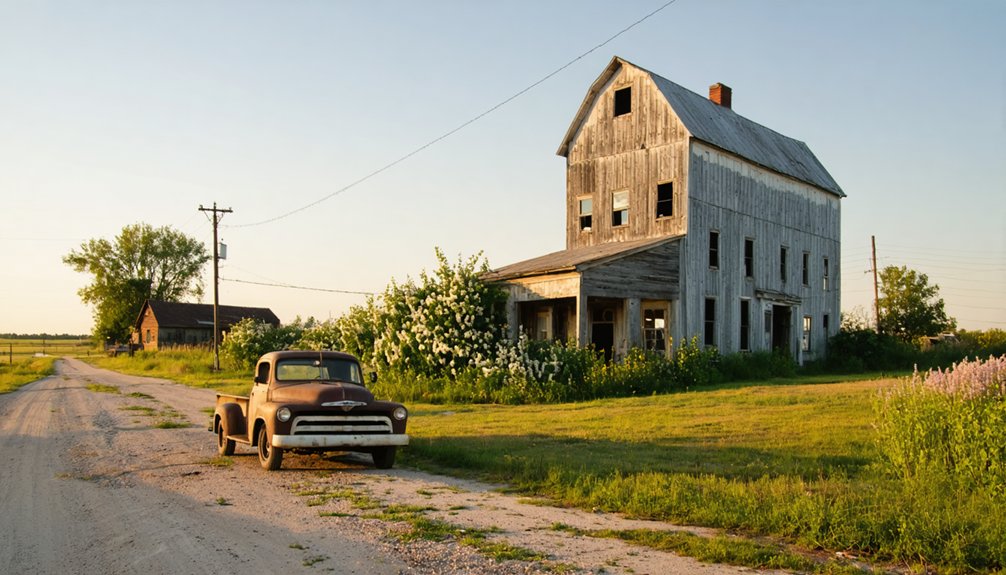
Before you pack your first supply bag, spring’s unpredictable temperament demands respect—I learned this the hard way during an April trek to Elcor when an unexpected snowstorm transformed the gravel access road into an impassable slurry of mud and slush.
You’ll need waterproof boots, high-visibility gear for roadside markers, and mosquito repellent by mid-spring.
Four-wheel drive opens doors to remote Dodge County ruins once roads dry mid-April.
Target late May for ideal conditions—14-hour daylight lets you chain multiple Goodhue County sites together, while wildflower blooms carpet abandoned foundations and birdsong melodies replace the silence of winter.
Check forecasts religiously.
Thunderstorms strike fast.
Download self-guided maps offline since cell service fades near places like Taconite Harbor.
Respect private property boundaries, stick to marked trails, and you’ll discover Minnesota’s forgotten corners safely.
What to Bring for Ghost Town Exploration
Smart planning means nothing if you’re standing at a crumbling foundation in Gary-Roosevelt with inadequate gear. I once watched a photographer slice open his palm on a corroded mining implement because he’d dismissed gloves as “overkill.” Your packing list shapes whether you’ll document Minnesota’s abandoned settlements comfortably or cut your expedition short with preventable injuries.
Essential gear balancing visitor safety with historical preservation:
- Sturdy boots and cut-resistant gloves protect against rusty debris
- Headlamp plus backup flashlight illuminate decaying structures hands-free
- First-aid kit addresses immediate injuries before help arrives
- GPS device with offline maps navigates remote locations
- Respirator mask filters asbestos and mold particles
Pack light but deliberately. That multi-tool repairs unexpected gear failures. Extra batteries keep your lights burning through extended explorations. You’re claiming independence to roam forgotten places—equip yourself accordingly.
Photography Tips for Capturing Historic Sites

Spring’s longer days give you perfect conditions to photograph Minnesota’s abandoned structures. Position yourself with the sun behind you during morning or late afternoon shoots to illuminate weathered facades and prevent harsh backlighting.
You’ll want to move in close with a 35-80mm lens to capture the intricate decay: peeling paint layers, rusted hardware, and carved wooden details that tell stories of the people who once lived here.
On overcast days, which Minnesota springs deliver regularly, the soft diffused light eliminates harsh shadows and brings out the subtle textures in crumbling brick, splintered wood, and moss-covered foundations.
Natural Spring Lighting Techniques
When photographing Minnesota’s abandoned settlements, natural light becomes your most powerful tool for revealing the character etched into weathered clapboard and crumbling foundations. Spring fog filtering through empty doorways creates ethereal diffusion, while blooming flora frames your compositions with seasonal color.
Master these lighting approaches:
- Golden hour positioning: Place subjects with backlighting for rim-lit silhouettes against warm skies
- Overcast advantages: Use cloudy conditions as nature’s softbox for even illumination across high-contrast scenes
- Directional emphasis: Capture side-lighting during morning hours to accentuate texture and architectural depth
- Natural reflectors: Bounce ambient light off pale concrete walls to fill harsh shadows
- Filter enhancement: Deploy polarizers post-rain to intensify saturated greens and restore vibrant spring hues
Adjust white balance throughout the day as Minnesota’s spring light shifts from cool dawn to warm afternoon glow.
Architectural Detail Composition
Minnesota’s ghost towns offer architectural fragments that demand compositional intentionality—every peeling paint curl, rusted hinge, and fractured window frame tells a story worth isolating.
You’ll find architectural symmetry in abandoned storefronts where centered doorways and matching windows create natural balance. Fill your frame tightly with weathered textures to eliminate sky distractions.
Pattern repetition emerges in row houses and grain elevators—use these recurring elements along Rule of Thirds intersections for dynamic compositions.
Shoot straight-on for symmetrical facades, then experiment with angles. Converge vertical lines from bottom corners to exaggerate deteriorating heights. Leading lines from cracked sidewalks guide viewers into doorways.
I’ve captured my strongest images by combining level horizontals with negative space around solitary structures, letting emptiness amplify abandonment’s weight.
Weather-Worn Texture Closeups
Peeling clapboards reveal decades of expansion and contraction, their lifted edges catching spring’s angled light like tiny awnings over stories written in grain. You’ll find weathered textures everywhere—rusted door hinges, fractured window putty, and sun-bleached advertisements ghosting through layers of paint.
Photographic closeups transform these details into portraits of time itself.
- Shoot at golden hour when raking light emphasizes every splinter and crack
- Get within inches of rust patterns blooming across metal surfaces
- Focus on wood grain where weather has stripped away paint to expose raw history
- Capture nail heads surrounded by rust halos bleeding into silvered boards
- Frame paint chips curling away from substrate like ancient scrolls
Your macro lens becomes a time machine, documenting entropy’s patient artistry.
Respecting and Preserving Minnesota’s Ghost Towns
As spring sun melts the last patches of snow from weathered foundations and crumbling storefronts, you’ll find yourself standing at the threshold of Minnesota’s forgotten settlements—places where preservation isn’t just about protecting old buildings, but honoring the stories etched into every rotting timber and rusted nail.
Your exploration carries responsibility. Legal compliance means respecting Minnesota’s Field Archaeology Act—you can’t disturb archaeological sites without proper licensing.
If you discover burial grounds, report them to the State Archaeologist. Leave artifacts untouched; they’re protected under state law.
Preservation strategies work best through documentation. Photograph deteriorating structures before nature reclaims them.
Share locations respectfully with historical societies rather than broadcasting coordinates online. Your footsteps shouldn’t accelerate decay.
Walk carefully around foundations, avoid climbing unstable walls, and pack out everything you bring. These ghost towns survive through your restraint.
Frequently Asked Questions
Are Any Ghost Towns in Minnesota Actually Haunted or Have Paranormal Activity?
Like whispers frozen in time, you’ll find haunted legends swirling around Grey Cloud Island’s cemetery apparitions and Wasioja’s Civil War specters. While paranormal investigations remain limited by private access, these abandoned sites certainly stir your imagination with their eerie, documented sightings.
Can You Camp Overnight Near Minnesota’s Ghost Towns During Spring?
You’ll find excellent spring camping near Minnesota’s ghost towns at Forestville and Frontenac state parks. Pack your camping gear for wooded bluffs, and watch for wildlife encounters along trails where deer and wild turkeys roam freely through abandoned settlements.
Exploring abandoned places in Minnesota can lead to some intriguing discoveries, from old railway depots to forgotten homes that tell stories of the past. Each site offers a unique glimpse into the history and culture that shaped the region. Don’t forget your camera—these hidden gems provide perfect backdrops for photography enthusiasts.
Which Ghost Towns Have the Best Wildflower Viewing in Spring?
Hidden beneath towering maples near Forestville, you’ll discover spectacular wildflower sightings—bloodroot, trilliums, and Virginia bluebells carpet the forest floor. These spring blooms transform abandoned settlements into nature’s secret gardens, offering you unforgettable exploration freedom.
Do Any Ghost Towns Charge Admission Fees or Require Permits?
Most Minnesota ghost towns don’t charge fees since they’re abandoned sites. However, Historic Forestville requires a state park vehicle permit for access. These historical preservation sites balance tourist attractions with free exploration, letting you roam independently through authentic remnants.
Are Minnesota Ghost Towns Safe to Visit Alone or Family-Friendly?
You’ll find Minnesota’s ghost towns are double-edged swords—Forestville’s historical preservation offers visitor amenities like restrooms and rangers for families, while remote sites like Elcor demand caution when exploring alone due to unstable structures and isolation.
References
- https://en.wikipedia.org/wiki/List_of_ghost_towns_in_Minnesota
- https://www.carvercountyhistoricalsociety.org/ghost_towns.php
- https://thievesriver.com/blogs/articles/ghost-towns-in-minnesota
- https://kroc.com/9-strange-ghost-towns-within-100-miles-of-rochester-minnesota/
- https://www.minnesotahistory.org/post/a-complete-guide-to-the-ghost-towns-of-hennepin-county
- https://quickcountry.com/minnesotas-abandoned-ghost-towns/
- https://www.youtube.com/watch?v=5bCG6B2rzZY
- https://pbsnorth.org/show/minnesotas-lost-mining-towns/
- https://www.geotab.com/ghost-towns/
- https://www.mngoodage.com/voices/mn-history/2019/07/a-ghost-town-turned-history-site/