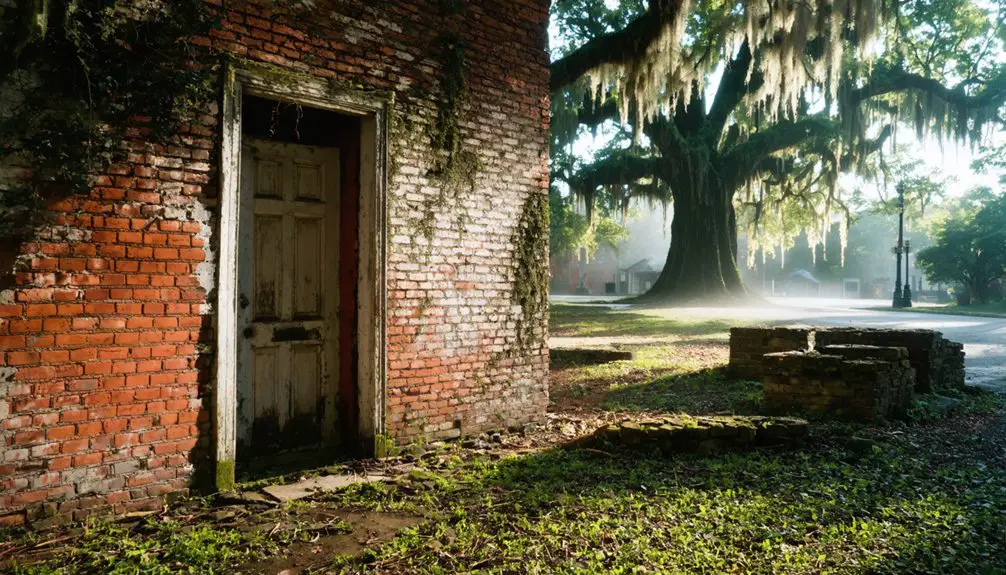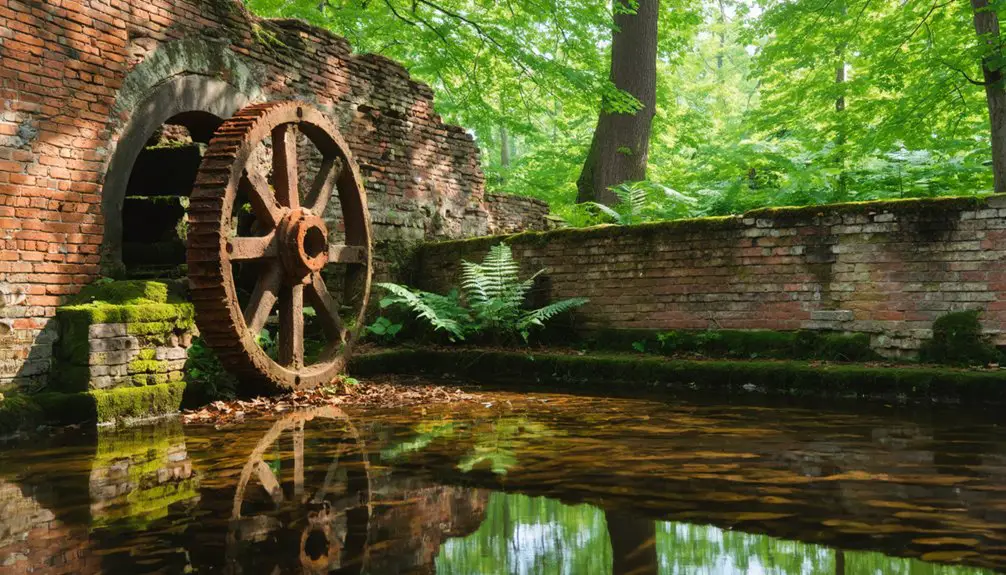
Virginia’s spring transforms ghost towns into wildflower-draped time capsules perfect for exploration. You’ll discover Jamestown’s archaeological foundations from 1607, Henricus’s 810-acre colonial site bursting with blooms, and Matildaville’s canal ruins within Great Falls Park. Coastal Wash Woods offers preserved shipwreck lumber amid Atlantic dunes, while Union Level’s abandoned tobacco hub whispers of 1920s prosperity. Pack sturdy boots and your camera—mild spring weather makes traversing these remote sites comfortable. The stories behind these forgotten settlements reveal fascinating chapters of Virginia’s past that most visitors never encounter.
Key Takeaways
- Jamestown (1607) offers reconstructed forts, archaeological foundations, and visitor exhibits showcasing America’s first permanent English settlement.
- Henricus features 810 acres of colonial architecture and spring wildflowers on the site of Virginia’s first planned university.
- Matildaville displays canal ruins within Great Falls Park, illustrating George Washington’s early industrial engineering efforts from the 1780s.
- Wash Woods preserves a salvaged cypress church steeple and scattered coastal ruins accessible through False Cape State Park’s trails.
- Spring provides mild weather ideal for exploring; pack sturdy boots, water, maps, and GPS for remote ghost town sites.
Jamestown: Where America’s Story Began
When you step onto Jamestown Island on a crisp spring morning, you’re walking where America’s English story truly began. Established May 14, 1607, this settlement predates the Pilgrims by thirteen years. You’ll discover archaeological foundations revealing medieval architecture influences in the first brick statehouse from 1616.
The triangular fort reconstruction shows how 104 adventurers defended their newfound independence against hostile forces.
Ghost town preservation efforts let you trace where the first representative government took root in 1619. Walk the grounds where the Starving Time reduced 214 souls to just 60 survivors.
Spring’s mild weather makes exploring easier—you’ll want several hours to absorb the visitor center exhibits and outdoor excavations. This isn’t tourist fluff; it’s where your freedoms originated before the capital moved to Williamsburg in 1699. The site marks where Virginia became a colony in 1624, three years before transitioning to royal control. The site serves as a navigational aid for understanding multiple historical locations that share the Jamestown name across different regions.
Henricus: A Settlement Lost to Tragedy
Just twelve miles upriver from Jamestown’s struggles, Sir Thomas Dale envisioned something better in 1611—a fortified settlement that wouldn’t slowly poison its residents with brackish water and mosquito-borne death.
Dale’s remedy for Jamestown’s deadly failures: fresh water, higher ground, and a fortified refuge twelve miles upstream.
He built Henricus on Farrar’s Island with three streets of frame houses, watchtowers, and Virginia’s first planned university.
You’ll find reconstructed colonial architecture at Henricus Historical Park today, where interpreters demonstrate 17th-century trades among the wooden palisades.
The settlement thrived until March 1622, when collapsing Native alliances erupted into Opechancanough’s coordinated uprising.
The massacre killed George Thorpe and destroyed Dale’s vision of peaceful coexistence.
After the uprising, colonists conducted regular attacks against Native tribes, pushing them further westward.
The seven-acre fort was originally established with 300 militia soldiers under constant attack from Powhatan warriors during construction.
Walk the 810-acre site where spring wildflowers now blanket the ruins.
This wasn’t failure—it was freedom’s brutal education in survival.
Matildaville: George Washington’s Canal Dream
While Henricus collapsed under violence, George Washington dreamed of conquering nature itself—eighty vertical feet of churning whitewater where the Potomac River crashes through Great Falls. He chartered the Patowmack Company in 1785, building five locks that opened western frontier trade by 1802.
The town named for Light-Horse Harry Lee’s wife thrived as workers’ barracks, mills, and an inn clustered around the canal headquarters. The Superintendent’s House served as the Patowmack Company headquarters, standing as the grandest building in the town.
You’ll find fragile ruins scattered through Great Falls Park today, remnants of Washington’s bold engineering that influenced nationwide canal construction. Flat-bottom boats bypassed the falls using poles similar to gondolas, a unique navigation method that defined canal travel.
High costs and unpredictable water levels killed the venture by 1830, but historic preservation keeps this pioneer spirit alive.
Spring’s mild weather makes exploring these tourism development sites ideal—just respect the crumbling foundations of America’s first industrial dream.
Union Level: Echoes of the Tobacco Trade
Unlike Washington’s grand engineering vision at Matildaville, Union Level emerged from humbler origins—Saturday gatherings where Mecklenburg County farming families converged for weekly supplies in the tobacco-rich Southside.
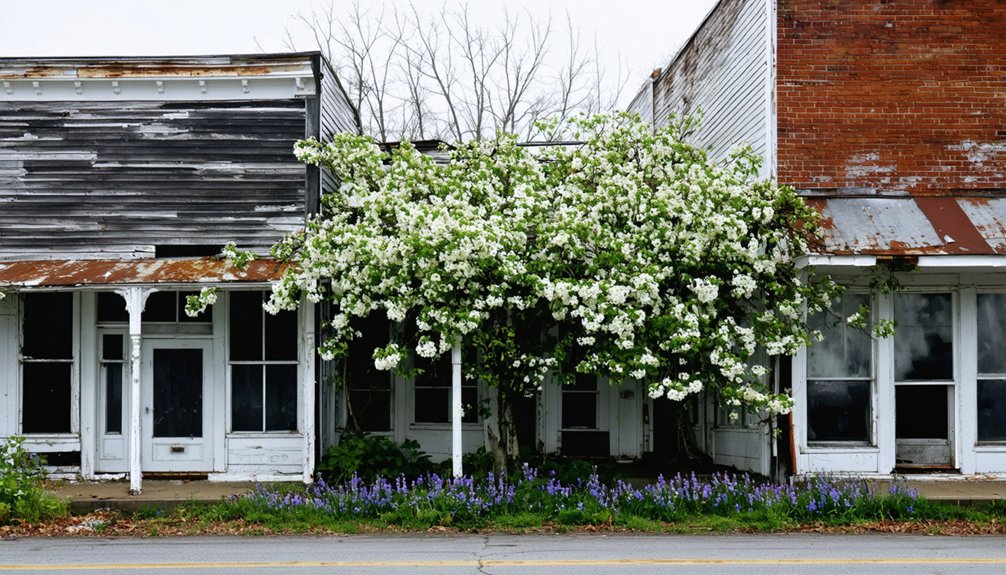
You’ll discover authentic urban decay along one street where eight abandoned storefronts stand sentinel, including C.P. Jones pharmacy with its weathered signage still visible.
This freedom-seeking community once thrived:
- 1920s peak: Over 20 businesses, including four general stores, two barbers, and Virginia’s most entrepreneurial spirit—a motorcycle dealer
- 1915 prosperity: Bank of Union Level symbolized financial independence
- Railroad era: Southern Railroad sparked commerce resurgence in early 1900s
- 1836 recognition: First postmaster James Bridgeforth established official status
The train service ceased by the mid-1980s, marking the beginning of Union Level’s final transformation into a ghost town. The historic railroad depot remains as a notable structure, though the tracks have long since fallen silent. Despite minimal preservation efforts, you’ll find compelling history in this tobacco-trade ghost town, accessible for spring exploration without crowds.
Colchester: The Port That Time Forgot
From tobacco fields to tidewater commerce, Virginia’s ghost towns reveal different faces of economic ambition. You’ll find Colchester where Old Colchester Road meets the Occoquan River—a once-thriving 18th-century port that vanished within sixty years. Walk these 140 forested acres where archaeological discoveries reveal foundations of taverns, warehouses, and homes that served frontier traders.
Explore 140 acres where an 18th-century port city vanished, leaving only archaeological traces of Virginia’s forgotten commercial dreams.
Spring’s perfect for exploring this open landscape before summer’s dense foliage obscures the terrain.
The 1807 hurricane sealed Colchester’s fate, washing away its bridge and redirecting stage traffic northward. By 1820, the town had fundamentally disappeared.
Today, there’s no marked parking or facilities—just raw exploration through time. Access the historic site through a narrow, one-lane underpass beneath the railroad that leads to the old port town’s location. Don’t miss the nearby Colchester Overpass, where local legends about the “Bunnyman Bridge” add supernatural intrigue to your ghost town adventure. The legend began circa 1970 in Fairfax County, spawning over fifty-four variants of the eerie tale.
Wash Woods: Coastal Isolation and Maritime Heritage
You’ll reach Wash Woods by hiking or biking six miles through False Cape State Park‘s maritime forest, the same isolation that once drew yellow fever refugees to this windswept shore.
The Atlantic claimed this settlement piece by piece—first through storms that gave the town its name, then the catastrophic back-to-back hurricanes of 1933 that finally drove the last 300 residents away.
Today, the Methodist church steeple still pierces the sky behind protective glass walls, built entirely from cypress lumber salvaged when the schooner John S. Wood wrecked offshore in 1895.
Atlantic Storms Reshaped Community
While most ghost towns fade slowly from economic decline, Wash Woods met a more violent end—battered into submission by the very ocean that gave it life. You’ll discover how relentless Atlantic storms transformed this thriving community of 300 souls into scattered ruins.
The forces that destroyed Wash Woods:
- Coastal erosion devoured unstable land throughout the 1920s-1930s, swallowing homes and livelihoods.
- Salty winds made farming impossible, forcing self-sufficient residents to depend on unpredictable fishing.
- Ancient shipwrecks littering the “Graveyard of the Atlantic” foreshadowed the settlement’s fate.
- A devastating hurricane delivered the final blow after lifesaving stations closed.
Remote Access Through Wilderness
Getting to Wash Woods requires commitment—there’s no parking lot, no paved road, not even a dirt track wide enough for vehicles. You’ll navigate winding paths through False Cape State Park, watching your footing shift from compacted dirt to loose sand that swallows your shoes. Remote hiking through this coastal wilderness means covering miles of isolation, where the nearest population feels impossibly distant.
Start your journey from Sandbridge in Virginia Beach, accessible via Interstate 64. Take Exit I-264 onto Birdneck Road.
From there, wilderness navigation demands you choose: foot, bicycle, or kayak. The boardwalk trails near Back Bay offer alternative routes, but every option tests your dedication.
This remoteness once fostered lawlessness among settlers, and today it filters casual visitors from true adventurers seeking authentic solitude.
Planning Your Spring Ghost Town Adventure
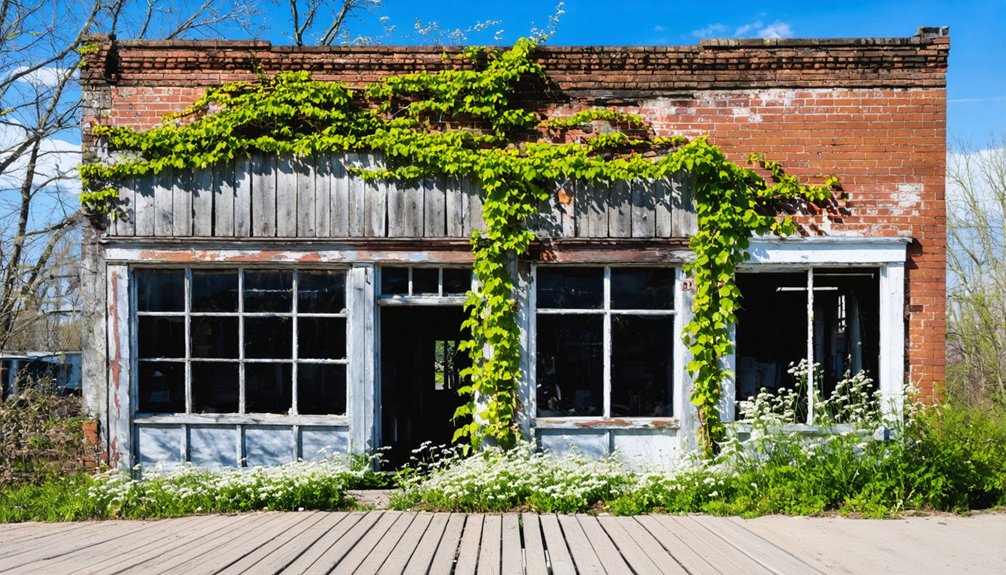
You’ll want to pack sturdy hiking boots, water, and a camera before setting out to explore Virginia’s abandoned settlements this spring.
Always honor posted No Trespassing signs—sites like Elko Tract currently restrict access, while locations such as Matildaville and Union Level welcome visitors through official channels.
Map out a realistic itinerary that accounts for travel distances and site-specific hours, particularly if you’re planning to visit Rosewell Plantation‘s limited weekday schedule or commit to the multi-mile trek into Wash Woods.
Essential Gear and Supplies
Before you set out to explore Virginia’s abandoned settlements, assembling the right gear transforms a casual outing into a safe, comfortable adventure.
Spring’s unpredictable weather demands layered clothing and waterproof boots—you’ll appreciate both when crossing streams near old mining sites. Local outfitters stock camping essentials like portable stoves and high-calorie trail food for overnight expeditions.
Your pack should include:
- Sturdy hiking boots with ankle support for traversing rocky terrain
- Navigation tools including maps, GPS, and compass for remote locations
- First aid kit and headlamp for exploring abandoned structures
- Water purification system and weather-appropriate layers
Wildlife safety remains paramount in Virginia’s backcountry. Solid footwear handles rough roads leading to isolated ghost towns, while sun protection and rain gear keep you comfortable during extended explorations through forgotten settlements.
Respecting Historical Site Rules
While packing the right equipment prepares you physically for ghost town exploration, understanding Virginia’s strict preservation laws protects both you and these fragile historical sites. You’ll need permits from the Department of Historic Resources before conducting any archaeological investigations or disturbing artifacts. Don’t assume abandoned properties lack owners—they’re still protected by law.
Virginia’s preservation regulations explicitly prohibit relic hunting on state-controlled land and damaging cave features. If you’re exploring historic districts, you can’t alter structures without approval.
Permitted activities mainly include respectful observation and photography. Think of yourself as a time-traveler documenting history, not claiming it.
These rules aren’t restrictions—they’re safeguards ensuring future adventurers experience the same haunting authenticity you’re seeking today.
Creating Your Itinerary
Planning your spring ghost town adventure through Virginia works best when you match geographic clusters with your available time and interests. You’ll find northern routes connecting Matildaville in Great Falls Park with nearby Rosewell Plantation, while central Virginia pairs Union Level with Pamplin along the High Bridge Trail. Consider these regional combinations:
As you venture through these historical landscapes, you might find the eerie remnants of abandoned towns in Virginia to explore. Each site tells a story of days gone by, offering a unique glimpse into the past. Don’t forget to bring your camera, as the haunting beauty of these locations can inspire both awe and reflection.
- Northern Virginia Day Trip: Explore Matildaville’s 1790s canal ruins within established park trails ensuring visitor safety.
- Central Virginia Route: Connect Union Level’s authentic storefronts with Pamplin’s railroad heritage in one afternoon.
- Richmond Area: Visit Falling Creek Ironworks’ 1619 colonial site respecting historical preservation boundaries.
- Coastal Adventure: Dedicate a full day to Wash Woods’ multi-mile hike through False Cape’s maritime wilderness.
Spring’s mild temperatures make outdoor exploration comfortable across all regions.
What to Bring for Your Historical Exploration
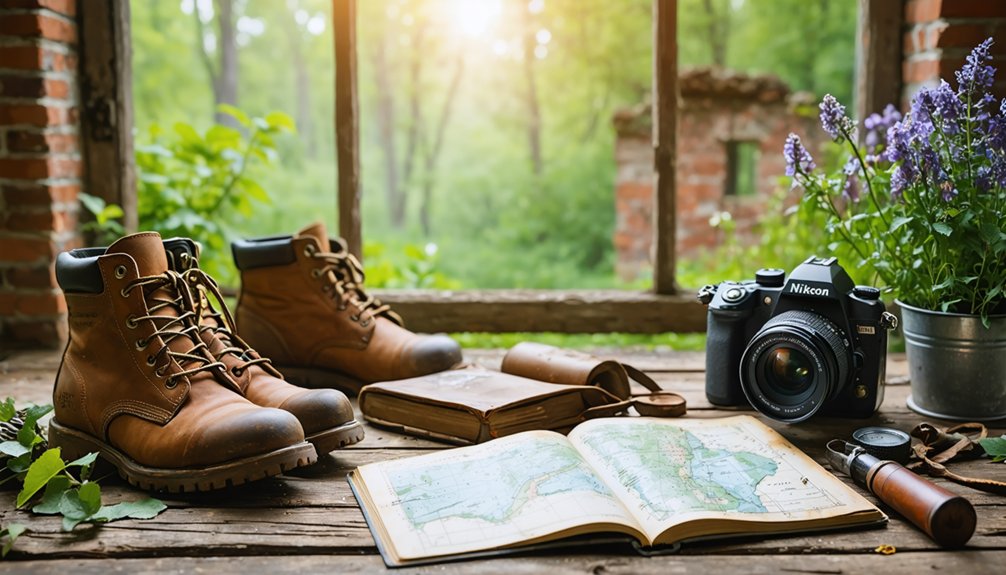
Your ghost town expedition requires careful preparation to maximize both safety and discovery. Pack sturdy hiking boots—those crumbling structures at Union Level and Matildaville demand reliable footing on uneven terrain. Bring a quality camera to document Rosewell‘s magnificent ruins and capture architectural details you’ll miss with your naked eye.
A flashlight proves essential for exploring darker corners, while a first-aid kit protects against unexpected scrapes. Don’t forget water and snacks; remote locations like Elko Tract offer no amenities.
While guided tours provide structured insight at accessible sites like Rosewell, many locations require self-directed exploration. Historical reenactments occasionally occur at maintained properties, but most ghost towns demand independent discovery.
Carry a notebook to record observations—these personal field notes transform casual visits into meaningful historical encounters that preserve Virginia’s vanishing heritage.
Frequently Asked Questions
Are Guided Tours Available at Virginia’s Ghost Town Sites?
Yes, you’ll find guided tours at Virginia’s haunted sites following tourism regulations and historical preservation standards. Knowledgeable guides lead candlelit walks through colonial buildings, sharing authentic ghost stories while respecting these treasured locations’ integrity and accessibility.
Which Ghost Towns Are Suitable for Visiting With Young Children?
Like scrolling through time’s Instagram feed, you’ll find Pamplin perfect for kids—its historical preservation creates safe exploration, while local legends spark imagination. The flat trails, wildflower fields, and family-friendly restaurants let everyone roam freely.
Can I Camp Overnight Near Any of These Ghost Town Locations?
You’ll find overnight camping at Erskine Ghost Town with camping permits required. It offers developed tent platforms beside New River. For other ghost town locations, you’ll need to explore local accommodations since primitive camping isn’t available onsite.
Are There Entrance Fees Required for Accessing These Historical Sites?
Most Virginia ghost towns you’ll explore are free, but Historic Jamestowne requires entrance fees ($15-30 depending on areas). Ticket purchase procedures are straightforward at visitor centers. Union Level and similar abandoned sites have no entrance fee policies whatsoever.
What Are the Best Photography Spots at Virginia’s Ghost Towns?
You’ll find jaw-dropping photography spots at Union Level’s vintage gas pump and C.P. Jones Drug Store facade. Master your photography techniques by capturing Pamplin’s ironwork storefronts and Mouth of Wilson’s woolen mill—perfect historical preservation subjects begging for your creative freedom.
References
- https://en.wikipedia.org/wiki/List_of_ghost_towns_in_Virginia
- https://kids.kiddle.co/List_of_ghost_towns_in_Virginia
- https://everafterinthewoods.com/deserted-ghost-towns-in-virginia-that-history-buffs-cant-resist-exploring/
- https://southsidedaily.com/abandoned-places-in-virginia/
- https://theforgottensouth.com/union-level-virginia-ghost-town-history/
- https://www.blueridgeoutdoors.com/go-outside/southern-ghost-towns/
- https://www.virginia.org/listing/union-level-ghost-town/4358/
- https://en.wikipedia.org/wiki/Jamestown
- https://en.wikipedia.org/wiki/History_of_Jamestown
- https://www.commonwealth.virginia.gov/about-virginia/history-and-facts-on-virginia/