You’ll find Alaska’s most enchanting ghost towns accessible during summer months, when Kennicott’s 14-story copper mill stands dramatically against its glacier backdrop, and Treadwell’s flooded mine ruins tell stories of a catastrophic 1917 collapse. McCarthy’s Golden Saloon still hosts visitors near abandoned mining structures, while Dyea’s Klondike Gold Rush remnants mark where 8,000 prospectors once passed through. Taku Harbor preserves indigenous Tlingit heritage alongside cannery ruins where Alaska’s last frontier resident lived for 56 years before the wilderness reclaimed everything he’d built.
Key Takeaways
- Kennicott Ghost Town features 14-story mills and preserved mining structures against a glacier, abandoned overnight in 1938 after copper operations ceased.
- Treadwell Ruins on Douglas Island offer 45 miles of gold mining tunnels that suddenly flooded in 1917, now with augmented reality tours.
- Dyea transformed from Tlingit trade hub to 8,000-resident boomtown during the Klondike Gold Rush, now part of a national historical park.
- McCarthy serves as a living ghost town with 40 residents, featuring the Golden Saloon and frozen-in-time buildings from the 1938 copper collapse.
- Taku Harbor displays Tlingit heritage and salmon cannery remnants, abandoned after fires destroyed operations in the early 1900s.
Kennicott Ghost Town: Alaska’s Richest Copper Mining Legacy
While most ghost towns emerge gradually as residents trickle away, Kennicott died overnight. In November 1938, the company ordered immediate evacuation—no return trains. Six hundred residents abandoned everything, leaving this $200 million copper empire frozen in time.
Six hundred residents fled Kennicott overnight in 1938, abandoning a $200 million copper empire that remains frozen in time.
You’ll discover North America’s finest industrial heritage site nestled against Kennicott Glacier.
From 1911-1938, miners extracted 600,000 tons of impossibly rich ore—some assayed at 70% pure copper. The mining technology remains intact: gravity-fed mill systems, ammonia leaching plants, and aerial trams that hauled 140-pound ore sacks from five different mines.
Today’s National Historic Landmark preserves this engineering marvel exactly as workers left it. Walk through the 14-story mill, peek into bunkhouses where beds never cooled, and explore the company store that sustained this remote wilderness operation. The place name shares its designation with various other entities, helping distinguish this specific Alaskan mining site. McCarthy, the neighboring leisure town, now hosts around 25 year-round residents who maintain cafes and gift shops in restored historic buildings.
Treadwell Ruins: Gold Mining History Near Juneau
Alaska’s ghost towns tell different stories of abandonment. At Treadwell, you’ll discover where mining innovation transformed Douglas Island into the world’s largest gold operation.
From 1882 to 1917, this pioneering low-grade ore facility extracted $66 million while housing thousands in a complete company town—complete with swimming pool and club.
You’ll walk among ruins where 45 miles of tunnels once descended 2,300 feet deep.
On April 21, 1917, the earth opened suddenly. Seawater flooded everything. A 200-foot geyser erupted at 2:15 a.m., swallowing three mines instantly. Every miner escaped; the horses didn’t.
Today’s trails wind through forest-reclaimed foundations and machinery. The historic Salt Water Pump House remains standing as a physical reminder of the mining operation’s infrastructure.
The complex operated 960 stamps across four contiguous mines by 1900, processing the low-grade ore that required 8.5 tons to yield a single ounce of gold.
The community legacy persists through preservation efforts, offering you augmented reality glimpses into Alaska’s richest past.
Dyea: Gateway to the Klondike Gold Rush
Long before stampeders arrived, Tlingit people recognized Dyea’s strategic value as a gateway to interior trade routes. They’d controlled the Chilkoot Pass for generations, exchanging coastal salmon and seal with inland nations for moose and copper—a sophisticated Indigenous trade network that predated white settlement by centuries.
For centuries, Tlingit traders mastered the Chilkoot Pass, building thriving networks that connected coastal and inland nations long before gold seekers arrived.
You’ll find Dyea transformed dramatically when 30,000 gold seekers flooded through during 1897-98’s frenzy. Within months, this Indigenous village exploded into an eight-block boomtown of 8,000 residents chasing Klondike history. The community supported over 150 businesses, including hotels, sawmills, newspapers, and even a chamber of commerce.
But freedom’s price came high—the devastating Palm Sunday Avalanche claimed dozens of lives.
Today, you can explore this ghost town within Klondike Gold Rush National Historical Park. Walk the silent streets where merchant shops once thrived, and visit the Slide Cemetery’s sobering memorial to those who gambled everything. Located 600 miles south of the Klondike gold fields, Dyea and neighboring Skagway served as the closest salt water ports where stampeders could dock before beginning their arduous trek north.
McCarthy: Remote Mining Community in the Wilderness
Deep in the Wrangell Mountains, where jagged peaks slice through clouds and glaciers carve ancient valleys, two prospectors stumbled onto one of North America’s richest copper deposits in the summer of 1900.
“Tarantula” Jack Smith and Clarence L. Warner discovered malachite and chalcocite near Bonanza Ridge, sparking an industrial history that’d transform the wilderness.
By 1911, entrepreneurs completed a 200-mile railroad connecting Kennecott’s mines to Cordova—a transportation infrastructure marvel that hauled 4.6 million tons of ore over three decades.
McCarthy emerged five miles from Kennecott as the miners’ vice town, offering everything the company town forbade: whiskey, poker, and companionship.
A red light district sprang up along the banks of McCarthy Creek, catering to miners seeking entertainment beyond the strict company town’s reach.
The Golden Saloon still hosts dinners and open mic nights, keeping the town’s social spirit alive for roughly 40 modern residents.
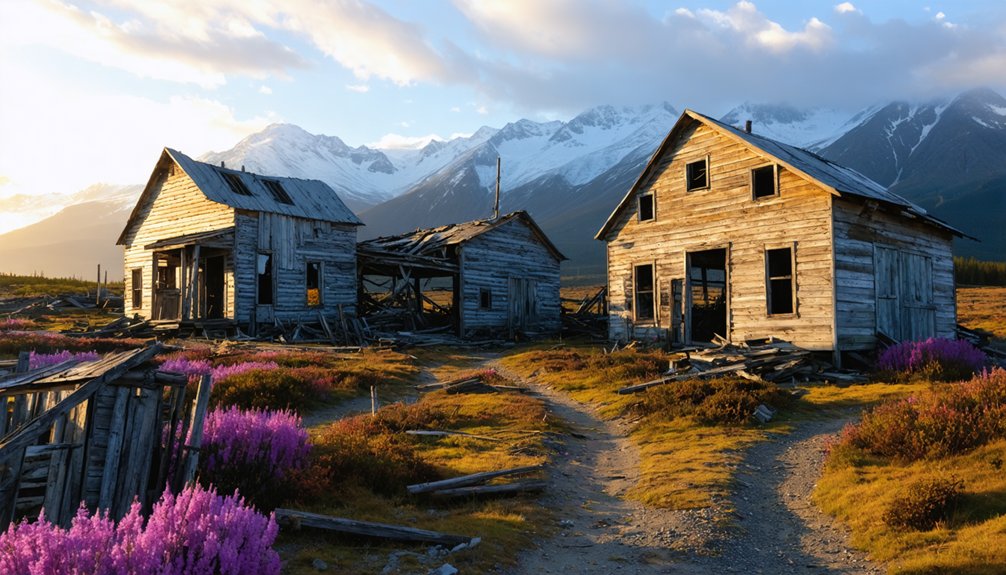
When copper prices collapsed in 1938, workers simply walked away, leaving buildings frozen in time—ready for you to explore today.
Taku Harbor: Coastal Cannery Remnants and Tlingit Heritage
Where coastal trade routes meet wilderness waters, Taku Harbor tells two intertwined stories—one of indigenous commerce spanning centuries, the other of industrial ambition that blazed bright and burned out fast.
The Taku Tlingit established Sik’na*x̱sáani here in the 1800s, controlling trade between coastal and interior peoples. Their Tlingit cultural heritage lives on in the cemetery marking the old village site, just twenty miles southeast of Juneau by boat. Hudson’s Bay Company operated Fort Durham trading post here from 1840 to 1843, exchanging goods with natives under agreement with the Russian America Company. The fort housed 35 personnel, including fifteen Hawaiian workers known as kanakas, within a stockade fortified by octagonal towers.
What you’ll discover among the pilings:
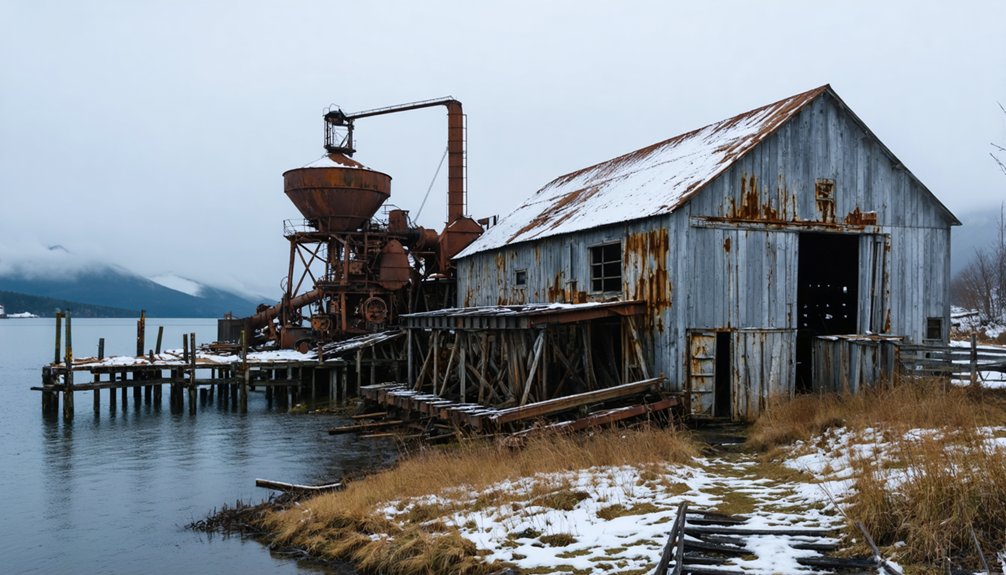
- Cannery architecture remnants from Alaska’s first cold-storage plant (1902)
- Retort doors and valves scattered where 500 workers once processed salmon
- Interpretive signs revealing how fires twice destroyed operations
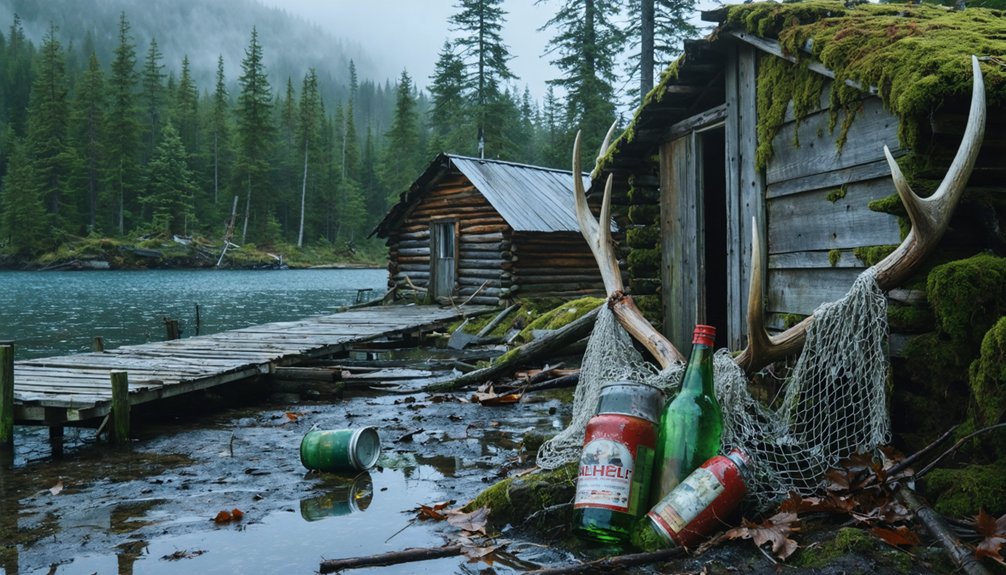
Henry “Tiger” Olson called this home for fifty-six years—the last resident when dismantling began in 1951.
Today’s anchorage welcomes adventurers chasing stories the mainland forgot.
Frequently Asked Questions
What Safety Precautions Should I Take When Exploring Abandoned Ghost Town Structures?
You’ll want to assess structural stability before entering—test floorboards, stay near walls, and keep exit routes clear. Respect historical preservation by not removing artifacts, while wearing respirators, sturdy boots, and always exploring with a partner for safety.
Are Camping Facilities Available Near These Ghost Towns During Summer Months?
You’ll find excellent camping options near Alaska’s ghost towns with varied campground amenities from basic sites to luxury tents. Consider travel insurance before your adventure, as remote locations mean limited services and unpredictable weather conditions during summer exploration.
Exploring remote ghost towns in Alaska can lead to discover hidden histories and breathtaking landscapes that are off the beaten path. Be prepared for the possibility of encountering wildlife and ensure you have the necessary gear for hiking through rugged terrain. Don’t forget to pack a camera to capture the haunting beauty of these abandoned places.
As you plan your journey through ghost towns in Alaska to explore, consider the rich stories that each site tells. Many of these locations were once bustling communities, and remnants of their past still stand, offering a glimpse into a different era. Engaging with local historians or joining guided tours can enhance your understanding and appreciation of these fascinating places.
Do I Need Special Permits to Photograph These Historic Ghost Town Sites?
Like a lens capturing freedom’s light, you won’t need photographic permits for casual ghost town photography. Your camera equipment roams unrestricted unless you’re bringing models, props, or sets—then commercial permits apply through local forest service offices.
What Wildlife Might I Encounter While Visiting Remote Alaskan Ghost Towns?
You’ll encounter brown bears, moose, bald eagles, and foxes roaming abandoned structures. Wildlife sightings are unpredictable, so carry bear spray and maintain distance. These conservation efforts protect Alaska’s wild residents reclaiming their territory—respect their freedom.
Are Guided Tours Available or Can I Explore These Ghost Towns Independently?
You’ll find both options available. At Kennecott, you can wander independently with NPS maps, embracing total freedom. Meanwhile, Juneau, Ketchikan, and Skagway offer guided tours revealing hidden stories you’d miss alone—combining structured insight with atmospheric adventure.
References
- https://thealaskafrontier.com/ghost-towns-in-alaska/
- https://www.atlasobscura.com/things-to-do/alaska/ghost-towns
- https://www.youtube.com/watch?v=AtwCPa7jiNc
- https://www.nps.gov/thingstodo/ghost-towns.htm
- https://motorcyclemojo.com/2015/09/alaska-ghost-towns/
- https://www.tripadvisor.com/Attractions-g28923-Activities-zft12156-Alaska.html
- https://www.travelalaska.com/explore-alaska/articles/off-the-beaten-path-alaska-destinations
- https://www.ultimathulelodge.com/blog/169452
- https://www.jasonchapmanphoto.com/kennecott
- https://en.wikipedia.org/wiki/Kennecott